
Indian Boiler Regulations, 2026 · Chapter 12 · Shell Type Boilers of Welded Construction
Regulation 503. Hydraulic test
Not yet checked against the official Gazette; verify before relying on it.
503.Hydraulic test.─ (1) (a) Each Class I Boiler shall, on completion of all welding and/or repairs and after heat-treatment, be subjected to a hydraulic test of 1.5 times the design pressure without any indication of weakness or defect.
(b)Each Class II and Class III Boiler shall be tested to a pressure twice the design pressure.
(2)(a) The test shall be witnessed by the Inspecting Authority or Competent Person.
(b)The test pressure shall be maintained for a period not less than 30 minutes.
(c)In the interest of safety, it is important that the boiler be properly vented, so as to prevent the formation of air pockets, before the test pressure as applied.
Notes:
1. It is recommended that the temperature of the water shall not be less than 7°C during the hydraulic test.
2. It is further recommended that before the boiler is approached for close examination, the pressure shall be reduced to not less than 1.1 times the design pressure and not more than 0.9 times the hydraulic test pressure.
3. On completion of hydraulic test, release of pressure shall be gradual.
4. Deflection of different pressure parts shall be examined carefully and there shall not be any permanent set after release of pressure.
(3)If any repairs are found to be necessary during or subsequent to the hydraulic pressure test, the boiler shall again be subjected to the pressure test specified above after completion of the repairs and after any heat treatment provided repaired weld joint requires heat treatment as per regulation 453.
Note: Observations and remarks of Competent Person/ Inspecting Authority shall be recorded for filing with maker’s papers.
In short
Regulation 503 sets the hydraulic test for boilers in this chapter. It applies after all welding, repairs and heat treatment are complete.
Key points
- (1)(a) Class I: test at 1.5 times the design pressure, with no sign of weakness or defect.
- (1)(b) Class II and Class III: test at twice the design pressure.
- (2)(a) The Inspecting Authority or a Competent Person must witness the test.
- (2)(b) Hold the test pressure for at least 30 minutes.
- (2)(c) Vent the boiler properly before applying pressure, so no air pockets form.
- Recommendations in the notes:
- water temperature not less than 7°C;
- before close examination, reduce pressure to not less than 1.1 times the design pressure and not more than 0.9 times the test pressure;
- release pressure gradually;
- check deflection of pressure parts, with no permanent set after release.
- (3) If repairs are needed during or after the test, test again after the repairs and after any heat treatment the repaired weld needs under regulation 453.
Watch out
- The observations and remarks of the Competent Person or Inspecting Authority must be recorded and filed with the maker's papers.
Written by IBRsource editors · last edited 2026-11-20. Explanations simplify and are not a design method, testing procedure or authorisation. Requirements come from the complete regulations, the Gazette and approved documentation.
Comparison pending: the IBR 1950 text in force on 30 September 2026 is not yet established for this provision, so no change is claimed (how this works).
Orientation hints (unverified)
These candidates come from automated heading matching against DPIIT's scanned historical print edition of IBR 1950. That edition uses imperial units and riveted-construction provisions, so it is not the operative 2026 predecessor text. Regulation numbers alone never prove equivalence.
| Historical 1950-edition reg. | Heading as OCR'd | Heading similarity | Source image |
|---|---|---|---|
| 56 | Hydraulic Test | 100% | Chapter II (DPIIT scan), image 10 |
| 72 | Hydraulic Test | 100% | Chapter II (DPIIT scan), image 14 |
| 504 | Hydraulic test for new economisers | 100% | Chapter XI (DPIIT scan), image 2 |
Amendment history of the candidate IBR 1950 regulations: Reg. 56 (3 amendments)
IBR 1950 regulation 56 as last published in the DPIIT web edition (archived 2022)
Unofficial archived copy, not verified; see the regulation 56 page for its amendments.
| Reg. 56 MATERIALS OF CONSTRUCTION SEAMLESS FERRITIC PIPES FOR HIGH TEMPERATURE SERVICE Hydraulic Test |
| (i) Each pipe shall be tested by the manufacturer and shall withstand a hydraulic pressure to one and half times the design pressure but not greater than pressure calculated by the following formula given below. In the absence of working pressure is indicated in the Test Certificate then the tested pressure indicated in the Test Certificate divided by 1.5 shall be the maximum working pressure P = 2 S t / d where P = test pressure D = specified outside diameter of the pipe t = specified wall thickness of the pipe S = stress which shall be taken as 40% of the minimum tensile strength at room temperature. (ii) Notwithstanding anything contained in the above clause, the hydraulic test at the maker's works may be dispensed with provided that the pipes are subject to non destructive testing by an appropriate method like Ultrasonic or Eddy current or stray flux testing |
IBR 1950 regulation 504 as last published in the DPIIT web edition (archived 2022)
Unofficial archived copy, not verified; see the regulation 504 page for its amendments.
| Reg. 502, Reg. 503, Reg. 504 ECONOMISERS | ||||||||||||||
| ||||||||||||||
|
ECONOMISERS | ||||||||||||||
| ||||||||||||||
|
ECONOMISERS | ||||||||||||||
|
Images of the official Gazette pages that contain this regulation. Click to zoom. Compare word by word before relying on the extracted text.
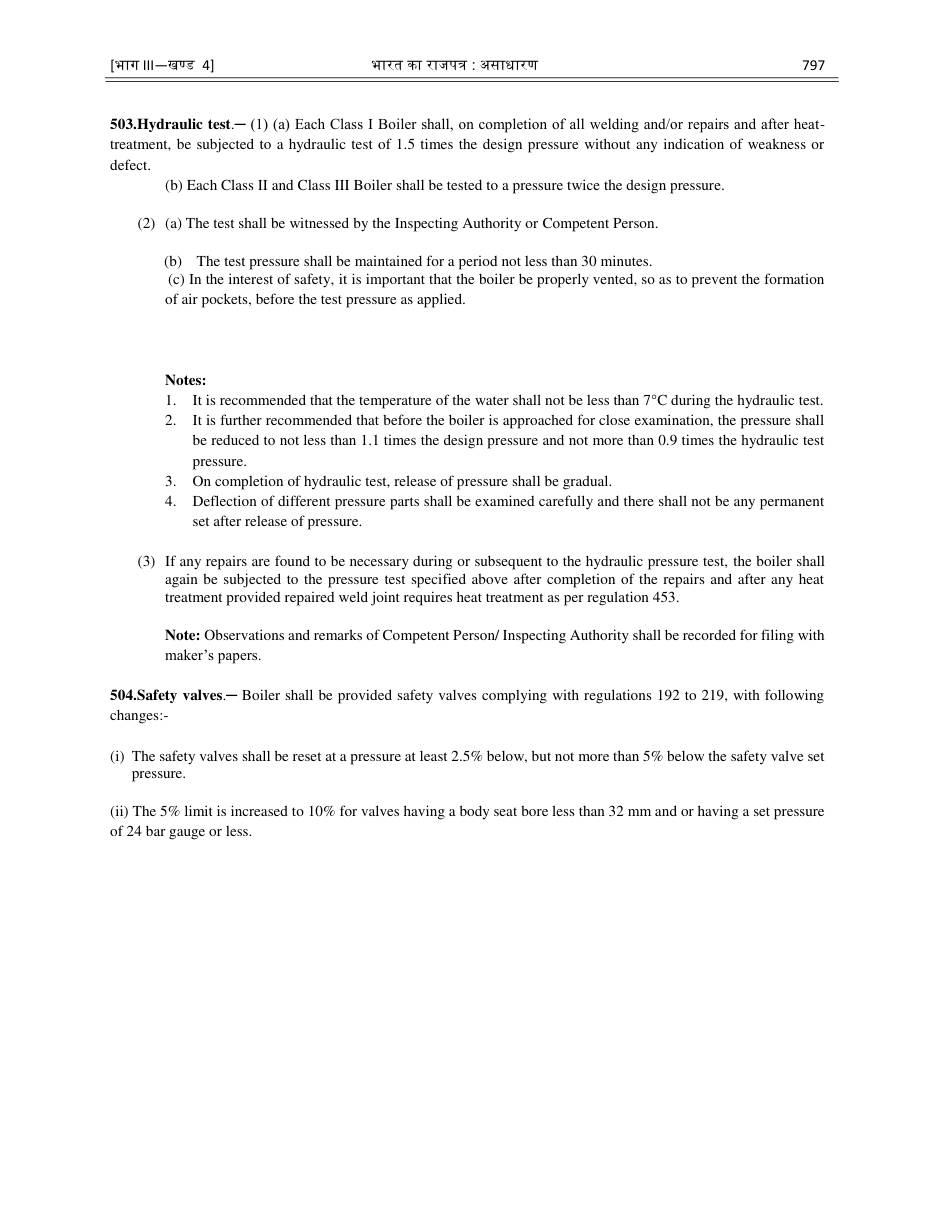
Indian Boiler Regulations, 2026, reg. 503, Regulation 503, Gazette of India, Extraordinary, Part III—Section 4, No. 596, 1 October 2026, printed p.797. https://egazette.gov.in/WriteReadData/2026/276813.pdf (text consulted via IBRsource, 2026-11-23).
The citation refers to the government publication. Cite the Gazette, not this website.