
Indian Boiler Regulations, 2026 · Chapter 12 · Shell Type Boilers of Welded Construction
Regulation 416. Firebox Stays
Not yet checked against the official Gazette; verify before relying on it.
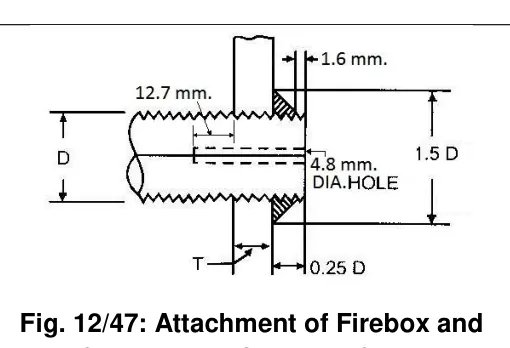
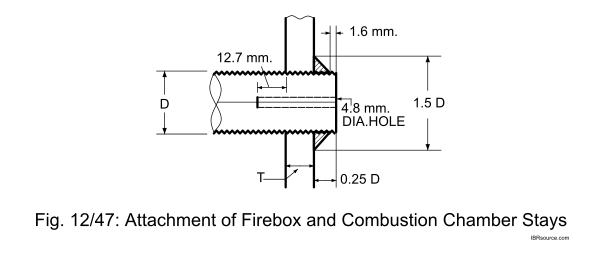
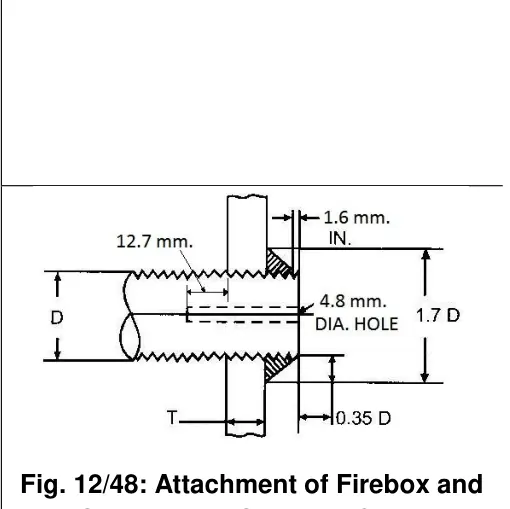
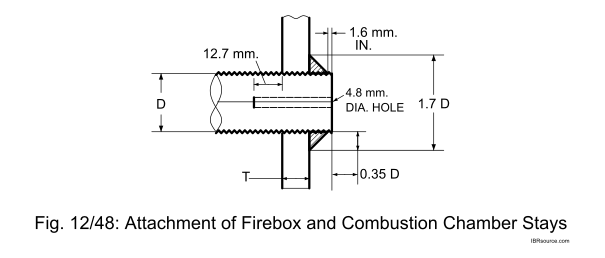
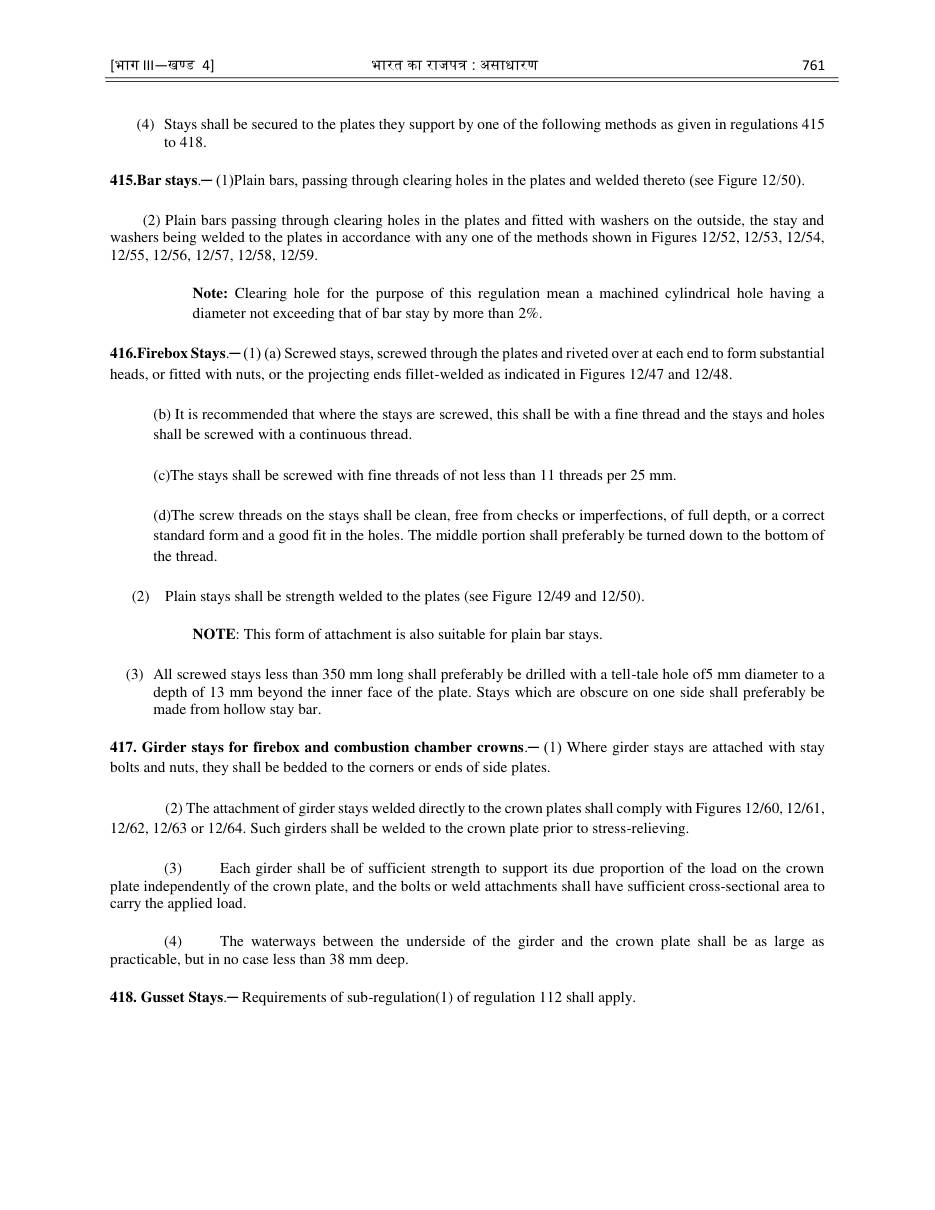
416.Firebox Stays.─ (1) (a) Screwed stays, screwed through the plates and riveted over at each end to form substantial heads, or fitted with nuts, or the projecting ends fillet-welded as indicated in Figures 12/47 and 12/48.
(b)It is recommended that where the stays are screwed, this shall be with a fine thread and the stays and holes shall be screwed with a continuous thread.
(c)The stays shall be screwed with fine threads of not less than 11 threads per 25 mm.
(d)The screw threads on the stays shall be clean, free from checks or imperfections, of full depth, or a correct standard form and a good fit in the holes. The middle portion shall preferably be turned down to the bottom of the thread.
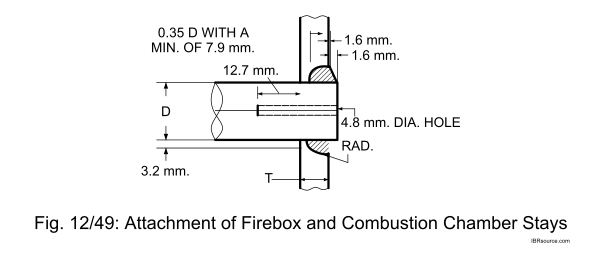
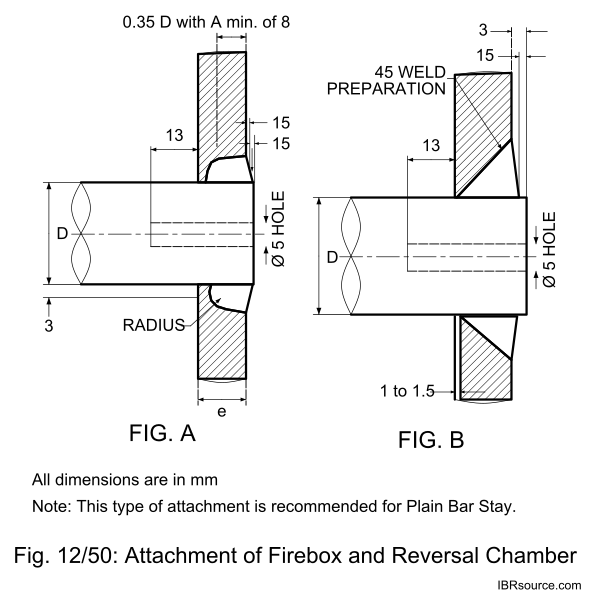
(2)Plain stays shall be strength welded to the plates (see Figure 12/49 and 12/50).
NOTE: This form of attachment is also suitable for plain bar stays.
(3)All screwed stays less than 350 mm long shall preferably be drilled with a tell-tale hole of5 mm diameter to a depth of 13 mm beyond the inner face of the plate. Stays which are obscure on one side shall preferably be made from hollow stay bar.
Parts of this extracted text look garbled; read the Gazette page before using any value.
Figures cited in this regulation (4, exact crops of the Gazette)
View Gazette page 808 · figure catalogue
Reconstructed CAD: DXF · SVG · Preview (redrawn, checked against the print; technical review pending)
View Gazette page 808 · figure catalogue
Reconstructed CAD: DXF · SVG · Preview (redrawn, checked against the print; technical review pending)
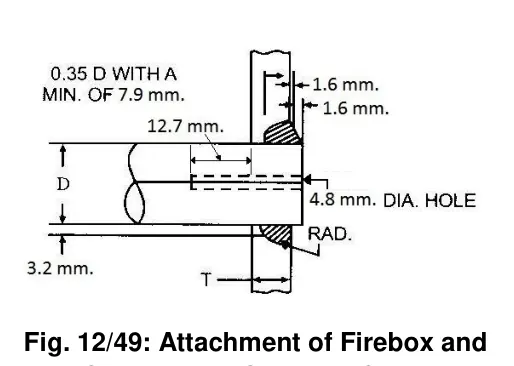
View Gazette page 809 · figure catalogue
Reconstructed CAD: DXF · SVG · Preview (redrawn, checked against the print; technical review pending)
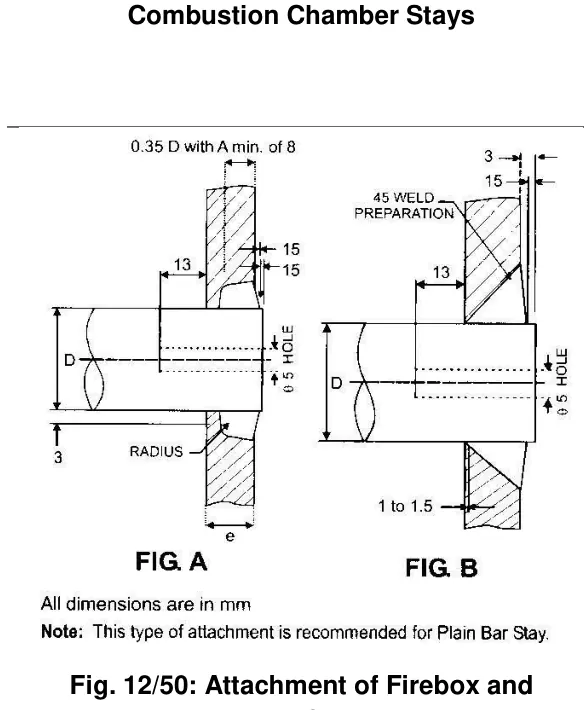
View Gazette page 809 · figure catalogue
Reconstructed CAD: DXF · SVG · Preview (redrawn, checked against the print; technical review pending)
In short
Regulation 416 sets how firebox stays are secured to the plates.
Key points
- (1)(a) Screwed stays go through the plates and are riveted over at each end to form substantial heads, or fitted with nuts, or their projecting ends are fillet-welded (Figures 12/47 and 12/48).
- (1)(b) Screwing with a fine, continuous thread through stays and holes is recommended.
- (1)(c) Threads must be fine, not less than 11 threads per 25 mm.
- (1)(d) Threads must be clean, free from checks or imperfections, full depth, correct standard form and a good fit. The middle portion should preferably be turned down to the bottom of the thread.
- (2) Plain stays are strength welded to the plates. The note says this also suits plain bar stays.
- (3) Screwed stays less than 350 mm long should preferably have a tell-tale hole drilled to a depth of 13 mm beyond the inner face of the plate. Stays obscured on one side should preferably be made from hollow stay bar.
Watch out
- The tell-tale hole diameter is run together with other text in the extracted version. Check the Gazette page for the exact value.
Written by IBRsource editors · last edited 2026-11-20. Explanations simplify and are not a design method, testing procedure or authorisation. Requirements come from the complete regulations, the Gazette and approved documentation.
Comparison pending: the IBR 1950 text in force on 30 September 2026 is not yet established for this provision, so no change is claimed (how this works).
Orientation hints (unverified)
These candidates come from automated heading matching against DPIIT's scanned historical print edition of IBR 1950. That edition uses imperial units and riveted-construction provisions, so it is not the operative 2026 predecessor text. Regulation numbers alone never prove equivalence.
No candidate heading found in the historical print edition.
Images of the official Gazette pages that contain this regulation. Click to zoom. Compare word by word before relying on the extracted text.
Indian Boiler Regulations, 2026, reg. 416, Regulation 416, Gazette of India, Extraordinary, Part III—Section 4, No. 596, 1 October 2026, printed p.761. https://egazette.gov.in/WriteReadData/2026/276813.pdf (text consulted via IBRsource, 2026-11-23).
The citation refers to the government publication. Cite the Gazette, not this website.