
Indian Boiler Regulations, 2026 · Chapter 12 · Shell Type Boilers of Welded Construction
Regulation 477. Stays for fire boxes and circular furnaces
Not yet checked against the official Gazette; verify before relying on it.
477. Stays for fire boxes and circular furnaces.─ (1) For solid crew stays to combustion chambers and fire-boxes and for longitudinal and cross Stays, the maximum allowable working pressure for the stays is to be calculated from the appropriate one of the following formulae:
     C 1.28 2

P =  ---- D - -----

     A  N                 Equation (12/17)

                C x D1 2  Equation (12/18)
     P = ----------

                  A
Where, is the maximum allowable working pressure in kg/cm2,
P = is diameter of stays over threads in mm,
D = is diameter of body of stay at its smallest part in mm, D1 = is number of threads of stay per mm,
N = is area in square mm supported by one stay for area to be supported by stays near tubes in fire-box tube plates A = of Loco-type boilers,
499.17943 for steel or special wrought iron screw stays to combustion chamber or fire-boxes,
C =     607.45216 for steel longitudinal or cross stays fitted with nuts,
C =     330.44272 for copper stays.
=
(2)Where stays are made with enlarged ends and the body of the stay is smaller in diameter than at the bottom of the thread, the maximum allowable working pressure shall be calculated from the second Equation (12/18).
(3)In case of circumferential stay for circular furnaces and fire-boxes, the diameter of stay shall not be less than 19 mm or twice the thickness of the fire-box plate, whichever is greater. In the case of screwed threads the diameter shall be measured over the threads. The pitch of the stays at the fire-box shall not exceed 14 times the thickness of the fire-box plate.
Parts of this extracted text look garbled; read the Gazette page before using any value.
Tables and formulae are shown in their extracted layout. Alignment, superscripts and subscripts may be lost. The Gazette page image is authoritative.
In short
Sets the maximum allowable working pressure for screwed stays to combustion chambers and fire-boxes and for longitudinal and cross stays, and size limits for circumferential stays in circular furnaces.
Key points
- (1) Use Equation (12/17) (based on diameter over threads and threads per mm) or Equation (12/18) (based on the body diameter at its smallest part), with the supported area A and constant C.
- (1) C = 499.17943 for steel or special wrought iron screw stays to combustion chambers or fire-boxes; 607.45216 for steel longitudinal or cross stays fitted with nuts; 330.44272 for copper stays.
- (2) Stays with enlarged ends, whose body is smaller than the bottom of the thread, use Equation (12/18).
- (3) Circumferential stays for circular furnaces and fire-boxes: diameter at least 19 mm or twice the fire-box plate thickness, whichever is greater, measured over the threads if screwed. Pitch at the fire-box must not exceed 14 times the fire-box plate thickness.
Watch out
- The symbol definitions in the extracted text are shifted against the symbols. Check the Gazette page for the exact formulae.
Written by IBRsource editors · last edited 2026-11-20. Explanations simplify and are not a design method, testing procedure or authorisation. Requirements come from the complete regulations, the Gazette and approved documentation.
Comparison pending: the IBR 1950 text in force on 30 September 2026 is not yet established for this provision, so no change is claimed (how this works).
Orientation hints (unverified)
These candidates come from automated heading matching against DPIIT's scanned historical print edition of IBR 1950. That edition uses imperial units and riveted-construction provisions, so it is not the operative 2026 predecessor text. Regulation numbers alone never prove equivalence.
| Historical 1950-edition reg. | Heading as OCR'd | Heading similarity | Source image |
|---|---|---|---|
| 586 | Fire | 100% | Chapter XII (DPIIT scan), image 10 |
IBR 1950 regulation 586 as last published in the DPIIT web edition (archived 2022)
Unofficial archived copy, not verified; see the regulation 586 page for its amendments.
| Reg. 585 a, Reg. 585 b, Reg. 586 | |||||||||||||||||
Reg. 585 b Circumferential stays for circular furnaces and fire-boxes
Reg. 586 Fire-box Crown stays for Loco-type Boilers
| |||||||||||||||||
Images of the official Gazette pages that contain this regulation. Click to zoom. Compare word by word before relying on the extracted text.
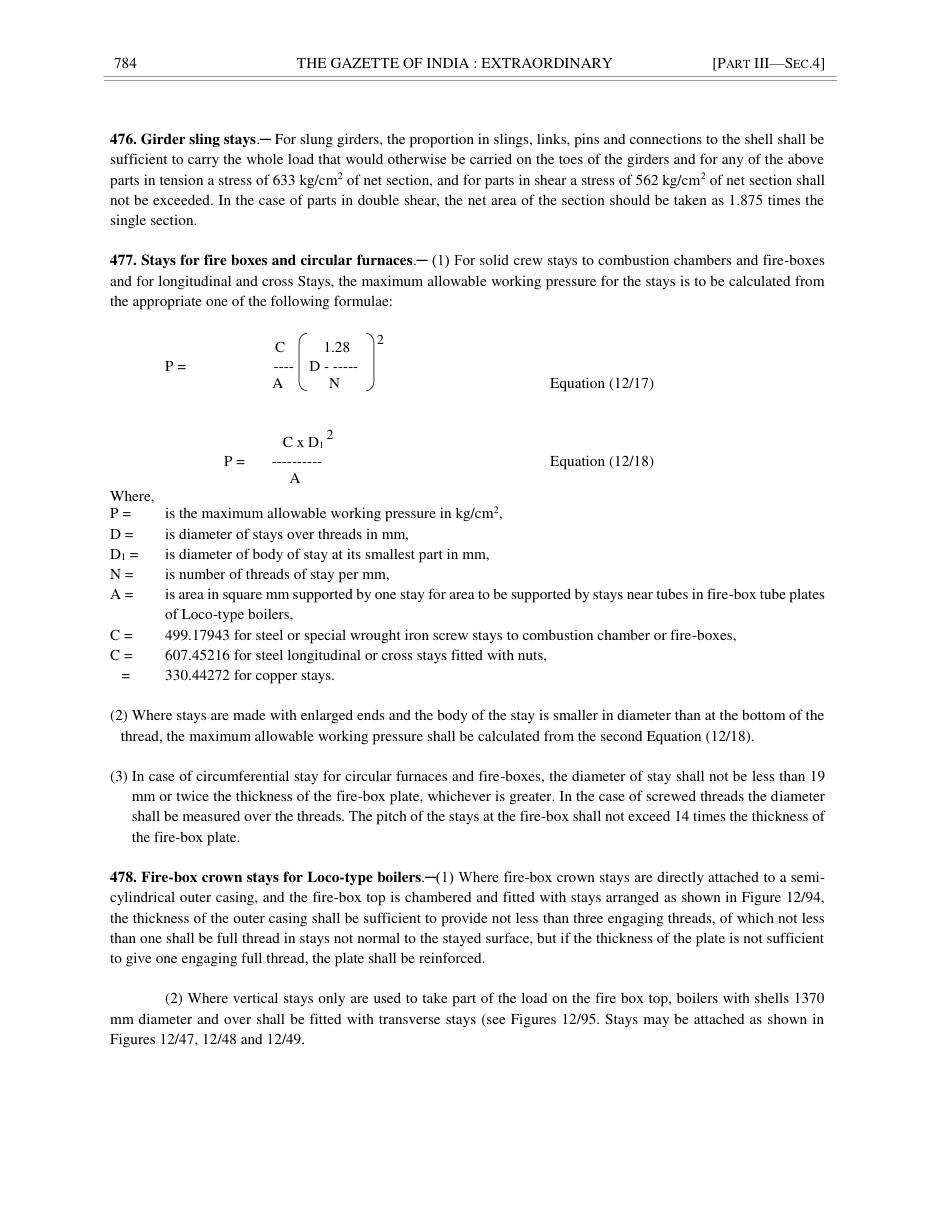
Indian Boiler Regulations, 2026, reg. 477, Regulation 477, Gazette of India, Extraordinary, Part III—Section 4, No. 596, 1 October 2026, printed p.784. https://egazette.gov.in/WriteReadData/2026/276813.pdf (text consulted via IBRsource, 2026-11-23).
The citation refers to the government publication. Cite the Gazette, not this website.