
Indian Boiler Regulations, 2026 · Chapter 12 · Shell Type Boilers of Welded Construction
Regulation 479. Longitudinal bar stays
Not yet checked against the official Gazette; verify before relying on it.
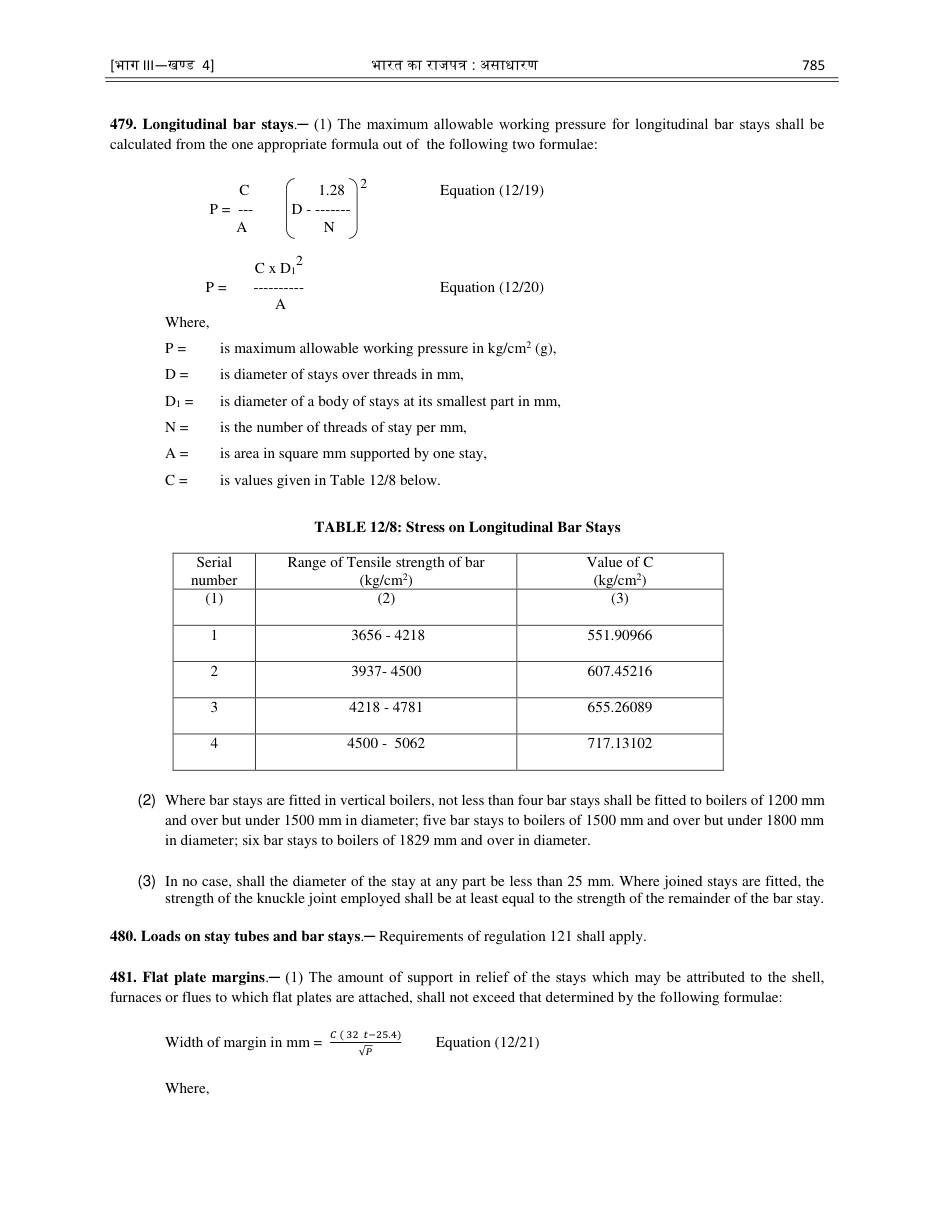
479. Longitudinal bar stays.─ (1) The maximum allowable working pressure for longitudinal bar stays shall be calculated from the one appropriate formula out of the following two formulae:
     C                  1.28 2                             Equation (12/19)
P = ---            D - -------

     A                   N

        P =        C x D12                                 Equation (12/20)
Where,             ----------

                       A
P = is maximum allowable working pressure in kg/cm2 (g),
D = is diameter of stays over threads in mm,
D1 = is diameter of a body of stays at its smallest part in mm,
N = is the number of threads of stay per mm,
A = is area in square mm supported by one stay,
C = is values given in Table 12/8 below.
TABLE 12/8: Stress on Longitudinal Bar Stays
| Serial number | Range of Tensile strength of bar (kg/cm2) | Value of C (kg/cm2) |
| (1) | (2) | (3) |
| 1 | 3656 - 4218 | 551.90966 |
| 2 | 3937- 4500 | 607.45216 |
| 3 | 4218 - 4781 | 655.26089 |
| 4 | 4500 - 5062 | 717.13102 |
Table structure read from the Gazette PDF, page 785. Verification status as for the text above.
Show original extracted text (diagnostic, not authoritative)
 Serial            Range of Tensile strength of bar                          Value of C
number                           (kg/cm2)                                     (kg/cm2)

  (1)                               (2)                                          (3)

   1                           3656 - 4218                                   551.90966

   2                           3937- 4500                                    607.45216

   3                           4218 - 4781                                   655.26089

   4                           4500 - 5062                                   717.13102
(2)Where bar stays are fitted in vertical boilers, not less than four bar stays shall be fitted to boilers of 1200 mm and over but under 1500 mm in diameter; five bar stays to boilers of 1500 mm and over but under 1800 mm in diameter; six bar stays to boilers of 1829 mm and over in diameter.
(3)In no case, shall the diameter of the stay at any part be less than 25 mm. Where joined stays are fitted, the strength of the knuckle joint employed shall be at least equal to the strength of the remainder of the bar stay.
Parts of this extracted text look garbled; read the Gazette page before using any value.
Tables and formulae are shown in their extracted layout. Alignment, superscripts and subscripts may be lost. The Gazette page image is authoritative.
In short
Sets the maximum allowable working pressure for longitudinal bar stays, the number of bar stays in vertical boilers, and the minimum stay diameter.
Key points
- (1) Use Equation (12/19) (diameter over threads and threads per mm) or Equation (12/20) (body diameter at its smallest part), with A (area supported by one stay, mm2) and C from Table 12/8.
- (1) Table 12/8 sets C by the range of tensile strength of the bar. See the Official text tab for values.
- (2) In vertical boilers: at least four bar stays for diameters of 1200 mm and over but under 1500 mm; five for 1500 mm and over but under 1800 mm; six for 1829 mm and over.
- (3) Stay diameter must never be less than 25 mm at any part.
- (3) Where jointed stays are used, the knuckle joint must be at least as strong as the rest of the bar stay.
Watch out
- As printed, the diameter bands in (2) leave a gap between 1800 mm and 1829 mm. Check the Gazette page for the exact figures.
Written by IBRsource editors · last edited 2026-11-20. Explanations simplify and are not a design method, testing procedure or authorisation. Requirements come from the complete regulations, the Gazette and approved documentation.
Comparison pending: the IBR 1950 text in force on 30 September 2026 is not yet established for this provision, so no change is claimed (how this works).
Orientation hints (unverified)
These candidates come from automated heading matching against DPIIT's scanned historical print edition of IBR 1950. That edition uses imperial units and riveted-construction provisions, so it is not the operative 2026 predecessor text. Regulation numbers alone never prove equivalence.
| Historical 1950-edition reg. | Heading as OCR'd | Heading similarity | Source image |
|---|---|---|---|
| 108 | Longitudinal Seams | 80% | Chapter III (DPIIT scan), image 1 |
IBR 1950 regulation 108 as last published in the DPIIT web edition (archived 2022)
Unofficial archived copy, not verified; see the regulation 108 page for its amendments.
| Reg. 108, Reg. 109, Reg. 110 SHELLS, ANGLE RINGS, BUTT STRAPS, ETC. Longitudinal Seams |
| The longitudinal seams of shell belts shall be butt-jointed with double straps when the diameter or Working Pressure exceeds the limits stated below :-
Butt straps shall be cut from the shell plates, or, alternatively, all the butt straps of each required thickness shall be cut from one plate. The lengths of the straps wherever practicable shall be transverse to the direction of rolling of the plate. Straps shall be pressed or bent in rolls to the shell curvature. Reg. 110 SHELLS, ANGLE RINGS, BUTT STRAPS, ETC. Thinning of Butt Straps |
Images of the official Gazette pages that contain this regulation. Click to zoom. Compare word by word before relying on the extracted text.
Indian Boiler Regulations, 2026, reg. 479, Regulation 479, Gazette of India, Extraordinary, Part III—Section 4, No. 596, 1 October 2026, printed p.785. https://egazette.gov.in/WriteReadData/2026/276813.pdf (text consulted via IBRsource, 2026-11-23).
The citation refers to the government publication. Cite the Gazette, not this website.