
Indian Boiler Regulations, 2026 · Chapter 12 · Shell Type Boilers of Welded Construction
Regulation 481. Flat plate margins
Not yet checked against the official Gazette; verify before relying on it.
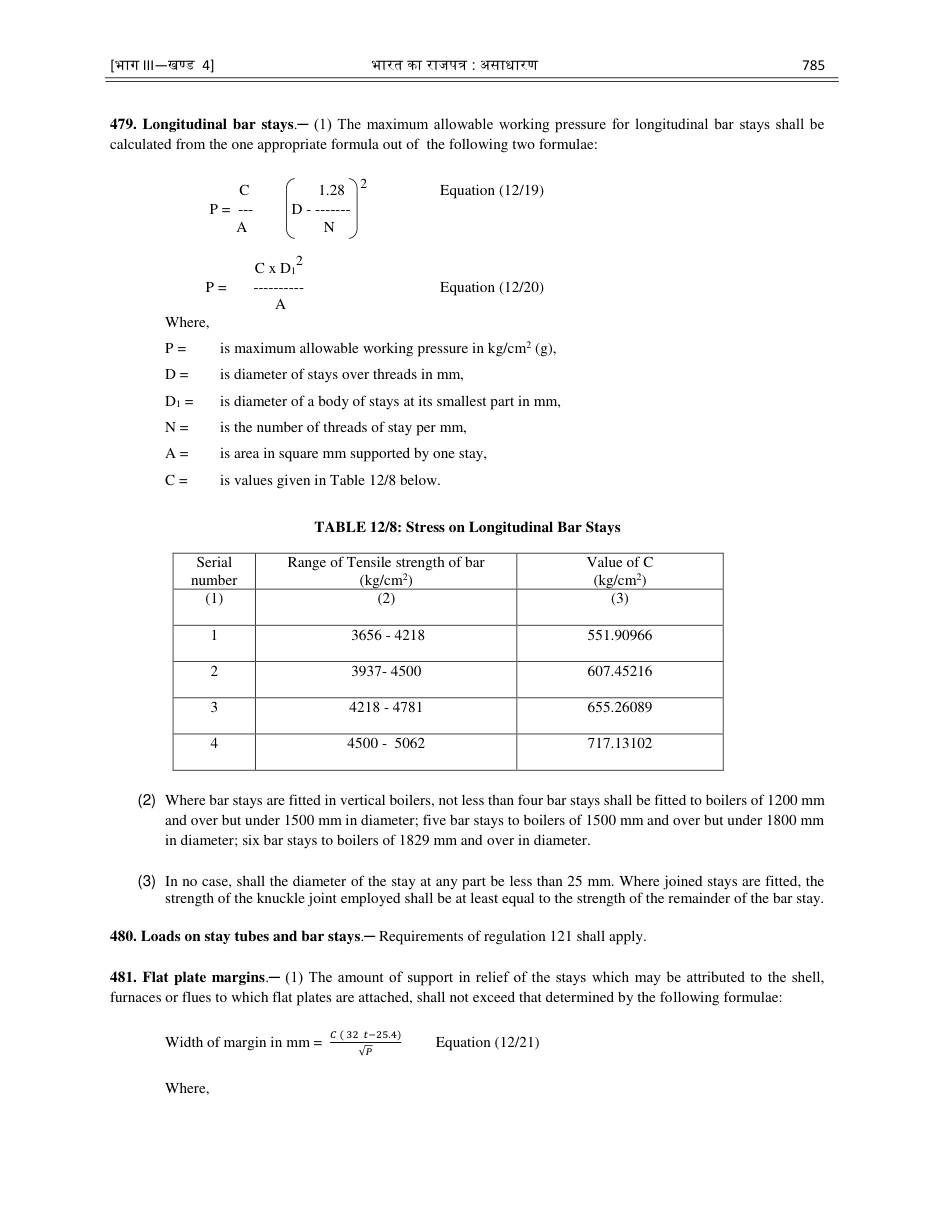
481. Flat plate margins.─ (1) The amount of support in relief of the stays which may be attributed to the shell, furnaces or flues to which flat plates are attached, shall not exceed that determined by the following formulae:
Width of margin in mm = 𝐶 ( 32 𝑡−25.4) Equation (12/21)
√𝑃
Where, t is plate thickness in mm
P is maximum allowable working pressure in kg/cm2 (g)
C = 0.92008 for plates exposed to flame.
C = 0.98107 for plates not exposed to flame.
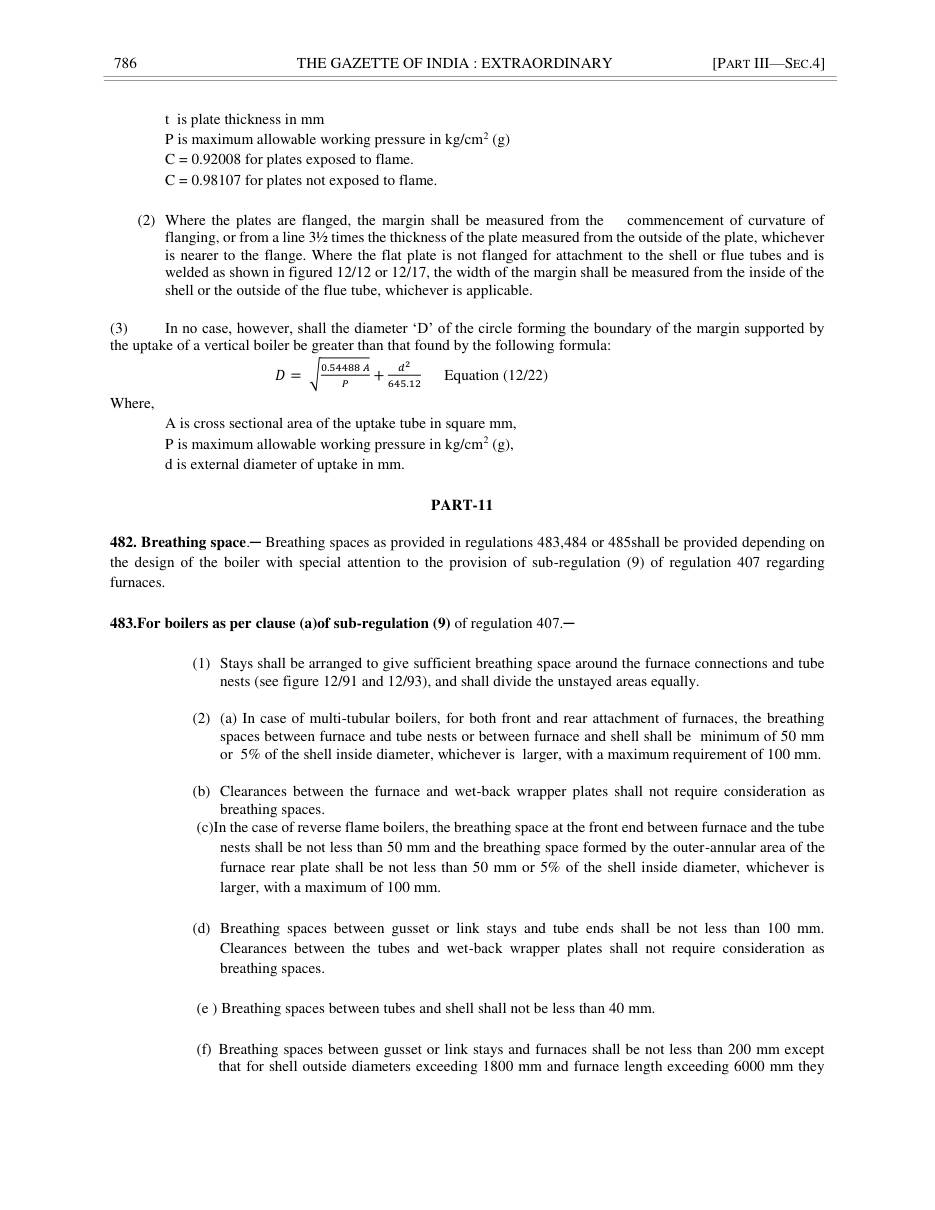
(2)Where the plates are flanged, the margin shall be measured from the commencement of curvature of flanging, or from a line 3½ times the thickness of the plate measured from the outside of the plate, whichever is nearer to the flange. Where the flat plate is not flanged for attachment to the shell or flue tubes and is welded as shown in figured 12/12 or 12/17, the width of the margin shall be measured from the inside of the shell or the outside of the flue tube, whichever is applicable.
(3)In no case, however, shall the diameter ‘D’ of the circle forming the boundary of the margin supported by the uptake of a vertical boiler be greater than that found by the following formula:
𝐷 = √0.54488 𝐴 + 𝑑2 Equation (12/22)
𝑃 645.12
Where,
A is cross sectional area of the uptake tube in square mm,
P is maximum allowable working pressure in kg/cm2 (g), d is external diameter of uptake in mm.
Tables and formulae are shown in their extracted layout. Alignment, superscripts and subscripts may be lost. The Gazette page image is authoritative.
In short
Regulation 481 limits how much of a flat plate's load can be treated as carried by the shell, furnace or flue the plate is attached to. That supported strip is the margin. Outside it, the plate needs stays. A second formula caps the margin around the uptake of a vertical boiler.
Key points
- (1) The maximum width of margin in mm is given by Equation (12/21). It uses the plate thickness t (mm), the maximum allowable working pressure P (kg/cm² (g)) and a constant C:
- C = 0.92008 for plates exposed to flame;
- C = 0.98107 for plates not exposed to flame.
- (2) Where the margin is measured from:
- Flanged plates: from the commencement of curvature of the flanging, or from a line 3½ times the plate thickness measured from the outside of the plate, whichever is nearer to the flange.
- Unflanged plates welded as in Figures 12/12 or 12/17: from the inside of the shell or the outside of the flue tube, as applicable.
- (3) Vertical boilers: the diameter D of the circle bounding the margin supported by the uptake must not exceed the value from Equation (12/22). It uses the uptake's cross-sectional area A (square mm), P, and the external diameter of the uptake d (mm).
Watch out
- The two equations did not extract cleanly. Use the Official text tab and the Gazette page for their exact form.
- The constant C depends on whether the plate is exposed to flame. Pick the right one for each plate.
Written by IBRsource editors · last edited 2026-11-20. Explanations simplify and are not a design method, testing procedure or authorisation. Requirements come from the complete regulations, the Gazette and approved documentation.
Comparison pending: the IBR 1950 text in force on 30 September 2026 is not yet established for this provision, so no change is claimed (how this works).
Orientation hints (unverified)
These candidates come from automated heading matching against DPIIT's scanned historical print edition of IBR 1950. That edition uses imperial units and riveted-construction provisions, so it is not the operative 2026 predecessor text. Regulation numbers alone never prove equivalence.
| Historical 1950-edition reg. | Heading as OCR'd | Heading similarity | Source image |
|---|---|---|---|
| 589 | Flat Plate Margins | 100% | Chapter XII (DPIIT scan), image 11 |
| 113 | Flat End Plates | 73% | Chapter III (DPIIT scan), image 2 |
| 114 | Stren thening of Flat End Plate at Manhole | 71% | Chapter III (DPIIT scan), image 2 |
Amendment history of the candidate IBR 1950 regulations: Reg. 113 (1 amendment)
IBR 1950 regulation 589 as last published in the DPIIT web edition (archived 2022)
Unofficial archived copy, not verified; see the regulation 589 page for its amendments.
| Reg. 589 | |||||||
|
IBR 1950 regulation 113 as last published in the DPIIT web edition (archived 2022)
Unofficial archived copy, not verified; see the regulation 113 page for its amendments.
| Reg. 113 END PLATES Flat End Plates
|
IBR 1950 regulation 114 as last published in the DPIIT web edition (archived 2022)
Unofficial archived copy, not verified; see the regulation 114 page for its amendments.
| Reg. 114 END PLATES Strengthening of Flat End Plate at Manhole
|
Images of the official Gazette pages that contain this regulation. Click to zoom. Compare word by word before relying on the extracted text.
Indian Boiler Regulations, 2026, reg. 481, Regulation 481, Gazette of India, Extraordinary, Part III—Section 4, No. 596, 1 October 2026, printed p.785–786. https://egazette.gov.in/WriteReadData/2026/276813.pdf (text consulted via IBRsource, 2026-11-23).
The citation refers to the government publication. Cite the Gazette, not this website.