
Indian Boiler Regulations, 2026 · Chapter 12 · Shell Type Boilers of Welded Construction
Regulation 437. Tensile tests
Not yet checked against the official Gazette; verify before relying on it.
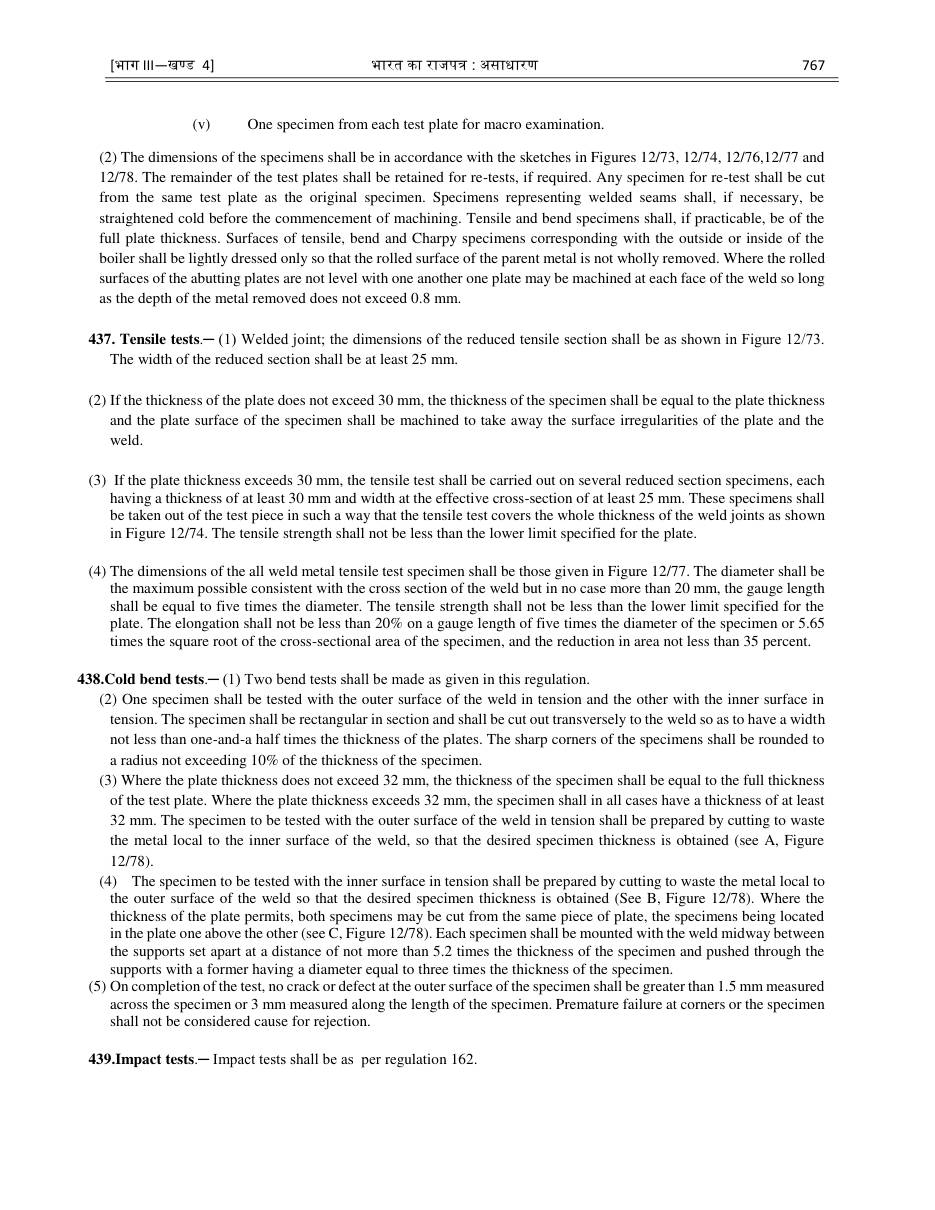
437. Tensile tests.─ (1) Welded joint; the dimensions of the reduced tensile section shall be as shown in Figure 12/73. The width of the reduced section shall be at least 25 mm.
(2)If the thickness of the plate does not exceed 30 mm, the thickness of the specimen shall be equal to the plate thickness and the plate surface of the specimen shall be machined to take away the surface irregularities of the plate and the weld.
(3)If the plate thickness exceeds 30 mm, the tensile test shall be carried out on several reduced section specimens, each having a thickness of at least 30 mm and width at the effective cross-section of at least 25 mm. These specimens shall be taken out of the test piece in such a way that the tensile test covers the whole thickness of the weld joints as shown in Figure 12/74. The tensile strength shall not be less than the lower limit specified for the plate.
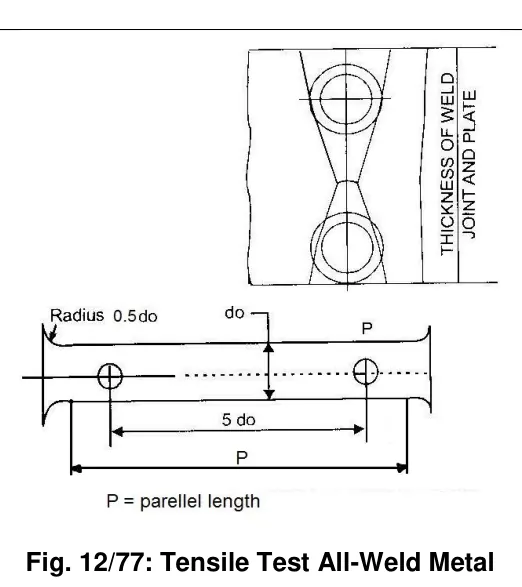
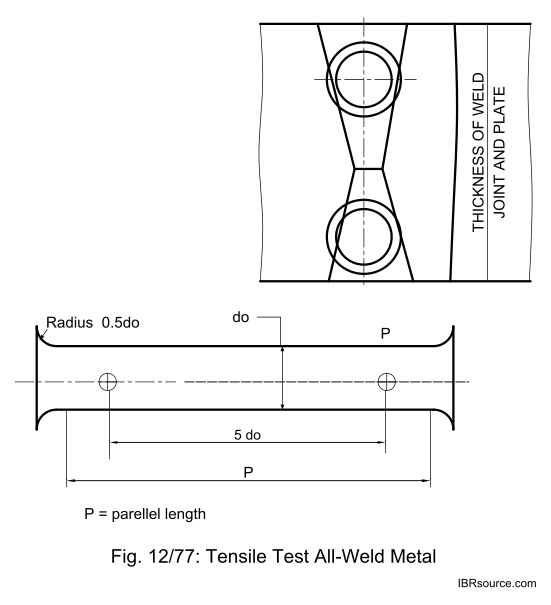
(4)The dimensions of the all weld metal tensile test specimen shall be those given in Figure 12/77. The diameter shall be the maximum possible consistent with the cross section of the weld but in no case more than 20 mm, the gauge length shall be equal to five times the diameter. The tensile strength shall not be less than the lower limit specified for the plate. The elongation shall not be less than 20% on a gauge length of five times the diameter of the specimen or 5.65 times the square root of the cross-sectional area of the specimen, and the reduction in area not less than 35 percent.
Figures cited in this regulation (3, exact crops of the Gazette)
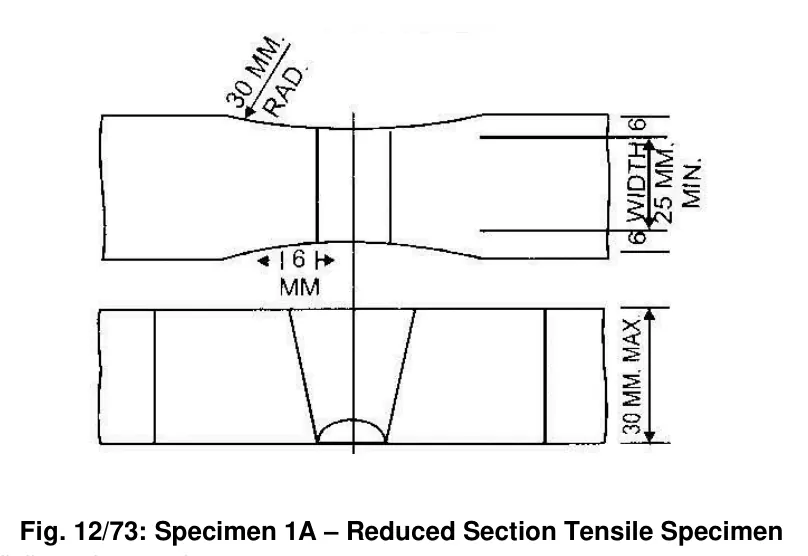
View Gazette page 816 · figure catalogue
Reconstructed CAD: DXF · SVG · Preview (redrawn, checked against the print; technical review pending)
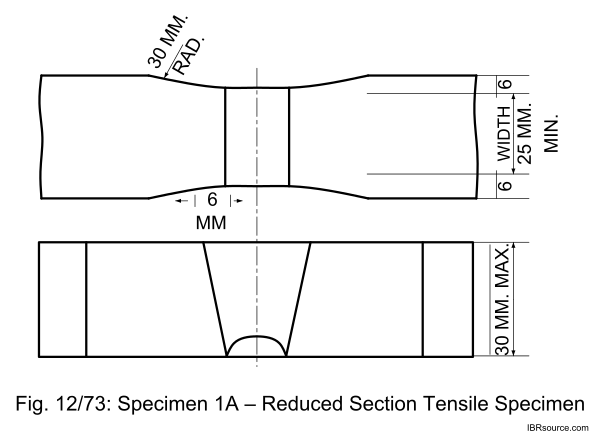
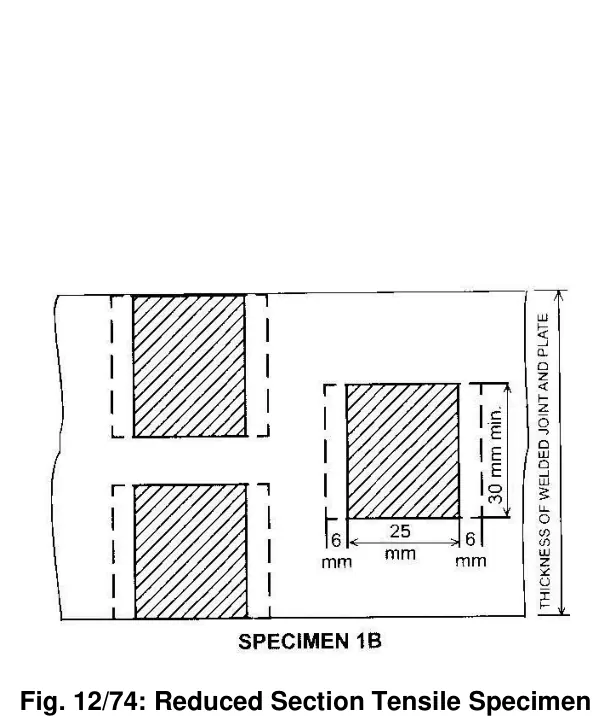
View Gazette page 817 · figure catalogue
Reconstructed CAD: DXF · SVG · Preview (redrawn, checked against the print; technical review pending)
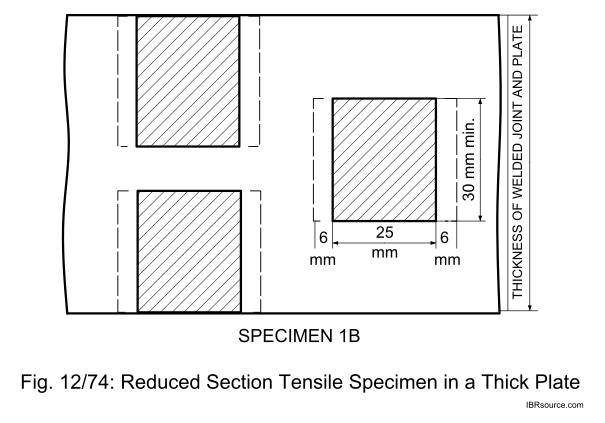
View Gazette page 818 · figure catalogue
Reconstructed CAD: DXF · SVG · Preview (redrawn, checked against the print; technical review pending)
In short
Sets specimen dimensions and acceptance values for the tensile tests on Class I welded test plates.
Key points
- (1) Welded joint specimen: reduced section as in Figure 12/73, at least 25 mm wide.
- (2) Plate not over 30 mm thick: specimen thickness equals plate thickness, with surfaces machined to remove plate and weld irregularities.
- (3) Plate over 30 mm thick: use several reduced-section specimens, each at least 30 mm thick and at least 25 mm wide, together covering the whole weld thickness (Figure 12/74). Tensile strength must not be below the lower limit specified for the plate.
- (4) All weld metal specimen (Figure 12/77): diameter as large as the weld allows but not more than 20 mm; gauge length five times the diameter.
- (4) Acceptance: tensile strength not below the plate's specified lower limit; elongation at least 20% on a gauge length of five times the diameter (or 5.65 times the square root of the cross-sectional area); reduction in area at least 35 percent.
Written by IBRsource editors · last edited 2026-11-20. Explanations simplify and are not a design method, testing procedure or authorisation. Requirements come from the complete regulations, the Gazette and approved documentation.
Comparison pending: the IBR 1950 text in force on 30 September 2026 is not yet established for this provision, so no change is claimed (how this works).
Orientation hints (unverified)
These candidates come from automated heading matching against DPIIT's scanned historical print edition of IBR 1950. That edition uses imperial units and riveted-construction provisions, so it is not the operative 2026 predecessor text. Regulation numbers alone never prove equivalence.
| Historical 1950-edition reg. | Heading as OCR'd | Heading similarity | Source image |
|---|---|---|---|
| 17 | Number of Tensile Tests | 100% | Chapter II (DPIIT scan), image 2 |
| 83 | Tensile Tests | 100% | Chapter II (DPIIT scan), image 16 |
| 260 | Tensile Tests | 100% | Chapter V (DPIIT scan), image 6 |
Amendment history of the candidate IBR 1950 regulations: Reg. 17 (3 amendments) · Reg. 260 (1 amendment)
IBR 1950 regulation 17 as last published in the DPIIT web edition (archived 2022)
Unofficial archived copy, not verified; see the regulation 17 page for its amendments.
| Reg. 17 MATERIALS OF CONSTRUCTION STEEL PLATES, RIVETS, SECTION AND BARS IN CARBON STEEL |
| (a) Plates – For shell plates, butt straps and plates, gusset plates, end plates, furnace plates and flanging plates one tensile test piece shall be cut from each plate as rolled. (b) Angle, tee, rivet, and stay bars.- One tensile test shall be made from each 15 or part of 15 bars rolled of each section or diameter from the same charge, but not less than two tensile tests shall be made unless the total number of bars rolled from the same charge is 8 or less than 8 and the bars of the same section or diameter, in which case one tensile test shall suffice. For round bars of 1¾ inches diameter and under, the numbers 50 and 20 shall be substituted for 15 and 8 respectively for determining the number of tests required. |
IBR 1950 regulation 83 as last published in the DPIIT web edition (archived 2022)
Unofficial archived copy, not verified; see the regulation 83 page for its amendments.
| Reg. 83 MATERIALS OF CONSTRUCTION FORGED OR ROLLED PRESSURE PARTS OTHER THAN SEAMLESS DRUMS OF CARBON STEEL Tensile strength |
| (a) The tensile strength of the material shall conform to one of the following four grades:- (i) 37 to 45 kgf/mm2 (b) The upper yield point at room temperature shall be not less than 50% of the specified minimum tensile strength. (c) The minimum values of the stress at proof limit 0.2% at elevated temperature Et of the material may be calculated by multiplying the minimum specified tensile strength at room temperature R20 by the value of the ratio Et/R20 given in the table under Regulation 16. (d) The breaking elongation in percentage shall not be less than
|
IBR 1950 regulation 260 as last published in the DPIIT web edition (archived 2022)
Unofficial archived copy, not verified; see the regulation 260 page for its amendments.
|
| ||||||
Reg. 260
(b) All-weld Metal
|
Images of the official Gazette pages that contain this regulation. Click to zoom. Compare word by word before relying on the extracted text.
Indian Boiler Regulations, 2026, reg. 437, Regulation 437, Gazette of India, Extraordinary, Part III—Section 4, No. 596, 1 October 2026, printed p.767. https://egazette.gov.in/WriteReadData/2026/276813.pdf (text consulted via IBRsource, 2026-11-23).
The citation refers to the government publication. Cite the Gazette, not this website.