BETAIndependent engineering reference. Source-text verification is ongoing.Verification ongoing.Verification status →
IBRsourceIndian Boiler Regulations, made clear

Indian Boiler Regulations, 2026 · Chapter 12 · Shell Type Boilers of Welded Construction

Regulation 414. Bar stays and firebox stays

Official text — not yet verifiedGazette 1 Oct 2026 · printed pp. 760–761

Not yet checked against the official Gazette; verify before relying on it.

Reproduced from the Gazette of India · verification status above

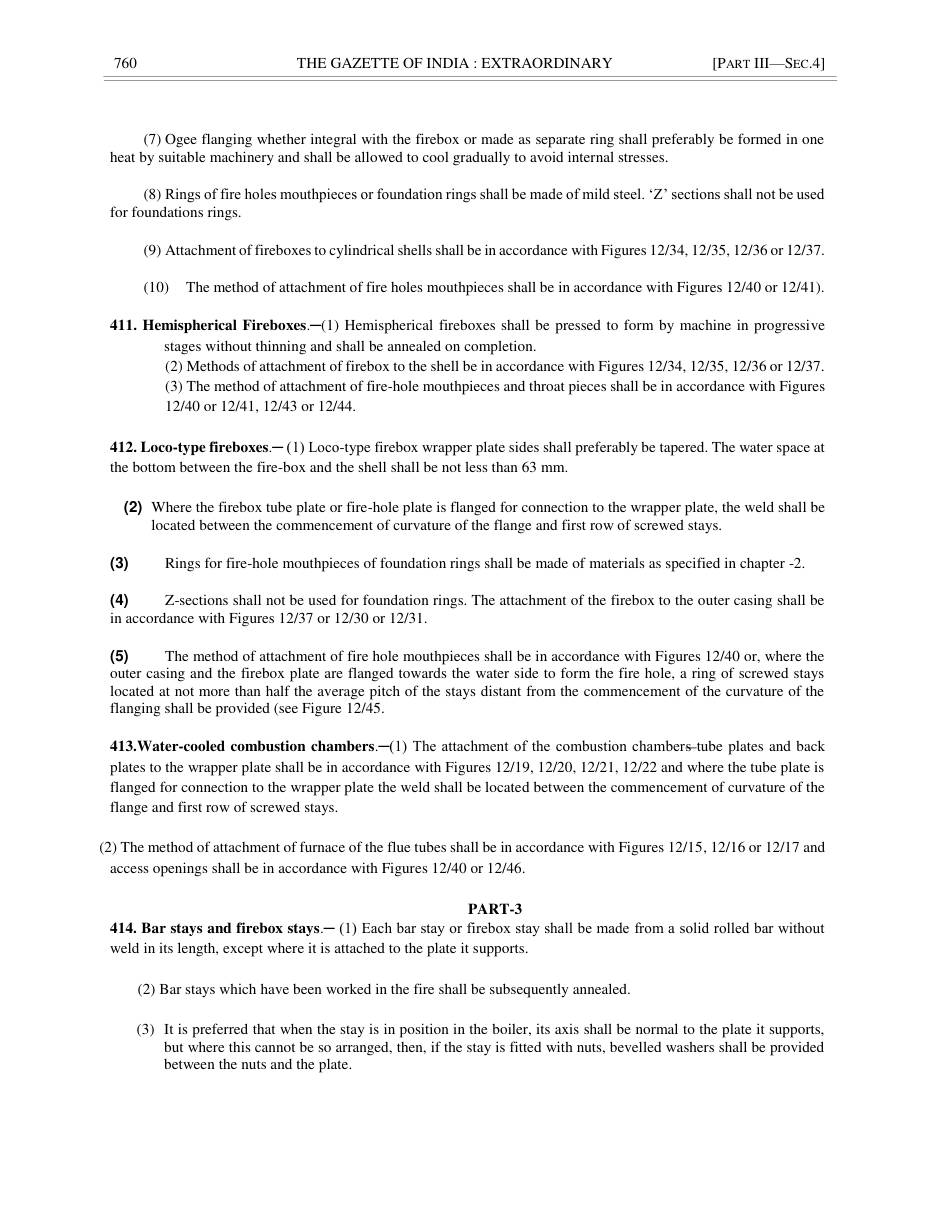
414. Bar stays and firebox stays.─ (1) Each bar stay or firebox stay shall be made from a solid rolled bar without weld in its length, except where it is attached to the plate it supports.

(2)Bar stays which have been worked in the fire shall be subsequently annealed.

(3)It is preferred that when the stay is in position in the boiler, its axis shall be normal to the plate it supports, but where this cannot be so arranged, then, if the stay is fitted with nuts, bevelled washers shall be provided between the nuts and the plate.

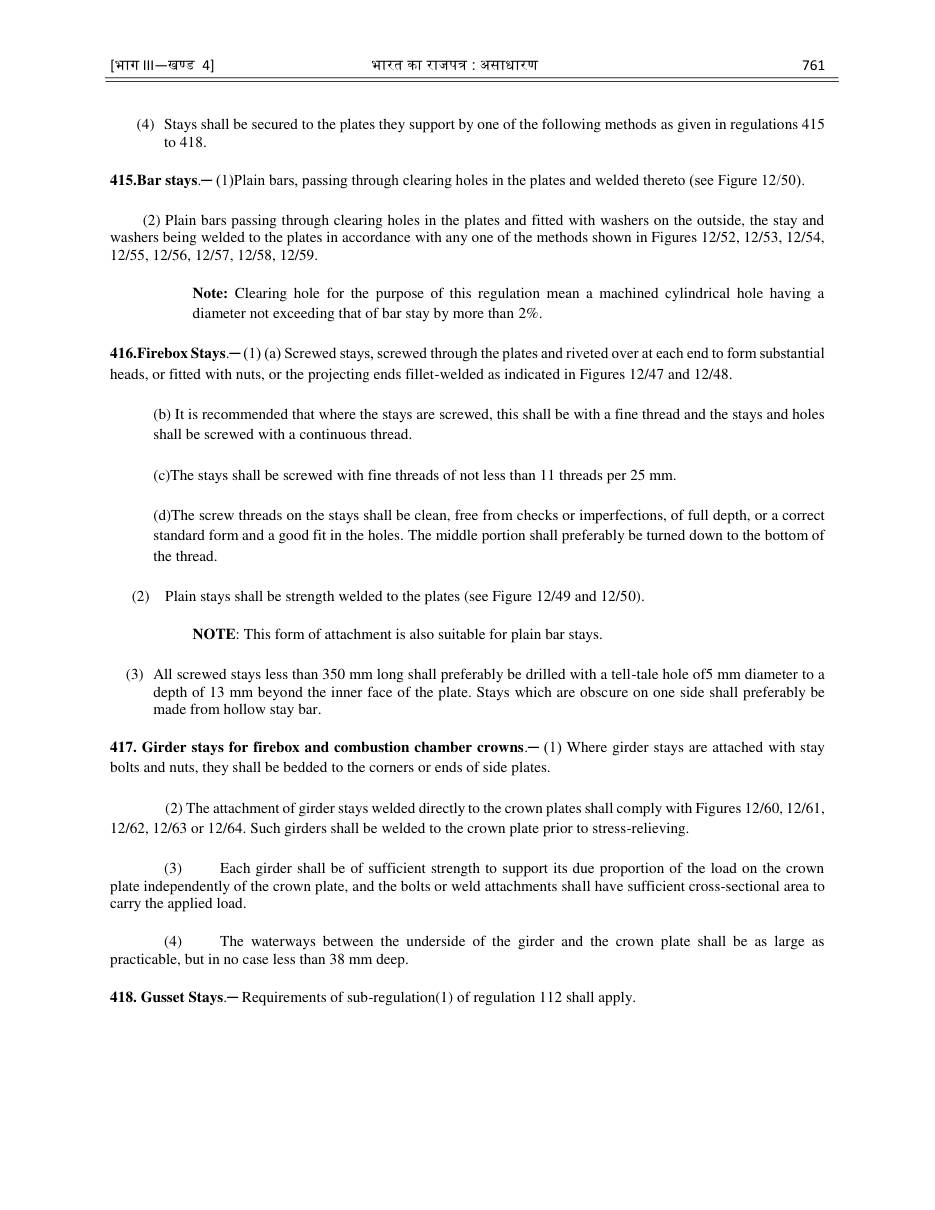
(4)Stays shall be secured to the plates they support by one of the following methods as given in regulations 415 to 418.

Referenced provisions

Reg. 415 · Reg. 418

Independent explanation — not the law · draft · engineer review in progress

In short

Regulation 414 sets general rules for bar stays and firebox stays in welded boilers.

Key points

  • (1) Each stay is made from a solid rolled bar with no weld in its length, except where it is attached to the plate it supports.
  • (2) Bar stays worked in the fire must be annealed afterwards.
  • (3) The stay axis should preferably be normal to the plate. Where it cannot be and nuts are used, bevelled washers go between the nuts and the plate.
  • (4) Stays are secured by one of the methods in regulations 415 to 418.

Written by IBRsource editors · last edited 2026-11-20. Explanations simplify and are not a design method, testing procedure or authorisation. Requirements come from the complete regulations, the Gazette and approved documentation.

Comparison pending: the IBR 1950 text in force on 30 September 2026 is not yet established for this provision, so no change is claimed (how this works).

Orientation hints (unverified)

These candidates come from automated heading matching against DPIIT's scanned historical print edition of IBR 1950. That edition uses imperial units and riveted-construction provisions, so it is not the operative 2026 predecessor text. Regulation numbers alone never prove equivalence.

Historical 1950-edition reg.Heading as OCR'dHeading similaritySource image
588Loads on Stay Tubes and Bar Stays76%Chapter XII (DPIIT scan), image 11
IBR 1950 regulation 588 as last published in the DPIIT web edition (archived 2022)

Unofficial archived copy, not verified; see the regulation 588 page for its amendments.

Reg. 587, Reg. 588

Longitudinal Bar Stays

The maximum working pressure for longitudinal bar stays is to be calculated from the appropriate one of the following two formulae:

WP= C         1.28
(D - ------------)²
        N
Equation XII/21
A

WP= C x D1² Equation XII/22
A

WP is working pressure in pounds per square inch,
D is diameter of stays over threads in inches,
D1 is diameter of body of stays at its smallest part in inches,
N is the number of threads of stay per inch,
A is area in square inches supported by one stay.
C is values given in Table below:

TABLE XII/5
Stress on Longitudinal Bar Stays
Range of tensile strength of bar
Value of C
Tons per square inch Pounds per square inch
26/30 7850
28/32 8640
30/34 9420
32/36 10200

Where bar stays are fitted in vertical boilers, not less than four bar stays shall be fitted to boilers of 4 feet and over but under 5 feet in diameter; five bar stays to boilers of 5 feet and over but under 6 feet in diameter; six bar stays to boiler of 6 feet and over in diameter.

In no case, shall the diameter of the stay at any part be less than 1 inch. Where joined stays are fitted, the strength of the knuckle joint employed shall be at least equal to the strength of the remainder of the bar stay.


Reg. 588

Loads on Stay Tubes and Bar Stays

Stay tubes and bar stays shall be designed to carry the whole load due to the pressure on the area to be supported, the areas being calculated as follows:-

a) For a stay tube within the tube nest the net area to be supported shall be the product of the horizontal and vertical pitches, in inches, of the stay tubes less the area of the tube holes embraced. Where the pitch of the stay tubes is irregular the area shall be taken as the square of the mean pitch of the stay tubes (i.e., the square of ¼ of the sum of the four sides, of any quadrilateral bounded by four adjacent stay tubes), less the area of the tube holes embraced.
b) For a stay tube in the boundary row, or for a bar stay, the net area to be supported shall be the area, in square inches enclosed by lines passing midway between the stay and the adjacent points of support and by the boundary margin (see Regulation 589), less the area of any tubes or stays embraced.
c) In the case of a bar stay where there are no stay tubes in the tube nest the area to be supported shall extend to the tangential boundary of the tube nest.

Images of the official Gazette pages that contain this regulation. Click to zoom. Compare word by word before relying on the extracted text.
Instrument
Indian Boiler Regulations, 2026 (made by the Central Boilers Board under s.40 of the Boilers Act, 2025)
Notification
F.No. P-30014/3/2021-Boiler dated 7 Aug 2026
Published
Gazette of India, Extraordinary, Part III Sec. 4, No. 596, 1 Oct 2026 (CG-DL-E-06102026-276813)
In force
1 Oct 2026 (reg. 1(3): date of publication in the Official Gazette)
Printed Gazette page
760–761
PDF page index
760–761 · open official e-Gazette PDF
Extraction
pdftotext layout mode, sequential regulation detector · text hash 4197f2102f27c422
Verification
Official text — not yet verified
Amendments checked
None known after 1 Oct 2026 as of build date (not a guarantee). Amendment log
How to cite

Indian Boiler Regulations, 2026, reg. 414, Regulation 414, Gazette of India, Extraordinary, Part III—Section 4, No. 596, 1 October 2026, printed p.760–761. https://egazette.gov.in/WriteReadData/2026/276813.pdf (text consulted via IBRsource, 2026-11-23).

The citation refers to the government publication. Cite the Gazette, not this website.

Help improve this page

Engineers like you keep IBRsource accurate. Every checked correction or tip helps the next reader.