
Indian Boiler Regulations, 2026 · Chapter 12 · Shell Type Boilers of Welded Construction
Regulation 430. Compensating plates
Not yet checked against the official Gazette; verify before relying on it.
430. Compensating plates.─ Compensating plates shall be of same material as that of shell and before attachment, shall bed closely to the plates to which they are to be connected. Any weld therein shall be on the transverse centre line.
In short
Sets three conditions for compensating plates.
Key points
- They must be of the same material as the shell.
- Before attachment, they must bed closely to the plates they are joined to.
- Any weld in a compensating plate must lie on the transverse centre line.
Written by IBRsource editors · last edited 2026-11-20. Explanations simplify and are not a design method, testing procedure or authorisation. Requirements come from the complete regulations, the Gazette and approved documentation.
Comparison pending: the IBR 1950 text in force on 30 September 2026 is not yet established for this provision, so no change is claimed (how this works).
Orientation hints (unverified)
These candidates come from automated heading matching against DPIIT's scanned historical print edition of IBR 1950. That edition uses imperial units and riveted-construction provisions, so it is not the operative 2026 predecessor text. Regulation numbers alone never prove equivalence.
| Historical 1950-edition reg. | Heading as OCR'd | Heading similarity | Source image |
|---|---|---|---|
| 33 | Plates | 100% | Chapter II (DPIIT scan), image 3 |
| 118 | Tube Plates | 71% | Chapter III (DPIIT scan), image 2 |
| 634 | Tube plates | 71% | Chapter XV (DPIIT scan), image 3 |
IBR 1950 regulation 33 as last published in the DPIIT web edition (archived 2022)
Unofficial archived copy, not verified; see the regulation 33 page for its amendments.
| Reg. 33 MATERIALS OF CONSTRUCTION COPPER PLATES, STAY AND RIVET BARS |
| (a) Process.- The copper shall be fire-refined or electrolytic and hot-rolled from suitable cakes. (b) Chemical Composition.- The chemical composition of the plates shall be as follows:-
(c) Freedom from defects.- The plates shall be clean, smooth and free from defects and shall have a workmanlike finish. They shall be thoroughly annealed. (d) Rolling Margin.- No plate shall be under the specified thickness at any part, not more than 5% over the calculated weight. The scrap margin, partly sheared and left attached, shall be not less than 3 inches at the ends and 1½ inches at each side. (e) Tensile Tests.- One tensile test shall be taken from each plate as rolled. The tensile breaking strength, from Standard Test Piece A, shall not be less than 14 tons per sq. inch with an elongation of not less than 35%. (f) Hot and Cold Bend tests.- One hot (temperature between 1200°F and 1400°F) and one cold bend test shall be taken from each plate as rolled. For either hot or cold bend tests, the test piece shall withstand being doubled over without fracture until the sides are touching and parallel. |
IBR 1950 regulation 118 as last published in the DPIIT web edition (archived 2022)
Unofficial archived copy, not verified; see the regulation 118 page for its amendments.
| Reg. 118, Reg. 119, Reg. 120 END PLATES
Tube Plates Parts of flat tube plates within the tube nests
Reg. 120 END PLATES Flanging of End Plates All flanges shall be a good fit to the shell and flues. Flogging and/or hammering in the fitting of these parts is prohibited. The caulking edges of all flanged plates shall be machined or machine gas cut. |
Images of the official Gazette pages that contain this regulation. Click to zoom. Compare word by word before relying on the extracted text.
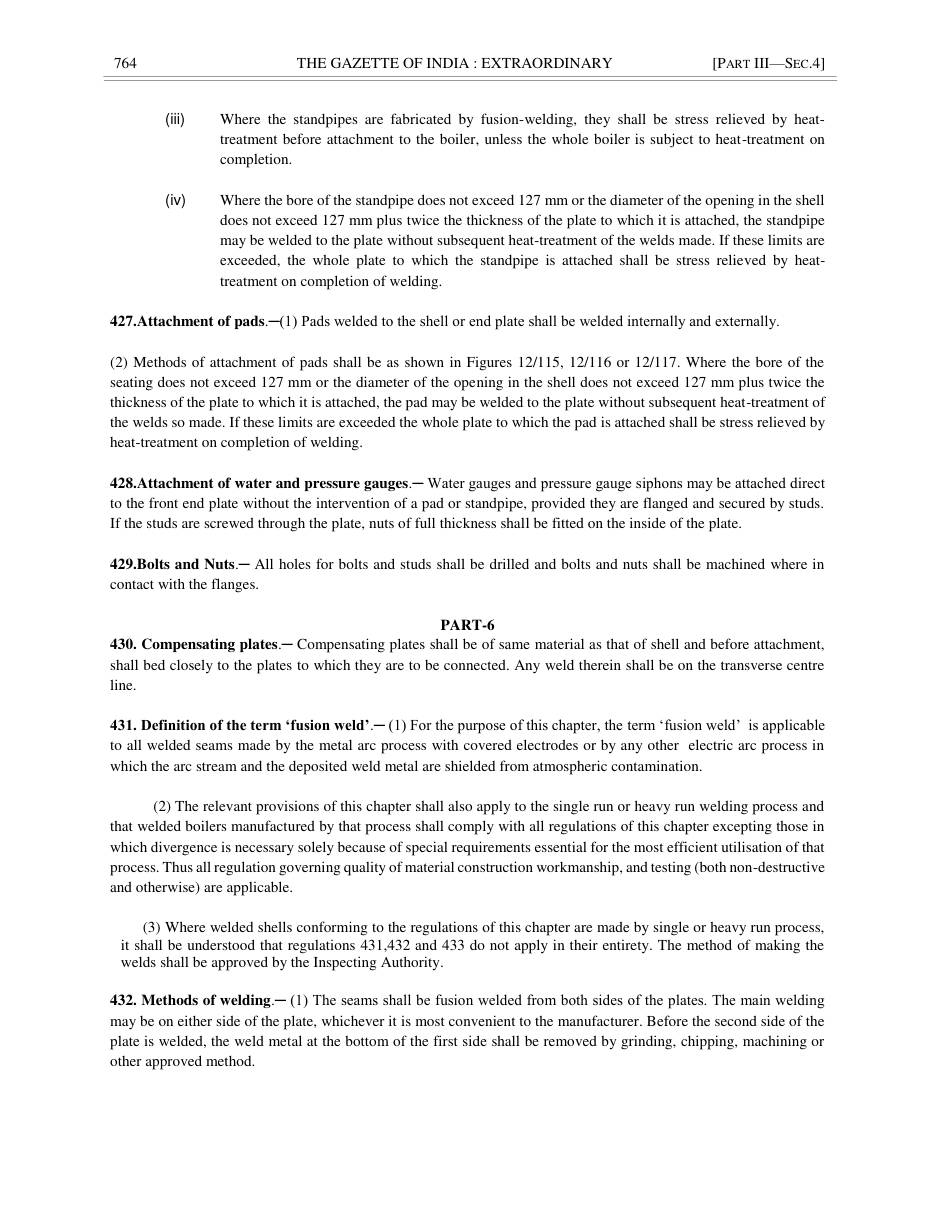
Indian Boiler Regulations, 2026, reg. 430, Regulation 430, Gazette of India, Extraordinary, Part III—Section 4, No. 596, 1 October 2026, printed p.764. https://egazette.gov.in/WriteReadData/2026/276813.pdf (text consulted via IBRsource, 2026-11-23).
The citation refers to the government publication. Cite the Gazette, not this website.