BETAIndependent engineering reference. Source-text verification is ongoing.Verification ongoing.Verification status →
IBRsourceIndian Boiler Regulations, made clear

Indian Boiler Regulations, 2026 · Chapter 12 · Shell Type Boilers of Welded Construction

Regulation 445. Tensile test

Official text — not yet verifiedGazette 1 Oct 2026 · printed p. 770Figure referenced

Not yet checked against the official Gazette; verify before relying on it.

Reproduced from the Gazette of India · verification status above

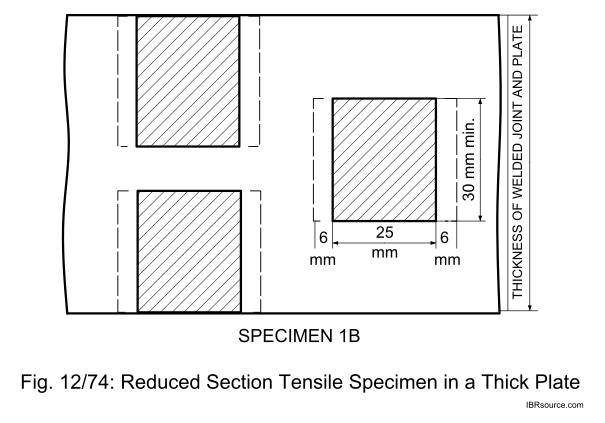
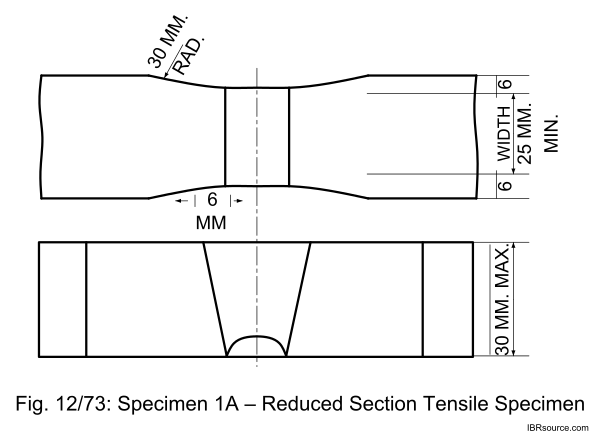
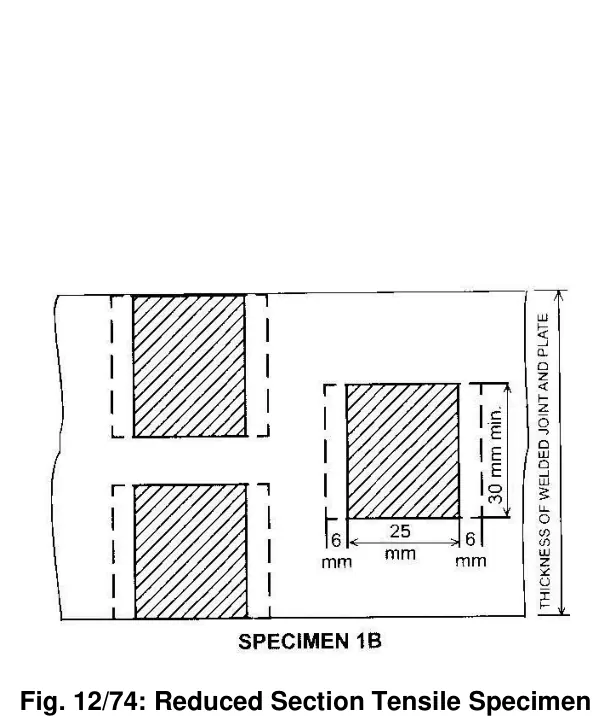
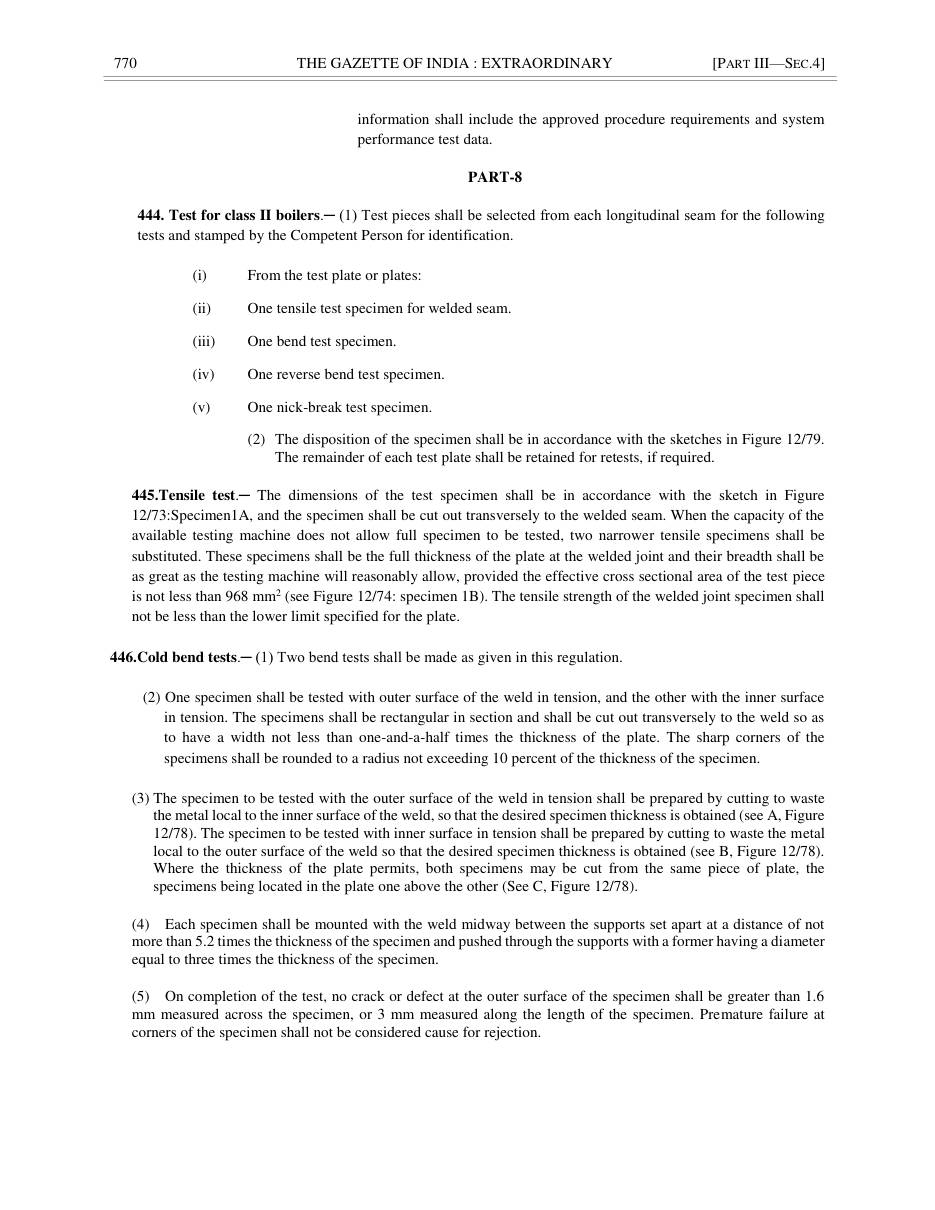
445.Tensile test.─ The dimensions of the test specimen shall be in accordance with the sketch in Figure 12/73:Specimen1A, and the specimen shall be cut out transversely to the welded seam. When the capacity of the available testing machine does not allow full specimen to be tested, two narrower tensile specimens shall be substituted. These specimens shall be the full thickness of the plate at the welded joint and their breadth shall be as great as the testing machine will reasonably allow, provided the effective cross sectional area of the test piece is not less than 968 mm2 (see Figure 12/74: specimen 1B). The tensile strength of the welded joint specimen shall not be less than the lower limit specified for the plate.

Figures cited in this regulation (2, exact crops of the Gazette)
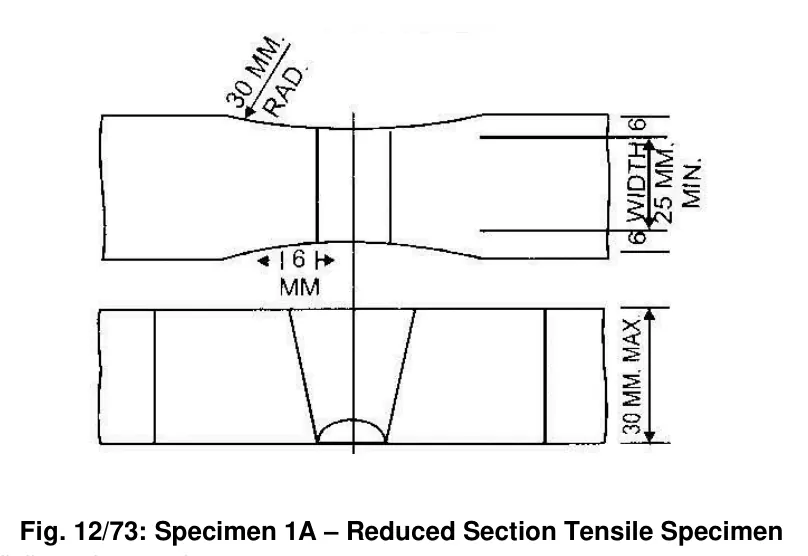
Gazette Fig. 12/73: Specimen 1A – Reduced Section Tensile Specimen
Fig. 12/73Specimen 1A – Reduced Section Tensile Specimen
View Gazette page 816 · figure catalogue
Reconstructed CAD: DXF · SVG · Preview (redrawn, checked against the print; technical review pending)
Gazette Fig. 12/74: Reduced Section Tensile Specimen in a Thick Plate
Fig. 12/74Reduced Section Tensile Specimen in a Thick Plate
View Gazette page 817 · figure catalogue
Reconstructed CAD: DXF · SVG · Preview (redrawn, checked against the print; technical review pending)
Independent explanation — not the law · draft · engineer review in progress

In short

Sets the tensile test on the welded joint for Class II boilers.

Key points

  • The specimen follows Figure 12/73 (Specimen 1A) and is cut across the welded seam.
  • If the testing machine cannot take the full specimen, two narrower specimens are used instead. Each is full plate thickness at the joint and as wide as the machine reasonably allows, with an effective cross-sectional area of at least 968 mm2 (Figure 12/74, Specimen 1B).
  • The tensile strength of the welded joint must not be below the lower limit specified for the plate.

Written by IBRsource editors · last edited 2026-11-20. Explanations simplify and are not a design method, testing procedure or authorisation. Requirements come from the complete regulations, the Gazette and approved documentation.

Comparison pending: the IBR 1950 text in force on 30 September 2026 is not yet established for this provision, so no change is claimed (how this works).

Orientation hints (unverified)

These candidates come from automated heading matching against DPIIT's scanned historical print edition of IBR 1950. That edition uses imperial units and riveted-construction provisions, so it is not the operative 2026 predecessor text. Regulation numbers alone never prove equivalence.

Historical 1950-edition reg.Heading as OCR'dHeading similaritySource image
91Tensile test100%Chapter II (DPIIT scan), image 18
1Tensile test for joint100%Chapter V (DPIIT scan), image 5
2Tensile test for all100%Chapter V (DPIIT scan), image 5

Amendment history of the candidate IBR 1950 regulations: Reg. 1 (1 amendment) · Reg. 2 (8 amendments)

IBR 1950 regulation 91 as last published in the DPIIT web edition (archived 2022)

Unofficial archived copy, not verified; see the regulation 91 page for its amendments.

Reg. 91
MATERIALS OF CONSTRUCTION

GENERAL GREY IRON CASTINGS (GRADE A)

Tensile test

A tensile test bar machined to the dimensions shown in Regulation 88(b) and tested with either plain or screwed ends must show a breaking strength of not less than that shown in the following table:-

Diameter of test bar
Minimum ultimate tensile stress – Grade A

Inches

Tons per sq. inch
0.6 12.5
0.875 12
1.2 11
1.6 10.5
2.1 10


Note – Self-aligning grips to ensure axial loading are recommended.

IBR 1950 regulation 1 as last published in the DPIIT web edition (archived 2022)

Unofficial archived copy, not verified; see the regulation 1 page for its amendments.

Reg. 1
Short Title, Extent, Application and Commencement:

1) These Regulations may be called the Indian Boiler Regulations, 1950.
2) They extend to the whole of India, except the State of Jammu and Kashmir.
2a)

These Regulations generally apply to:-

(i) all boilers, including those working on the principles of natural circulation, forced circulation and forced flow with no fixed steam water line, and
(ii) to steam pipes.
3) They shall come into force at once

IBR 1950 regulation 2 as last published in the DPIIT web edition (archived 2022)

Unofficial archived copy, not verified; see the regulation 2 page for its amendments.

Reg. 2
Definitions

In these Regulations, unless the context otherwise requires

a)

the “Act” means the Indian Boilers Act, 1923:

b) “Accident” means an explosion of a boiler or steam-pipe or any damage of a boiler or steam-pipe, which is calculated to weaken the strength thereof so as to render it liable to explode:
c)

“Boiler” means any closed vessel exceeding 22.75 litres (five gallons) in capacity which is used expressly for generating steam under pressure and includes any mounting or other fitting attached to such vessel, which is wholly or partly under pressure when steam is shut off:

cc) “Calculation Pressure”, in relation to a boiler, means the design pressure of any part adjusted to take into account the pressure drops corresponding to the most severe conditions of pressure drop and hydraulic head;
d) “Chief Inspector” and “Inspector” means, respectively, a person appointed to be a Chief Inspector and an Inspector under the Act:
dd) “Competent Authority” means an authority recognised by the Central Boilers Board in the manner as laid down in regulation 4A to 4H, as competent to issue certificates to welders for the purposes of regulation 4(b)(ii) and regulation 605;
ddd) "Design Pressure" means:-

(i) in relation to a natural or assisted circulation boiler, the maximum allowable working pressure in the steam drum of the boiler;
(ii) in relation to a once through forced-circulation boiler, the maximum allowable working pressure at the final superheater steam outlet;
e) “Economiser” means any part of a feed-pipe that is wholly or partly exposed to the action of flue gases for the purpose of recovery of waste heat:
ee) “Evaluation Committee” means a committee constituted by the Central Government consisting of :-

(a) Technical Adviser (Boilers) : Chairman
(b) Chief Inspector (Boilers) of the State where the unit is located : Member
c) A representative of the manufacturers of boilers/ancillaries in public sector.
: Member
f) “feed-pipe” (i) means any pipe or connected fitting wholly or partly under pressure through which feed-water passes directly to a boiler.
(ii) every reference to a steam-pipe or steam-pipes shall be deemed to include also a reference to feed-pipe or feed-pipes respectively.
g) “Inspecting Authority” means an authority recognised by the Central Boilers Board in the manner as laid down in regulation 4A to 4H, as competent to grant a certificate in Form-II, II-A or II-B.
h) “Inspecting Officer” means :-

(i) in respect of material manufactured or boilers constructed in any State an officer appointed by the Inspecting Authority in that State;
(ii) in respect of material manufactured or boilers constructed outside the States an officer acting on behalf of the Inspecting Authority:
(iii) in respect of :

(a) Approval of drawings of boilers or parts thereto with minor changes, where necessary, except for the drawings of the first set of boilers or parts thereto;
(b) Inspection at stages of manufacture including examination of repairs;
hh) “Liaison Sub-Committee” means a committee constituted by the Central Boilers Board under bye-law 3 (i)(e) of the Bye-Laws of the Central Boilers Board.
i) “owner” includes any person using a boiler as agent of the owner thereof and any person using a boiler which he has hired or obtained on loan from the owner thereof :
j) “prescribed” means prescribed by regulations or rules made under the Act:
k) ”Steam-pipe” means any pipe through which steam passes from a boiler to a prime-mover or other user or both if :-

(i) the pressure at which steam passes through such pipe exceeds 3.5 Kilograms per square centimetre above atmospheric pressure; or
(ii) such pipe exceeds 254 millimetres in internal diameter; and includes in either case any connected fitting of a steam-pipe.
l) “State” or “States” means a State or the States to which these regulations extend.
m) “Structural alteration, addition or renewal” shall not be deemed to include any renewal or replacement, of a petty nature when the part or fitting used for replacement is not inferior in strength, efficiency or otherwise to the replaced part or fitting
n) “Technical Adviser (Boilers)” means Technical Adviser (Boilers) to the Government of India in the Ministry of Industry (Department of Industrial Development).

Images of the official Gazette pages that contain this regulation. Click to zoom. Compare word by word before relying on the extracted text.
Instrument
Indian Boiler Regulations, 2026 (made by the Central Boilers Board under s.40 of the Boilers Act, 2025)
Notification
F.No. P-30014/3/2021-Boiler dated 7 Aug 2026
Published
Gazette of India, Extraordinary, Part III Sec. 4, No. 596, 1 Oct 2026 (CG-DL-E-06102026-276813)
In force
1 Oct 2026 (reg. 1(3): date of publication in the Official Gazette)
Printed Gazette page
770
PDF page index
770 · open official e-Gazette PDF
Extraction
pdftotext layout mode, sequential regulation detector · text hash 389020907079f6e8
Verification
Official text — not yet verified
Amendments checked
None known after 1 Oct 2026 as of build date (not a guarantee). Amendment log
How to cite

Indian Boiler Regulations, 2026, reg. 445, Regulation 445, Gazette of India, Extraordinary, Part III—Section 4, No. 596, 1 October 2026, printed p.770. https://egazette.gov.in/WriteReadData/2026/276813.pdf (text consulted via IBRsource, 2026-11-23).

The citation refers to the government publication. Cite the Gazette, not this website.

Help improve this page

Engineers like you keep IBRsource accurate. Every checked correction or tip helps the next reader.