
Indian Boiler Regulations, 2026 · Chapter 12 · Shell Type Boilers of Welded Construction
Regulation 499. Foundations of Loco type boiler fireboxes
Not yet checked against the official Gazette; verify before relying on it.
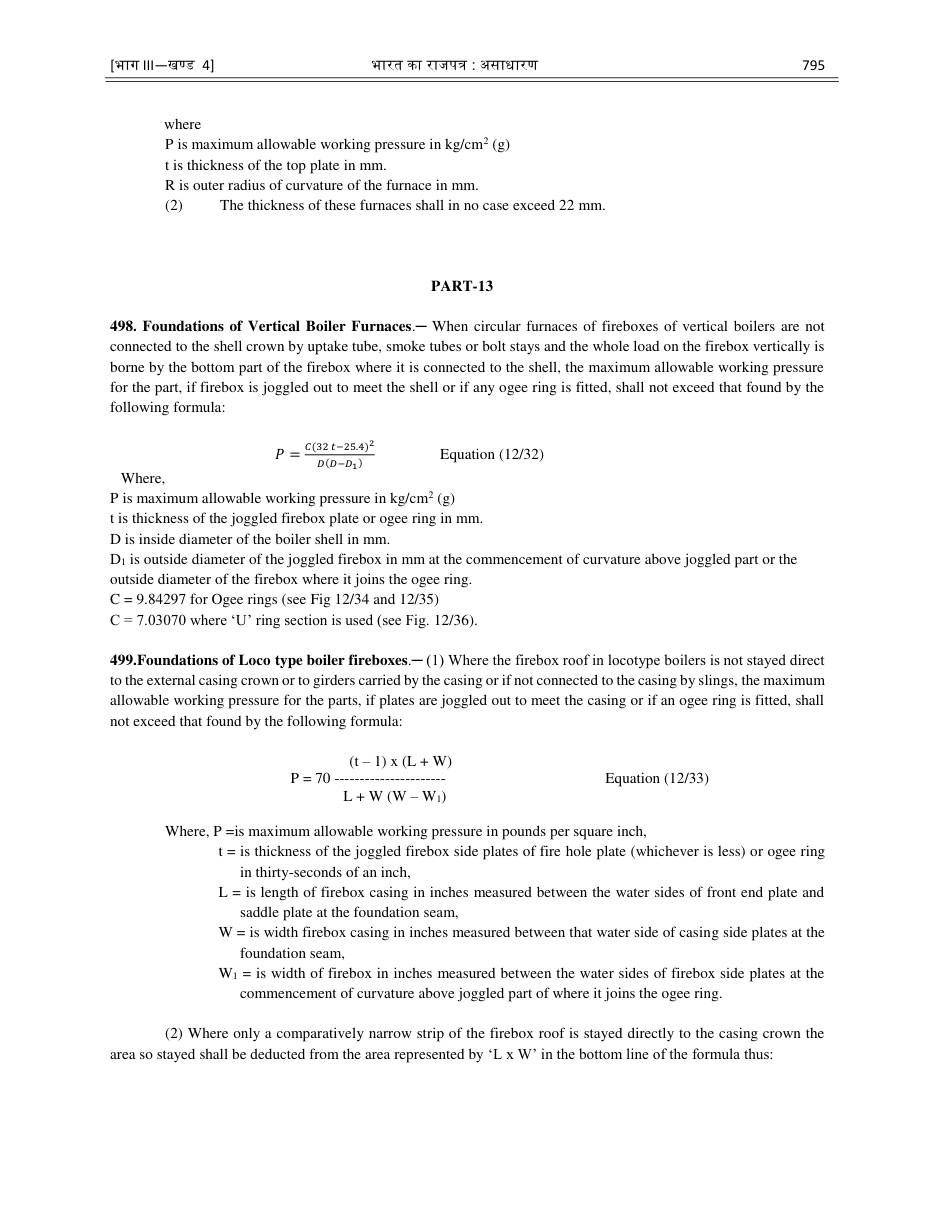
499.Foundations of Loco type boiler fireboxes.─ (1) Where the firebox roof in locotype boilers is not stayed direct to the external casing crown or to girders carried by the casing or if not connected to the casing by slings, the maximum allowable working pressure for the parts, if plates are joggled out to meet the casing or if an ogee ring is fitted, shall not exceed that found by the following formula:
           (t – 1) x (L + W)                         Equation (12/33)
P = 70 ----------------------

          L + W (W – W1)
Where, P =is maximum allowable working pressure in pounds per square inch, t = is thickness of the joggled firebox side plates of fire hole plate (whichever is less) or ogee ring in thirty-seconds of an inch,
L = is length of firebox casing in inches measured between the water sides of front end plate and saddle plate at the foundation seam,
W = is width firebox casing in inches measured between that water side of casing side plates at the foundation seam,
W1 = is width of firebox in inches measured between the water sides of firebox side plates at the commencement of curvature above joggled part of where it joins the ogee ring.
(2)Where only a comparatively narrow strip of the firebox roof is stayed directly to the casing crown the area so stayed shall be deducted from the area represented by ‘L x W’ in the bottom line of the formula thus:
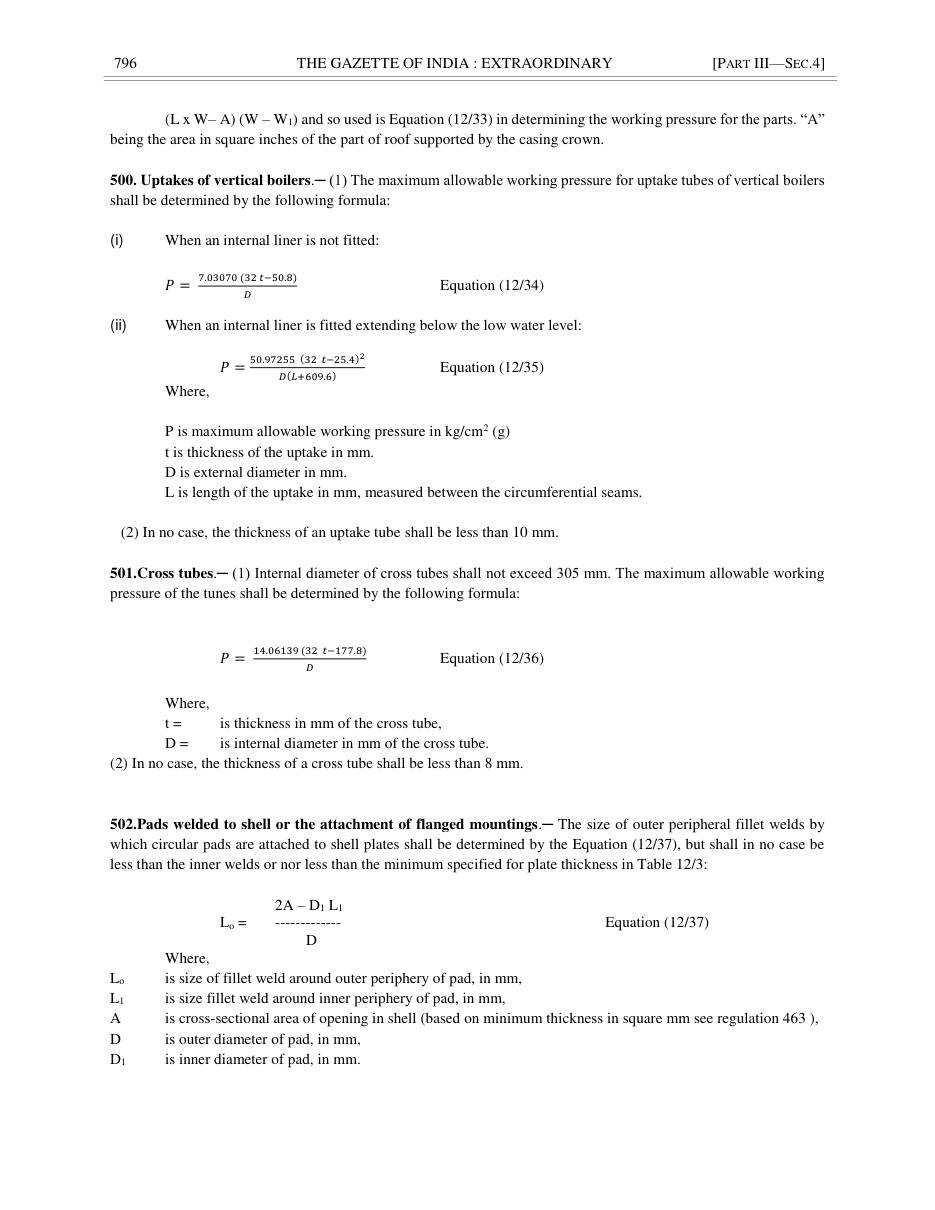
(L x W– A) (W – W1) and so used is Equation (12/33) in determining the working pressure for the parts. “A” being the area in square inches of the part of roof supported by the casing crown.
Tables and formulae are shown in their extracted layout. Alignment, superscripts and subscripts may be lost. The Gazette page image is authoritative.
In short
Regulation 499 covers the foundation joint of loco-type boiler fireboxes where the firebox roof is not stayed to the casing crown, to girders carried by the casing, or by slings. If plates are joggled out to meet the casing or an ogee ring is fitted, the working pressure for those parts is limited by Equation (12/33).
Key points
- (1) The formula uses the constant 70 and these quantities:
- P in pounds per square inch;
- t, the thickness of the joggled firebox side plates or fire hole plate (whichever is less) or ogee ring, in thirty-seconds of an inch;
- L and W, the casing length and width at the foundation seam, in inches;
- W1, the firebox width at the start of curvature above the joggle or where it joins the ogee ring, in inches.
- (2) Where only a narrow strip of the firebox roof is stayed directly to the casing crown, deduct that area A (square inches) from L x W in the bottom line of the formula.
Watch out
- Unlike the neighbouring regulations, this formula is in imperial units. Keep every input in the units stated.
Written by IBRsource editors · last edited 2026-11-20. Explanations simplify and are not a design method, testing procedure or authorisation. Requirements come from the complete regulations, the Gazette and approved documentation.
Comparison pending: the IBR 1950 text in force on 30 September 2026 is not yet established for this provision, so no change is claimed (how this works).
Orientation hints (unverified)
These candidates come from automated heading matching against DPIIT's scanned historical print edition of IBR 1950. That edition uses imperial units and riveted-construction provisions, so it is not the operative 2026 predecessor text. Regulation numbers alone never prove equivalence.
| Historical 1950-edition reg. | Heading as OCR'd | Heading similarity | Source image |
|---|---|---|---|
| 596 | Foundations of Vertical Boiler Furnaces | 70% | Chapter XII (DPIIT scan), image 14 |
IBR 1950 regulation 596 as last published in the DPIIT web edition (archived 2022)
Unofficial archived copy, not verified; see the regulation 596 page for its amendments.
| Reg. 596, Reg. 597 | ||||||||||||||||||
Reg. 597 Foundations of Loco-type Boiler Fireboxes
| ||||||||||||||||||
Images of the official Gazette pages that contain this regulation. Click to zoom. Compare word by word before relying on the extracted text.
Indian Boiler Regulations, 2026, reg. 499, Regulation 499, Gazette of India, Extraordinary, Part III—Section 4, No. 596, 1 October 2026, printed p.795–796. https://egazette.gov.in/WriteReadData/2026/276813.pdf (text consulted via IBRsource, 2026-11-23).
The citation refers to the government publication. Cite the Gazette, not this website.