BETAIndependent engineering reference. Source-text verification is ongoing.Verification ongoing.Verification status →
IBRsourceIndian Boiler Regulations, made clear

Indian Boiler Regulations, 2026 · Chapter 12 · Shell Type Boilers of Welded Construction

Regulation 467. Flat crown plates for vertical boilers

Official text — not yet verifiedGazette 1 Oct 2026 · printed p. 779

Not yet checked against the official Gazette; verify before relying on it.

Reproduced from the Gazette of India · verification status above

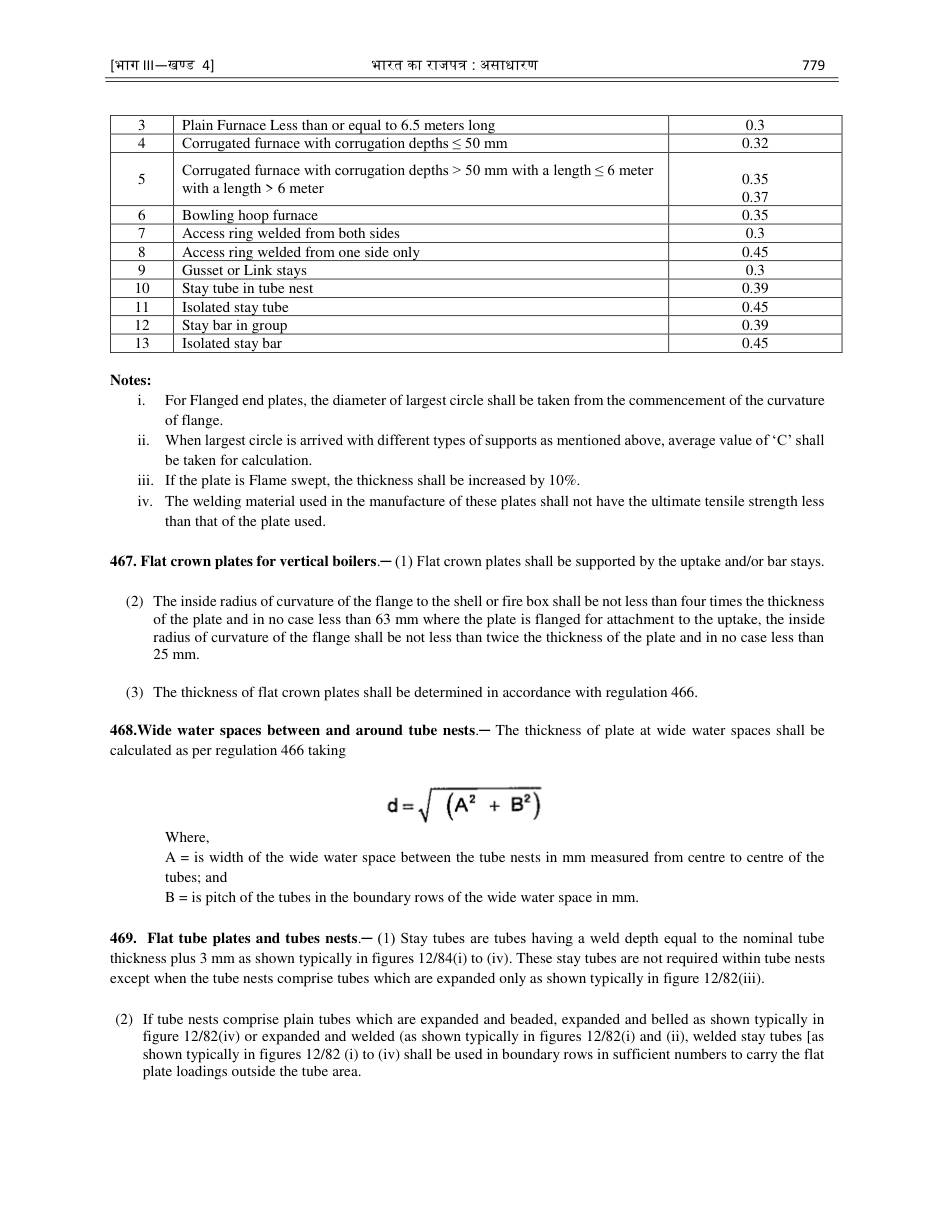
467. Flat crown plates for vertical boilers.─ (1) Flat crown plates shall be supported by the uptake and/or bar stays.

(2)The inside radius of curvature of the flange to the shell or fire box shall be not less than four times the thickness of the plate and in no case less than 63 mm where the plate is flanged for attachment to the uptake, the inside radius of curvature of the flange shall be not less than twice the thickness of the plate and in no case less than 25 mm.

(3)The thickness of flat crown plates shall be determined in accordance with regulation 466.

Referenced provisions

Reg. 466

Independent explanation — not the law · draft · engineer review in progress

In short

Sets support, flange and thickness rules for flat crown plates of vertical boilers.

Key points

  • (1) Flat crown plates must be supported by the uptake and/or bar stays.
  • (2) Inside radius of the flange to the shell or fire box: at least four times the plate thickness and never less than 63 mm.
  • (2) Where the plate is flanged to attach to the uptake: inside radius at least twice the plate thickness and never less than 25 mm.
  • (3) Thickness is found using regulation 466.

Written by IBRsource editors · last edited 2026-11-20. Explanations simplify and are not a design method, testing procedure or authorisation. Requirements come from the complete regulations, the Gazette and approved documentation.

Comparison pending: the IBR 1950 text in force on 30 September 2026 is not yet established for this provision, so no change is claimed (how this works).

Orientation hints (unverified)

These candidates come from automated heading matching against DPIIT's scanned historical print edition of IBR 1950. That edition uses imperial units and riveted-construction provisions, so it is not the operative 2026 predecessor text. Regulation numbers alone never prove equivalence.

Historical 1950-edition reg.Heading as OCR'dHeading similaritySource image
33Plates100%Chapter II (DPIIT scan), image 3
113Flat End Plates85%Chapter III (DPIIT scan), image 2
574Stayed flat surfaces (other than crowns of Vertical boilers)73%Chapter XII (DPIIT scan), image 6

Amendment history of the candidate IBR 1950 regulations: Reg. 113 (1 amendment) · Reg. 574 (1 amendment)

IBR 1950 regulation 33 as last published in the DPIIT web edition (archived 2022)

Unofficial archived copy, not verified; see the regulation 33 page for its amendments.

Reg. 33
MATERIALS OF CONSTRUCTION

COPPER PLATES, STAY AND RIVET BARS

Plates

(a) Process.- The copper shall be fire-refined or electrolytic and hot-rolled from suitable cakes.

(b) Chemical Composition.- The chemical composition of the plates shall be as follows:-

Per cent.
Copper 99.2 minimum
Arsenic .30 to .50
Antimony 0.05 maximum
Bismuth 0.05 maximum
Oxygen 0.10 maximum

(c) Freedom from defects.- The plates shall be clean, smooth and free from defects and shall have a workmanlike finish. They shall be thoroughly annealed.

(d) Rolling Margin.- No plate shall be under the specified thickness at any part, not more than 5% over the calculated weight. The scrap margin, partly sheared and left attached, shall be not less than 3 inches at the ends and 1½ inches at each side.

(e) Tensile Tests.- One tensile test shall be taken from each plate as rolled.

The tensile breaking strength, from Standard Test Piece A, shall not be less than 14 tons per sq. inch with an elongation of not less than 35%.

(f) Hot and Cold Bend tests.- One hot (temperature between 1200°F and 1400°F) and one cold bend test shall be taken from each plate as rolled.

For either hot or cold bend tests, the test piece shall withstand being doubled over without fracture until the sides are touching and parallel.

IBR 1950 regulation 113 as last published in the DPIIT web edition (archived 2022)

Unofficial archived copy, not verified; see the regulation 113 page for its amendments.

Reg. 113
END PLATES
Flat End Plates

a) The plates of boilers shall preferably be in one piece made from one rolled plate. Alternatively, the end plates may be built up from two pieces by riveting or by fusion butt-welding. In the latter case, the line of weld shall be parallel to the horizontal axis of the boiler and the entire plate after flanging shall be subjected to stress relieving and the weld shall be radiographed.
b) The peripheral flanging of end plates shall be done by machine. Such flanging shall preferably be done in one operation, but where this is impracticable sectional or creep machine flanging may be permitted, provided that the plate is worked at a suitable temperature, and the plate is heated to an adequate distance beyond the portion under immediate treatment.
bb) In the construction of unfired boilers when the dished ends do not form a part of the heating surface, cold spun dished ends conforming to IS: 2825 may be used.
c) Care must be taken to see that the flanges are circular and of good surface, free from local irregularities, and that they are parallel and square with the flat part of the plate. For the purpose of relieving internal stresses, all plates which have been flanged or locally heated shall afterwards be efficiently annealed unless during the last stage of manufacture they have been uniformly heated throughout.
d) Flat portions of end plates, on completion of all flanging and machining operations, shall be flat and free from set or distortion.

IBR 1950 regulation 574 as last published in the DPIIT web edition (archived 2022)

Unofficial archived copy, not verified; see the regulation 574 page for its amendments.

Reg. 572, Reg. 573, Reg. 574

Raised manhole frames, cover plates and joint bolts

Raised circular manhole frames not exceeding 16 inches in diameter shall not be less than ¾ inch thick in all parts.

The circular cover plates and joint flanges for such frames shall be not less than-

1 inch thick for pressures not exceeding 120 pounds per square inch.

1- 1/8 inches thick for pressures exceeding 120 pounds per square inch but not exceeding 200 pounds per square inch.

1 ¼ inches thick for pressure exceeding 200 pounds but not exceeding 250 pounds per square inch.

For pressure exceeding 250 pounds per square inch, raised circular manhole frames shall not be fitted.

The cover plates shall be secured by at least sixteen steel bolts not less than 1 inch diameter, such that the stress in the bolts due to steam pressure shall not exceed:-
5,000 pounds per square inch for 1 inch bolts.
6,000 pounds per square inch for 1- 1/8 inches bolts.
6,500 pounds per square inch for 1 ¼ inches bolts.

For the purpose of calculation the pressure shall be assumed to act on the whole area within the pitch circle of the bolts and the bolt area at the bottom of the screw thread shall be taken.


Reg. 573

Stand Pipes and branches-
a) The thickness and bolting of all flanges for joining the mountings  and fittings shall be in accordance with the dimensions as laid down in Appendix- E to these regulations. In no case, however, shall the thickness of flanges be less than 13 mm.
b)
(i) The Wall thickness of nozzles and other connections shall not be less than that specified for the applicable loading, namely, internal pressure, bending and static loads.
(ii) The pressure loading shall be determined by regulation 564, but in no case shall the thickness be less than that calculated by the following formula:-

t = 0.04D + 2.5 mm (equation XII/10)

where, t is the thickness of standpipe and D is the outside diameter of connection. If the branch is connected by screwing, the thickness ‘t’ shall be measured at the root of the thread.
c) Where a double flanged steam pipe is tapered, the thickness of flange joining the boiler and fitting shall correspond to the bore of pipe at the flange connection in accordance with Appendix-E to these regulations.


Reg. 574

Stayed Flat surfaces (other than Crowns of Vertical Boilers).

Stayed heads/ Braced and stayed surfaces.

For various braced and stayed flat plates and those which by these regulations require staying as flat surfaces with braces or stay bolts of uniform diameter symmetrically spaced, the thickness should be calculate by the following formula; namely:-

                                             __________
                        e  =  Cd      Ö P        +   e1
Ö   f1

Where,

P=design pressure in kgf/cm²
e=thickness, in mm.
d=diameter of the largest circle taken between staying points of the plate (in mm)
f1=0.85 f (f as defined in regulation 271), kfg/cm²
e1=additional thickness equal to 0.75 mm (0.03 in)
C=coefficient having the following values:-

1) C=0.33 for flanged connections;

NOTE:
d is the diameter of the largest circle taken from the commencement of the curvature of the flange.
2) C=0.40 for stays screwed in plate with nut or screwed and welded, or plain end strength welded on the outside;
3) C=0.33 for screwed bar stays with washer of not less than 3.5 times the diameter of bar stay;
4) C=0.31 for screwed bar stays with reinforcing plate, washer and nut on the outside.

NOTES:
1. If the plate is stayed in any other way, average values of C shall be taken into account.

2. If the plate is flame swept, the thickness shall be increased by 10%.

3. The welding materials used in the manufacture of these plates shall not have the ultimate tensile strength less than that of the plate used.

Images of the official Gazette pages that contain this regulation. Click to zoom. Compare word by word before relying on the extracted text.
Instrument
Indian Boiler Regulations, 2026 (made by the Central Boilers Board under s.40 of the Boilers Act, 2025)
Notification
F.No. P-30014/3/2021-Boiler dated 7 Aug 2026
Published
Gazette of India, Extraordinary, Part III Sec. 4, No. 596, 1 Oct 2026 (CG-DL-E-06102026-276813)
In force
1 Oct 2026 (reg. 1(3): date of publication in the Official Gazette)
Printed Gazette page
779
PDF page index
779 · open official e-Gazette PDF
Extraction
pdftotext layout mode, sequential regulation detector · text hash 453611bcfb8742fd
Verification
Official text — not yet verified
Amendments checked
None known after 1 Oct 2026 as of build date (not a guarantee). Amendment log
How to cite

Indian Boiler Regulations, 2026, reg. 467, Regulation 467, Gazette of India, Extraordinary, Part III—Section 4, No. 596, 1 October 2026, printed p.779. https://egazette.gov.in/WriteReadData/2026/276813.pdf (text consulted via IBRsource, 2026-11-23).

The citation refers to the government publication. Cite the Gazette, not this website.

Help improve this page

Engineers like you keep IBRsource accurate. Every checked correction or tip helps the next reader.