
Indian Boiler Regulations, 2026 · Chapter 3 · Construction and Workmanship
Regulation 137. Internal doors
Not yet checked against the official Gazette; verify before relying on it.
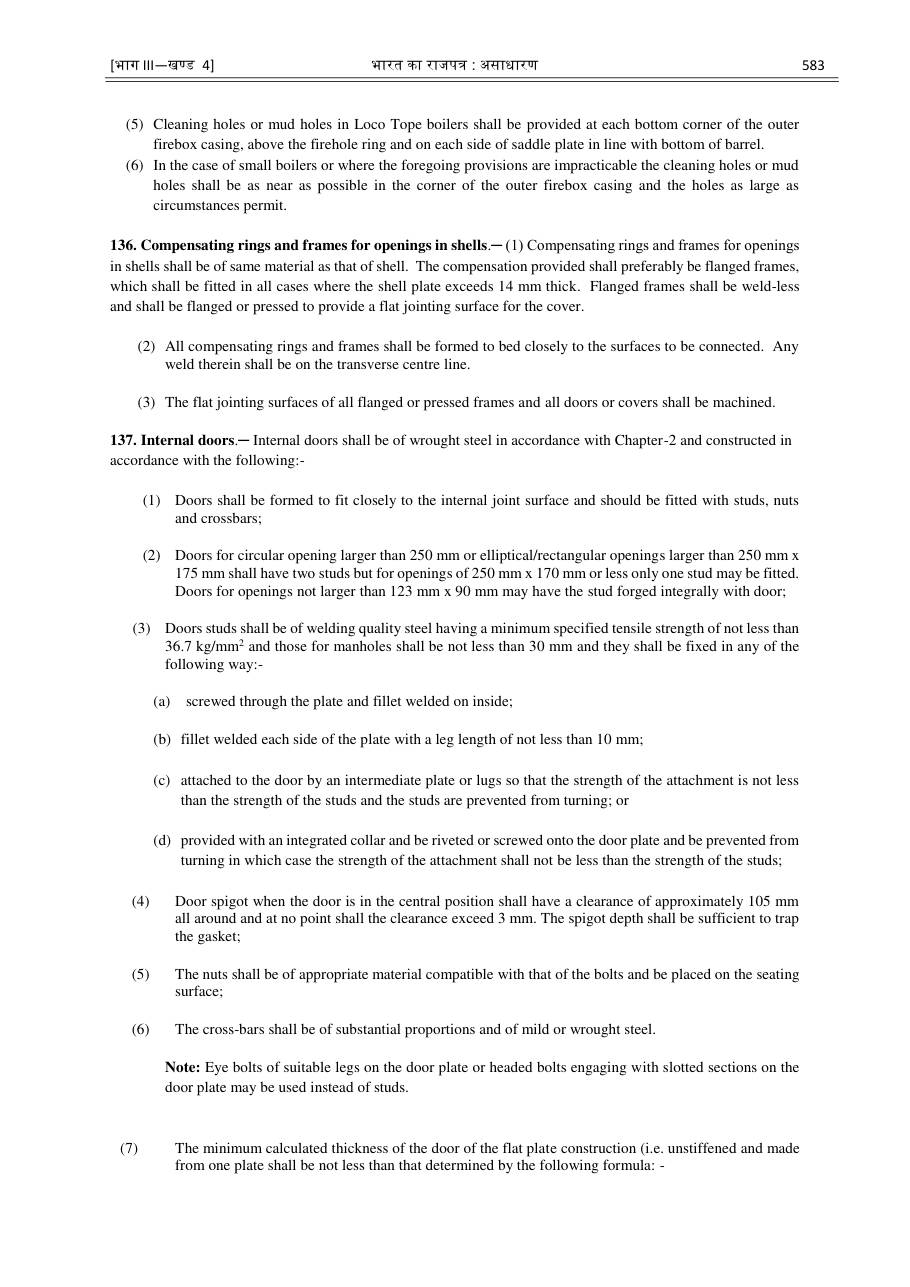
137. Internal doors.─ Internal doors shall be of wrought steel in accordance with Chapter-2 and constructed in accordance with the following:-
(1)Doors shall be formed to fit closely to the internal joint surface and should be fitted with studs, nuts and crossbars;
(2)Doors for circular opening larger than 250 mm or elliptical/rectangular openings larger than 250 mm x 175 mm shall have two studs but for openings of 250 mm x 170 mm or less only one stud may be fitted. Doors for openings not larger than 123 mm x 90 mm may have the stud forged integrally with door;
(3)Doors studs shall be of welding quality steel having a minimum specified tensile strength of not less than
36.7 kg/mm2 and those for manholes shall be not less than 30 mm and they shall be fixed in any of the following way:-
(a)screwed through the plate and fillet welded on inside;
(b)fillet welded each side of the plate with a leg length of not less than 10 mm;
(c)attached to the door by an intermediate plate or lugs so that the strength of the attachment is not less than the strength of the studs and the studs are prevented from turning; or
(d)provided with an integrated collar and be riveted or screwed onto the door plate and be prevented from turning in which case the strength of the attachment shall not be less than the strength of the studs;
(4)Door spigot when the door is in the central position shall have a clearance of approximately 105 mm all around and at no point shall the clearance exceed 3 mm. The spigot depth shall be sufficient to trap the gasket;
(5)The nuts shall be of appropriate material compatible with that of the bolts and be placed on the seating surface;
(6)The cross-bars shall be of substantial proportions and of mild or wrought steel.
Note: Eye bolts of suitable legs on the door plate or headed bolts engaging with slotted sections on the door plate may be used instead of studs.
(7)The minimum calculated thickness of the door of the flat plate construction (i.e. unstiffened and made from one plate shall be not less than that determined by the following formula: -
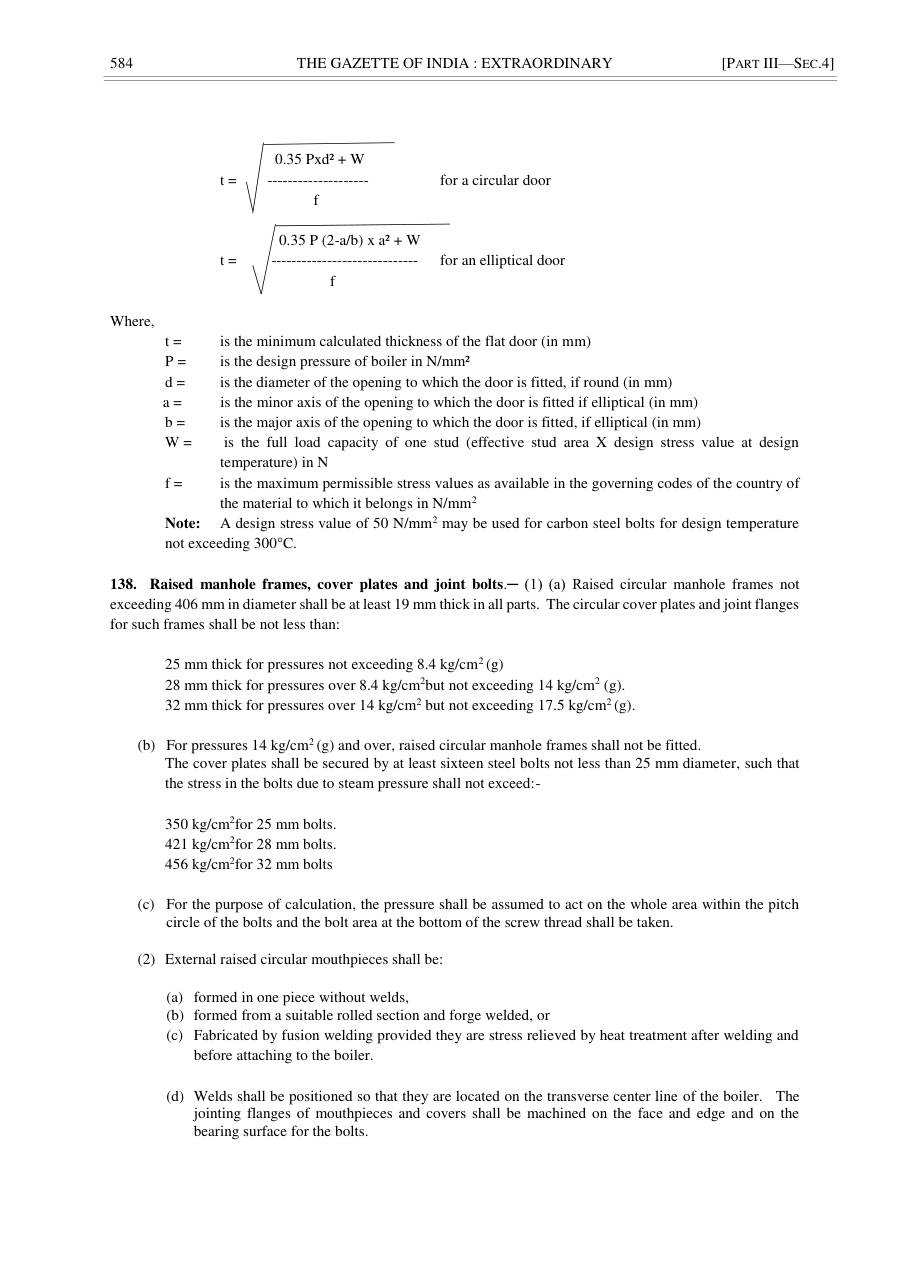
          0.35 Pxd² + W   for a circular door
t = --------------------

                  f

           0.35 P (2-a/b) x a² + W
t = ----------------------------- for an elliptical door

                     f
Where, t = is the minimum calculated thickness of the flat door (in mm)
P = is the design pressure of boiler in N/mm² d = is the diameter of the opening to which the door is fitted, if round (in mm)
a = is the minor axis of the opening to which the door is fitted if elliptical (in mm)
b = is the major axis of the opening to which the door is fitted, if elliptical (in mm)
W = is the full load capacity of one stud (effective stud area X design stress value at design temperature) in N f = is the maximum permissible stress values as available in the governing codes of the country of the material to which it belongs in N/mm2
Note: A design stress value of 50 N/mm2 may be used for carbon steel bolts for design temperature not exceeding 300°C.
Parts of this extracted text look garbled; read the Gazette page before using any value.
Tables and formulae are shown in their extracted layout. Alignment, superscripts and subscripts may be lost. The Gazette page image is authoritative.
In short
Regulation 137 covers internal doors: material, studs, nuts, cross-bars, spigot clearance and formulae for the minimum thickness of flat doors.
Key points
- (1) Doors are wrought steel as per Chapter 2, formed to fit closely to the joint surface, with studs, nuts and crossbars.
- (2) Circular openings larger than 250 mm, or elliptical/rectangular openings larger than 250 mm x 175 mm, need two studs. Openings of 250 mm x 170 mm or less may have one. Openings not larger than 123 mm x 90 mm may have the stud forged integrally with the door.
- (3) Studs are welding quality steel of at least 36.7 kg/mm² tensile strength; manhole studs at least 30 mm. Four fixing methods are allowed, including fillet welding each side of the plate with a leg length of at least 10 mm.
- (4) Spigot clearance is limited and the spigot must be deep enough to trap the gasket. The extracted clearance figures look garbled; check the Gazette page for the exact values.
- (5)–(6) Nuts must be compatible with the bolts and placed on the seating surface; cross-bars substantial, of mild or wrought steel. Eye bolts or headed bolts in slotted sections may replace studs (Note).
- (7) The minimum thickness t of an unstiffened one-plate flat door is given by formulae for circular and elliptical doors, using design pressure P, opening diameter d (or minor and major axes a and b), full load of one stud W, and permissible stress f. For carbon steel bolts up to 300°C, a design stress of 50 N/mm² may be used. See the Official text tab for the formulae.
Watch out
- The two-stud and one-stud thresholds in (2) are written as 250 mm x 175 mm and 250 mm x 170 mm. Check the Gazette page.
Written by IBRsource editors · last edited 2026-11-20. Explanations simplify and are not a design method, testing procedure or authorisation. Requirements come from the complete regulations, the Gazette and approved documentation.
Comparison pending: the IBR 1950 text in force on 30 September 2026 is not yet established for this provision, so no change is claimed (how this works).
Orientation hints (unverified)
These candidates come from automated heading matching against DPIIT's scanned historical print edition of IBR 1950. That edition uses imperial units and riveted-construction provisions, so it is not the operative 2026 predecessor text. Regulation numbers alone never prove equivalence.
| Historical 1950-edition reg. | Heading as OCR'd | Heading similarity | Source image |
|---|---|---|---|
| 567 | Dished ends subject to internal pressure | 73% | Chapter XII (DPIIT scan), image 4 |
IBR 1950 regulation 567 as last published in the DPIIT web edition (archived 2022)
Unofficial archived copy, not verified; see the regulation 567 page for its amendments.
| Reg. 567, Reg. 567A | ||||||||||||||||||||||
Reg. 567A
|
Images of the official Gazette pages that contain this regulation. Click to zoom. Compare word by word before relying on the extracted text.
Indian Boiler Regulations, 2026, reg. 137, Regulation 137, Gazette of India, Extraordinary, Part III—Section 4, No. 596, 1 October 2026, printed p.583–584. https://egazette.gov.in/WriteReadData/2026/276813.pdf (text consulted via IBRsource, 2026-11-23).
The citation refers to the government publication. Cite the Gazette, not this website.