BETAIndependent engineering reference. Source-text verification is ongoing.Verification ongoing.Verification status →
IBRsourceIndian Boiler Regulations, made clear

Indian Boiler Regulations, 2026 · Chapter 3 · Construction and Workmanship

Regulation 129. Seatings for mountings

Official text — not yet verifiedGazette 1 Oct 2026 · printed p. 581

Not yet checked against the official Gazette; verify before relying on it.

Reproduced from the Gazette of India · verification status above

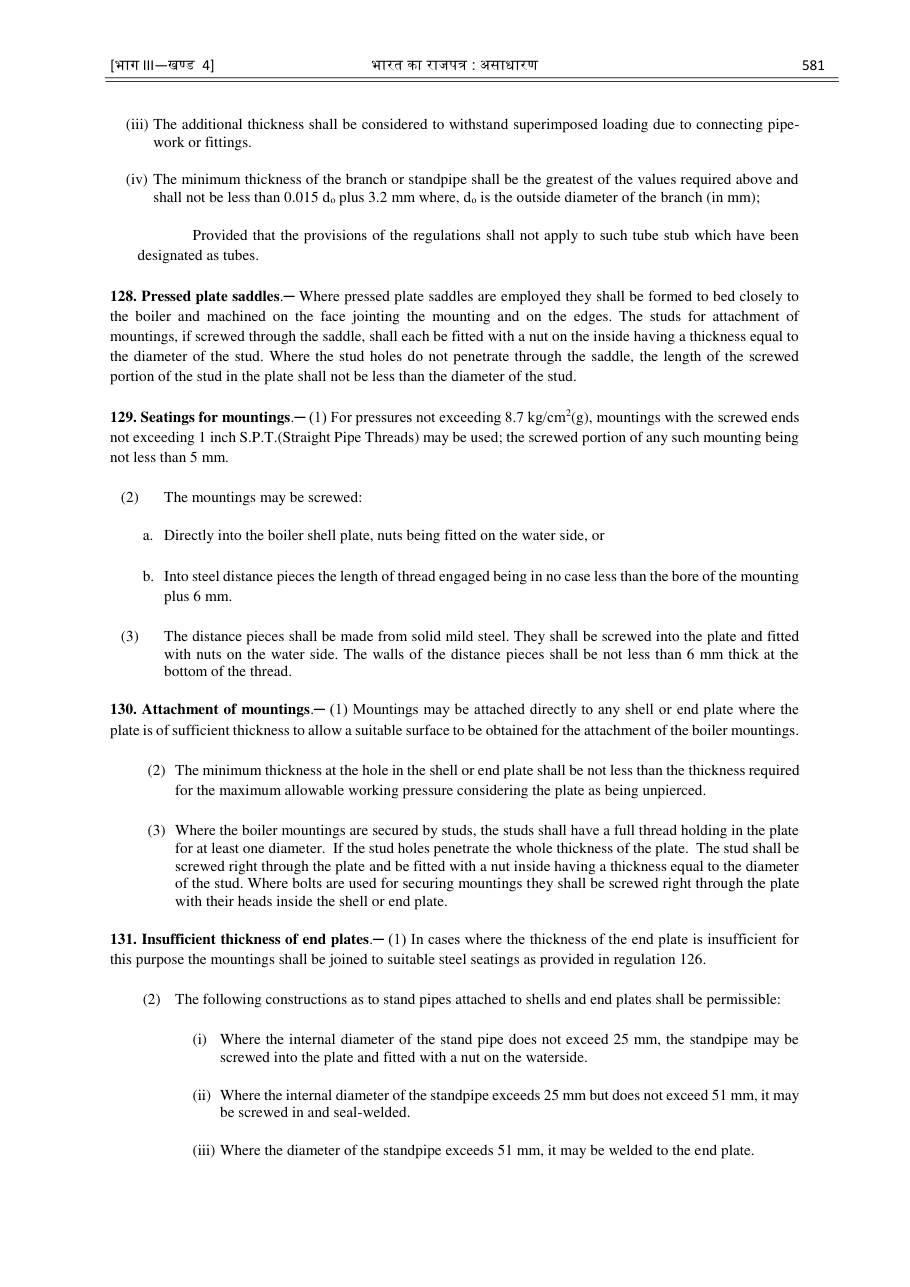
129. Seatings for mountings.─ (1) For pressures not exceeding 8.7 kg/cm2(g), mountings with the screwed ends not exceeding 1 inch S.P.T.(Straight Pipe Threads) may be used; the screwed portion of any such mounting being not less than 5 mm.

(2)The mountings may be screwed:

a. Directly into the boiler shell plate, nuts being fitted on the water side, or b. Into steel distance pieces the length of thread engaged being in no case less than the bore of the mounting plus 6 mm.

(3)The distance pieces shall be made from solid mild steel. They shall be screwed into the plate and fitted with nuts on the water side. The walls of the distance pieces shall be not less than 6 mm thick at the bottom of the thread.

Independent explanation — not the law · draft · engineer review in progress

In short

Regulation 129 allows small screwed mountings on low-pressure boilers and sets how they are screwed in.

Key points

  • (1) For pressures not exceeding 8.7 kg/cm²(g), mountings with screwed ends not exceeding 1 inch S.P.T. (Straight Pipe Threads) may be used. The screwed portion must be at least 5 mm.
  • (2) They may be screwed directly into the shell plate with nuts on the water side, or into steel distance pieces with thread engagement of at least the mounting bore plus 6 mm.
  • (3) Distance pieces must be solid mild steel, screwed into the plate with nuts on the water side, with walls at least 6 mm thick at the bottom of the thread.

Written by IBRsource editors · last edited 2026-11-20. Explanations simplify and are not a design method, testing procedure or authorisation. Requirements come from the complete regulations, the Gazette and approved documentation.

Comparison pending: the IBR 1950 text in force on 30 September 2026 is not yet established for this provision, so no change is claimed (how this works).

Orientation hints (unverified)

These candidates come from automated heading matching against DPIIT's scanned historical print edition of IBR 1950. That edition uses imperial units and riveted-construction provisions, so it is not the operative 2026 predecessor text. Regulation numbers alone never prove equivalence.

Historical 1950-edition reg.Heading as OCR'dHeading similaritySource image
409Seatings for Mounting98%Chapter X (DPIIT scan), image 2
635Stand pipes, nozzles, pads and seatings for mounting and their attachments71%Chapter XV (DPIIT scan), image 3
IBR 1950 regulation 409 as last published in the DPIIT web edition (archived 2022)

Unofficial archived copy, not verified; see the regulation 409 page for its amendments.

Reg. 409

RIVETED STEEL BOILERS

Seating for Mounting

Where the working pressure is not greater than 250 lb./sq.in. mountings have screwed ends not exceeding ¾ inch, standard Pipe Thread may be used.

The mountings may be screwed:

i) Directly into the boiler shell plates, nuts being fitted on the waterside or
(ii)  

Into steel distance pieces (see Fig.35), the length of thread engaged being is no case less than the bore of the mountings plus one quarter inch.

That distance piece shall be made solid from mild steel and shall be screwed into the boiler pieces and fitted with nuts on the water side. The walls of the distance plates shall be not less in thickness than one-quarters inch at the bottom of the thread.
Method of attachment by welding of connector to sells are shown in Figures 36 to 40.

Water gauges and pressure gauge siphons may be attached direct to the boiler shell or ends without the intervention of a pad or standpipe, provided they are flanged and secured by studs. If the studs are screwed through the plate, nuts of full thickness shall be fitted on the inside of the boiler.

Where the design pressure exceeds 250 lb./sq. in or the nominal bore of the mounting exceeds ¾ inch mountings shall be attached by short standpipes or pads.

Flanges and pads in contact with the boiler shall be formed to bed closely to the plate to which they are attached.

Standpipes:- Where short standpipes are used the flanges shall be machined on the jointing and bolting surfaces and shall bed closely to the plate. The caulking edge of the flange shall be machined or flame cut by machine. Where separate flanges are fitted they shall be attached as shown in Fig 28, 29, 30 and 33.

Standpipes fabricated by fusion welding shall be stress relieved by heat treatment before attachment to the boiler.

Where the outside diameter of a standpipe is not greater than 5 inches plus twice the thickness of the shell plate in inches, the standpipe may be secured by fusion welding in the manner shown in Figures 41-A and 41-B without subsequent stress relieving by heat treatment.

MINIMUM WELD ATTACHMENT FOR STANDPIPES 5 INCH BORE AND UNDER WITH PLATE THICKNESS Ts EQUAL TO 1.5 Tn OR GREATER FIG. 41-A AND 41-B MINIMUM WELD ATTACHMENT FOR STAND PIPES UP TO AND INCLUDING 4 INCH BORE NOT REQUIRING COMPENSATING PLATES 

NOTE: 
TWO TYPES SHOWN A & B ARE REQUIRED ONLY WHERE THE ELECTRODES AND TECHNIQUES TO BE USED HAVE BEEN SHOWN AS SEPARATELY PREPARED TEST SPECIMENS TO GIVE FULL PENETRATION WITH SOUND WELDING AT THE ROOT AND THE GROOVES. 

Where the outside diameter of the standpipe exceeds 5 inches plus twice the thickness of the shell plate in inches, the standpipe may be secured by fusion welding as shown in Figure 42 and 43. The standpipe and the entire plate to which it is attached shall be stress relieved by heat treatment.

Standpipes shall be designed to withstand the internal pressure, but additional thickness may be required for:

(1) Compensation (see Regulation 407).
(2) Stress imposed on the standpipe by expansion and contraction of externally attached pipework.
The thickness of the standpipe shall be not less than ¼ inch or that give by the following formulae, whichever is the greater:
(a) for working pressure up to and including 250 lbs./ sq. in…t = D+4
(b) for working pressure above 250 lbs. / sq. in …t =1.4 D+6
where t = thickness of standpipe in thirty-seconds of an inch.

Images of the official Gazette pages that contain this regulation. Click to zoom. Compare word by word before relying on the extracted text.
Instrument
Indian Boiler Regulations, 2026 (made by the Central Boilers Board under s.40 of the Boilers Act, 2025)
Notification
F.No. P-30014/3/2021-Boiler dated 7 Aug 2026
Published
Gazette of India, Extraordinary, Part III Sec. 4, No. 596, 1 Oct 2026 (CG-DL-E-06102026-276813)
In force
1 Oct 2026 (reg. 1(3): date of publication in the Official Gazette)
Printed Gazette page
581
PDF page index
581 · open official e-Gazette PDF
Extraction
pdftotext layout mode, sequential regulation detector · text hash 15ddb5cb0880492f
Verification
Official text — not yet verified
Amendments checked
None known after 1 Oct 2026 as of build date (not a guarantee). Amendment log
How to cite

Indian Boiler Regulations, 2026, reg. 129, Regulation 129, Gazette of India, Extraordinary, Part III—Section 4, No. 596, 1 October 2026, printed p.581. https://egazette.gov.in/WriteReadData/2026/276813.pdf (text consulted via IBRsource, 2026-11-23).

The citation refers to the government publication. Cite the Gazette, not this website.

Help improve this page

Engineers like you keep IBRsource accurate. Every checked correction or tip helps the next reader.