
Indian Boiler Regulations, 2026 · Chapter 3 · Construction and Workmanship
Regulation 124. Attachment of Steel Tubes
Not yet checked against the official Gazette; verify before relying on it.
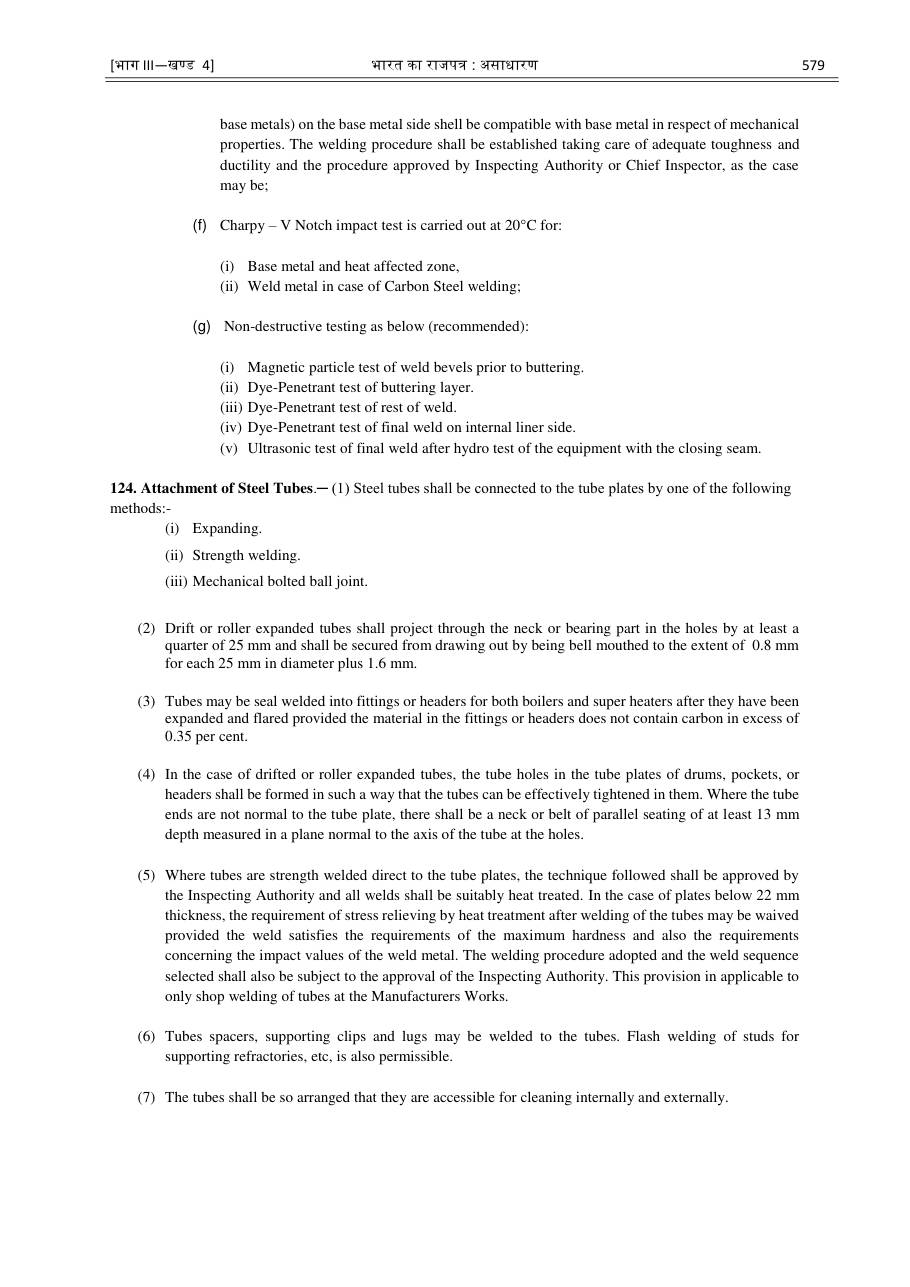
124. Attachment of Steel Tubes.─ (1) Steel tubes shall be connected to the tube plates by one of the following methods:-
(i)Expanding.
(ii)Strength welding.
(iii)Mechanical bolted ball joint.
(2)Drift or roller expanded tubes shall project through the neck or bearing part in the holes by at least a quarter of 25 mm and shall be secured from drawing out by being bell mouthed to the extent of 0.8 mm for each 25 mm in diameter plus 1.6 mm.
(3)Tubes may be seal welded into fittings or headers for both boilers and super heaters after they have been expanded and flared provided the material in the fittings or headers does not contain carbon in excess of
0.35 per cent.
(4)In the case of drifted or roller expanded tubes, the tube holes in the tube plates of drums, pockets, or headers shall be formed in such a way that the tubes can be effectively tightened in them. Where the tube ends are not normal to the tube plate, there shall be a neck or belt of parallel seating of at least 13 mm depth measured in a plane normal to the axis of the tube at the holes.
(5)Where tubes are strength welded direct to the tube plates, the technique followed shall be approved by the Inspecting Authority and all welds shall be suitably heat treated. In the case of plates below 22 mm thickness, the requirement of stress relieving by heat treatment after welding of the tubes may be waived provided the weld satisfies the requirements of the maximum hardness and also the requirements concerning the impact values of the weld metal. The welding procedure adopted and the weld sequence selected shall also be subject to the approval of the Inspecting Authority. This provision in applicable to only shop welding of tubes at the Manufacturers Works.
(6)Tubes spacers, supporting clips and lugs may be welded to the tubes. Flash welding of studs for supporting refractories, etc, is also permissible.
(7)The tubes shall be so arranged that they are accessible for cleaning internally and externally.
In short
Regulation 124 sets how steel tubes are attached to tube plates and headers: by expanding, strength welding or mechanical bolted ball joint.
Key points
- (1) Allowed methods: expanding, strength welding, or mechanical bolted ball joint.
- (2) Drift or roller expanded tubes must project through the neck or bearing part by at least a quarter of 25 mm and be bell mouthed by 0.8 mm for each 25 mm of diameter plus 1.6 mm.
- (3) Expanded and flared tubes may also be seal welded into fittings or headers, if the fitting or header material has no more than 0.35 per cent carbon.
- (4) Tube holes must allow effective tightening. Where tube ends are not normal to the tube plate, a parallel seating of at least 13 mm depth (measured normal to the tube axis) is needed.
- (5) Strength welding direct to tube plates needs a technique approved by the Inspecting Authority and suitable heat treatment of all welds. For plates below 22 mm thick, stress relieving may be waived if the weld meets maximum hardness and weld metal impact requirements. Welding procedure and sequence also need Inspecting Authority approval.
- (6) Spacers, supporting clips and lugs may be welded to tubes; flash welding of studs for supporting refractories is permitted.
- (7) Tubes must be accessible for internal and external cleaning.
Watch out
- The stress-relief waiver in (5) applies only to shop welding at the manufacturer's works.
Written by IBRsource editors · last edited 2026-11-20. Explanations simplify and are not a design method, testing procedure or authorisation. Requirements come from the complete regulations, the Gazette and approved documentation.
Comparison pending: the IBR 1950 text in force on 30 September 2026 is not yet established for this provision, so no change is claimed (how this works).
Orientation hints (unverified)
These candidates come from automated heading matching against DPIIT's scanned historical print edition of IBR 1950. That edition uses imperial units and riveted-construction provisions, so it is not the operative 2026 predecessor text. Regulation numbers alone never prove equivalence.
| Historical 1950-edition reg. | Heading as OCR'd | Heading similarity | Source image |
|---|---|---|---|
| 631 | Tubes | 100% | Chapter XV (DPIIT scan), image 3 |
| 580 | Pitch of tubes | 73% | Chapter XII (DPIIT scan), image 9 |
IBR 1950 regulation 580 as last published in the DPIIT web edition (archived 2022)
Unofficial archived copy, not verified; see the regulation 580 page for its amendments.
| Reg. 580, Reg. 581 | |||||||||||||||||
Reg. 581 Stay tubes
| |||||||||||||||||
Images of the official Gazette pages that contain this regulation. Click to zoom. Compare word by word before relying on the extracted text.
Indian Boiler Regulations, 2026, reg. 124, Regulation 124, Gazette of India, Extraordinary, Part III—Section 4, No. 596, 1 October 2026, printed p.579–580. https://egazette.gov.in/WriteReadData/2026/276813.pdf (text consulted via IBRsource, 2026-11-23).
The citation refers to the government publication. Cite the Gazette, not this website.