
Indian Boiler Regulations, 2026 · Chapter 3 · Construction and Workmanship
Regulation 106. Diagonal bar or rod stays
Not yet checked against the official Gazette; verify before relying on it.
106. Diagonal bar or rod stays.─ The sectional area of diagonal rod or bar stay shall bear the same proportion to that of a direct stay as the length of the diagonal stay bears to the length of the perpendicular line from the end of the diagonal stay to the surface supported. The ends of diagonal stays, shall not be bent, but shall be attached to the plate with bevelled washers and nuts or with riveted tee, blocks or angles and shackle pins (refer regulation 105 for eyes and pins).
In short
Regulation 106 sets the size and end attachment of diagonal bar or rod stays.
Key points
- The sectional area of a diagonal stay, compared with a direct stay, is in the same ratio as the diagonal length to the perpendicular distance from its end to the supported surface.
- Ends are attached with bevelled washers and nuts, or with riveted tee, blocks or angles and shackle pins. See regulation 105 for eyes and pins.
Watch out
- The ends of diagonal stays must not be bent.
Written by IBRsource editors · last edited 2026-11-20. Explanations simplify and are not a design method, testing procedure or authorisation. Requirements come from the complete regulations, the Gazette and approved documentation.
Comparison pending: the IBR 1950 text in force on 30 September 2026 is not yet established for this provision, so no change is claimed (how this works).
Orientation hints (unverified)
These candidates come from automated heading matching against DPIIT's scanned historical print edition of IBR 1950. That edition uses imperial units and riveted-construction provisions, so it is not the operative 2026 predecessor text. Regulation numbers alone never prove equivalence.
| Historical 1950-edition reg. | Heading as OCR'd | Heading similarity | Source image |
|---|---|---|---|
| 134 | Diagonal Bar or Rod Stays | 100% | Chapter III (DPIIT scan), image 6 |
IBR 1950 regulation 134 as last published in the DPIIT web edition (archived 2022)
Unofficial archived copy, not verified; see the regulation 134 page for its amendments.
| Reg. 133, Reg. 134 STAYS Jointed Stays Where jointed longitudinal stays are fitted, they shall, where practicable, be fitted with pins having an effective sectional area 25 per cent in excess of that of the stay. If the pins are slack in the holes, the total slackness shall not be more than 1/6 inch. The pins shall be as close as possible to the shoulder of the eye forging. The shoulder of the forging shall be at least ½ inch wide all round, i.e., the diameter at the shoulder shall be not less than the diameter of the hole plus 1 inch . Reg. 134 STAYS Diagonal Bar or Rod Stays The sectional area of diagonal rod or bar stay shall bear the same proportion to that of a direct stay as the length of the diagonal stay bears to the length of the perpendicular line from the end of the diagonal stay to the surface supported. The ends of diagonal stays, shall not be bent, but shall be attached to the plate with revelled washers and nuts or with riveted tee, blocks or angles and shackle pins (see Regulation 133 for eyes and pins). |
Images of the official Gazette pages that contain this regulation. Click to zoom. Compare word by word before relying on the extracted text.
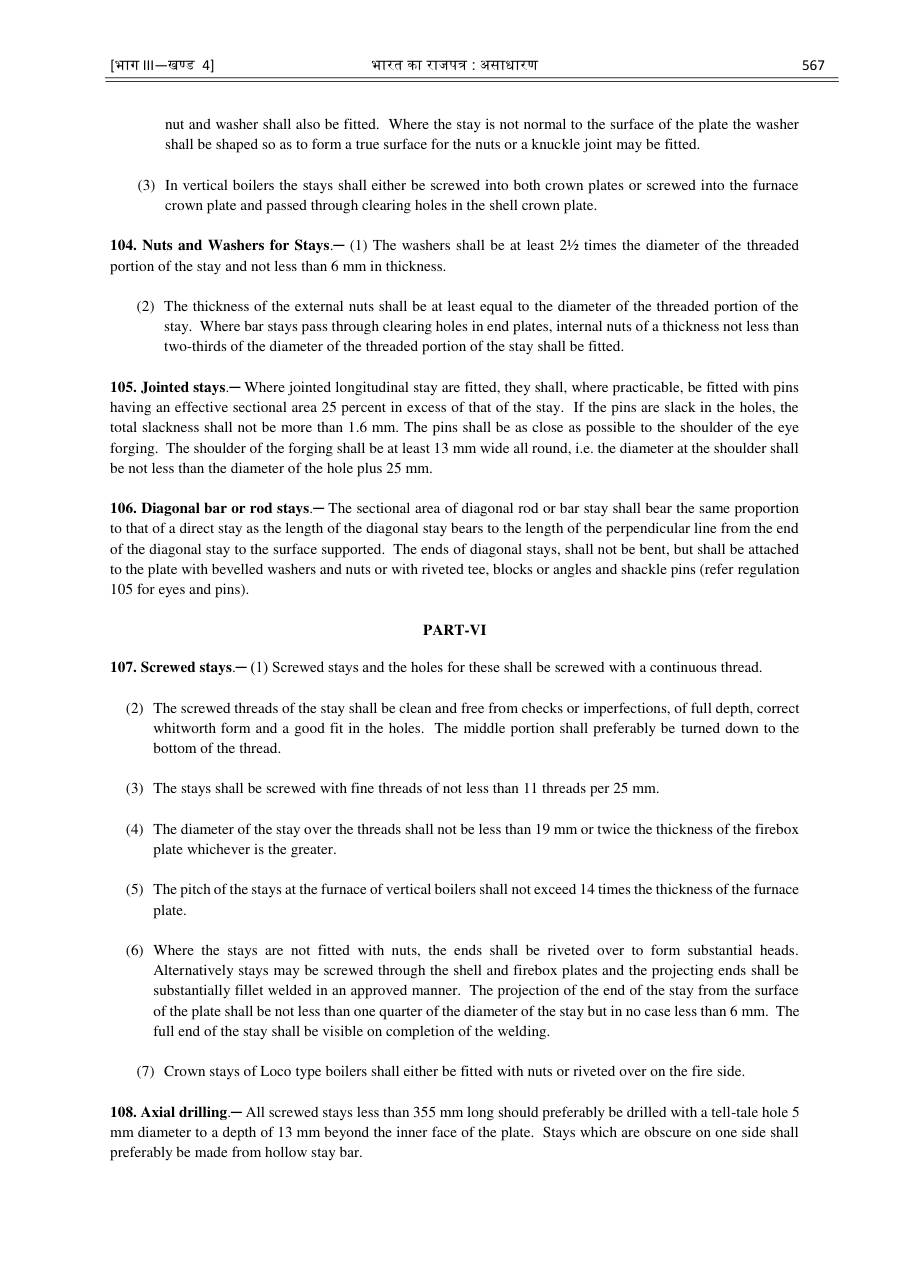
Indian Boiler Regulations, 2026, reg. 106, Regulation 106, Gazette of India, Extraordinary, Part III—Section 4, No. 596, 1 October 2026, printed p.567. https://egazette.gov.in/WriteReadData/2026/276813.pdf (text consulted via IBRsource, 2026-11-23).
The citation refers to the government publication. Cite the Gazette, not this website.