
Indian Boiler Regulations, 2026 · Chapter 3 · Construction and Workmanship
Regulation 135. Manholes, mudholes etc
Not yet checked against the official Gazette; verify before relying on it.
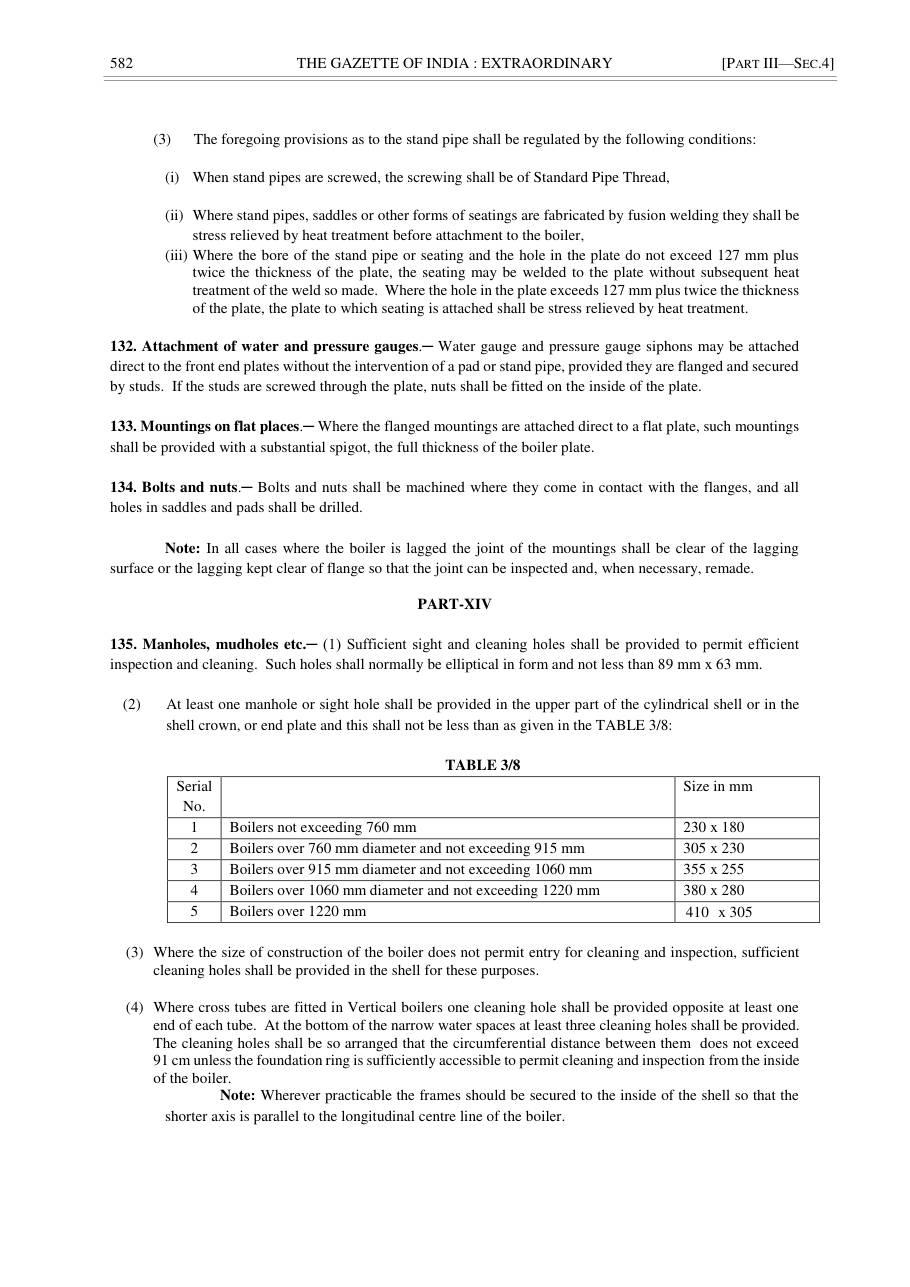
135. Manholes, mudholes etc.─ (1) Sufficient sight and cleaning holes shall be provided to permit efficient inspection and cleaning. Such holes shall normally be elliptical in form and not less than 89 mm x 63 mm.
(2)At least one manhole or sight hole shall be provided in the upper part of the cylindrical shell or in the shell crown, or end plate and this shall not be less than as given in the TABLE 3/8:
Serial TABLE 3/8 Size in mm
| Serial No. | Size in mm | |
|---|---|---|
| 1 | Boilers not exceeding 760 mm | 230 x 180 |
| 2 | Boilers over 760 mm diameter and not exceeding 915 mm | 305 x 230 |
| 3 | Boilers over 915 mm diameter and not exceeding 1060 mm | 355 x 255 |
| 4 | Boilers over 1060 mm diameter and not exceeding 1220 mm | 380 x 280 |
| 5 | Boilers over 1220 mm | 410 x 305 |
Table structure read from the Gazette PDF, page 582. Verification status as for the text above.
Show original extracted text (diagnostic, not authoritative)
No.
 1     Boilers not exceeding 760 mm                                              230 x 180
 2     Boilers over 760 mm diameter and not exceeding 915 mm                     305 x 230
 3     Boilers over 915 mm diameter and not exceeding 1060 mm                    355 x 255
 4     Boilers over 1060 mm diameter and not exceeding 1220 mm                   380 x 280
 5     Boilers over 1220 mm                                                      410 x 305
(3)Where the size of construction of the boiler does not permit entry for cleaning and inspection, sufficient cleaning holes shall be provided in the shell for these purposes.
(4)Where cross tubes are fitted in Vertical boilers one cleaning hole shall be provided opposite at least one end of each tube. At the bottom of the narrow water spaces at least three cleaning holes shall be provided. The cleaning holes shall be so arranged that the circumferential distance between them does not exceed 91 cm unless the foundation ring is sufficiently accessible to permit cleaning and inspection from the inside of the boiler.
Note: Wherever practicable the frames should be secured to the inside of the shell so that the shorter axis is parallel to the longitudinal centre line of the boiler.
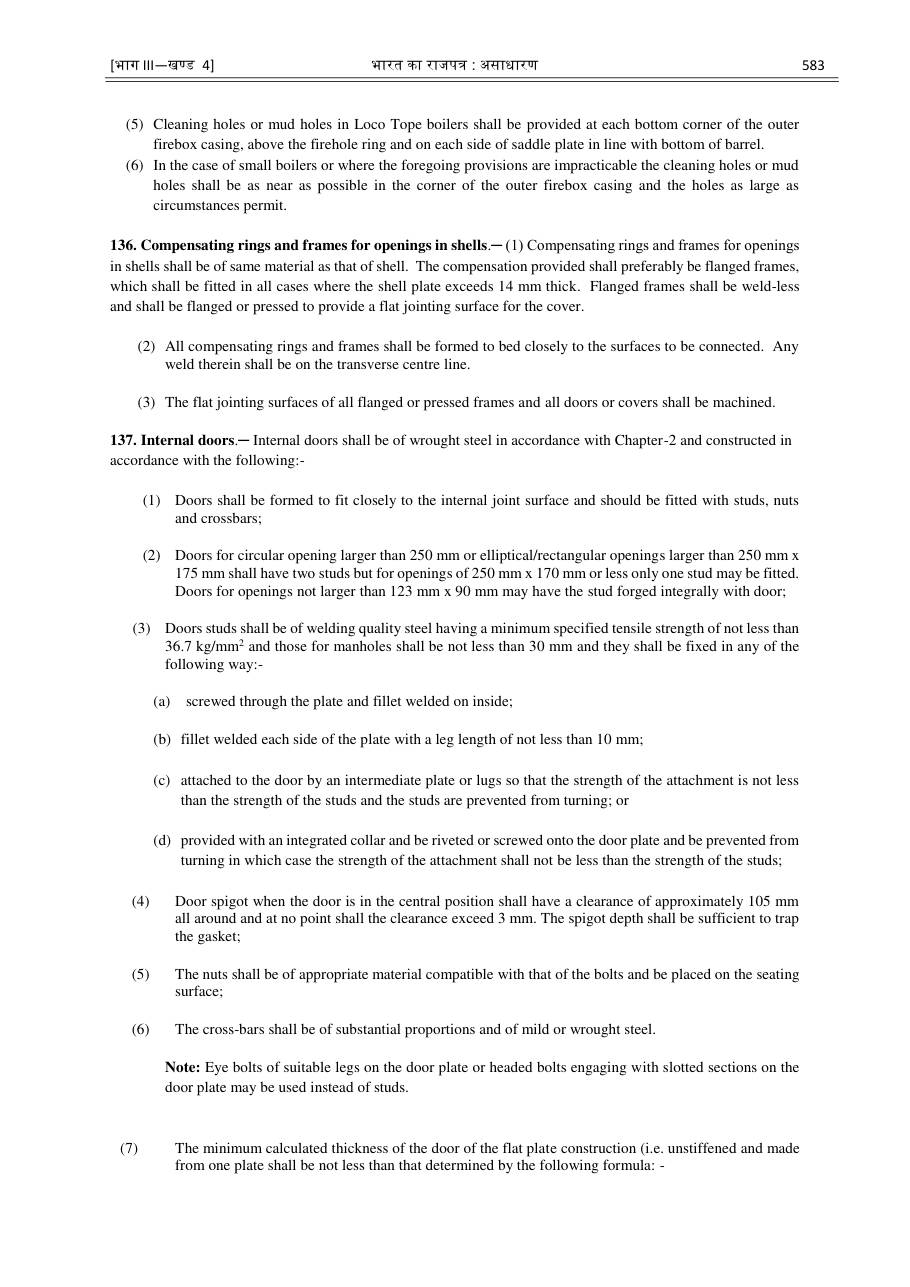
(5)Cleaning holes or mud holes in Loco Tope boilers shall be provided at each bottom corner of the outer firebox casing, above the firehole ring and on each side of saddle plate in line with bottom of barrel.
(6)In the case of small boilers or where the foregoing provisions are impracticable the cleaning holes or mud holes shall be as near as possible in the corner of the outer firebox casing and the holes as large as circumstances permit.
Tables and formulae are shown in their extracted layout. Alignment, superscripts and subscripts may be lost. The Gazette page image is authoritative.
In short
Regulation 135 requires enough sight holes, cleaning holes, manholes and mud holes for efficient inspection and cleaning, and sets minimum sizes and locations.
Key points
- (1) Sight and cleaning holes are normally elliptical and not less than 89 mm x 63 mm.
- (2) At least one manhole or sight hole is needed in the upper part of the shell, shell crown or end plate. Table 3/8 sets its minimum size by boiler diameter, from 230 x 180 mm (boilers not exceeding 760 mm) up to 410 x 305 mm (boilers over 1220 mm). See the Official text tab for the full table.
- (3) If the boiler is too small for entry, enough cleaning holes must be provided in the shell.
- (4) Vertical boilers with cross tubes need a cleaning hole opposite at least one end of each tube, and at least three cleaning holes at the bottom of narrow water spaces, no more than 91 cm apart circumferentially unless the foundation ring is accessible from inside.
- (5) Loco-type boilers need cleaning or mud holes at each bottom corner of the outer firebox casing, above the firehole ring, and each side of the saddle plate in line with the bottom of the barrel.
- (6) For small boilers, or where these provisions are impracticable, holes go as near as possible to the corners of the outer firebox casing, as large as circumstances permit.
Written by IBRsource editors · last edited 2026-11-20. Explanations simplify and are not a design method, testing procedure or authorisation. Requirements come from the complete regulations, the Gazette and approved documentation.
Comparison pending: the IBR 1950 text in force on 30 September 2026 is not yet established for this provision, so no change is claimed (how this works).
Orientation hints (unverified)
These candidates come from automated heading matching against DPIIT's scanned historical print edition of IBR 1950. That edition uses imperial units and riveted-construction provisions, so it is not the operative 2026 predecessor text. Regulation numbers alone never prove equivalence.
No candidate heading found in the historical print edition.
Images of the official Gazette pages that contain this regulation. Click to zoom. Compare word by word before relying on the extracted text.
Indian Boiler Regulations, 2026, reg. 135, Regulation 135, Gazette of India, Extraordinary, Part III—Section 4, No. 596, 1 October 2026, printed p.582–583. https://egazette.gov.in/WriteReadData/2026/276813.pdf (text consulted via IBRsource, 2026-11-23).
The citation refers to the government publication. Cite the Gazette, not this website.