
Indian Boiler Regulations, 2026 · Chapter 3 · Construction and Workmanship
Regulation 121. Load on stay tubes and stay bars
Not yet checked against the official Gazette; verify before relying on it.
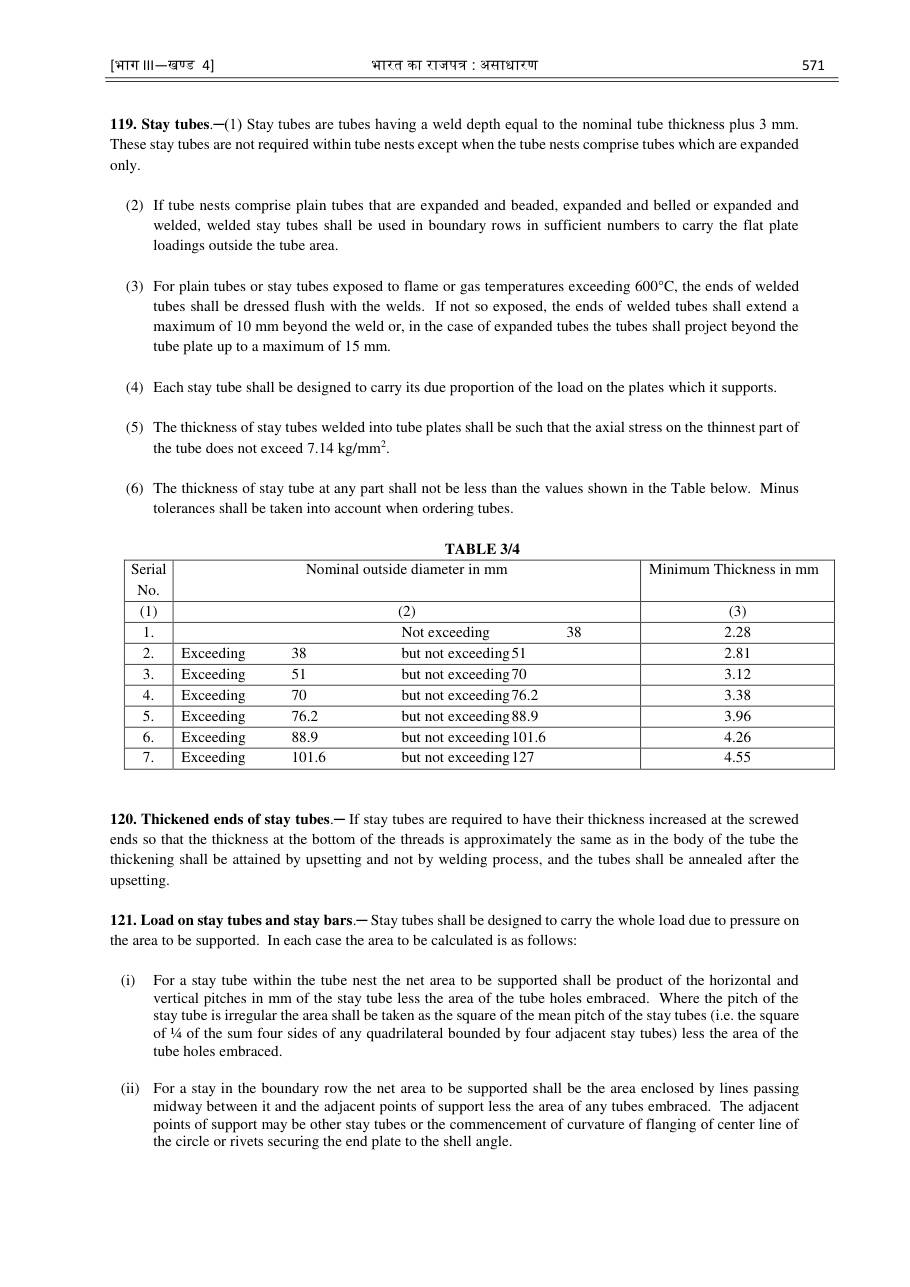
121. Load on stay tubes and stay bars.─ Stay tubes shall be designed to carry the whole load due to pressure on the area to be supported. In each case the area to be calculated is as follows:
(i)For a stay tube within the tube nest the net area to be supported shall be product of the horizontal and vertical pitches in mm of the stay tube less the area of the tube holes embraced. Where the pitch of the stay tube is irregular the area shall be taken as the square of the mean pitch of the stay tubes (i.e. the square of ¼ of the sum four sides of any quadrilateral bounded by four adjacent stay tubes) less the area of the tube holes embraced.
(ii)For a stay in the boundary row the net area to be supported shall be the area enclosed by lines passing midway between it and the adjacent points of support less the area of any tubes embraced. The adjacent points of support may be other stay tubes or the commencement of curvature of flanging of center line of the circle or rivets securing the end plate to the shell angle.
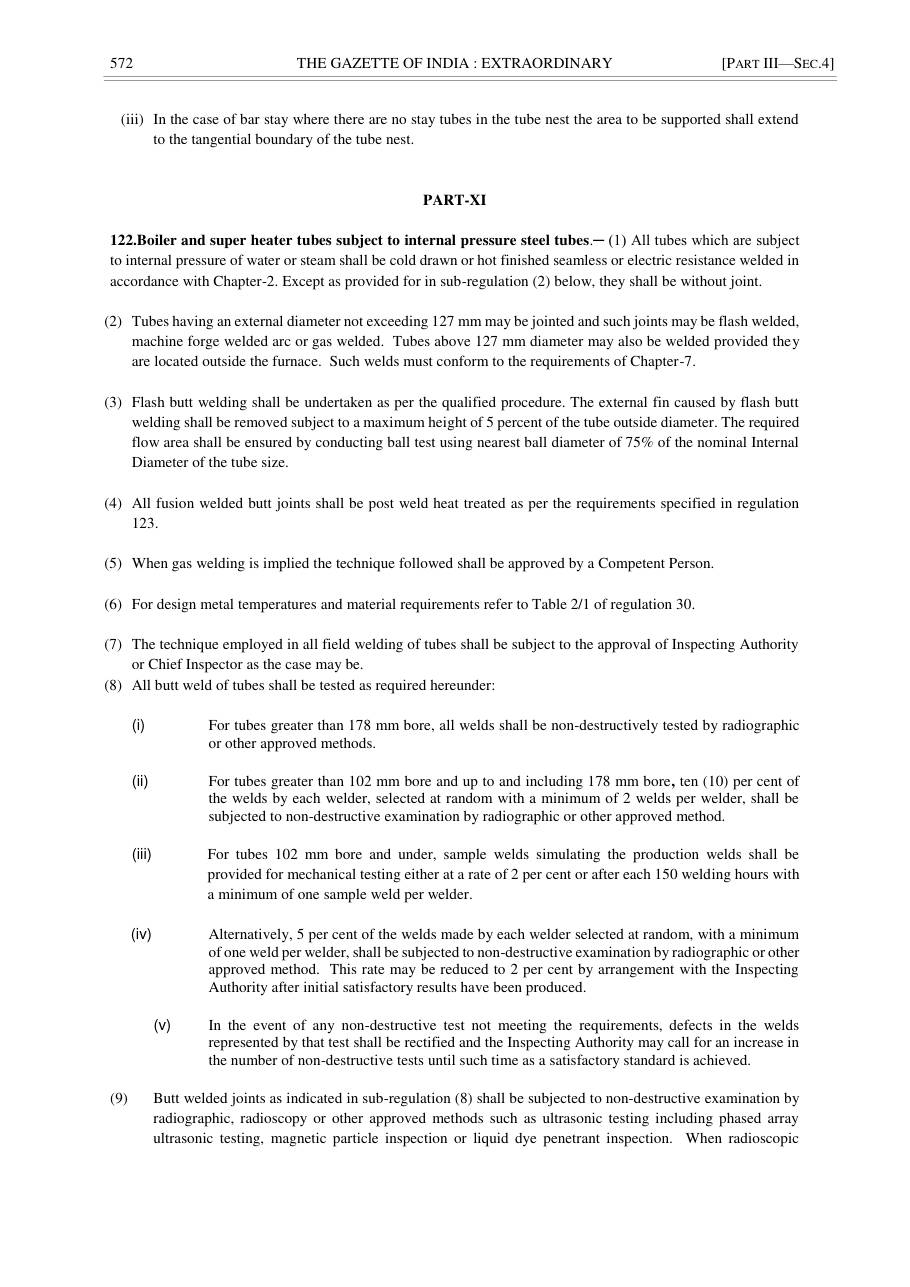
(iii)In the case of bar stay where there are no stay tubes in the tube nest the area to be supported shall extend to the tangential boundary of the tube nest.
In short
Stay tubes must be designed to carry the whole load due to pressure on the area they support. Regulation 121 explains how to work out that supported area for three cases.
Key points
- (i) Stay tube inside the tube nest: net area = horizontal pitch × vertical pitch (pitches in mm, giving mm²), less the area of the tube holes embraced. If the pitch is irregular, use the square of the mean pitch (a quarter of the sum of the four sides of the quadrilateral formed by four adjacent stay tubes), again less the tube holes embraced.
- (ii) Stay in the boundary row: net area = area enclosed by lines drawn midway between the stay and the adjacent points of support, less any tubes embraced. Adjacent points of support may be other stay tubes, the start of curvature of flanging, or the centre line of the rivets securing the end plate to the shell angle.
- (iii) Bar stays with no stay tubes in the tube nest: the supported area extends to the tangential boundary of the tube nest.
Watch out
- Always deduct the area of tube holes or tubes embraced. The gross pitch area alone is not the supported area.
Written by IBRsource editors · last edited 2026-11-20. Explanations simplify and are not a design method, testing procedure or authorisation. Requirements come from the complete regulations, the Gazette and approved documentation.
Comparison pending: the IBR 1950 text in force on 30 September 2026 is not yet established for this provision, so no change is claimed (how this works).
Orientation hints (unverified)
These candidates come from automated heading matching against DPIIT's scanned historical print edition of IBR 1950. That edition uses imperial units and riveted-construction provisions, so it is not the operative 2026 predecessor text. Regulation numbers alone never prove equivalence.
| Historical 1950-edition reg. | Heading as OCR'd | Heading similarity | Source image |
|---|---|---|---|
| 30 | Stay Bars | 100% | Chapter II (DPIIT scan), image 3 |
| 31 | Stay Bars | 100% | Chapter II (DPIIT scan), image 3 |
| 581 | Stay tubes | 100% | Chapter XII (DPIIT scan), image 9 |
Amendment history of the candidate IBR 1950 regulations: Reg. 581 (3 amendments)
IBR 1950 regulation 30 as last published in the DPIIT web edition (archived 2022)
Unofficial archived copy, not verified; see the regulation 30 page for its amendments.
| Reg. 30 MATERIALS OF CONSTRUCTION WROUGHT IRON STAY AND RIVET BARS |
| The tensile breaking strength shall be between 21 and 25 tons with an elongation of not less than 22 per cent measured on the Standard Test Piece B or 27 per cent measured on the Standard Test Piece B1. |
IBR 1950 regulation 31 as last published in the DPIIT web edition (archived 2022)
Unofficial archived copy, not verified; see the regulation 31 page for its amendments.
| Reg. 31 MATERIALS OF CONSTRUCTION WROUGHT IRON STAY AND RIVET BARS |
| To comply with Regulation 19. |
IBR 1950 regulation 581 as last published in the DPIIT web edition (archived 2022)
Unofficial archived copy, not verified; see the regulation 581 page for its amendments.
| Reg. 580, Reg. 581 | |||||||||||||||||
Reg. 581 Stay tubes
| |||||||||||||||||
Images of the official Gazette pages that contain this regulation. Click to zoom. Compare word by word before relying on the extracted text.
Indian Boiler Regulations, 2026, reg. 121, Regulation 121, Gazette of India, Extraordinary, Part III—Section 4, No. 596, 1 October 2026, printed p.571–572. https://egazette.gov.in/WriteReadData/2026/276813.pdf (text consulted via IBRsource, 2026-11-23).
The citation refers to the government publication. Cite the Gazette, not this website.