
Indian Boiler Regulations, 2026 · Chapter 3 · Construction and Workmanship
Regulation 126. Stand pipes and pads etc.
Not yet checked against the official Gazette; verify before relying on it.
126. Stand pipes and pads etc..─Stand pipes and seating for carrying mountings shall be made of wrought, cast of fabricated steel. These shall take the form of short stand pipes, pressed steel plate saddles, forged pads or pads cut from round rolled bar as may be most convenient and secured to the boiler by welding. Where short stand pipes are used they shall be of solid forged, fabricated or cast steel. They shall be carefully bedded to the shell before attachment. The jointing faces to which mountings are to be bolted shall be machined. Pads shall have sufficient thickness to allow the drilling of stud holes for mountings without the inner surface being pierced and the length of the screwed portion of the stud in the pad shall be not less than the diameter of the stud.
In short
Stand pipes and seatings carrying mountings must be wrought, cast or fabricated steel, secured to the boiler by welding.
Key points
- Forms allowed: short stand pipes, pressed steel plate saddles, forged pads, or pads cut from round rolled bar.
- Short stand pipes must be solid forged, fabricated or cast steel and carefully bedded to the shell before attachment.
- Jointing faces for bolted mountings must be machined.
- Pads must be thick enough to drill stud holes without piercing the inner surface. The screwed length of the stud in the pad must be at least the stud diameter.
Written by IBRsource editors · last edited 2026-11-20. Explanations simplify and are not a design method, testing procedure or authorisation. Requirements come from the complete regulations, the Gazette and approved documentation.
Comparison pending: the IBR 1950 text in force on 30 September 2026 is not yet established for this provision, so no change is claimed (how this works).
Orientation hints (unverified)
These candidates come from automated heading matching against DPIIT's scanned historical print edition of IBR 1950. That edition uses imperial units and riveted-construction provisions, so it is not the operative 2026 predecessor text. Regulation numbers alone never prove equivalence.
| Historical 1950-edition reg. | Heading as OCR'd | Heading similarity | Source image |
|---|---|---|---|
| 411 | Pads | 100% | Chapter X (DPIIT scan), image 4 |
| 635 | Stand pipes, nozzles, pads and seatings for mounting and their attachments | 91% | Chapter XV (DPIIT scan), image 3 |
IBR 1950 regulation 411 as last published in the DPIIT web edition (archived 2022)
Unofficial archived copy, not verified; see the regulation 411 page for its amendments.
| Reg. 410, Reg. 411, Reg. 412
Reg. 411
Reg. 412
|
Images of the official Gazette pages that contain this regulation. Click to zoom. Compare word by word before relying on the extracted text.
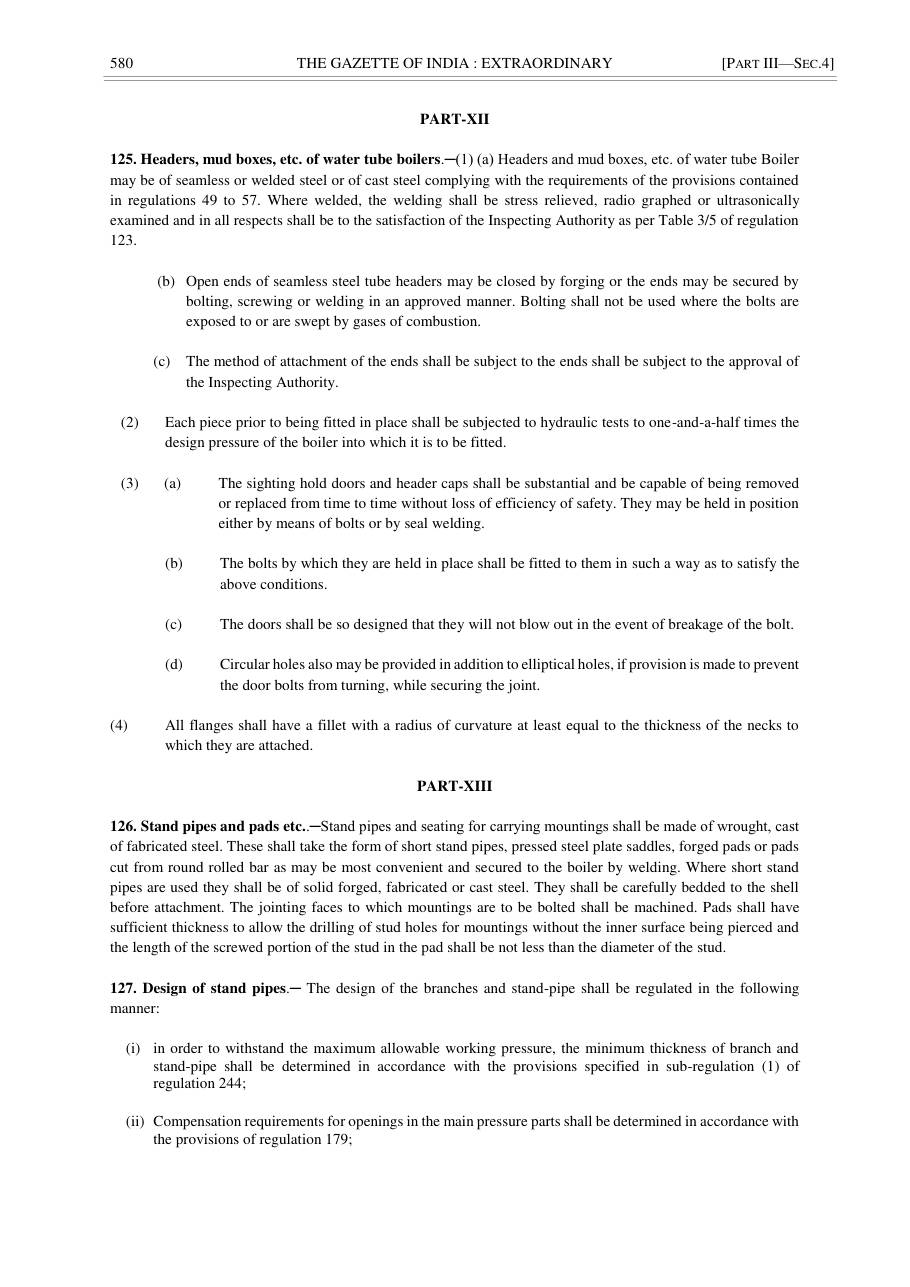
Indian Boiler Regulations, 2026, reg. 126, Regulation 126, Gazette of India, Extraordinary, Part III—Section 4, No. 596, 1 October 2026, printed p.580. https://egazette.gov.in/WriteReadData/2026/276813.pdf (text consulted via IBRsource, 2026-11-23).
The citation refers to the government publication. Cite the Gazette, not this website.