BETAIndependent engineering reference. Source-text verification is ongoing.Verification ongoing.Verification status →
IBRsourceIndian Boiler Regulations, made clear

Indian Boiler Regulations, 2026 · Chapter 8 · Inspection and Testing of Boilers and Pipes during Construction and Boiler Registration

Regulation 300. Procedure for Registration

Official text — not yet verifiedGazette 1 Oct 2026 · printed p. 701

Not yet checked against the official Gazette; verify before relying on it.

Reproduced from the Gazette of India · verification status above

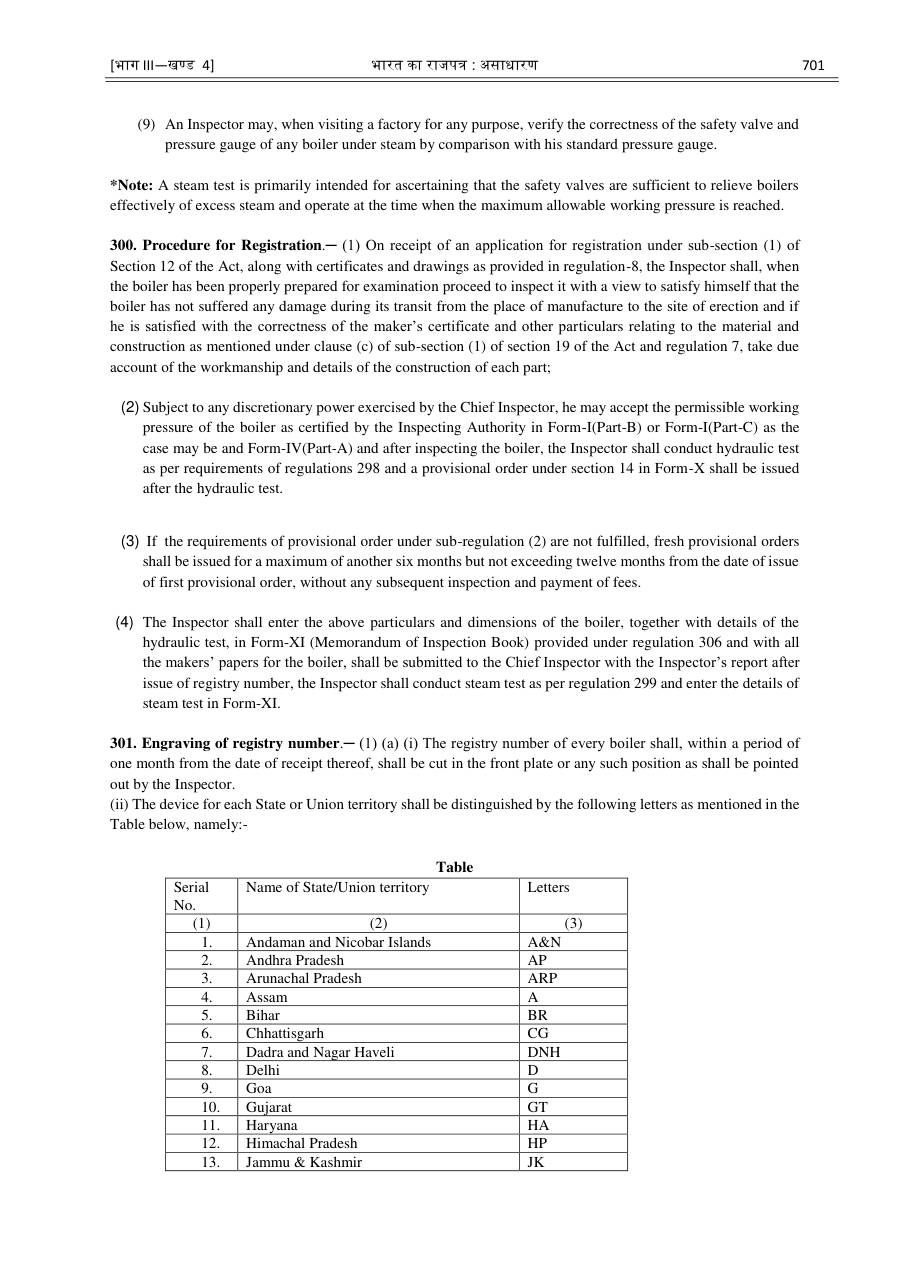
300. Procedure for Registration.─ (1) On receipt of an application for registration under sub-section (1) of Section 12 of the Act, along with certificates and drawings as provided in regulation-8, the Inspector shall, when the boiler has been properly prepared for examination proceed to inspect it with a view to satisfy himself that the boiler has not suffered any damage during its transit from the place of manufacture to the site of erection and if he is satisfied with the correctness of the maker’s certificate and other particulars relating to the material and construction as mentioned under clause (c) of sub-section (1) of section 19 of the Act and regulation 7, take due account of the workmanship and details of the construction of each part;

(2)Subject to any discretionary power exercised by the Chief Inspector, he may accept the permissible working pressure of the boiler as certified by the Inspecting Authority in Form-I(Part-B) or Form-I(Part-C) as the case may be and Form-IV(Part-A) and after inspecting the boiler, the Inspector shall conduct hydraulic test as per requirements of regulations 298 and a provisional order under section 14 in Form-X shall be issued after the hydraulic test.

(3)If the requirements of provisional order under sub-regulation (2) are not fulfilled, fresh provisional orders shall be issued for a maximum of another six months but not exceeding twelve months from the date of issue of first provisional order, without any subsequent inspection and payment of fees.

(4)The Inspector shall enter the above particulars and dimensions of the boiler, together with details of the hydraulic test, in Form-XI (Memorandum of Inspection Book) provided under regulation 306 and with all the makers’ papers for the boiler, shall be submitted to the Chief Inspector with the Inspector’s report after issue of registry number, the Inspector shall conduct steam test as per regulation 299 and enter the details of steam test in Form-XI.

Independent explanation — not the law · draft · engineer review in progress

In short

Regulation 300 sets the Inspector's procedure for registering a boiler, from site inspection through hydraulic test, provisional order and steam test.

Key points

  • (1) On an application under sub-section (1) of Section 12 of the Act, with certificates and drawings per regulation 8, the Inspector inspects the prepared boiler. He checks it was not damaged in transit, checks the maker's certificate and particulars (section 19 of the Act and regulation 7), and takes account of workmanship.
  • (2) Subject to the Chief Inspector's discretion, he may accept the working pressure certified by the Inspecting Authority in Form-I (Part-B or Part-C) and Form-IV (Part-A). He then conducts the hydraulic test per regulation 298, after which a provisional order under section 14 is issued in Form-X.
  • (3) If the provisional order's requirements are not met, fresh provisional orders may be issued for up to another six months, but not beyond twelve months from the first order, without re-inspection or fees.
  • (4) Particulars and hydraulic test details go into Form-XI (Memorandum of Inspection Book) under regulation 306, and are sent with the maker's papers and report to the Chief Inspector. After the registry number is issued, the Inspector conducts the steam test per regulation 299 and records it in Form-XI.

Written by IBRsource editors · last edited 2026-11-20. Explanations simplify and are not a design method, testing procedure or authorisation. Requirements come from the complete regulations, the Gazette and approved documentation.

Comparison pending: the IBR 1950 text in force on 30 September 2026 is not yet established for this provision, so no change is claimed (how this works).

Orientation hints (unverified)

These candidates come from automated heading matching against DPIIT's scanned historical print edition of IBR 1950. That edition uses imperial units and riveted-construction provisions, so it is not the operative 2026 predecessor text. Regulation numbers alone never prove equivalence.

Historical 1950-edition reg.Heading as OCR'dHeading similaritySource image
381Procedure for registration100%Chapter IX (DPIIT scan), image 2
525Procedure for Registration100%Chapter XI (DPIIT scan), image 7
385Registration fee86%Chapter IX (DPIIT scan), image 4

Amendment history of the candidate IBR 1950 regulations: Reg. 381 (2 amendments) · Reg. 525 (1 amendment) · Reg. 385 (5 amendments)

IBR 1950 regulation 381 as last published in the DPIIT web edition (archived 2022)

Unofficial archived copy, not verified; see the regulation 381 page for its amendments.

Reg. 381

Procedure for registration

a) On receipt of an application for registration under Section 7(1) of the Act, the Inspector shall, when the boiler has been properly prepared for examination proceed to measure in complete detail all its parts, ascertain the working pressure allowed by the Regulations by making a series of calculations of the strength of the various parts, such calculations being based on his measurement and if he is satisfied with the correctness of the maker’s certificate, on the dimensions and other particulars relating to the material and construction as stated therein [vide Section 14(1)(c) of the Act and Regulation]. In making his calculations he shall after examination of the material, take due account of the workmanship and details of the construction of each part. In his examination the Inspector may, if he deems necessary bore the plates or other parts to ascertain their thickness and in making his calculations he shall be guided by the requirements of the Regulations.
b) If no formulae or co-efficient applicable to any part is contained in the Regulations, the Chief Inspector shall in his discretion determine the fitness of such part.
c) The strength of the weakest part so calculated or determined, subject to any discretionary power exercised by the Chief Inspector, shall determine the permissible working pressure of the boiler. After inspecting the boiler and ascertaining by the prescribed calculations the maximum pressure at which the boiler may be worked, the Inspector shall hydraulically test and steam-test it in accordance with requirements of Regulations 379 and 380 and a provisional order under Section 9 of the Act in Form V may be issued after the hydraulic test.
d) The Inspector shall enter the above particulars and dimensions of the boiler and calculations of strength of the various parts, together with details of the hydraulic and of the steam tests, in a “Memorandum of Inspection” Book (vide Regulation 386) which, together with all the maker’s papers for the boiler, shall be submitted to the Chief Inspector with the Inspector’s report under sub-section (3) of Section 7 of the Act in Form I.
e) Where a certificate in Form II and a Memorandum of Inspection Book in Form I are furnished by an Inspecting Authority in accordance with sub-regulation (c) of Regulation 4, the Inspector shall, on receipt of an application for registration under sub-section (1) of Section 7 of the Act, proceed to make such examination and measurement of boiler as will satisfy him that the boiler is the one certified by the Inspecting Authority and carry out a thorough examination and check the measurements to ensure the correctness of the Inspecting Authority’s certificate and that no damage has been caused in transit.

The Inspector shall, if he is satisfied with the condition of the boiler, the correctness of the particulars and approved working pressure entered in Form I by the Inspecting authority, subject the boiler to hydraulic test in accordance with Regulation 379.

When the Inspector is satisfied that the boiler has satisfactorily withstood the test, he shall issue a provisional order to enable the boilers to the worked.
IBR 1950 regulation 525 as last published in the DPIIT web edition (archived 2022)

Unofficial archived copy, not verified; see the regulation 525 page for its amendments.

Reg. 524, Reg. 525
STANDARD CONDITIONS FOR THE DESIGN AND CONSTRUCTION OF ECONOMISER, FEED PIPES, FEED HEATERS AND OTHER SIMILAR VESSELS

REGULATIONS FOR REGISTRATION AND INSPECTION OF ECONOMISERS AND FEED PIPES

Preparation for inspection

a)

At each inspection the economiser shall be emptied and thoroughly cleaned internally and externally and in the flues. All mountings shall be opened up and all caps, doors and blank flanges removed to permit adequate inspection.
b) The owner of an economiser to which this Regulation is applicable shall obtain the approval of the Chief Inspector in writing to the method of disconnection which he proposes to use and shall be responsible for ensuring that the method so approved is followed in practice.


Reg. 525

STANDARD CONDITIONS FOR THE DESIGN AND CONSTRUCTION OF ECONOMISER, FEED PIPES, FEED HEATERS AND OTHER SIMILAR VESSELS

REGULATIONS FOR REGISTRATION AND INSPECTION OF ECONOMISERS AND FEED PIPES

Procedure for Registration
a) On receipt of an application for registration the Inspector shall, after the economiser has been prepared for examination, take full particulars of the design and ascertain the working pressure allowed by the Regulations.
b)

The fitness of the economiser parts shall be determined as per the following formulae:-

(i)

Cast Iron Smooth Tube Economisers with Pressed Socket Joints.

WP = AZ + 225N Eqn.(124)
70a n

Where,

WP=Design pressure in pounds per square inch (gauge).
A= Area of contact surface of a single socket, square inches.
a= Cross sectional area measured on the mean diameter of a socket hole, in square inches.
Z=Breakdown load of an unreinforced socket joint in pounds.
N=Number of stays per header.
n=Number of sockets per header.

For existing standard designs the breakdown load of an unreinforced socket joint shall be taken as not greater than 13,500 lbs. For designs not already in use before the date of this standard the corresponding figure shall be taken as not greater than 75 per cent of the load as determined by experiment.
(ii) Headers of approximately rectangular cross section.

WP = C(t-2) Eqn.(125)
b²
Where,

t = Thickness in thirty-second of an inch.
b = Distance between the sides of header supporting the surface, in inches.
WP= Design pressure, in pounds per square inch (gauge)
C = 11 where the water side surface is flat

= 22 where the water side surface is curved, provided that the curvature is continued without interruption and the thickness at each end of the side is not less than that determined with C=11.

In no case, however, shall the thickness of the side of a header be less than 16 thirty-seconds of an inch at any part.
Next >>>
IBR 1950 regulation 385 as last published in the DPIIT web edition (archived 2022)

Unofficial archived copy, not verified; see the regulation 385 page for its amendments.

Reg. 384

Boiler rating

The boiler rating shall be the number of square metres (to the nearest whole number) in the heating surface of the boiler as determined under Regulation 383.


Reg. 385

Registration fee

The required fee to accompany an application under sub-section (1) of section 7 of the Act shall be:-

For boiler rating not exceeding 10                                                                              Rs.600/-

For boiler rating exceeding 10 but not exceeding 30                                              Rs.800/-

For boiler rating exceeding 30 but not exceeding 50                                              Rs.900/-

For boiler rating  exceeding 50 but not exceeding 70                                           Rs.1100/-

For boiler rating  exceeding 70 but not exceeding 90                                           Rs.1300/-

For boiler rating  exceeding 90 but not exceeding 110                                        Rs.1500/-

For boiler rating  exceeding 110 but not exceeding 200                                      Rs.1700/-

For boiler rating  exceeding 200 but not exceeding 400                                      Rs.1900/-

For boiler rating  exceeding 400 but not exceeding 600                                      Rs.2200/-

For boiler rating  exceeding 600 but not exceeding 800                                      Rs.2400/-

For boiler rating  exceeding 800 but not exceeding 1000                                    Rs.2700/-

For boiler rating  exceeding 1000 but not exceeding 1200                                 Rs.3200/-

For boiler rating  exceeding 1200 but not exceeding 1400                                 Rs.3600/-

For boiler rating  exceeding 1400 but not exceeding 1600                                 Rs.4200/-

For boiler rating  exceeding 1600 but not exceeding 1800                                 Rs.4500/-

For boiler rating  exceeding 1800 but not exceeding 2000                                 Rs.5000/-

For boiler rating  exceeding 2000 but not exceeding 2200                                 Rs.5400/-

For boiler rating  exceeding 2200 but not exceeding 2400                                 Rs.6000/-

For boiler rating  exceeding 2400 but not exceeding 2600                                 Rs.6300/-

For boiler rating  exceeding 2600 but not exceeding 2800                                 Rs.6800/-

For boiler rating  exceeding 2800 but not exceeding 3000                                 Rs.7200/-

                Above 3000 for every 200 or part thereof an additional fee of Rs.200/- shall be charged:

                Provided that the Chief Inspector may direct that no fee shall be payable in respect of a fresh application made in pursuance of sub-section (2) of section 14 of the Act.


Images of the official Gazette pages that contain this regulation. Click to zoom. Compare word by word before relying on the extracted text.
Instrument
Indian Boiler Regulations, 2026 (made by the Central Boilers Board under s.40 of the Boilers Act, 2025)
Notification
F.No. P-30014/3/2021-Boiler dated 7 Aug 2026
Published
Gazette of India, Extraordinary, Part III Sec. 4, No. 596, 1 Oct 2026 (CG-DL-E-06102026-276813)
In force
1 Oct 2026 (reg. 1(3): date of publication in the Official Gazette)
Printed Gazette page
701
PDF page index
701 · open official e-Gazette PDF
Extraction
pdftotext layout mode, sequential regulation detector · text hash 6342d285caaffd32
Verification
Official text — not yet verified
Amendments checked
None known after 1 Oct 2026 as of build date (not a guarantee). Amendment log
How to cite

Indian Boiler Regulations, 2026, reg. 300, Regulation 300, Gazette of India, Extraordinary, Part III—Section 4, No. 596, 1 October 2026, printed p.701. https://egazette.gov.in/WriteReadData/2026/276813.pdf (text consulted via IBRsource, 2026-11-23).

The citation refers to the government publication. Cite the Gazette, not this website.

Help improve this page

Engineers like you keep IBRsource accurate. Every checked correction or tip helps the next reader.