
Indian Boiler Regulations, 2026 · Chapter 8 · Inspection and Testing of Boilers and Pipes during Construction and Boiler Registration
Regulation 299. Steam tests
Not yet checked against the official Gazette; verify before relying on it.
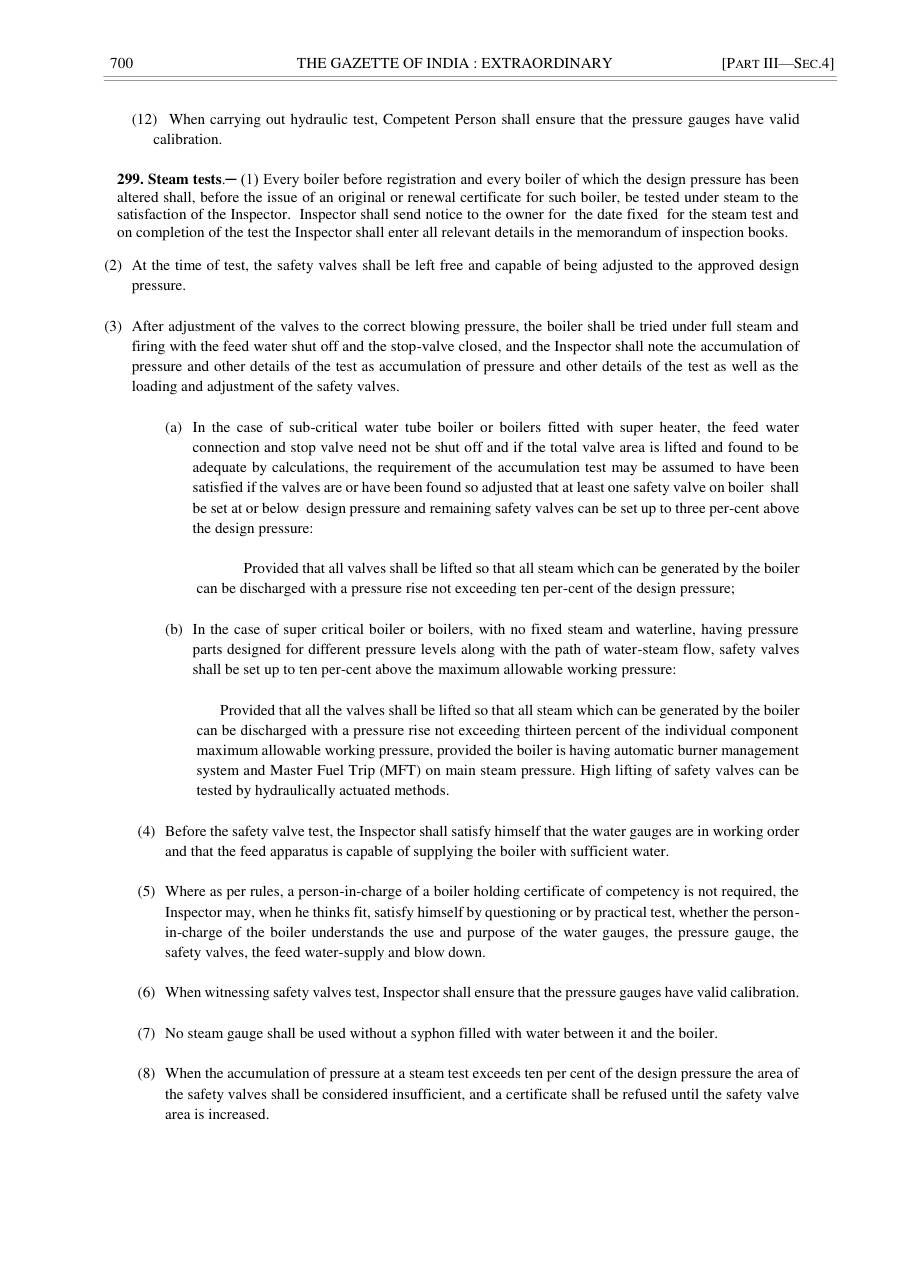
299. Steam tests.─ (1) Every boiler before registration and every boiler of which the design pressure has been altered shall, before the issue of an original or renewal certificate for such boiler, be tested under steam to the satisfaction of the Inspector. Inspector shall send notice to the owner for the date fixed for the steam test and on completion of the test the Inspector shall enter all relevant details in the memorandum of inspection books.
(2)At the time of test, the safety valves shall be left free and capable of being adjusted to the approved design pressure.
(3)After adjustment of the valves to the correct blowing pressure, the boiler shall be tried under full steam and firing with the feed water shut off and the stop-valve closed, and the Inspector shall note the accumulation of pressure and other details of the test as accumulation of pressure and other details of the test as well as the loading and adjustment of the safety valves.
(a)In the case of sub-critical water tube boiler or boilers fitted with super heater, the feed water connection and stop valve need not be shut off and if the total valve area is lifted and found to be adequate by calculations, the requirement of the accumulation test may be assumed to have been satisfied if the valves are or have been found so adjusted that at least one safety valve on boiler shall be set at or below design pressure and remaining safety valves can be set up to three per-cent above the design pressure:
Provided that all valves shall be lifted so that all steam which can be generated by the boiler can be discharged with a pressure rise not exceeding ten per-cent of the design pressure;
(b)In the case of super critical boiler or boilers, with no fixed steam and waterline, having pressure parts designed for different pressure levels along with the path of water-steam flow, safety valves shall be set up to ten per-cent above the maximum allowable working pressure:
Provided that all the valves shall be lifted so that all steam which can be generated by the boiler can be discharged with a pressure rise not exceeding thirteen percent of the individual component maximum allowable working pressure, provided the boiler is having automatic burner management system and Master Fuel Trip (MFT) on main steam pressure. High lifting of safety valves can be tested by hydraulically actuated methods.
(4)Before the safety valve test, the Inspector shall satisfy himself that the water gauges are in working order and that the feed apparatus is capable of supplying the boiler with sufficient water.
(5)Where as per rules, a person-in-charge of a boiler holding certificate of competency is not required, the Inspector may, when he thinks fit, satisfy himself by questioning or by practical test, whether the person-in-charge of the boiler understands the use and purpose of the water gauges, the pressure gauge, the safety valves, the feed water-supply and blow down.
(6)When witnessing safety valves test, Inspector shall ensure that the pressure gauges have valid calibration.
(7)No steam gauge shall be used without a syphon filled with water between it and the boiler.
(8)When the accumulation of pressure at a steam test exceeds ten per cent of the design pressure the area of the safety valves shall be considered insufficient, and a certificate shall be refused until the safety valve area is increased.
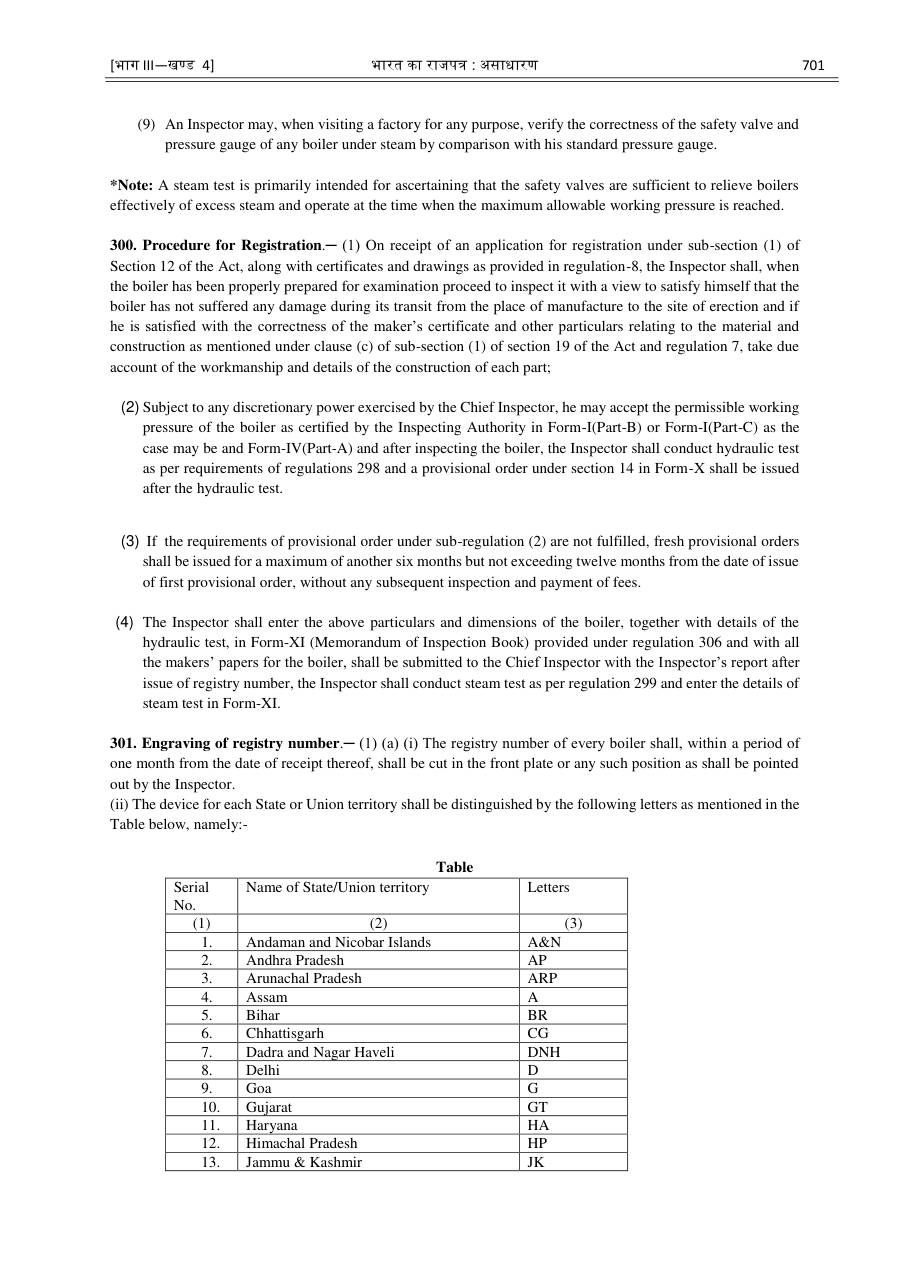
(9)An Inspector may, when visiting a factory for any purpose, verify the correctness of the safety valve and pressure gauge of any boiler under steam by comparison with his standard pressure gauge.
*Note: A steam test is primarily intended for ascertaining that the safety valves are sufficient to relieve boilers effectively of excess steam and operate at the time when the maximum allowable working pressure is reached.
In short
Every boiler must pass a steam test before registration, and again when its design pressure is altered, before an original or renewal certificate is issued. The test is mainly to confirm that the safety valves can relieve excess steam and operate at the maximum allowable working pressure.
Key points
- (1) The Inspector gives the owner notice of the test date and records the details in the memorandum of inspection book.
- (2)–(3) Safety valves are left free for adjustment to design pressure. After setting, the boiler is fired at full steam with feed water shut off and stop valve closed (a supervised test condition, not an operating practice), and the Inspector notes the accumulation of pressure and valve loading.
- (3)(a) Sub-critical water tube boilers or boilers with superheaters: feed and stop valve need not be shut if lifted valve area is adequate by calculation. At least one valve is set at or below design pressure, the rest up to three per-cent above. All valves must discharge full steam with a pressure rise not exceeding ten per-cent of design pressure.
- (3)(b) Super critical boilers, or boilers with no fixed steam and water line and pressure parts designed for different pressure levels: valves may be set up to ten per-cent above maximum allowable working pressure, with a rise not exceeding thirteen percent, if the boiler has automatic burner management and Master Fuel Trip on main steam pressure. High lift may be tested hydraulically.
- (4), (6)–(7) Before the test, water gauges and feed apparatus must work, pressure gauges must have valid calibration, and every steam gauge needs a water-filled syphon.
- (5) Where no certified person-in-charge is required, the Inspector may test their understanding of gauges, safety valves, feed and blow down.
- (9) An Inspector visiting a factory may check any boiler's safety valve and pressure gauge against his standard gauge.
Watch out
- (8) If accumulation exceeds ten per cent of design pressure (the limit for ordinary boilers; see the different rule for supercritical boilers below), the safety valve area is insufficient and the certificate must be refused until the area is increased.
Written by IBRsource editors · last edited 2026-11-20. Explanations simplify and are not a design method, testing procedure or authorisation. Requirements come from the complete regulations, the Gazette and approved documentation.
Comparison pending: the IBR 1950 text in force on 30 September 2026 is not yet established for this provision, so no change is claimed (how this works).
Orientation hints (unverified)
These candidates come from automated heading matching against DPIIT's scanned historical print edition of IBR 1950. That edition uses imperial units and riveted-construction provisions, so it is not the operative 2026 predecessor text. Regulation numbers alone never prove equivalence.
No candidate heading found in the historical print edition.
Images of the official Gazette pages that contain this regulation. Click to zoom. Compare word by word before relying on the extracted text.
Indian Boiler Regulations, 2026, reg. 299, Regulation 299, Gazette of India, Extraordinary, Part III—Section 4, No. 596, 1 October 2026, printed p.700–701. https://egazette.gov.in/WriteReadData/2026/276813.pdf (text consulted via IBRsource, 2026-11-23).
The citation refers to the government publication. Cite the Gazette, not this website.