
Indian Boiler Regulations, 2026 · Chapter 8 · Inspection and Testing of Boilers and Pipes during Construction and Boiler Registration
Regulation 298. Procedure of hydraulic tests
Not yet checked against the official Gazette; verify before relying on it.
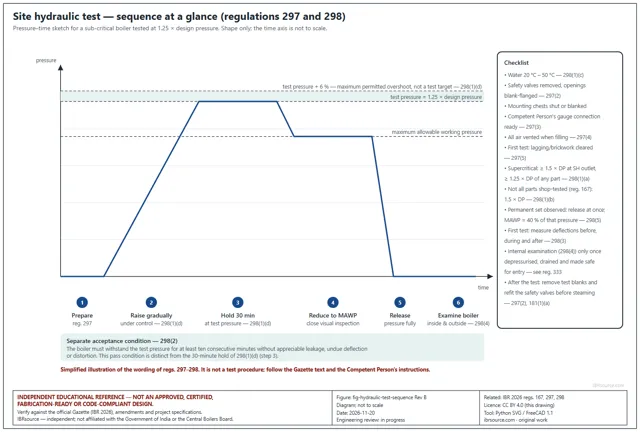
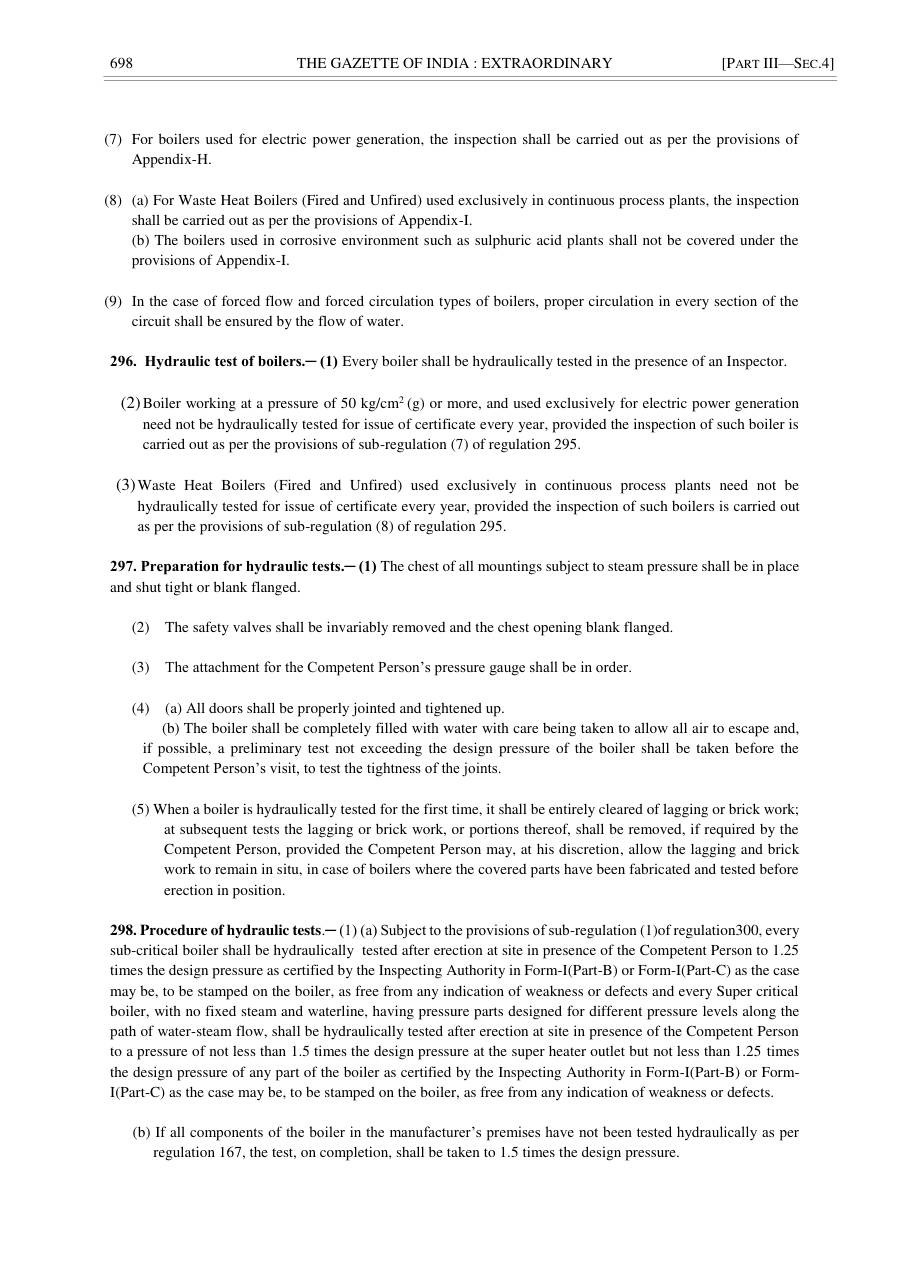
298. Procedure of hydraulic tests.─ (1) (a) Subject to the provisions of sub-regulation (1)of regulation300, every sub-critical boiler shall be hydraulically tested after erection at site in presence of the Competent Person to 1.25 times the design pressure as certified by the Inspecting Authority in Form-I(Part-B) or Form-I(Part-C) as the case may be, to be stamped on the boiler, as free from any indication of weakness or defects and every Super critical boiler, with no fixed steam and waterline, having pressure parts designed for different pressure levels along the path of water-steam flow, shall be hydraulically tested after erection at site in presence of the Competent Person to a pressure of not less than 1.5 times the design pressure at the super heater outlet but not less than 1.25 times the design pressure of any part of the boiler as certified by the Inspecting Authority in Form-I(Part-B) or Form-I(Part-C) as the case may be, to be stamped on the boiler, as free from any indication of weakness or defects.
(b)If all components of the boiler in the manufacturer’s premises have not been tested hydraulically as per regulation 167, the test, on completion, shall be taken to 1.5 times the design pressure.
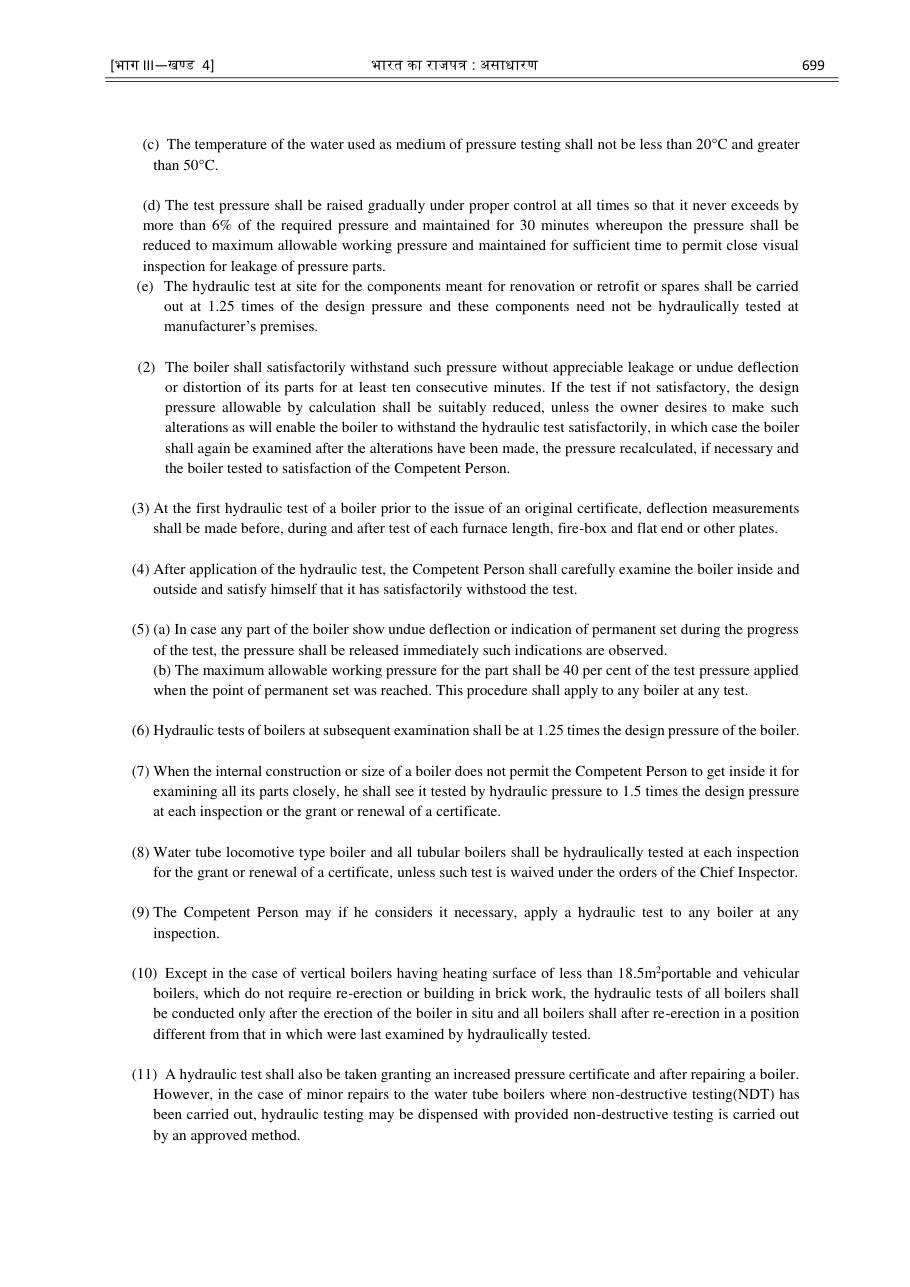
(c)The temperature of the water used as medium of pressure testing shall not be less than 20°C and greater than 50°C.
(d)The test pressure shall be raised gradually under proper control at all times so that it never exceeds by more than 6% of the required pressure and maintained for 30 minutes whereupon the pressure shall be reduced to maximum allowable working pressure and maintained for sufficient time to permit close visual inspection for leakage of pressure parts.
(e)The hydraulic test at site for the components meant for renovation or retrofit or spares shall be carried out at 1.25 times of the design pressure and these components need not be hydraulically tested at manufacturer’s premises.
(2)The boiler shall satisfactorily withstand such pressure without appreciable leakage or undue deflection or distortion of its parts for at least ten consecutive minutes. If the test if not satisfactory, the design pressure allowable by calculation shall be suitably reduced, unless the owner desires to make such alterations as will enable the boiler to withstand the hydraulic test satisfactorily, in which case the boiler shall again be examined after the alterations have been made, the pressure recalculated, if necessary and the boiler tested to satisfaction of the Competent Person.
(3)At the first hydraulic test of a boiler prior to the issue of an original certificate, deflection measurements shall be made before, during and after test of each furnace length, fire-box and flat end or other plates.
(4)After application of the hydraulic test, the Competent Person shall carefully examine the boiler inside and outside and satisfy himself that it has satisfactorily withstood the test.
(5)(a) In case any part of the boiler show undue deflection or indication of permanent set during the progress of the test, the pressure shall be released immediately such indications are observed.
(b)The maximum allowable working pressure for the part shall be 40 per cent of the test pressure applied when the point of permanent set was reached. This procedure shall apply to any boiler at any test.
(6)Hydraulic tests of boilers at subsequent examination shall be at 1.25 times the design pressure of the boiler.
(7)When the internal construction or size of a boiler does not permit the Competent Person to get inside it for examining all its parts closely, he shall see it tested by hydraulic pressure to 1.5 times the design pressure at each inspection or the grant or renewal of a certificate.
(8)Water tube locomotive type boiler and all tubular boilers shall be hydraulically tested at each inspection for the grant or renewal of a certificate, unless such test is waived under the orders of the Chief Inspector.
(9)The Competent Person may if he considers it necessary, apply a hydraulic test to any boiler at any inspection.
(10)Except in the case of vertical boilers having heating surface of less than 18.5m2portable and vehicular boilers, which do not require re-erection or building in brick work, the hydraulic tests of all boilers shall be conducted only after the erection of the boiler in situ and all boilers shall after re-erection in a position different from that in which were last examined by hydraulically tested.
(11)A hydraulic test shall also be taken granting an increased pressure certificate and after repairing a boiler. However, in the case of minor repairs to the water tube boilers where non-destructive testing(NDT) has been carried out, hydraulic testing may be dispensed with provided non-destructive testing is carried out by an approved method.
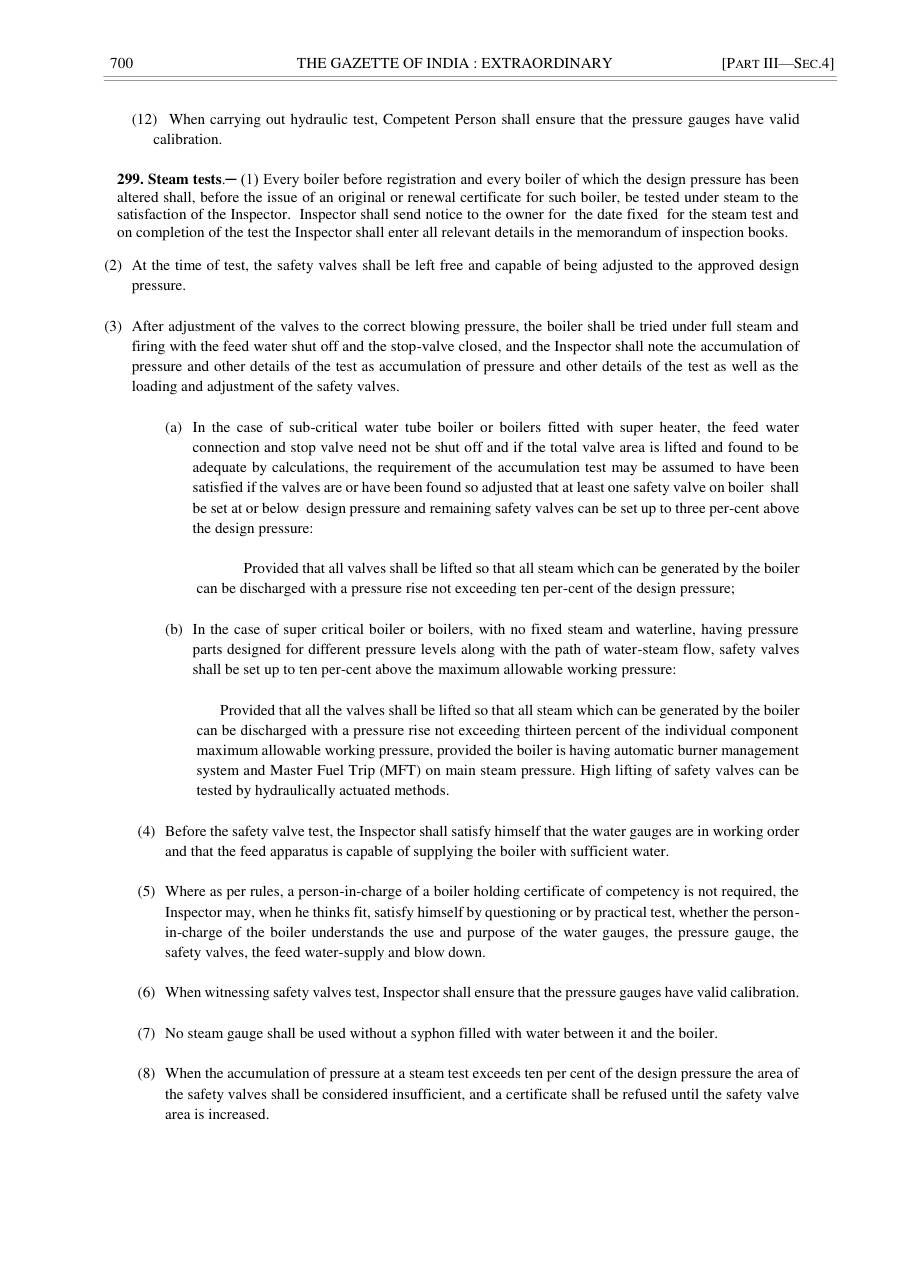
(12)When carrying out hydraulic test, Competent Person shall ensure that the pressure gauges have valid calibration.
In short
Regulation 298 sets the site hydraulic test after erection, witnessed by the Competent Person. Preparation is in regulation 297.
Test pressures (sub-reg. 1)
- Sub-critical boilers: 1.25 × design pressure. This is the design pressure certified by the Inspecting Authority in Form-I (Part B or C) and stamped on the boiler.
- Supercritical boilers with no fixed steam and water line and pressure parts at different design levels: not less than 1.5 × design pressure at the superheater outlet, and not less than 1.25 × design pressure of any part.
- If the components were not all hydraulically tested at the maker's works under regulation 167, the site test is at 1.5 × design pressure.
- Renovation, retrofit or spare components: site test at 1.25 × design pressure, with no maker's-works test required.
How the test is run
- Water temperature between 20 °C and 50 °C.
- Raise pressure gradually under control, never more than 6 % above the required test pressure. Hold for 30 minutes, then reduce to the maximum allowable working pressure and hold long enough for a close visual inspection for leaks.
Read the remaining sub-regulations on the Gazette page for acceptance and what happens after the test.
Written by IBRsource editors · last edited 2026-11-20. Explanations simplify and are not a design method, testing procedure or authorisation. Requirements come from the complete regulations, the Gazette and approved documentation.
Original drawings for this regulation
Comparison pending: the IBR 1950 text in force on 30 September 2026 is not yet established for this provision, so no change is claimed (how this works).
Orientation hints (unverified)
These candidates come from automated heading matching against DPIIT's scanned historical print edition of IBR 1950. That edition uses imperial units and riveted-construction provisions, so it is not the operative 2026 predecessor text. Regulation numbers alone never prove equivalence.
| Historical 1950-edition reg. | Heading as OCR'd | Heading similarity | Source image |
|---|---|---|---|
| 527 | Procedure for Hydraulic test | 93% | Chapter XI (DPIIT scan), image 8 |
| 56 | Hydraulic Test | 78% | Chapter II (DPIIT scan), image 10 |
| 72 | Hydraulic Test | 78% | Chapter II (DPIIT scan), image 14 |
Amendment history of the candidate IBR 1950 regulations: Reg. 527 (1 amendment) · Reg. 56 (3 amendments)
IBR 1950 regulation 527 as last published in the DPIIT web edition (archived 2022)
Unofficial archived copy, not verified; see the regulation 527 page for its amendments.
|
REGULATIONS FOR REGISTRATION AND INSPECTION OF ECONOMISERS AND FEED PIPES | ||||||||||
| ||||||||||
|
REGULATIONS FOR REGISTRATION AND INSPECTION OF ECONOMISERS AND FEED PIPES | ||||||||||
| ||||||||||
|
REGULATIONS FOR REGISTRATION AND INSPECTION OF ECONOMISERS AND FEED PIPES | ||||||||||
|
IBR 1950 regulation 56 as last published in the DPIIT web edition (archived 2022)
Unofficial archived copy, not verified; see the regulation 56 page for its amendments.
| Reg. 56 MATERIALS OF CONSTRUCTION SEAMLESS FERRITIC PIPES FOR HIGH TEMPERATURE SERVICE Hydraulic Test |
| (i) Each pipe shall be tested by the manufacturer and shall withstand a hydraulic pressure to one and half times the design pressure but not greater than pressure calculated by the following formula given below. In the absence of working pressure is indicated in the Test Certificate then the tested pressure indicated in the Test Certificate divided by 1.5 shall be the maximum working pressure P = 2 S t / d where P = test pressure D = specified outside diameter of the pipe t = specified wall thickness of the pipe S = stress which shall be taken as 40% of the minimum tensile strength at room temperature. (ii) Notwithstanding anything contained in the above clause, the hydraulic test at the maker's works may be dispensed with provided that the pipes are subject to non destructive testing by an appropriate method like Ultrasonic or Eddy current or stray flux testing |
Images of the official Gazette pages that contain this regulation. Click to zoom. Compare word by word before relying on the extracted text.
Indian Boiler Regulations, 2026, reg. 298, Regulation 298, Gazette of India, Extraordinary, Part III—Section 4, No. 596, 1 October 2026, printed p.698–700. https://egazette.gov.in/WriteReadData/2026/276813.pdf (text consulted via IBRsource, 2026-11-23).
The citation refers to the government publication. Cite the Gazette, not this website.