
Indian Boiler Regulations, 2026 · Chapter 8 · Inspection and Testing of Boilers and Pipes during Construction and Boiler Registration
Regulation 329. Markings
Not yet checked against the official Gazette; verify before relying on it.
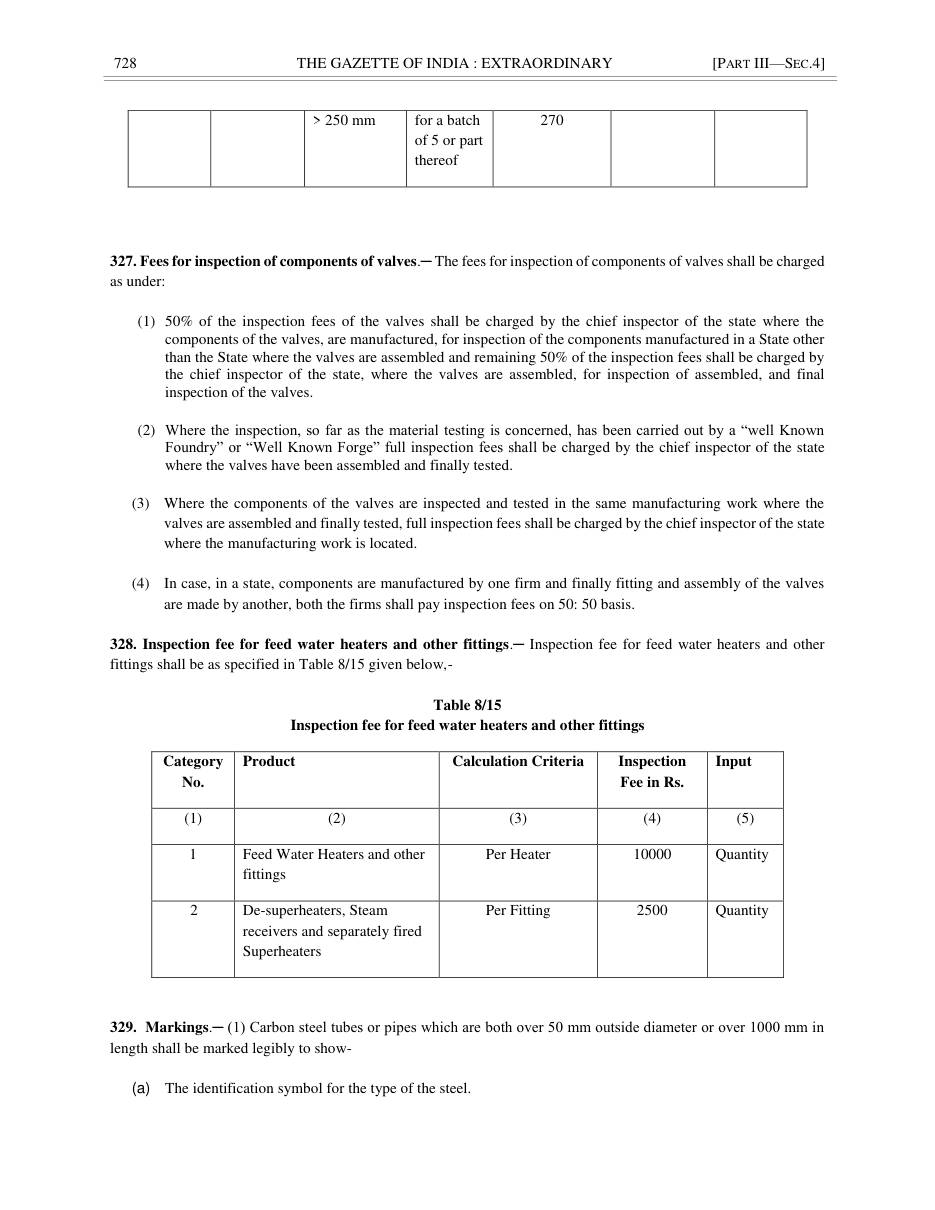
329. Markings.─ (1) Carbon steel tubes or pipes which are both over 50 mm outside diameter or over 1000 mm in length shall be marked legibly to show-
(a)The identification symbol for the type of the steel.
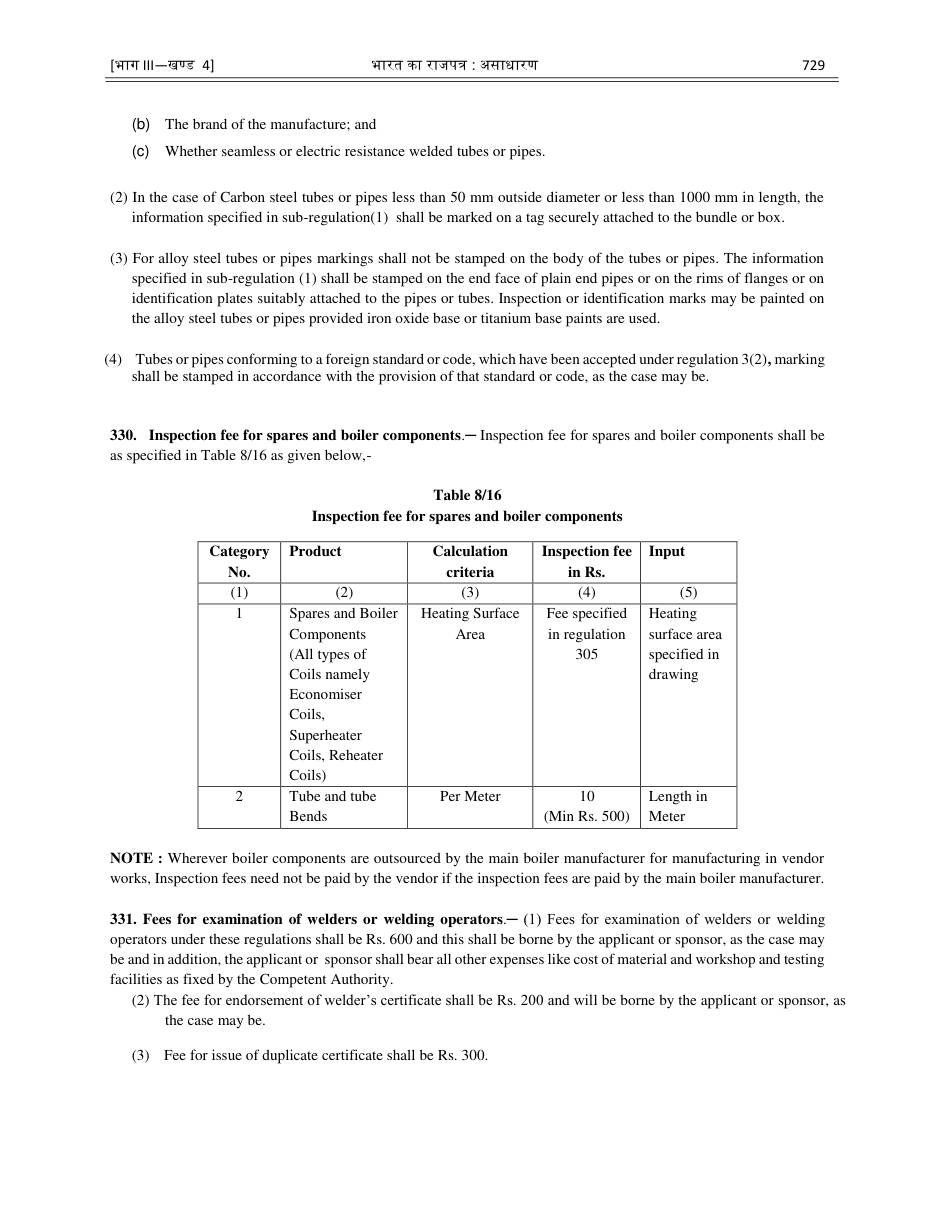
(b)The brand of the manufacture; and
(c)Whether seamless or electric resistance welded tubes or pipes.
(2)In the case of Carbon steel tubes or pipes less than 50 mm outside diameter or less than 1000 mm in length, the information specified in sub-regulation(1) shall be marked on a tag securely attached to the bundle or box.
(3)For alloy steel tubes or pipes markings shall not be stamped on the body of the tubes or pipes. The information specified in sub-regulation (1) shall be stamped on the end face of plain end pipes or on the rims of flanges or on identification plates suitably attached to the pipes or tubes. Inspection or identification marks may be painted on the alloy steel tubes or pipes provided iron oxide base or titanium base paints are used.
(4)Tubes or pipes conforming to a foreign standard or code, which have been accepted under regulation 3(2), marking shall be stamped in accordance with the provision of that standard or code, as the case may be.
In short
Regulation 329 sets how steel tubes and pipes must be marked so their steel type, maker and method of manufacture can be identified.
Key points
- (1) Carbon steel tubes or pipes over 50 mm outside diameter or over 1000 mm long are marked legibly with (a) the identification symbol for the type of steel, (b) the manufacturer's brand and (c) whether seamless or electric resistance welded.
- (2) Carbon steel tubes or pipes less than 50 mm outside diameter or less than 1000 mm long: the same information goes on a tag securely attached to the bundle or box. As printed, (1) says "both over 50 mm outside diameter or over 1000 mm in length", so the two conditions overlap for, say, a long thin tube; ask the Inspecting Authority which applies.
- (3) Alloy steel tubes or pipes: the information is stamped on the end face of plain end pipes, on flange rims, or on identification plates attached to the pipes. Inspection or identification marks may be painted on, but only with iron oxide base or titanium base paints.
- (4) Tubes or pipes to a foreign standard or code accepted under regulation 3(2) are stamped as that standard or code requires.
Watch out
- (3) Markings must not be stamped on the body of alloy steel tubes or pipes.
Written by IBRsource editors · last edited 2026-11-20. Explanations simplify and are not a design method, testing procedure or authorisation. Requirements come from the complete regulations, the Gazette and approved documentation.
Comparison pending: the IBR 1950 text in force on 30 September 2026 is not yet established for this provision, so no change is claimed (how this works).
Orientation hints (unverified)
These candidates come from automated heading matching against DPIIT's scanned historical print edition of IBR 1950. That edition uses imperial units and riveted-construction provisions, so it is not the operative 2026 predecessor text. Regulation numbers alone never prove equivalence.
No candidate heading found in the historical print edition.
Images of the official Gazette pages that contain this regulation. Click to zoom. Compare word by word before relying on the extracted text.
Indian Boiler Regulations, 2026, reg. 329, Regulation 329, Gazette of India, Extraordinary, Part III—Section 4, No. 596, 1 October 2026, printed p.728–729. https://egazette.gov.in/WriteReadData/2026/276813.pdf (text consulted via IBRsource, 2026-11-23).
The citation refers to the government publication. Cite the Gazette, not this website.