
Indian Boiler Regulations, 2026 · Chapter 8 · Inspection and Testing of Boilers and Pipes during Construction and Boiler Registration
Regulation 314. Ageing of Water Tube Boilers
Not yet checked against the official Gazette; verify before relying on it.
314. Ageing of Water Tube Boilers.─(1) (a) The boilers which are operating at temperature of 400°C (main steam outlet temperature) and above shall be tested by the Remnant Life Assessment Organisation for the components as per Table 8/6 of regulation 315 after they are in operation for 100,000 hours for assessment of the remnant life of the components.
(b)If results are acceptable as per the standards laid down by the Central Boilers Board, a certificate shall be issued by the Chief Inspector or Director of Boilers as the case may be, for extending the life of the boiler for a further period of six years or such less period as recommended by the Remnant Life Assessment Organisation. This assessment of remnant life shall be carried out thereafter every six years by a Remnant Life Assessment Organisation approved by the Central Boilers Board. The Remnant Life Assessment Organisation shall work in close coordination with the office of the Chief Inspector or Director of Boilers as the case may be, in the field of remnant life assessment and extension. The design pressure of such boilers may be reduced on the recommendations of the Remnant Life Assessment Organisation;
(2)(a)The boilers which are operating at a temperature of less than 400°C (main steam outlet temperature) on completion of a life of twenty-five years shall be tested by the Remnant Life Assessment Organisation for the components as per Table 8/7 given in regulation 315 for assessment of the remnant life of the components.
(b)If results are acceptable as per the standards laid down by the Central Boilers Board, a certificate shall be issued by the Chief Inspector or Director of Boilers as the case may be, for extending the life of the boiler for a further period of twelve years or such less period as recommended by the Remnant Life Assessment Organisation. This assessment of remnant life shall be carried out thereafter every twelve years by a Remnant Life Assessment Organisation approved by the Central Boilers Board. The Remnant Life Assessment Organisation shall work in close coordination with the office of the Chief Inspector or Director of Boilers as the case may be, in the field of remnant life assessment and extension. The design pressure of such boilers may be reduced on the recommendations of Remnant Life Assessment Organisation.
(c)Notwithstanding anything contained in this regulation, for boilers working at a pressure less that 50 kg/cm2 (g) and temperature less than 400°C (main steam outlet temperature), such elaborate remnant life assessment is not mandatory. However, in such cases, drums and headers of such boilers, shall be inspected by Ultrasonic testing, Magnetic particle testing and Dye Penetrant test.
Tables and formulae are shown in their extracted layout. Alignment, superscripts and subscripts may be lost. The Gazette page image is authoritative.
In short
Regulation 314 requires water tube boilers to undergo remnant life assessment by a Remnant Life Assessment Organisation (RLAO), with the trigger depending on main steam outlet temperature.
Key points
- (1) Boilers at 400°C and above: tested for the components in Table 8/6 of regulation 315 after 100,000 hours of operation. If results meet the Central Boilers Board's standards, life is extended by six years, or less if the RLAO recommends. Assessment is then repeated every six years.
- (2)(a)–(b) Boilers below 400°C: tested for the components in Table 8/7 on completing twenty-five years. Life is extended by twelve years, or less if recommended, with reassessment every twelve years.
- In both cases the Chief Inspector or Director of Boilers issues the extension certificate, the RLAO works in close coordination with that office, and design pressure may be reduced on the RLAO's recommendation.
Watch out
- (2)(c) For boilers working below 50 kg/cm2 (g) and below 400°C, the full remnant life assessment is not mandatory. Their drums and headers must still be inspected by ultrasonic, magnetic particle and dye penetrant testing.
Written by IBRsource editors · last edited 2026-11-20. Explanations simplify and are not a design method, testing procedure or authorisation. Requirements come from the complete regulations, the Gazette and approved documentation.
Comparison pending: the IBR 1950 text in force on 30 September 2026 is not yet established for this provision, so no change is claimed (how this works).
Orientation hints (unverified)
These candidates come from automated heading matching against DPIIT's scanned historical print edition of IBR 1950. That edition uses imperial units and riveted-construction provisions, so it is not the operative 2026 predecessor text. Regulation numbers alone never prove equivalence.
No candidate heading found in the historical print edition.
Images of the official Gazette pages that contain this regulation. Click to zoom. Compare word by word before relying on the extracted text.
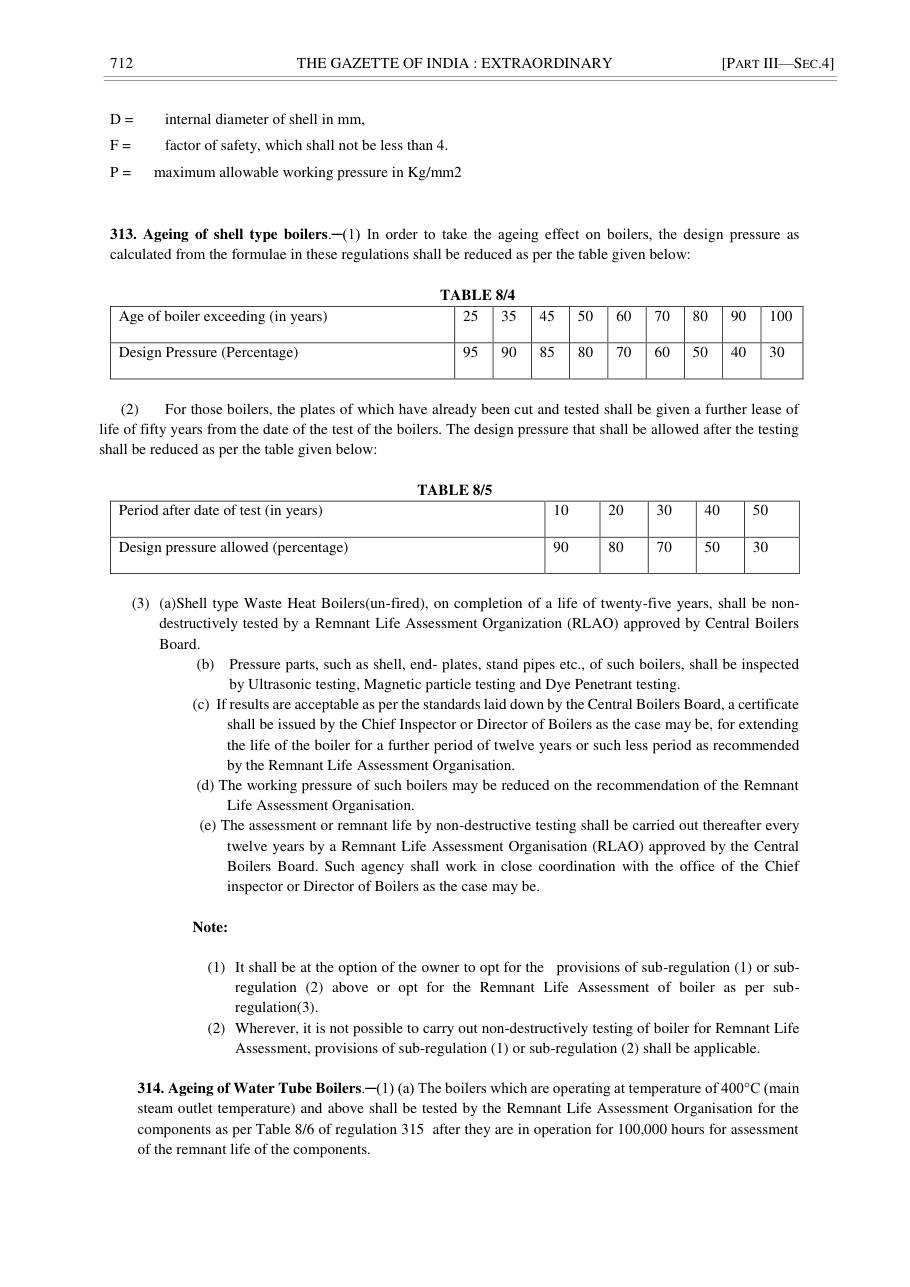
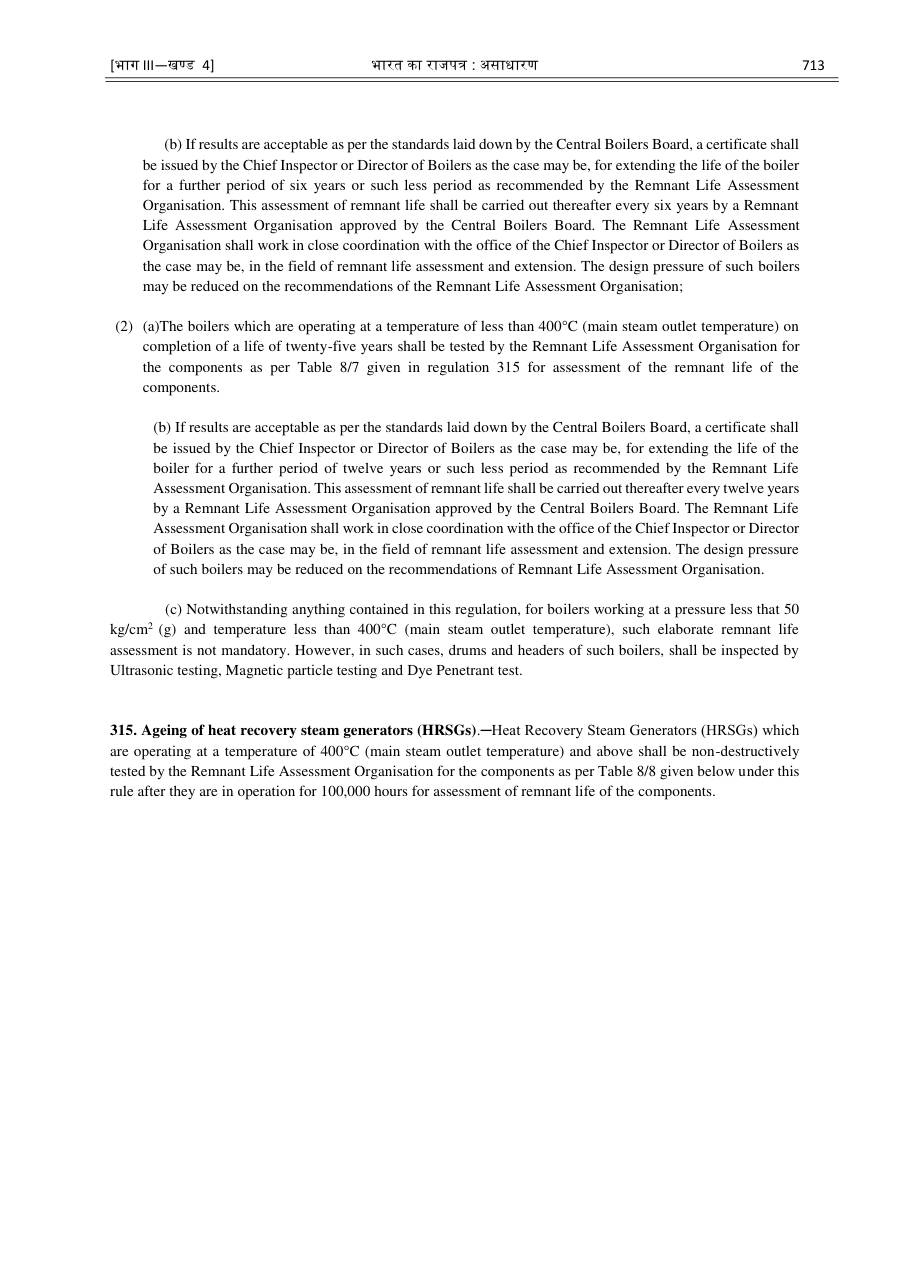
Indian Boiler Regulations, 2026, reg. 314, Regulation 314, Gazette of India, Extraordinary, Part III—Section 4, No. 596, 1 October 2026, printed p.712–713. https://egazette.gov.in/WriteReadData/2026/276813.pdf (text consulted via IBRsource, 2026-11-23).
The citation refers to the government publication. Cite the Gazette, not this website.