
Indian Boiler Regulations, 2026 · Chapter 8 · Inspection and Testing of Boilers and Pipes during Construction and Boiler Registration
Regulation 322. Inspection of pipes
Not yet checked against the official Gazette; verify before relying on it.
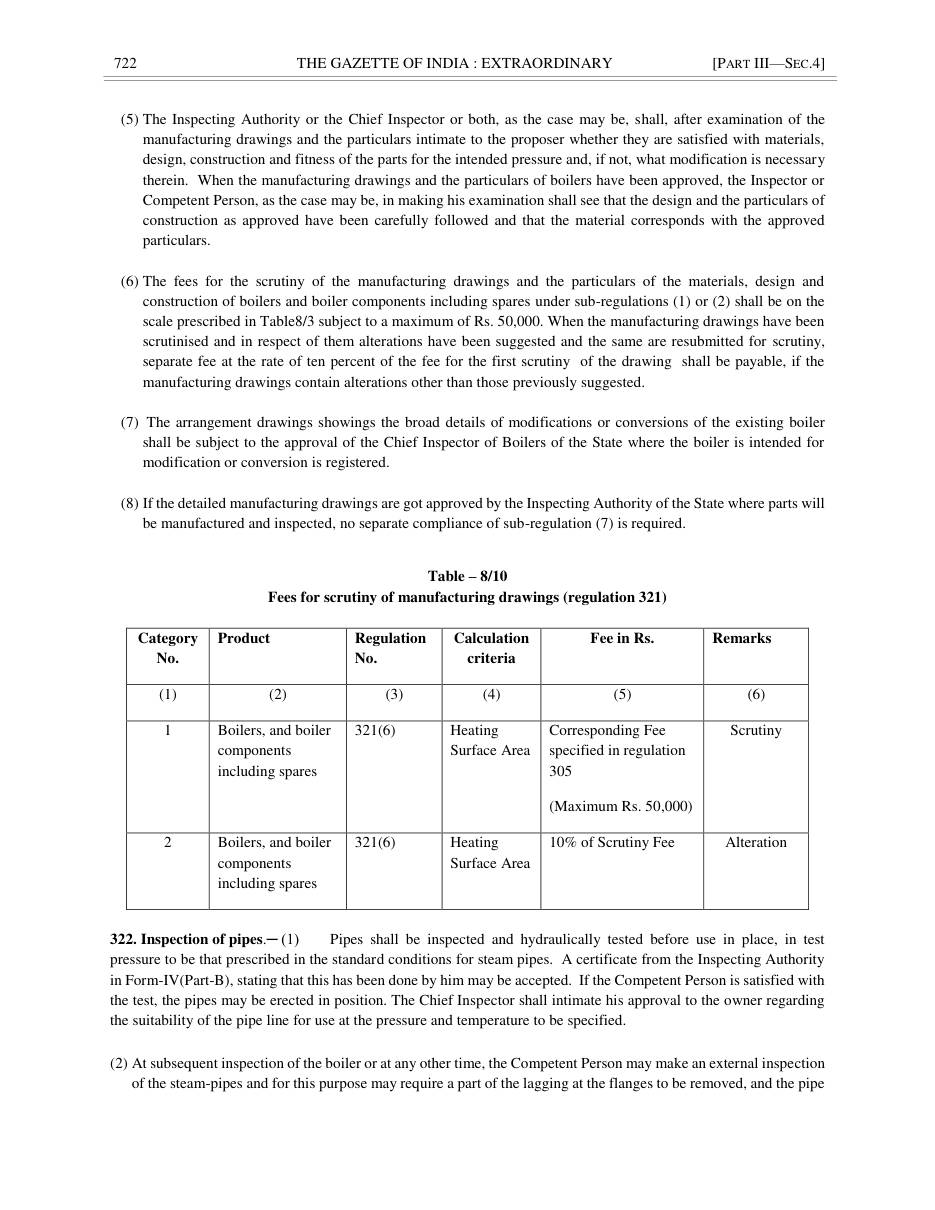
322. Inspection of pipes.─ (1) Pipes shall be inspected and hydraulically tested before use in place, in test pressure to be that prescribed in the standard conditions for steam pipes. A certificate from the Inspecting Authority in Form-IV(Part-B), stating that this has been done by him may be accepted. If the Competent Person is satisfied with the test, the pipes may be erected in position. The Chief Inspector shall intimate his approval to the owner regarding the suitability of the pipe line for use at the pressure and temperature to be specified.
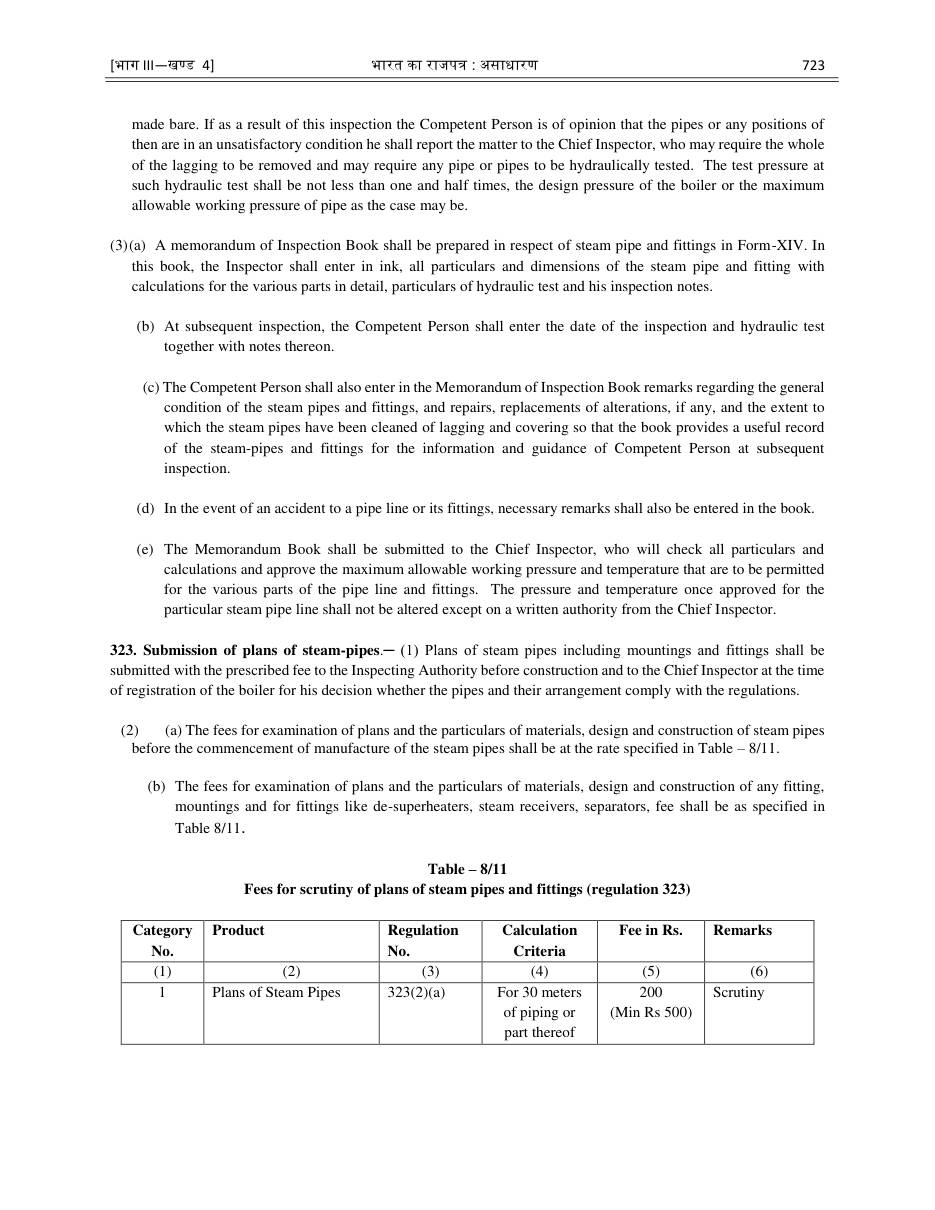
(2)At subsequent inspection of the boiler or at any other time, the Competent Person may make an external inspection of the steam-pipes and for this purpose may require a part of the lagging at the flanges to be removed, and the pipe made bare. If as a result of this inspection the Competent Person is of opinion that the pipes or any positions of then are in an unsatisfactory condition he shall report the matter to the Chief Inspector, who may require the whole of the lagging to be removed and may require any pipe or pipes to be hydraulically tested. The test pressure at such hydraulic test shall be not less than one and half times, the design pressure of the boiler or the maximum allowable working pressure of pipe as the case may be.
(3)(a) A memorandum of Inspection Book shall be prepared in respect of steam pipe and fittings in Form-XIV. In this book, the Inspector shall enter in ink, all particulars and dimensions of the steam pipe and fitting with calculations for the various parts in detail, particulars of hydraulic test and his inspection notes.
(b)At subsequent inspection, the Competent Person shall enter the date of the inspection and hydraulic test together with notes thereon.
(c)The Competent Person shall also enter in the Memorandum of Inspection Book remarks regarding the general condition of the steam pipes and fittings, and repairs, replacements of alterations, if any, and the extent to which the steam pipes have been cleaned of lagging and covering so that the book provides a useful record of the steam-pipes and fittings for the information and guidance of Competent Person at subsequent inspection.
(d)In the event of an accident to a pipe line or its fittings, necessary remarks shall also be entered in the book.
(e)The Memorandum Book shall be submitted to the Chief Inspector, who will check all particulars and calculations and approve the maximum allowable working pressure and temperature that are to be permitted for the various parts of the pipe line and fittings. The pressure and temperature once approved for the particular steam pipe line shall not be altered except on a written authority from the Chief Inspector.
In short
Regulation 322 covers inspection and hydraulic testing of steam pipes before use and at later inspections, and the steam pipe Memorandum of Inspection Book.
Key points
- (1) Pipes are inspected and hydraulically tested before use at the test pressure in the standard conditions for steam pipes. An Inspecting Authority certificate in Form-IV (Part-B) may be accepted. If the Competent Person is satisfied, the pipes may be erected. The Chief Inspector then tells the owner the approved pressure and temperature for the pipe line.
- (2) At later inspections the Competent Person may inspect the pipes externally and have lagging at the flanges removed. If he finds them unsatisfactory, he reports to the Chief Inspector, who may require all lagging removed and a hydraulic test at not less than one and half times the design pressure of the boiler or the maximum allowable working pressure of the pipe, as the case may be.
- (3)(a)–(d) A Memorandum of Inspection Book in Form-XIV is kept for steam pipes and fittings. The Inspector enters particulars, dimensions, calculations, hydraulic test details and notes. The Competent Person later enters inspection and test dates, general condition, repairs, replacements, alterations, lagging removed, and any accidents.
- (3)(e) The Chief Inspector checks the book and approves the maximum allowable working pressure and temperature for the various parts.
Watch out
- Once approved, the pressure and temperature for a steam pipe line cannot be altered without the Chief Inspector's written authority.
Written by IBRsource editors · last edited 2026-11-20. Explanations simplify and are not a design method, testing procedure or authorisation. Requirements come from the complete regulations, the Gazette and approved documentation.
Comparison pending: the IBR 1950 text in force on 30 September 2026 is not yet established for this provision, so no change is claimed (how this works).
Orientation hints (unverified)
These candidates come from automated heading matching against DPIIT's scanned historical print edition of IBR 1950. That edition uses imperial units and riveted-construction provisions, so it is not the operative 2026 predecessor text. Regulation numbers alone never prove equivalence.
| Historical 1950-edition reg. | Heading as OCR'd | Heading similarity | Source image |
|---|---|---|---|
| 528 | Memorandum of Inspection Book | 81% | Chapter XI (DPIIT scan), image 8 |
Amendment history of the candidate IBR 1950 regulation: Reg. 528 (1 amendment)
IBR 1950 regulation 528 as last published in the DPIIT web edition (archived 2022)
Unofficial archived copy, not verified; see the regulation 528 page for its amendments.
|
REGULATIONS FOR REGISTRATION AND INSPECTION OF ECONOMISERS AND FEED PIPES | ||||||||||
| ||||||||||
|
REGULATIONS FOR REGISTRATION AND INSPECTION OF ECONOMISERS AND FEED PIPES | ||||||||||
| ||||||||||
|
REGULATIONS FOR REGISTRATION AND INSPECTION OF ECONOMISERS AND FEED PIPES | ||||||||||
|
Images of the official Gazette pages that contain this regulation. Click to zoom. Compare word by word before relying on the extracted text.
Indian Boiler Regulations, 2026, reg. 322, Regulation 322, Gazette of India, Extraordinary, Part III—Section 4, No. 596, 1 October 2026, printed p.722–723. https://egazette.gov.in/WriteReadData/2026/276813.pdf (text consulted via IBRsource, 2026-11-23).
The citation refers to the government publication. Cite the Gazette, not this website.