
Indian Boiler Regulations, 2026 · Chapter 8 · Inspection and Testing of Boilers and Pipes during Construction and Boiler Registration
Regulation 302. Measurement of Heating Surface
Not yet checked against the official Gazette; verify before relying on it.
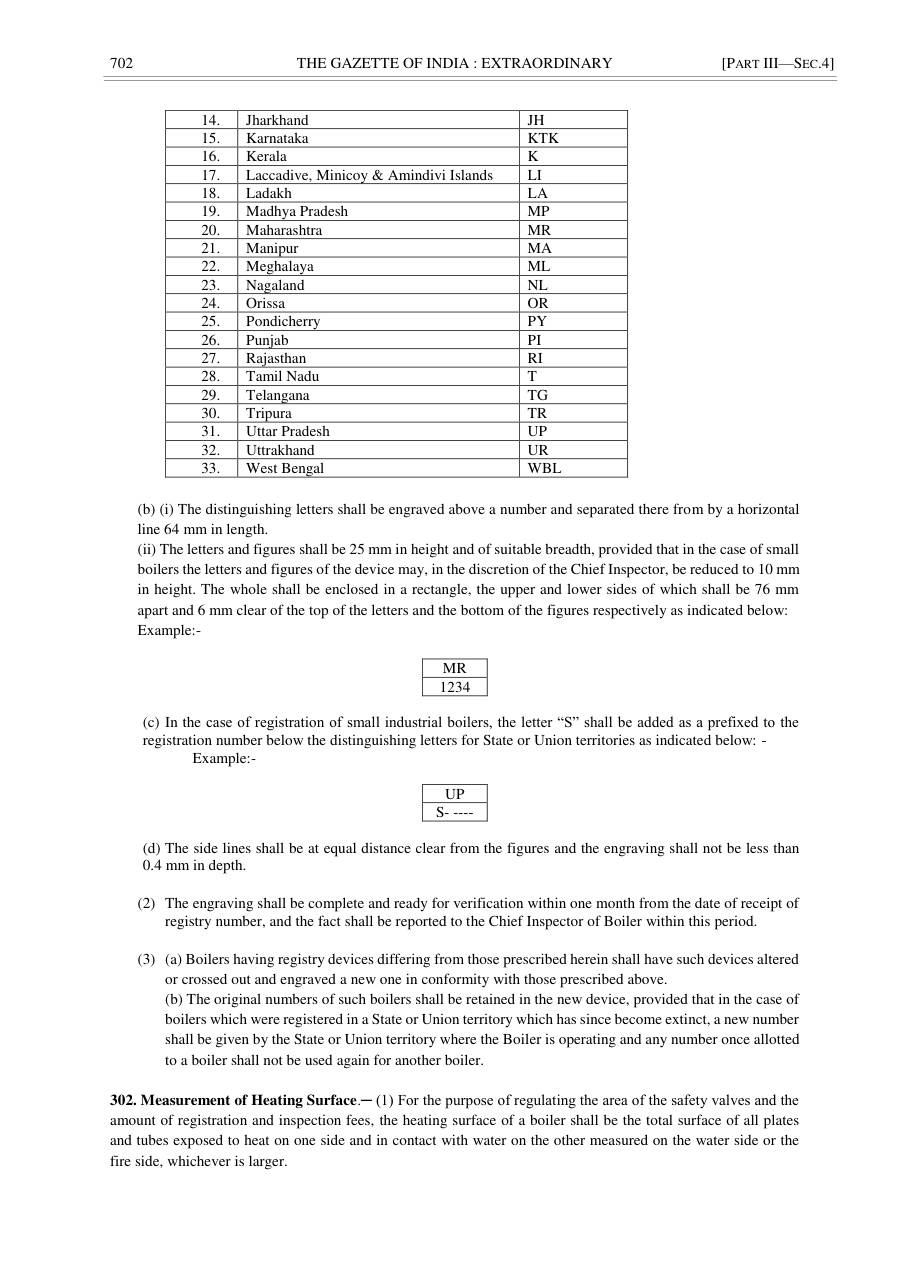
302. Measurement of Heating Surface.─ (1) For the purpose of regulating the area of the safety valves and the amount of registration and inspection fees, the heating surface of a boiler shall be the total surface of all plates and tubes exposed to heat on one side and in contact with water on the other measured on the water side or the fire side, whichever is larger.
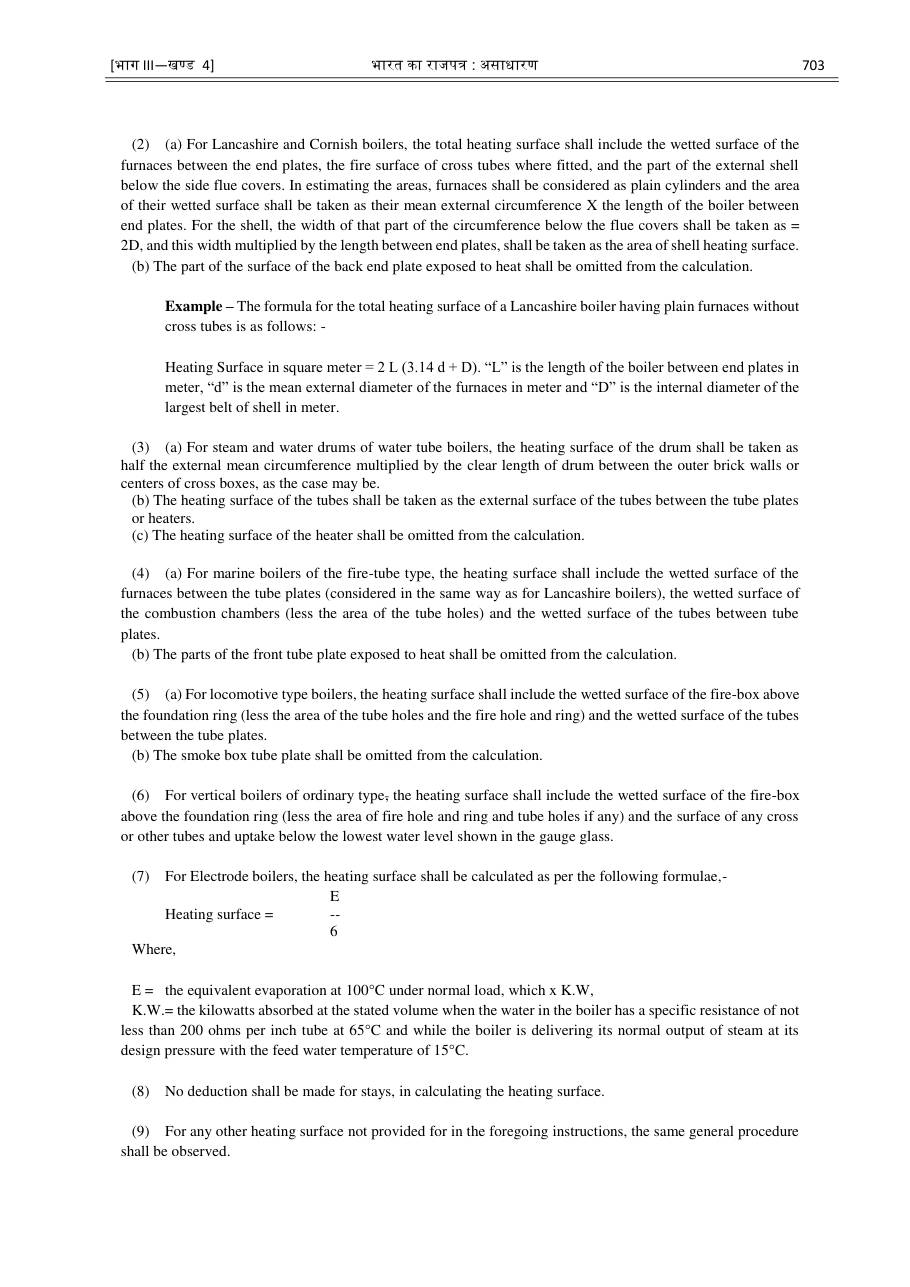
(2)(a) For Lancashire and Cornish boilers, the total heating surface shall include the wetted surface of the furnaces between the end plates, the fire surface of cross tubes where fitted, and the part of the external shell below the side flue covers. In estimating the areas, furnaces shall be considered as plain cylinders and the area of their wetted surface shall be taken as their mean external circumference X the length of the boiler between end plates. For the shell, the width of that part of the circumference below the flue covers shall be taken as = 2D, and this width multiplied by the length between end plates, shall be taken as the area of shell heating surface.
(b)The part of the surface of the back end plate exposed to heat shall be omitted from the calculation.
Example – The formula for the total heating surface of a Lancashire boiler having plain furnaces without cross tubes is as follows: -
Heating Surface in square meter = 2 L (3.14 d + D). “L” is the length of the boiler between end plates in meter, “d” is the mean external diameter of the furnaces in meter and “D” is the internal diameter of the largest belt of shell in meter.
(3)(a) For steam and water drums of water tube boilers, the heating surface of the drum shall be taken as half the external mean circumference multiplied by the clear length of drum between the outer brick walls or centers of cross boxes, as the case may be.
(b)The heating surface of the tubes shall be taken as the external surface of the tubes between the tube plates or heaters.
(c)The heating surface of the heater shall be omitted from the calculation.
(4)(a) For marine boilers of the fire-tube type, the heating surface shall include the wetted surface of the furnaces between the tube plates (considered in the same way as for Lancashire boilers), the wetted surface of the combustion chambers (less the area of the tube holes) and the wetted surface of the tubes between tube plates.
(b)The parts of the front tube plate exposed to heat shall be omitted from the calculation.
(5)(a) For locomotive type boilers, the heating surface shall include the wetted surface of the fire-box above the foundation ring (less the area of the tube holes and the fire hole and ring) and the wetted surface of the tubes between the tube plates.
(b)The smoke box tube plate shall be omitted from the calculation.
(6)For vertical boilers of ordinary type, the heating surface shall include the wetted surface of the fire-box above the foundation ring (less the area of fire hole and ring and tube holes if any) and the surface of any cross or other tubes and uptake below the lowest water level shown in the gauge glass.
(7)For Electrode boilers, the heating surface shall be calculated as per the following formulae,-
E
Heating surface = --
6
Where,
E = the equivalent evaporation at 100°C under normal load, which x K.W,
K.W.= the kilowatts absorbed at the stated volume when the water in the boiler has a specific resistance of not less than 200 ohms per inch tube at 65°C and while the boiler is delivering its normal output of steam at its design pressure with the feed water temperature of 15°C.
(8)No deduction shall be made for stays, in calculating the heating surface.
(9)For any other heating surface not provided for in the foregoing instructions, the same general procedure shall be observed.
Tables and formulae are shown in their extracted layout. Alignment, superscripts and subscripts may be lost. The Gazette page image is authoritative.
In short
Regulation 302 defines the heating surface of a boiler. This figure is used to size the safety valves and to work out registration and inspection fees.
Key points
- (1) Heating surface is the total surface of all plates and tubes exposed to heat on one side and in contact with water on the other. It is measured on the water side or the fire side, whichever is larger.
- (2) Lancashire and Cornish boilers: include the wetted surface of the furnaces between end plates, the fire surface of any cross tubes, and the part of the shell below the side flue covers. Furnaces are treated as plain cylinders. The back end plate surface exposed to heat is left out. A worked formula for a Lancashire boiler with plain furnaces and no cross tubes is given in the text.
- (3) Water tube boilers: drums count as half the external mean circumference times the clear drum length. Tubes count by their external surface between the tube plates or heaters. The heater is left out.
- (4) Fire-tube marine boilers: furnaces, combustion chambers (less tube holes) and tubes between tube plates. The parts of the front tube plate exposed to heat are left out.
- (5) Locomotive type boilers: fire-box above the foundation ring (less tube holes, fire hole and ring) and the tubes. The smoke box tube plate is left out.
- (6) Ordinary vertical boilers: fire-box above the foundation ring, plus cross tubes and uptake below the lowest water level shown in the gauge glass.
- (7) Electrode boilers: a formula based on the equivalent evaporation (E), derived from the kilowatts absorbed under stated test conditions. See the Official text tab for the formula and conditions.
- (8) No deduction is made for stays.
- (9) Any other heating surface follows the same general procedure.
Written by IBRsource editors · last edited 2026-11-20. Explanations simplify and are not a design method, testing procedure or authorisation. Requirements come from the complete regulations, the Gazette and approved documentation.
Comparison pending: the IBR 1950 text in force on 30 September 2026 is not yet established for this provision, so no change is claimed (how this works).
Orientation hints (unverified)
These candidates come from automated heading matching against DPIIT's scanned historical print edition of IBR 1950. That edition uses imperial units and riveted-construction provisions, so it is not the operative 2026 predecessor text. Regulation numbers alone never prove equivalence.
No candidate heading found in the historical print edition.
Images of the official Gazette pages that contain this regulation. Click to zoom. Compare word by word before relying on the extracted text.
Indian Boiler Regulations, 2026, reg. 302, Regulation 302, Gazette of India, Extraordinary, Part III—Section 4, No. 596, 1 October 2026, printed p.702–704. https://egazette.gov.in/WriteReadData/2026/276813.pdf (text consulted via IBRsource, 2026-11-23).
The citation refers to the government publication. Cite the Gazette, not this website.