
Indian Boiler Regulations, 2026 · Chapter 8 · Inspection and Testing of Boilers and Pipes during Construction and Boiler Registration
Regulation 295. Preparations of Inspection
Not yet checked against the official Gazette; verify before relying on it.
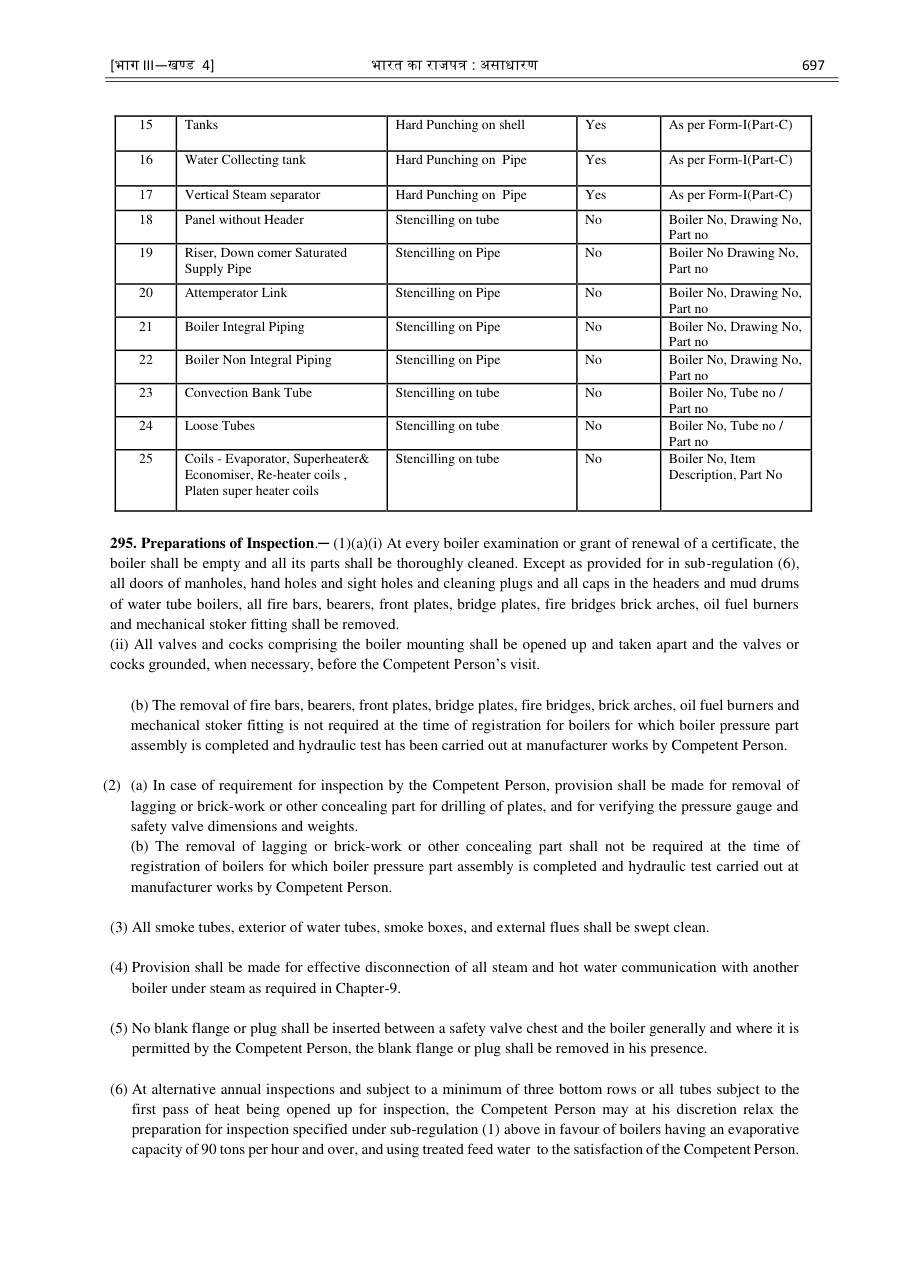
295. Preparations of Inspection.─ (1)(a)(i) At every boiler examination or grant of renewal of a certificate, the boiler shall be empty and all its parts shall be thoroughly cleaned. Except as provided for in sub-regulation (6), all doors of manholes, hand holes and sight holes and cleaning plugs and all caps in the headers and mud drums of water tube boilers, all fire bars, bearers, front plates, bridge plates, fire bridges brick arches, oil fuel burners and mechanical stoker fitting shall be removed.
(ii)All valves and cocks comprising the boiler mounting shall be opened up and taken apart and the valves or cocks grounded, when necessary, before the Competent Person’s visit.
(b)The removal of fire bars, bearers, front plates, bridge plates, fire bridges, brick arches, oil fuel burners and mechanical stoker fitting is not required at the time of registration for boilers for which boiler pressure part assembly is completed and hydraulic test has been carried out at manufacturer works by Competent Person.
(2)(a) In case of requirement for inspection by the Competent Person, provision shall be made for removal of lagging or brick-work or other concealing part for drilling of plates, and for verifying the pressure gauge and safety valve dimensions and weights.
(b)The removal of lagging or brick-work or other concealing part shall not be required at the time of registration of boilers for which boiler pressure part assembly is completed and hydraulic test carried out at manufacturer works by Competent Person.
(3)All smoke tubes, exterior of water tubes, smoke boxes, and external flues shall be swept clean.
(4)Provision shall be made for effective disconnection of all steam and hot water communication with another boiler under steam as required in Chapter-9.
(5)No blank flange or plug shall be inserted between a safety valve chest and the boiler generally and where it is permitted by the Competent Person, the blank flange or plug shall be removed in his presence.
(6)At alternative annual inspections and subject to a minimum of three bottom rows or all tubes subject to the first pass of heat being opened up for inspection, the Competent Person may at his discretion relax the preparation for inspection specified under sub-regulation (1) above in favour of boilers having an evaporative capacity of 90 tons per hour and over, and using treated feed water to the satisfaction of the Competent Person.
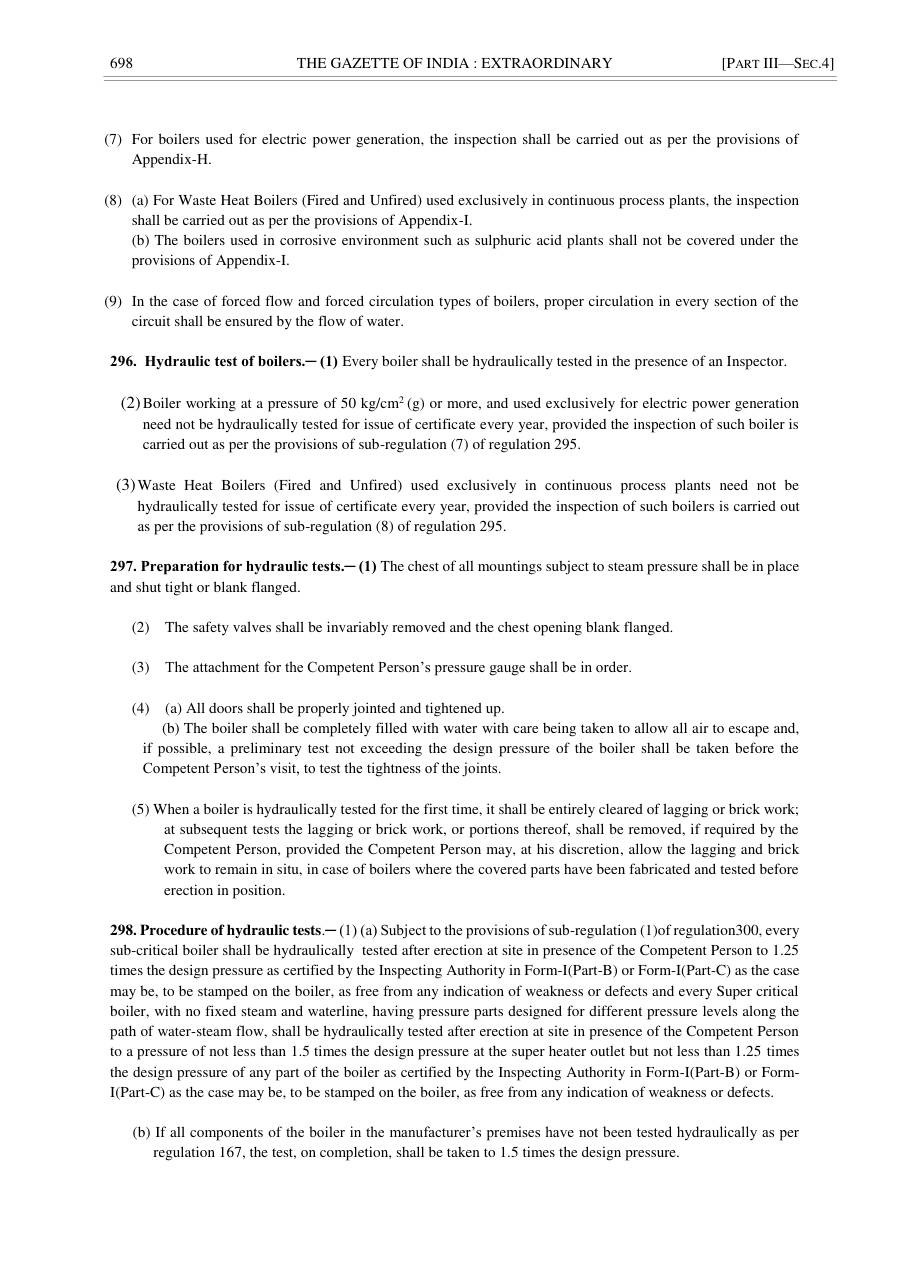
(7)For boilers used for electric power generation, the inspection shall be carried out as per the provisions of Appendix-H.
(8)(a) For Waste Heat Boilers (Fired and Unfired) used exclusively in continuous process plants, the inspection shall be carried out as per the provisions of Appendix-I.
(b)The boilers used in corrosive environment such as sulphuric acid plants shall not be covered under the provisions of Appendix-I.
(9)In the case of forced flow and forced circulation types of boilers, proper circulation in every section of the circuit shall be ensured by the flow of water.
In short
Regulation 295 sets how a boiler must be prepared before an examination or certificate renewal, with relaxations for some boilers.
Key points
- (1)(a) The boiler must be empty and thoroughly cleaned. Manhole, hand hole and sight hole doors, cleaning plugs, header and mud drum caps, fire bars, bearers, front and bridge plates, fire bridges, brick arches, oil burners and stoker fittings must be removed. Mounting valves and cocks must be opened up and taken apart before the Competent Person's visit.
- (1)(b), (2)(b) At registration, removal of firing gear and of lagging or brickwork is not required where the pressure part assembly was completed and hydraulically tested at the maker's works by the Competent Person.
- (2)(a) Otherwise, provision must be made to remove lagging or brickwork for drilling plates, and to verify pressure gauge and safety valve dimensions and weights.
- (3) Smoke tubes, water tube exteriors, smoke boxes and external flues must be swept clean.
- (4) All steam and hot water connections to any other boiler under steam must be effectively disconnected, as required in Chapter-9.
- (6) At alternate annual inspections, the Competent Person may relax (1) for boilers of 90 tons per hour and over using satisfactorily treated feed water, if at least three bottom rows or all first-pass tubes are opened up.
- (7) Power generation boilers are inspected per Appendix-H. (8) Waste heat boilers in continuous process plants per Appendix-I.
- (9) Forced flow and forced circulation boilers must have proper circulation in every circuit section ensured by water flow.
Watch out
- (5) No blank flange or plug may be put between a safety valve chest and the boiler generally. Where the Competent Person permits one, it must be removed in his presence.
- (8)(b) Boilers in corrosive environments such as sulphuric acid plants are not covered by Appendix-I.
Written by IBRsource editors · last edited 2026-11-20. Explanations simplify and are not a design method, testing procedure or authorisation. Requirements come from the complete regulations, the Gazette and approved documentation.
Comparison pending: the IBR 1950 text in force on 30 September 2026 is not yet established for this provision, so no change is claimed (how this works).
Orientation hints (unverified)
These candidates come from automated heading matching against DPIIT's scanned historical print edition of IBR 1950. That edition uses imperial units and riveted-construction provisions, so it is not the operative 2026 predecessor text. Regulation numbers alone never prove equivalence.
| Historical 1950-edition reg. | Heading as OCR'd | Heading similarity | Source image |
|---|---|---|---|
| 524 | Preparation for inspection | 92% | Chapter XI (DPIIT scan), image 7 |
IBR 1950 regulation 524 as last published in the DPIIT web edition (archived 2022)
Unofficial archived copy, not verified; see the regulation 524 page for its amendments.
| Reg. 524, Reg. 525 REGULATIONS FOR REGISTRATION AND INSPECTION OF ECONOMISERS AND FEED PIPES | |||||||||||||||||||
| |||||||||||||||||||
|
REGULATIONS FOR REGISTRATION AND INSPECTION OF ECONOMISERS AND FEED PIPES | |||||||||||||||||||
|
| Next >>> |
Images of the official Gazette pages that contain this regulation. Click to zoom. Compare word by word before relying on the extracted text.
Indian Boiler Regulations, 2026, reg. 295, Regulation 295, Gazette of India, Extraordinary, Part III—Section 4, No. 596, 1 October 2026, printed p.697–698. https://egazette.gov.in/WriteReadData/2026/276813.pdf (text consulted via IBRsource, 2026-11-23).
The citation refers to the government publication. Cite the Gazette, not this website.