
Indian Boiler Regulations, 2026 · Chapter 8 · Inspection and Testing of Boilers and Pipes during Construction and Boiler Registration
Regulation 327. Fees for inspection of components of valves
Not yet checked against the official Gazette; verify before relying on it.
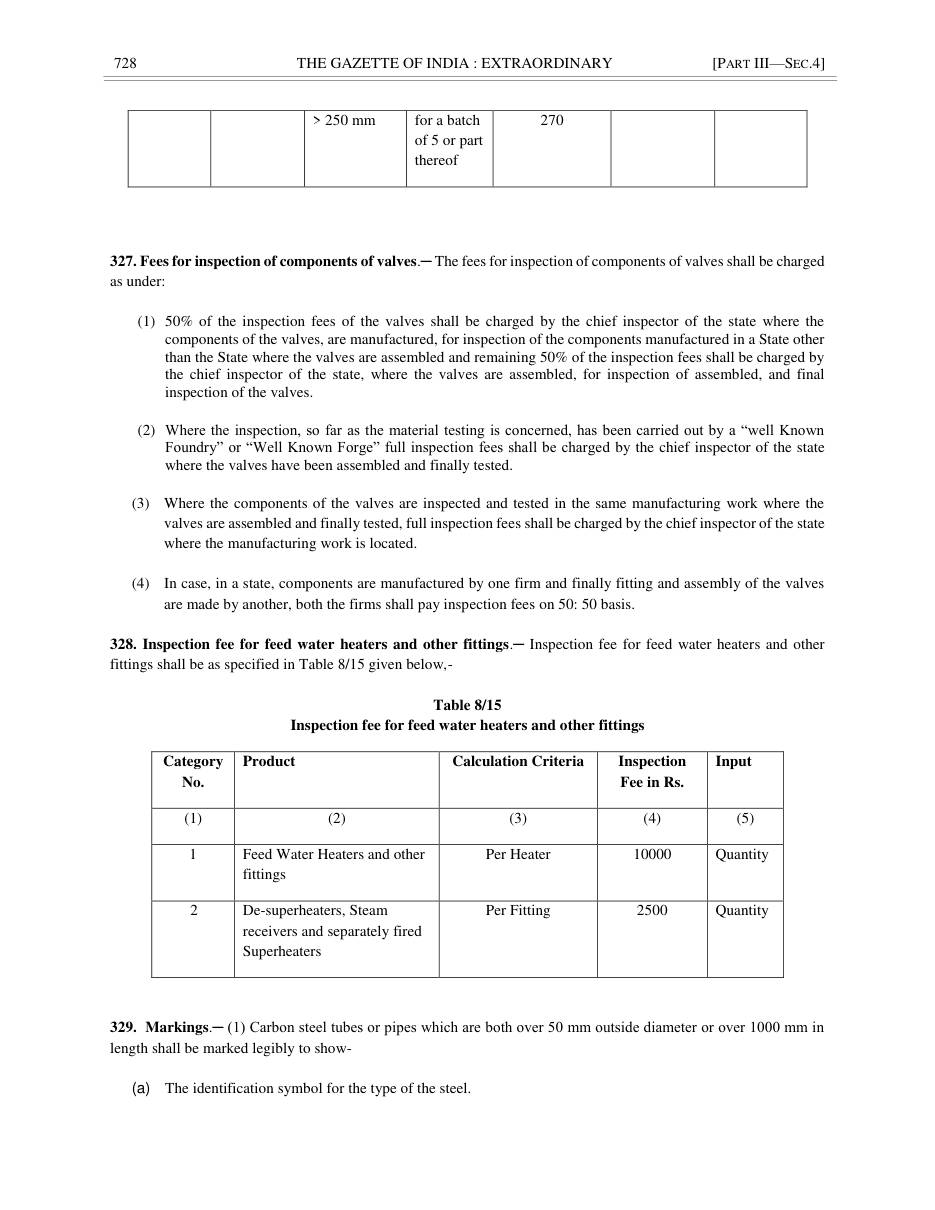
327. Fees for inspection of components of valves.─ The fees for inspection of components of valves shall be charged as under:
(1)50% of the inspection fees of the valves shall be charged by the chief inspector of the state where the components of the valves, are manufactured, for inspection of the components manufactured in a State other than the State where the valves are assembled and remaining 50% of the inspection fees shall be charged by the chief inspector of the state, where the valves are assembled, for inspection of assembled, and final inspection of the valves.
(2)Where the inspection, so far as the material testing is concerned, has been carried out by a “well Known Foundry” or “Well Known Forge” full inspection fees shall be charged by the chief inspector of the state where the valves have been assembled and finally tested.
(3)Where the components of the valves are inspected and tested in the same manufacturing work where the valves are assembled and finally tested, full inspection fees shall be charged by the chief inspector of the state where the manufacturing work is located.
(4)In case, in a state, components are manufactured by one firm and finally fitting and assembly of the valves are made by another, both the firms shall pay inspection fees on 50: 50 basis.
In short
Regulation 327 says how inspection fees for valves are split when the components and the assembled valve are inspected in different places or by different firms.
Key points
- (1) Components made in a different State from where the valves are assembled: 50% of the valve inspection fee goes to the Chief Inspector of the State where the components are made, and the remaining 50% to the Chief Inspector of the State where the valves are assembled and finally inspected.
- (2) If material testing was done by a "Well Known Foundry" or "Well Known Forge", the full fee is charged by the Chief Inspector of the State where the valves are assembled and finally tested.
- (3) If components are inspected and tested in the same works where the valves are assembled and tested, the full fee is charged by the Chief Inspector of the State where that works is located.
- (4) If, within one State, one firm makes the components and another assembles the valves, the two firms pay the inspection fee on a 50: 50 basis.
Written by IBRsource editors · last edited 2026-11-20. Explanations simplify and are not a design method, testing procedure or authorisation. Requirements come from the complete regulations, the Gazette and approved documentation.
Comparison pending: the IBR 1950 text in force on 30 September 2026 is not yet established for this provision, so no change is claimed (how this works).
Orientation hints (unverified)
These candidates come from automated heading matching against DPIIT's scanned historical print edition of IBR 1950. That edition uses imperial units and riveted-construction provisions, so it is not the operative 2026 predecessor text. Regulation numbers alone never prove equivalence.
| Historical 1950-edition reg. | Heading as OCR'd | Heading similarity | Source image |
|---|---|---|---|
| 524 | Preparation for inspection | 70% | Chapter XI (DPIIT scan), image 7 |
IBR 1950 regulation 524 as last published in the DPIIT web edition (archived 2022)
Unofficial archived copy, not verified; see the regulation 524 page for its amendments.
| Reg. 524, Reg. 525 REGULATIONS FOR REGISTRATION AND INSPECTION OF ECONOMISERS AND FEED PIPES | |||||||||||||||||||
| |||||||||||||||||||
|
REGULATIONS FOR REGISTRATION AND INSPECTION OF ECONOMISERS AND FEED PIPES | |||||||||||||||||||
|
| Next >>> |
Images of the official Gazette pages that contain this regulation. Click to zoom. Compare word by word before relying on the extracted text.
Indian Boiler Regulations, 2026, reg. 327, Regulation 327, Gazette of India, Extraordinary, Part III—Section 4, No. 596, 1 October 2026, printed p.728. https://egazette.gov.in/WriteReadData/2026/276813.pdf (text consulted via IBRsource, 2026-11-23).
The citation refers to the government publication. Cite the Gazette, not this website.