
Indian Boiler Regulations, 2026 · Chapter 8 · Inspection and Testing of Boilers and Pipes during Construction and Boiler Registration
Regulation 297. Preparation for hydraulic tests
Not yet checked against the official Gazette; verify before relying on it.
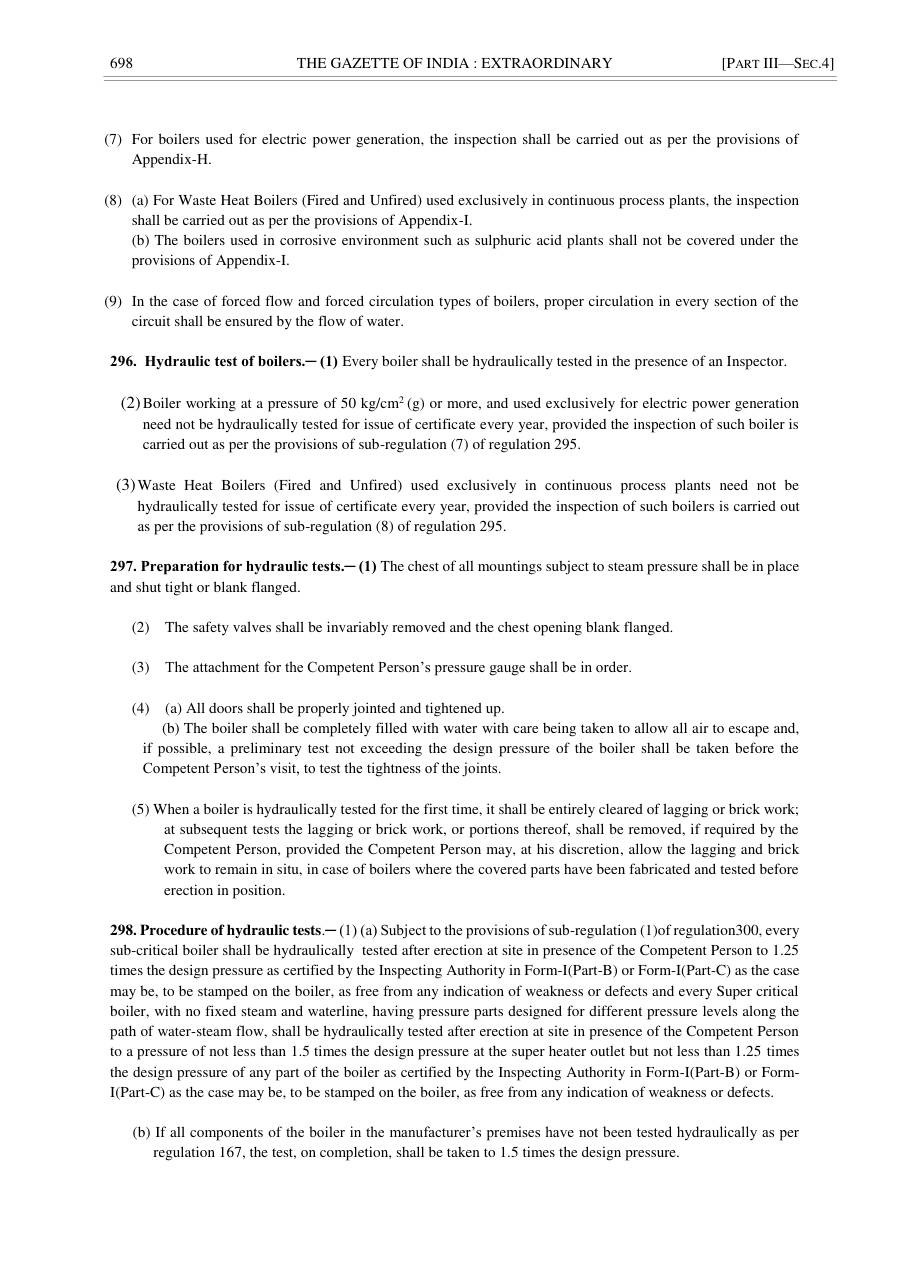
297. Preparation for hydraulic tests.─ (1) The chest of all mountings subject to steam pressure shall be in place and shut tight or blank flanged.
(2)The safety valves shall be invariably removed and the chest opening blank flanged.
(3)The attachment for the Competent Person’s pressure gauge shall be in order.
(4)(a) All doors shall be properly jointed and tightened up.
(b)The boiler shall be completely filled with water with care being taken to allow all air to escape and, if possible, a preliminary test not exceeding the design pressure of the boiler shall be taken before the Competent Person’s visit, to test the tightness of the joints.
(5)When a boiler is hydraulically tested for the first time, it shall be entirely cleared of lagging or brick work; at subsequent tests the lagging or brick work, or portions thereof, shall be removed, if required by the Competent Person, provided the Competent Person may, at his discretion, allow the lagging and brick work to remain in situ, in case of boilers where the covered parts have been fabricated and tested before erection in position.
In short
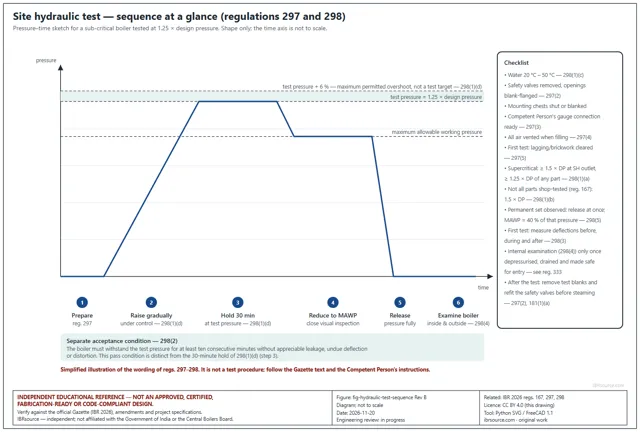
Regulation 297 is the preparation checklist before a hydraulic test. The test itself is in regulation 298.
Checklist
- All steam-pressure mounting chests in place and shut tight, or blank-flanged.
- Safety valves removed and their chest openings blank-flanged. This is not optional. After the test, every blank must be removed and the safety valves refitted before the boiler is steamed again.
- The connection for the Competent Person's pressure gauge ready.
- All doors properly jointed and tightened.
- Boiler completely filled with water, letting all air escape. If possible, run a preliminary tightness test not exceeding the design pressure before the Competent Person's visit.
- First hydraulic test: the boiler must be entirely cleared of lagging or brickwork. At later tests, lagging or brickwork is removed if the Competent Person requires it. The Competent Person may let it stay where the covered parts were fabricated and tested before erection.
Practical tip
Plan the lagging and brickwork sequence on site with the first hydraulic test in mind. Clearing insulation after the fact costs time.
Written by IBRsource editors · last edited 2026-11-20. Explanations simplify and are not a design method, testing procedure or authorisation. Requirements come from the complete regulations, the Gazette and approved documentation.
Original drawings for this regulation
Comparison pending: the IBR 1950 text in force on 30 September 2026 is not yet established for this provision, so no change is claimed (how this works).
Orientation hints (unverified)
These candidates come from automated heading matching against DPIIT's scanned historical print edition of IBR 1950. That edition uses imperial units and riveted-construction provisions, so it is not the operative 2026 predecessor text. Regulation numbers alone never prove equivalence.
| Historical 1950-edition reg. | Heading as OCR'd | Heading similarity | Source image |
|---|---|---|---|
| 56 | Hydraulic Test | 78% | Chapter II (DPIIT scan), image 10 |
| 72 | Hydraulic Test | 78% | Chapter II (DPIIT scan), image 14 |
| 527 | Procedure for Hydraulic test | 78% | Chapter XI (DPIIT scan), image 8 |
Amendment history of the candidate IBR 1950 regulations: Reg. 56 (3 amendments) · Reg. 527 (1 amendment)
IBR 1950 regulation 56 as last published in the DPIIT web edition (archived 2022)
Unofficial archived copy, not verified; see the regulation 56 page for its amendments.
| Reg. 56 MATERIALS OF CONSTRUCTION SEAMLESS FERRITIC PIPES FOR HIGH TEMPERATURE SERVICE Hydraulic Test |
| (i) Each pipe shall be tested by the manufacturer and shall withstand a hydraulic pressure to one and half times the design pressure but not greater than pressure calculated by the following formula given below. In the absence of working pressure is indicated in the Test Certificate then the tested pressure indicated in the Test Certificate divided by 1.5 shall be the maximum working pressure P = 2 S t / d where P = test pressure D = specified outside diameter of the pipe t = specified wall thickness of the pipe S = stress which shall be taken as 40% of the minimum tensile strength at room temperature. (ii) Notwithstanding anything contained in the above clause, the hydraulic test at the maker's works may be dispensed with provided that the pipes are subject to non destructive testing by an appropriate method like Ultrasonic or Eddy current or stray flux testing |
IBR 1950 regulation 527 as last published in the DPIIT web edition (archived 2022)
Unofficial archived copy, not verified; see the regulation 527 page for its amendments.
|
REGULATIONS FOR REGISTRATION AND INSPECTION OF ECONOMISERS AND FEED PIPES | ||||||||||
| ||||||||||
|
REGULATIONS FOR REGISTRATION AND INSPECTION OF ECONOMISERS AND FEED PIPES | ||||||||||
| ||||||||||
|
REGULATIONS FOR REGISTRATION AND INSPECTION OF ECONOMISERS AND FEED PIPES | ||||||||||
|
Images of the official Gazette pages that contain this regulation. Click to zoom. Compare word by word before relying on the extracted text.
Indian Boiler Regulations, 2026, reg. 297, Regulation 297, Gazette of India, Extraordinary, Part III—Section 4, No. 596, 1 October 2026, printed p.698. https://egazette.gov.in/WriteReadData/2026/276813.pdf (text consulted via IBRsource, 2026-11-23).
The citation refers to the government publication. Cite the Gazette, not this website.