BETAIndependent engineering reference. Source-text verification is ongoing.Verification ongoing.Verification status →
IBRsourceIndian Boiler Regulations, made clear

Indian Boiler Regulations, 2026 · Chapter 8 · Inspection and Testing of Boilers and Pipes during Construction and Boiler Registration

Regulation 328. Inspection fee for feed water heaters and other fittings

Official text — not yet verifiedGazette 1 Oct 2026 · printed p. 728Table

Not yet checked against the official Gazette; verify before relying on it.

Reproduced from the Gazette of India · verification status above

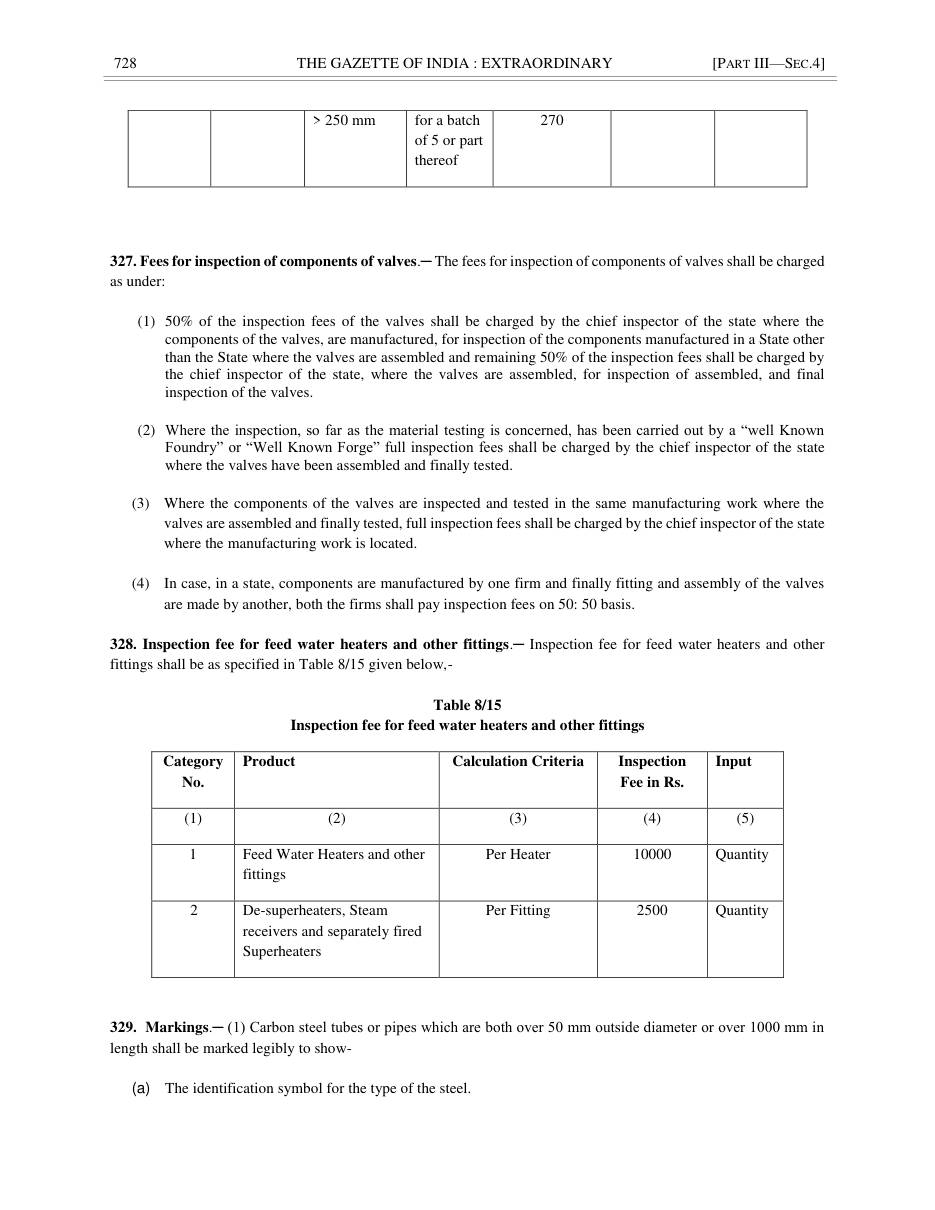
328. Inspection fee for feed water heaters and other fittings.─ Inspection fee for feed water heaters and other fittings shall be as specified in Table 8/15 given below,-

Table 8/15

Category No.ProductCalculation CriteriaInspection Fee in Rs.Input
(1)(2)(3)(4)(5)
1Feed Water Heaters and other fittingsPer Heater10000Quantity
2De-superheaters, Steam
receivers and separately fired
Superheaters
Per Fitting2500Quantity

Table structure read from the Gazette PDF, page 728. Verification status as for the text above.

Show original extracted text (diagnostic, not authoritative)
               Inspection fee for feed water heaters and other fittings

Category Product                     Calculation Criteria  Inspection    Input
   No.                                                     Fee in Rs.        (5)

(1)                (2)                     (3)             (4)           Quantity
                                                                         Quantity
1    Feed Water Heaters and other          Per Heater      10000

     fittings

2    De-superheaters, Steam                Per Fitting     2500

     receivers and separately fired

     Superheaters

Tables and formulae are shown in their extracted layout. Alignment, superscripts and subscripts may be lost. The Gazette page image is authoritative.

Independent explanation — not the law · draft · engineer review in progress

In short

Inspection fees for feed water heaters and other fittings are set in Table 8/15. Feed water heaters and other fittings are charged per heater. De-superheaters, steam receivers and separately fired superheaters are charged per fitting, at a lower rate. See the Official text tab for the amounts.

Written by IBRsource editors · last edited 2026-11-20. Explanations simplify and are not a design method, testing procedure or authorisation. Requirements come from the complete regulations, the Gazette and approved documentation.

Comparison pending: the IBR 1950 text in force on 30 September 2026 is not yet established for this provision, so no change is claimed (how this works).

Orientation hints (unverified)

These candidates come from automated heading matching against DPIIT's scanned historical print edition of IBR 1950. That edition uses imperial units and riveted-construction provisions, so it is not the operative 2026 predecessor text. Regulation numbers alone never prove equivalence.

Historical 1950-edition reg.Heading as OCR'dHeading similaritySource image
368Other Fittings and Mountings78%Chapter VIII (DPIIT scan), image 36
524Preparation for inspection70%Chapter XI (DPIIT scan), image 7
IBR 1950 regulation 368 as last published in the DPIIT web edition (archived 2022)

Unofficial archived copy, not verified; see the regulation 368 page for its amendments.

Reg. 368, Reg. 369

Bronze Screwed and Socketed joints and mountings and fittings of bronze

Mountings and fittings of bronze upto 76 mm (3”) diameter may be attached directly to steel pipes by screwing when the pressures and temperatures do not exceed 8.5 kg/cm² (120 lbs./sq.in.) and 225°C (435°F) respectively; where tapered threads are employed, such joints may be used for pressures not exceeding 17.6 kg/cm² (250 lbs./sq. in.). Bronze fittings above 76 mm (3”) diameter shall be of flanged construction.


Reg. 369

Reducing Valve

Where a reducing valve is installed in a pipe line the pipe line and accessories on the low pressure side of the reducing valve shall be protected by a suitable safety valve or valves so adjusted as to permit the steam to escape as soon as the safe working pressure is exceeded or by a suitable appliance for cutting off automatically the supply of steam as soon as the safe working pressure is exceeded.

IBR 1950 regulation 524 as last published in the DPIIT web edition (archived 2022)

Unofficial archived copy, not verified; see the regulation 524 page for its amendments.

Reg. 524, Reg. 525
STANDARD CONDITIONS FOR THE DESIGN AND CONSTRUCTION OF ECONOMISER, FEED PIPES, FEED HEATERS AND OTHER SIMILAR VESSELS

REGULATIONS FOR REGISTRATION AND INSPECTION OF ECONOMISERS AND FEED PIPES

Preparation for inspection

a)

At each inspection the economiser shall be emptied and thoroughly cleaned internally and externally and in the flues. All mountings shall be opened up and all caps, doors and blank flanges removed to permit adequate inspection.
b) The owner of an economiser to which this Regulation is applicable shall obtain the approval of the Chief Inspector in writing to the method of disconnection which he proposes to use and shall be responsible for ensuring that the method so approved is followed in practice.


Reg. 525

STANDARD CONDITIONS FOR THE DESIGN AND CONSTRUCTION OF ECONOMISER, FEED PIPES, FEED HEATERS AND OTHER SIMILAR VESSELS

REGULATIONS FOR REGISTRATION AND INSPECTION OF ECONOMISERS AND FEED PIPES

Procedure for Registration
a) On receipt of an application for registration the Inspector shall, after the economiser has been prepared for examination, take full particulars of the design and ascertain the working pressure allowed by the Regulations.
b)

The fitness of the economiser parts shall be determined as per the following formulae:-

(i)

Cast Iron Smooth Tube Economisers with Pressed Socket Joints.

WP = AZ + 225N Eqn.(124)
70a n

Where,

WP=Design pressure in pounds per square inch (gauge).
A= Area of contact surface of a single socket, square inches.
a= Cross sectional area measured on the mean diameter of a socket hole, in square inches.
Z=Breakdown load of an unreinforced socket joint in pounds.
N=Number of stays per header.
n=Number of sockets per header.

For existing standard designs the breakdown load of an unreinforced socket joint shall be taken as not greater than 13,500 lbs. For designs not already in use before the date of this standard the corresponding figure shall be taken as not greater than 75 per cent of the load as determined by experiment.
(ii) Headers of approximately rectangular cross section.

WP = C(t-2) Eqn.(125)
b²
Where,

t = Thickness in thirty-second of an inch.
b = Distance between the sides of header supporting the surface, in inches.
WP= Design pressure, in pounds per square inch (gauge)
C = 11 where the water side surface is flat

= 22 where the water side surface is curved, provided that the curvature is continued without interruption and the thickness at each end of the side is not less than that determined with C=11.

In no case, however, shall the thickness of the side of a header be less than 16 thirty-seconds of an inch at any part.
Next >>>

Images of the official Gazette pages that contain this regulation. Click to zoom. Compare word by word before relying on the extracted text.
Instrument
Indian Boiler Regulations, 2026 (made by the Central Boilers Board under s.40 of the Boilers Act, 2025)
Notification
F.No. P-30014/3/2021-Boiler dated 7 Aug 2026
Published
Gazette of India, Extraordinary, Part III Sec. 4, No. 596, 1 Oct 2026 (CG-DL-E-06102026-276813)
In force
1 Oct 2026 (reg. 1(3): date of publication in the Official Gazette)
Printed Gazette page
728
PDF page index
728 · open official e-Gazette PDF
Extraction
pdftotext layout mode, sequential regulation detector · text hash 4489d33d7d36bbb0
Verification
Official text — not yet verified
Amendments checked
None known after 1 Oct 2026 as of build date (not a guarantee). Amendment log
How to cite

Indian Boiler Regulations, 2026, reg. 328, Regulation 328, Gazette of India, Extraordinary, Part III—Section 4, No. 596, 1 October 2026, printed p.728. https://egazette.gov.in/WriteReadData/2026/276813.pdf (text consulted via IBRsource, 2026-11-23).

The citation refers to the government publication. Cite the Gazette, not this website.

Help improve this page

Engineers like you keep IBRsource accurate. Every checked correction or tip helps the next reader.