
Indian Boiler Regulations, 2026 · Chapter 4 · Fusion Welded Drums for Water Tube Boilers and Superheaters
Regulation 167. Hydraulic test at makers’ works
Not yet checked against the official Gazette; verify before relying on it.
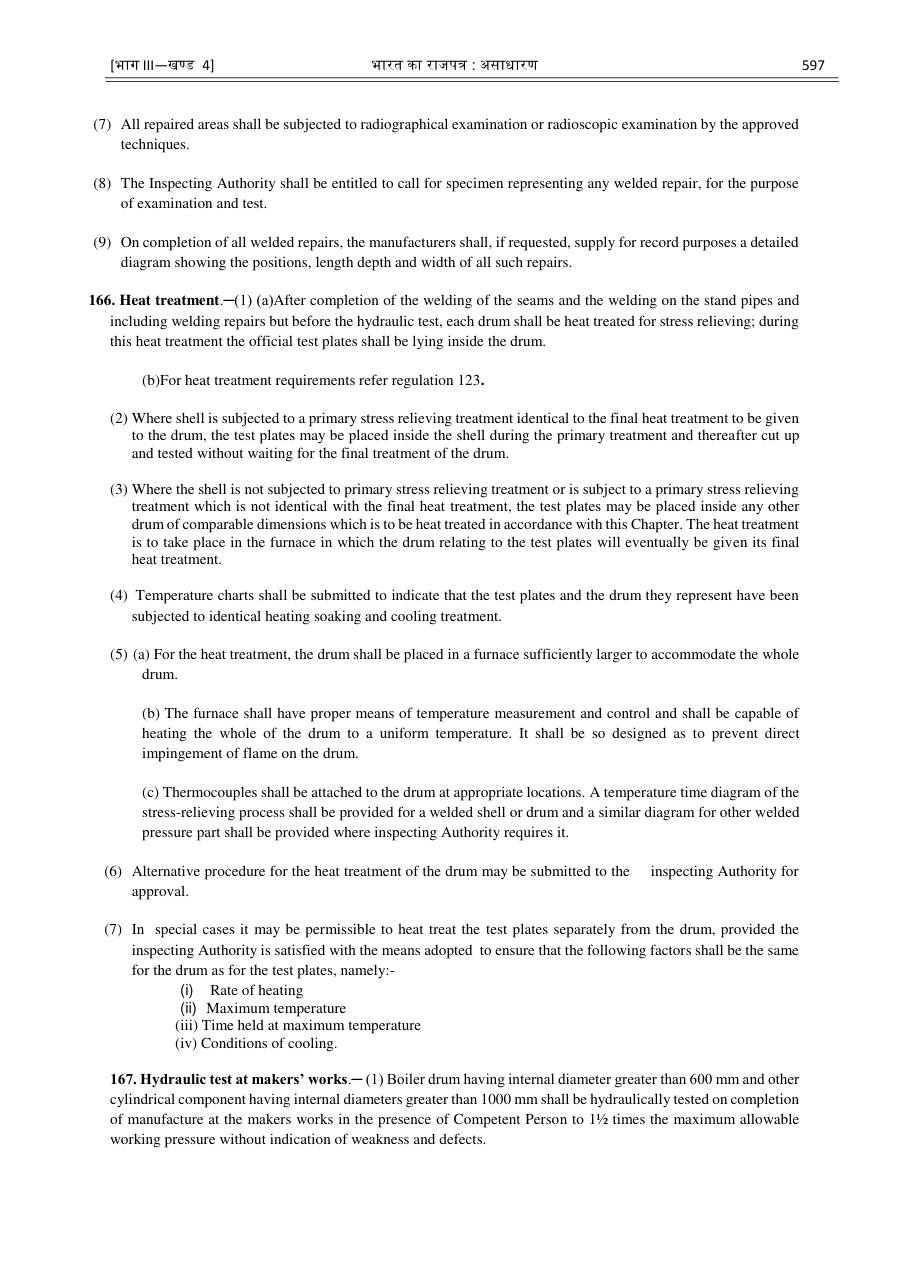
167. Hydraulic test at makers’ works.─ (1) Boiler drum having internal diameter greater than 600 mm and other cylindrical component having internal diameters greater than 1000 mm shall be hydraulically tested on completion of manufacture at the makers works in the presence of Competent Person to 1½ times the maximum allowable working pressure without indication of weakness and defects.
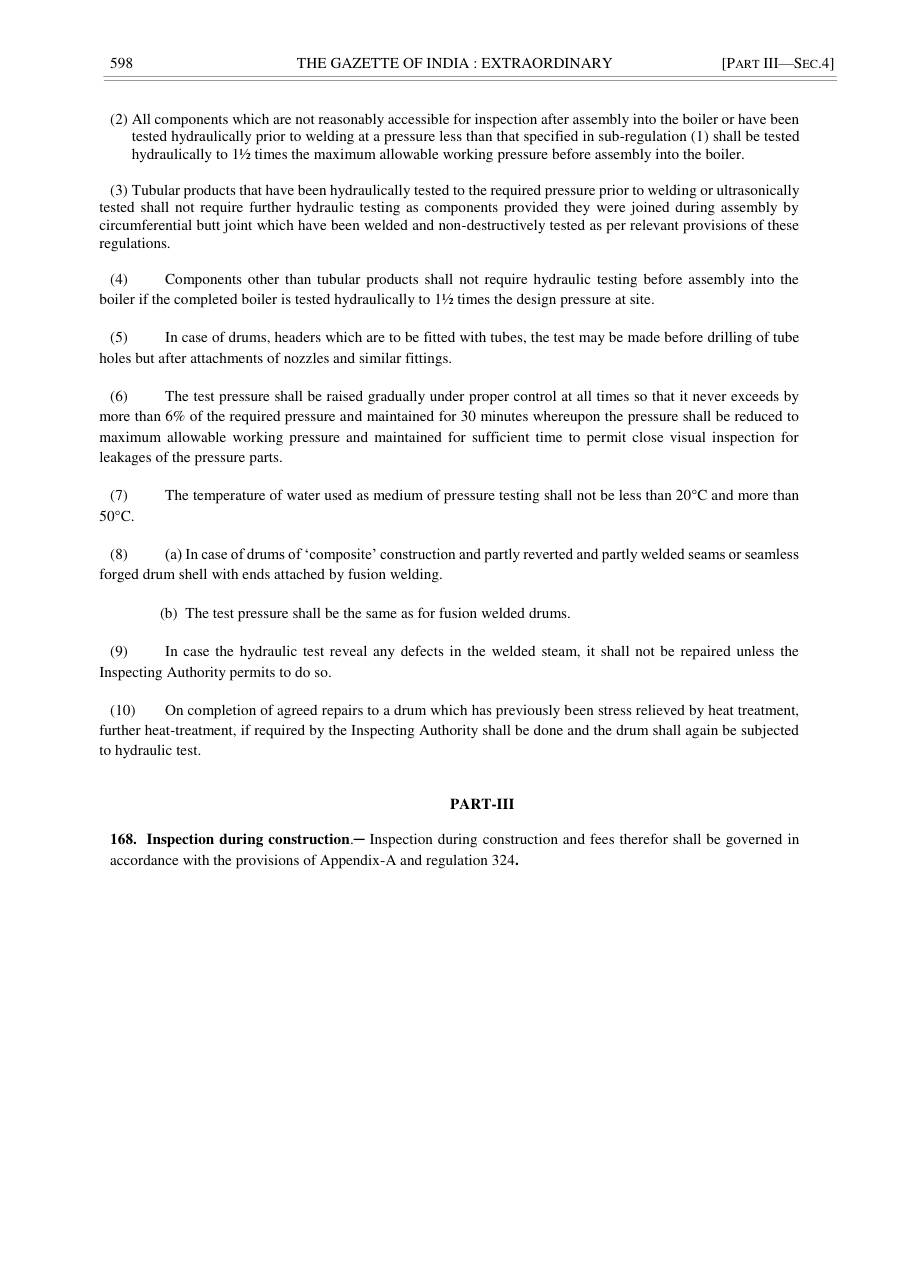
(2)All components which are not reasonably accessible for inspection after assembly into the boiler or have been tested hydraulically prior to welding at a pressure less than that specified in sub-regulation (1) shall be tested hydraulically to 1½ times the maximum allowable working pressure before assembly into the boiler.
(3)Tubular products that have been hydraulically tested to the required pressure prior to welding or ultrasonically tested shall not require further hydraulic testing as components provided they were joined during assembly by circumferential butt joint which have been welded and non-destructively tested as per relevant provisions of these regulations.
(4)Components other than tubular products shall not require hydraulic testing before assembly into the boiler if the completed boiler is tested hydraulically to 1½ times the design pressure at site.
(5)In case of drums, headers which are to be fitted with tubes, the test may be made before drilling of tube holes but after attachments of nozzles and similar fittings.
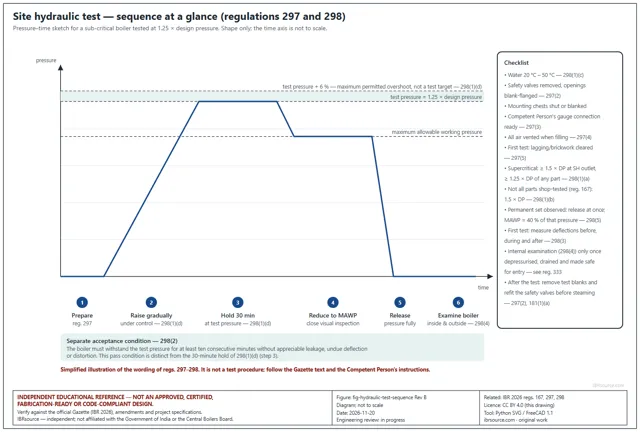
(6)The test pressure shall be raised gradually under proper control at all times so that it never exceeds by more than 6% of the required pressure and maintained for 30 minutes whereupon the pressure shall be reduced to maximum allowable working pressure and maintained for sufficient time to permit close visual inspection for leakages of the pressure parts.
(7)The temperature of water used as medium of pressure testing shall not be less than 20°C and more than 50°C.
(8)(a) In case of drums of ‘composite’ construction and partly reverted and partly welded seams or seamless forged drum shell with ends attached by fusion welding.
(b)The test pressure shall be the same as for fusion welded drums.
(9)In case the hydraulic test reveal any defects in the welded steam, it shall not be repaired unless the Inspecting Authority permits to do so.
(10)On completion of agreed repairs to a drum which has previously been stress relieved by heat treatment, further heat-treatment, if required by the Inspecting Authority shall be done and the drum shall again be subjected to hydraulic test.
In short
Regulation 167 sets the hydraulic test at the maker's works for drums and other components, and when it can be skipped.
Key points
- (1) Drums over 600 mm internal diameter, and other cylindrical components over 1000 mm, are tested at the works before the Competent Person to 1½ times the maximum allowable working pressure, without weakness or defects.
- (2) Components not reasonably accessible after assembly, or tested before welding at a lower pressure, are tested to 1½ times the maximum allowable working pressure before assembly.
- (3) Tubular products tested hydraulically or ultrasonically before welding need no further component test if joined by circumferential butt welds that were non-destructively tested.
- (4) Non-tubular components need no pre-assembly test if the completed boiler is tested to 1½ times the design pressure at site.
- (5) Drums and headers may be tested before drilling tube holes, but after nozzles and similar fittings are attached.
- (6) Pressure is raised gradually, never more than 6% above the required pressure, held for 30 minutes, then reduced to the maximum allowable working pressure for close visual inspection.
- (7) Test water must be between 20°C and 50°C.
- (8) Composite drums (partly riveted and partly welded) and seamless forged shells with fusion welded ends use the same test pressure as fusion welded drums.
Watch out
- (9)–(10) Defects found in the test must not be repaired without Inspecting Authority permission. After repair to a stress-relieved drum, further heat treatment may be required, and the hydraulic test is repeated.
Written by IBRsource editors · last edited 2026-11-20. Explanations simplify and are not a design method, testing procedure or authorisation. Requirements come from the complete regulations, the Gazette and approved documentation.
Original drawings for this regulation
Comparison pending: the IBR 1950 text in force on 30 September 2026 is not yet established for this provision, so no change is claimed (how this works).
Orientation hints (unverified)
These candidates come from automated heading matching against DPIIT's scanned historical print edition of IBR 1950. That edition uses imperial units and riveted-construction provisions, so it is not the operative 2026 predecessor text. Regulation numbers alone never prove equivalence.
| Historical 1950-edition reg. | Heading as OCR'd | Heading similarity | Source image |
|---|---|---|---|
| 56 | Hydraulic Test | 100% | Chapter II (DPIIT scan), image 10 |
| 72 | Hydraulic Test | 100% | Chapter II (DPIIT scan), image 14 |
| 268 | Hydraulic and Hammer Tests | 75% | Chapter V (DPIIT scan), image 8 |
Amendment history of the candidate IBR 1950 regulations: Reg. 56 (3 amendments) · Reg. 268 (3 amendments)
IBR 1950 regulation 56 as last published in the DPIIT web edition (archived 2022)
Unofficial archived copy, not verified; see the regulation 56 page for its amendments.
| Reg. 56 MATERIALS OF CONSTRUCTION SEAMLESS FERRITIC PIPES FOR HIGH TEMPERATURE SERVICE Hydraulic Test |
| (i) Each pipe shall be tested by the manufacturer and shall withstand a hydraulic pressure to one and half times the design pressure but not greater than pressure calculated by the following formula given below. In the absence of working pressure is indicated in the Test Certificate then the tested pressure indicated in the Test Certificate divided by 1.5 shall be the maximum working pressure P = 2 S t / d where P = test pressure D = specified outside diameter of the pipe t = specified wall thickness of the pipe S = stress which shall be taken as 40% of the minimum tensile strength at room temperature. (ii) Notwithstanding anything contained in the above clause, the hydraulic test at the maker's works may be dispensed with provided that the pipes are subject to non destructive testing by an appropriate method like Ultrasonic or Eddy current or stray flux testing |
IBR 1950 regulation 268 as last published in the DPIIT web edition (archived 2022)
Unofficial archived copy, not verified; see the regulation 268 page for its amendments.
|
| ||||||||||||||||||||
|
Images of the official Gazette pages that contain this regulation. Click to zoom. Compare word by word before relying on the extracted text.
Indian Boiler Regulations, 2026, reg. 167, Regulation 167, Gazette of India, Extraordinary, Part III—Section 4, No. 596, 1 October 2026, printed p.597–598. https://egazette.gov.in/WriteReadData/2026/276813.pdf (text consulted via IBRsource, 2026-11-23).
The citation refers to the government publication. Cite the Gazette, not this website.