
Indian Boiler Regulations, 2026 · Chapter 4 · Fusion Welded Drums for Water Tube Boilers and Superheaters
Regulation 151. Method of making welded joints
Not yet checked against the official Gazette; verify before relying on it.
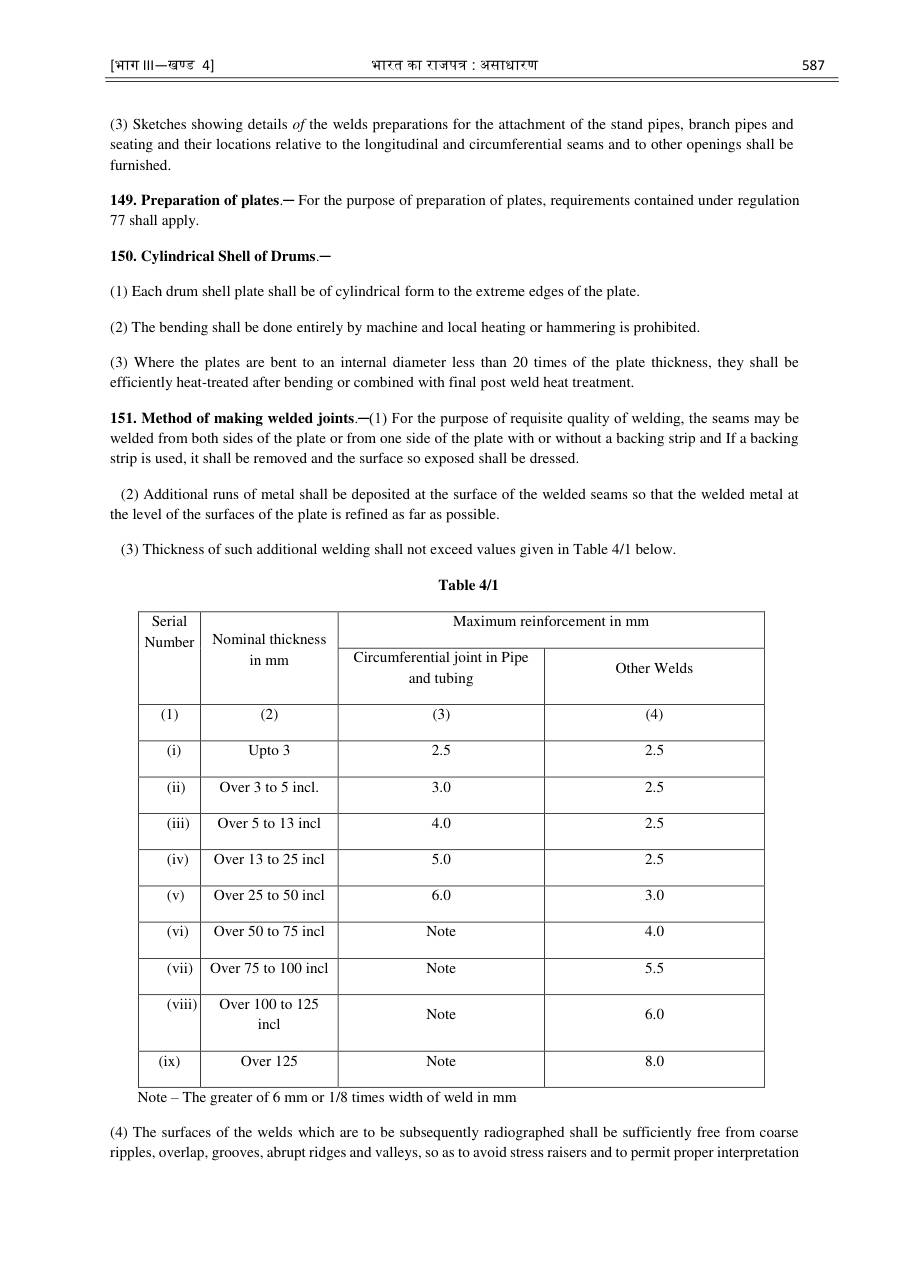
151. Method of making welded joints.─(1) For the purpose of requisite quality of welding, the seams may be welded from both sides of the plate or from one side of the plate with or without a backing strip and If a backing strip is used, it shall be removed and the surface so exposed shall be dressed.
(2)Additional runs of metal shall be deposited at the surface of the welded seams so that the welded metal at the level of the surfaces of the plate is refined as far as possible.
(3)Thickness of such additional welding shall not exceed values given in Table 4/1 below.
Table 4/1
| Serial Number | Nominal thickness in mm | Maximum reinforcement in mm | |
|---|---|---|---|
| Circumferential joint in Pipe and tubing | Other Welds | ||
| (1) | (2) | (3) | (4) |
| (i) | Upto 3 | 2.5 | 2.5 |
| (ii) | Over 3 to 5 incl. | 3.0 | 2.5 |
| (iii) | Over 5 to 13 incl | 4.0 | 2.5 |
| (iv) | Over 13 to 25 incl | 5.0 | 2.5 |
| (v) | Over 25 to 50 incl | 6.0 | 3.0 |
| (vi) | Over 50 to 75 incl | Note | 4.0 |
| (vii) | Over 75 to 100 incl | Note | 5.5 |
| (viii) | Over 100 to 125 incl | Note | 6.0 |
| (ix) | Over 125 | Note | 8.0 |
Table structure read from the Gazette PDF, page 587. Verification status as for the text above.
Show original extracted text (diagnostic, not authoritative)
 Serial                                 Maximum reinforcement in mm
Number
         Nominal thickness
                in mm              Circumferential joint in Pipe  Other Welds
                                             and tubing

(1)                (2)             (3)                                                     (4)

(i)                Upto 3          2.5                                                     2.5

(ii) Over 3 to 5 incl.             3.0                                                     2.5

(iii) Over 5 to 13 incl            4.0                                                     2.5

(iv) Over 13 to 25 incl            5.0                                                     2.5

(v) Over 25 to 50 incl             6.0                                                     3.0

(vi) Over 50 to 75 incl            Note                                                    4.0

(vii) Over 75 to 100 incl          Note                                                    5.5

(viii) Over 100 to 125 Note 6.0
                  incl

(ix)               Over 125        Note                                                    8.0
Note – The greater of 6 mm or 1/8 times width of weld in mm
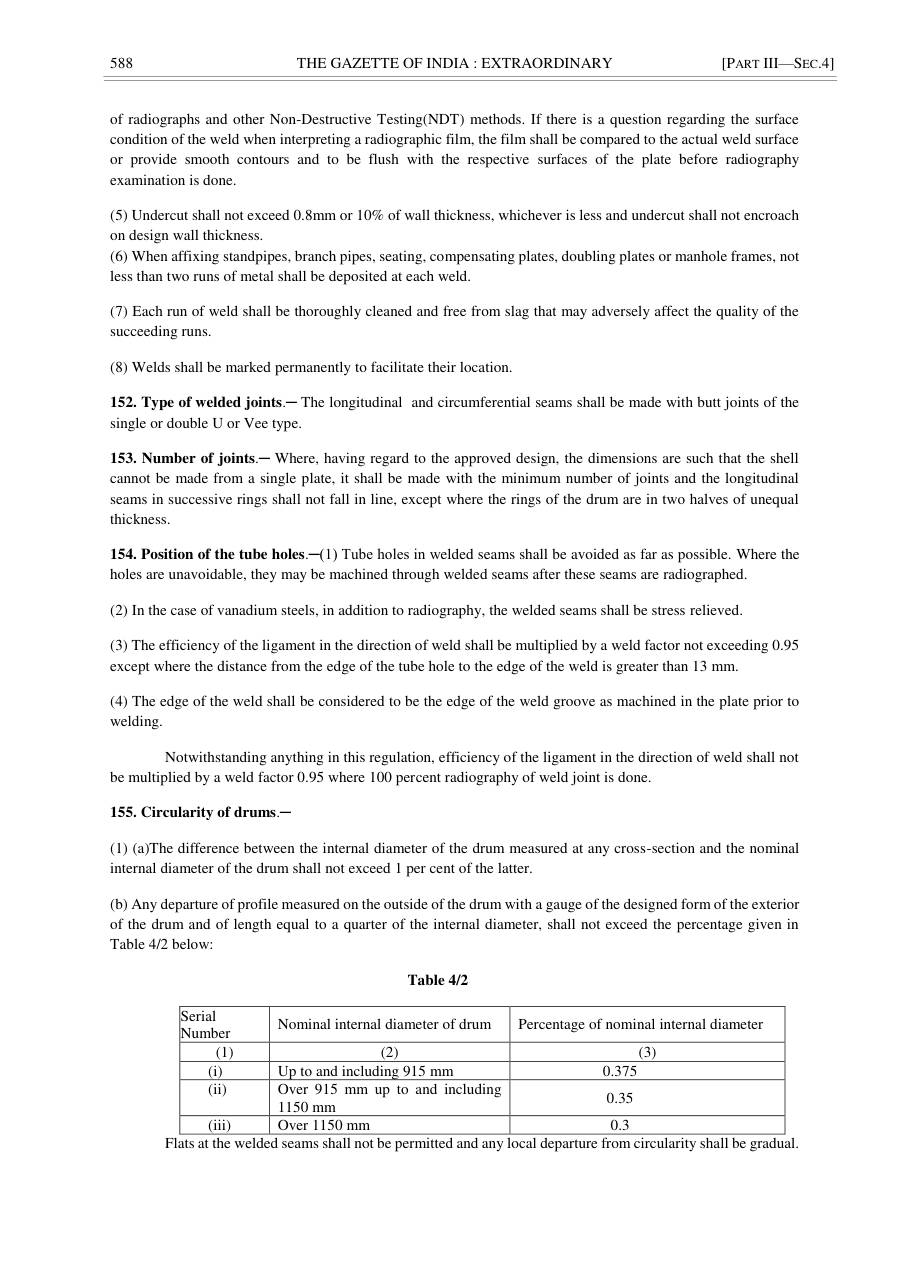
(4)The surfaces of the welds which are to be subsequently radiographed shall be sufficiently free from coarse ripples, overlap, grooves, abrupt ridges and valleys, so as to avoid stress raisers and to permit proper interpretation of radiographs and other Non-Destructive Testing(NDT) methods. If there is a question regarding the surface condition of the weld when interpreting a radiographic film, the film shall be compared to the actual weld surface or provide smooth contours and to be flush with the respective surfaces of the plate before radiography examination is done.
(5)Undercut shall not exceed 0.8mm or 10% of wall thickness, whichever is less and undercut shall not encroach on design wall thickness.
(6)When affixing standpipes, branch pipes, seating, compensating plates, doubling plates or manhole frames, not less than two runs of metal shall be deposited at each weld.
(7)Each run of weld shall be thoroughly cleaned and free from slag that may adversely affect the quality of the succeeding runs.
(8)Welds shall be marked permanently to facilitate their location.
Tables and formulae are shown in their extracted layout. Alignment, superscripts and subscripts may be lost. The Gazette page image is authoritative.
In short
Regulation 151 sets how drum seams are welded: welding sides, backing strips, reinforcement limits, surface finish, undercut, number of runs, cleaning and marking.
Key points
- (1) Seams may be welded from both sides, or from one side with or without a backing strip. A backing strip, if used, must be removed and the exposed surface dressed.
- (2) Additional runs are deposited at the surface so the weld metal at plate level is refined as far as possible.
- (3) Table 4/1 limits the height of this reinforcement by nominal thickness, with separate columns for circumferential joints in pipe and tubing and for other welds. See the Official text tab for the values.
- (4) Welds to be radiographed must be free enough from ripples, overlap, grooves, ridges and valleys to avoid stress raisers and allow proper interpretation of radiographs and other NDT.
- (5) Undercut must not exceed 0.8mm or 10% of wall thickness, whichever is less, and must not encroach on design wall thickness.
- (6) At least two runs are needed when attaching standpipes, branch pipes, seatings, compensating or doubling plates or manhole frames.
- (7) Each run must be cleaned and free from slag before the next.
- (8) Welds must be permanently marked so they can be located.
Written by IBRsource editors · last edited 2026-11-20. Explanations simplify and are not a design method, testing procedure or authorisation. Requirements come from the complete regulations, the Gazette and approved documentation.
Comparison pending: the IBR 1950 text in force on 30 September 2026 is not yet established for this provision, so no change is claimed (how this works).
Orientation hints (unverified)
These candidates come from automated heading matching against DPIIT's scanned historical print edition of IBR 1950. That edition uses imperial units and riveted-construction provisions, so it is not the operative 2026 predecessor text. Regulation numbers alone never prove equivalence.
No candidate heading found in the historical print edition.
Images of the official Gazette pages that contain this regulation. Click to zoom. Compare word by word before relying on the extracted text.
Indian Boiler Regulations, 2026, reg. 151, Regulation 151, Gazette of India, Extraordinary, Part III—Section 4, No. 596, 1 October 2026, printed p.587–588. https://egazette.gov.in/WriteReadData/2026/276813.pdf (text consulted via IBRsource, 2026-11-23).
The citation refers to the government publication. Cite the Gazette, not this website.