
Indian Boiler Regulations, 2026 · Chapter 4 · Fusion Welded Drums for Water Tube Boilers and Superheaters
Regulation 156. Mechanical test and test plates of fusion welded seams
Not yet checked against the official Gazette; verify before relying on it.
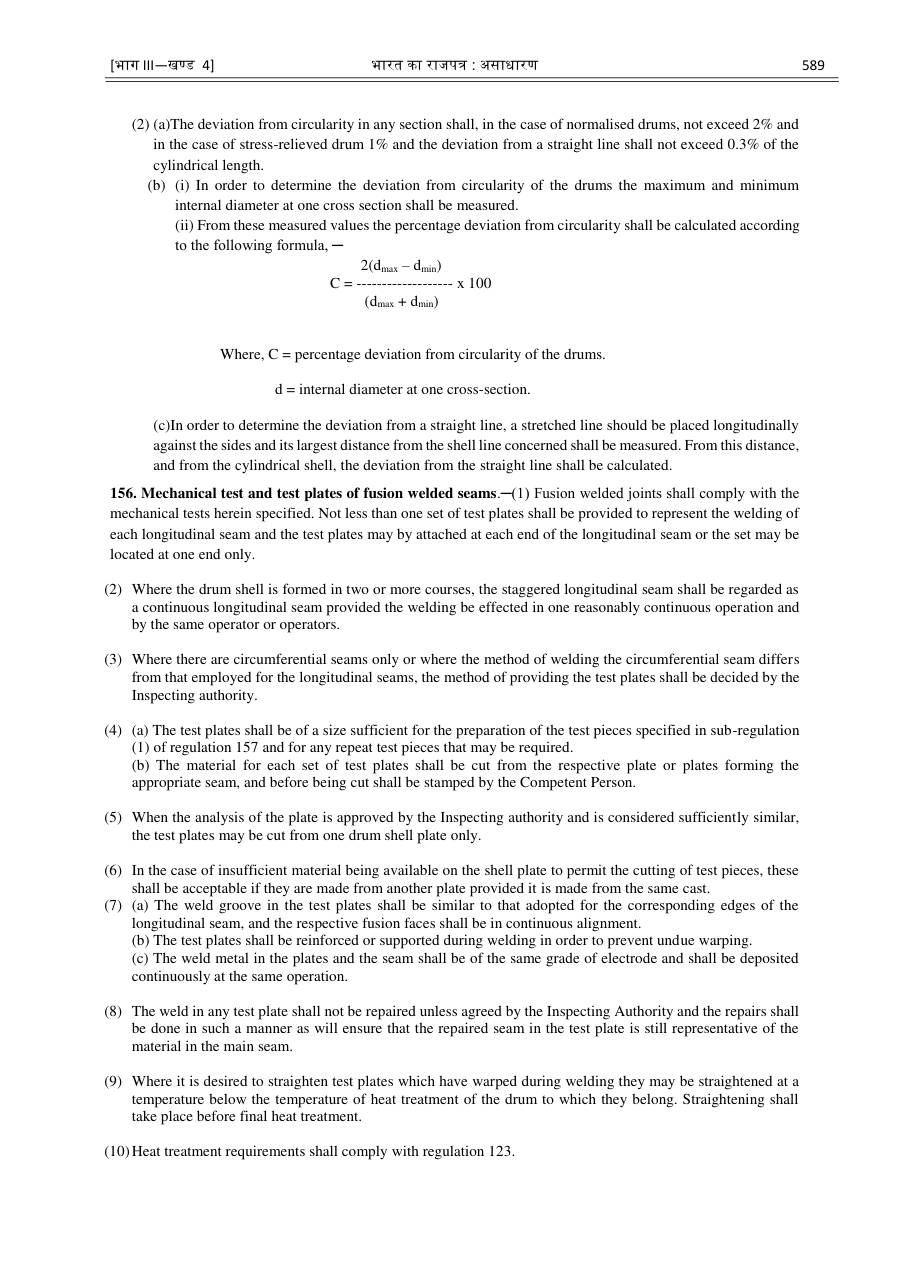
156. Mechanical test and test plates of fusion welded seams.─(1) Fusion welded joints shall comply with the mechanical tests herein specified. Not less than one set of test plates shall be provided to represent the welding of each longitudinal seam and the test plates may by attached at each end of the longitudinal seam or the set may be located at one end only.
(2)Where the drum shell is formed in two or more courses, the staggered longitudinal seam shall be regarded as a continuous longitudinal seam provided the welding be effected in one reasonably continuous operation and by the same operator or operators.
(3)Where there are circumferential seams only or where the method of welding the circumferential seam differs from that employed for the longitudinal seams, the method of providing the test plates shall be decided by the Inspecting authority.
(4)(a) The test plates shall be of a size sufficient for the preparation of the test pieces specified in sub-regulation
(1)of regulation 157 and for any repeat test pieces that may be required.
(b)The material for each set of test plates shall be cut from the respective plate or plates forming the appropriate seam, and before being cut shall be stamped by the Competent Person.
(5)When the analysis of the plate is approved by the Inspecting authority and is considered sufficiently similar, the test plates may be cut from one drum shell plate only.
(6)In the case of insufficient material being available on the shell plate to permit the cutting of test pieces, these shall be acceptable if they are made from another plate provided it is made from the same cast.
(7)(a) The weld groove in the test plates shall be similar to that adopted for the corresponding edges of the longitudinal seam, and the respective fusion faces shall be in continuous alignment.
(b)The test plates shall be reinforced or supported during welding in order to prevent undue warping.
(c)The weld metal in the plates and the seam shall be of the same grade of electrode and shall be deposited continuously at the same operation.
(8)The weld in any test plate shall not be repaired unless agreed by the Inspecting Authority and the repairs shall be done in such a manner as will ensure that the repaired seam in the test plate is still representative of the material in the main seam.
(9)Where it is desired to straighten test plates which have warped during welding they may be straightened at a temperature below the temperature of heat treatment of the drum to which they belong. Straightening shall take place before final heat treatment.
(10)Heat treatment requirements shall comply with regulation 123.
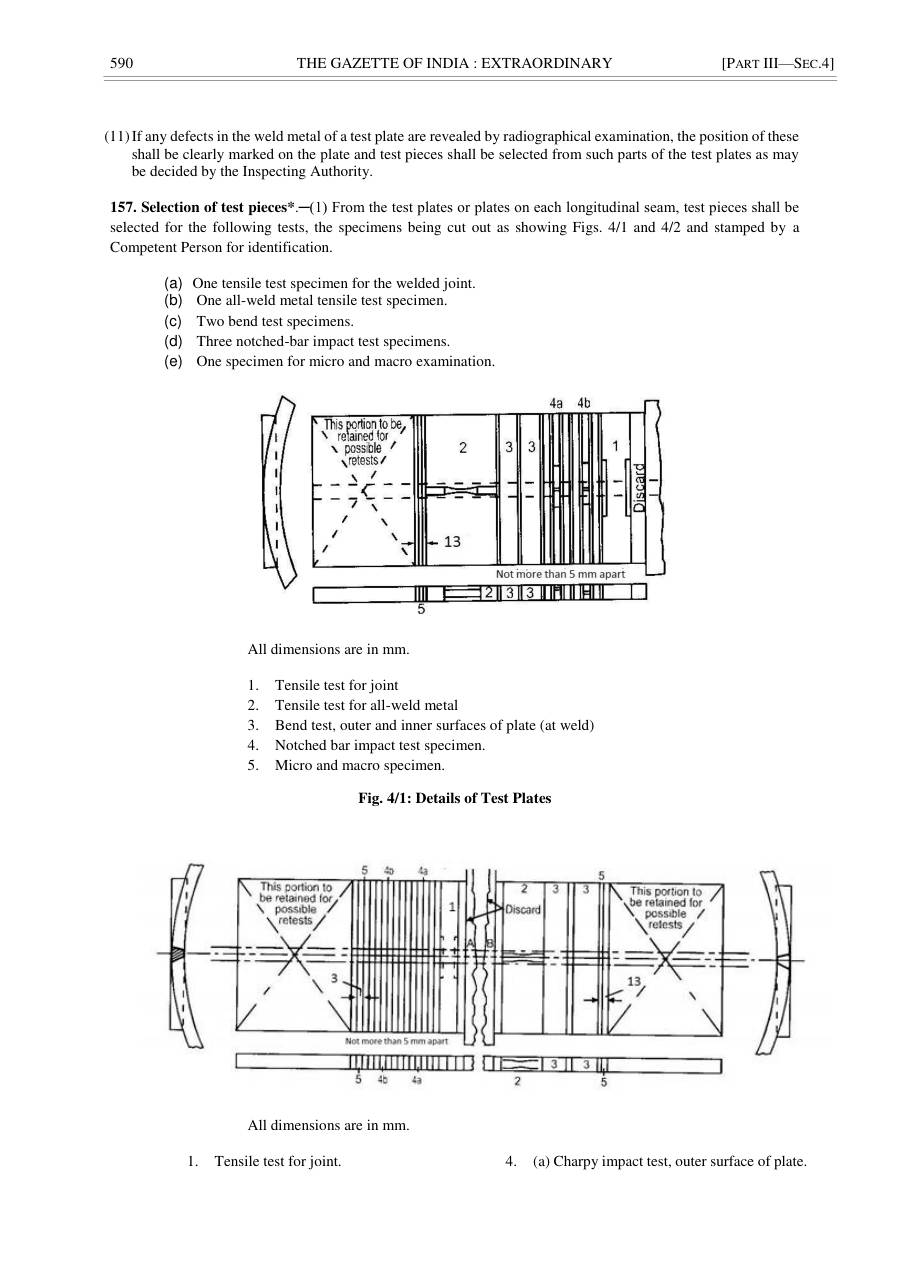
(11)If any defects in the weld metal of a test plate are revealed by radiographical examination, the position of these shall be clearly marked on the plate and test pieces shall be selected from such parts of the test plates as may be decided by the Inspecting Authority.
In short
Fusion welded joints must pass mechanical tests on test plates welded with the seam. Regulation 156 sets how those test plates are provided and handled.
Key points
- (1) At least one set of test plates per longitudinal seam, attached at each end or at one end only.
- (2) A staggered longitudinal seam across several courses counts as one seam if welded in one reasonably continuous operation by the same operator(s).
- (3) For circumferential-only seams, or where they are welded differently, the Inspecting Authority decides the test plate arrangement.
- (4) Plates must be large enough for the test pieces in regulation 157 and retests, cut from the seam's own plate(s) and stamped by the Competent Person before cutting.
- (5)–(6) Test plates may come from one shell plate if the analysis is approved as similar, or from another plate of the same cast if material is short.
- (7) Weld groove must match the seam, with fusion faces aligned; plates supported against warping; same electrode grade, deposited continuously in the same operation.
- (9) Warped plates may be straightened below the drum's heat treatment temperature, before final heat treatment.
- (10) Heat treatment follows regulation 123.
- (11) Defects found by radiography are marked, and the Inspecting Authority decides where test pieces are taken.
Watch out
- (8) Test plate welds must not be repaired unless the Inspecting Authority agrees, and any repair must keep the plate representative of the main seam.
Written by IBRsource editors · last edited 2026-11-20. Explanations simplify and are not a design method, testing procedure or authorisation. Requirements come from the complete regulations, the Gazette and approved documentation.
Comparison pending: the IBR 1950 text in force on 30 September 2026 is not yet established for this provision, so no change is claimed (how this works).
Orientation hints (unverified)
These candidates come from automated heading matching against DPIIT's scanned historical print edition of IBR 1950. That edition uses imperial units and riveted-construction provisions, so it is not the operative 2026 predecessor text. Regulation numbers alone never prove equivalence.
| Historical 1950-edition reg. | Heading as OCR'd | Heading similarity | Source image |
|---|---|---|---|
| 33 | Plates | 100% | Chapter II (DPIIT scan), image 3 |
| 89 | Mechanical test | 100% | Chapter II (DPIIT scan), image 18 |
| 107 | Welded Shell Plates | 81% | Chapter III (DPIIT scan), image 1 |
Amendment history of the candidate IBR 1950 regulations: Reg. 89 (1 amendment)
IBR 1950 regulation 33 as last published in the DPIIT web edition (archived 2022)
Unofficial archived copy, not verified; see the regulation 33 page for its amendments.
| Reg. 33 MATERIALS OF CONSTRUCTION COPPER PLATES, STAY AND RIVET BARS |
| (a) Process.- The copper shall be fire-refined or electrolytic and hot-rolled from suitable cakes. (b) Chemical Composition.- The chemical composition of the plates shall be as follows:-
(c) Freedom from defects.- The plates shall be clean, smooth and free from defects and shall have a workmanlike finish. They shall be thoroughly annealed. (d) Rolling Margin.- No plate shall be under the specified thickness at any part, not more than 5% over the calculated weight. The scrap margin, partly sheared and left attached, shall be not less than 3 inches at the ends and 1½ inches at each side. (e) Tensile Tests.- One tensile test shall be taken from each plate as rolled. The tensile breaking strength, from Standard Test Piece A, shall not be less than 14 tons per sq. inch with an elongation of not less than 35%. (f) Hot and Cold Bend tests.- One hot (temperature between 1200°F and 1400°F) and one cold bend test shall be taken from each plate as rolled. For either hot or cold bend tests, the test piece shall withstand being doubled over without fracture until the sides are touching and parallel. |
IBR 1950 regulation 89 as last published in the DPIIT web edition (archived 2022)
Unofficial archived copy, not verified; see the regulation 89 page for its amendments.
| Reg. 89 MATERIALS OF CONSTRUCTION GENERAL GREY IRON CASTINGS (GRADE A) Mechanical test |
| The casting must comply with the transverse and tensile tests specified in Regulation 90 and Regulation 91. All test pieces shall be selected by the Inspector and tested in his presence and to his satisfaction. |
IBR 1950 regulation 107 as last published in the DPIIT web edition (archived 2022)
Unofficial archived copy, not verified; see the regulation 107 page for its amendments.
| Reg. 105, Reg. 106, Reg. 107 SHELLS, ANGLE RINGS, BUTT STRAPS, ETC. Angle Rings |
| Angle rings for the attachment of end plates to shell plates and/or flue sections shall be rolled or machined so that they fit closely to the flat and cylindrical surfaces to be connected, and shall be machined or machine gas cut on the caulking edges. Where shell plates and end plate are connected by means of an external angle ring, the angle rings shall be no less in thickness than as follows :-
Reg. 107 SHELLS, ANGLE RINGS, BUTT STRAPS, ETC. Welded Shell Plates The requirements of welded shells shall be covered by the provisions made in the Regulations in Chapter V or Chapter XII, as the case may be. The working pressure of such shells shall comply with Regulation 176 where J = 100 and C = 2.75. |
Images of the official Gazette pages that contain this regulation. Click to zoom. Compare word by word before relying on the extracted text.
Indian Boiler Regulations, 2026, reg. 156, Regulation 156, Gazette of India, Extraordinary, Part III—Section 4, No. 596, 1 October 2026, printed p.589–590. https://egazette.gov.in/WriteReadData/2026/276813.pdf (text consulted via IBRsource, 2026-11-23).
The citation refers to the government publication. Cite the Gazette, not this website.