
Indian Boiler Regulations, 2026 · Chapter 4 · Fusion Welded Drums for Water Tube Boilers and Superheaters
Regulation 170. Permissible working stresses for shells of boiler and integral super heater drums and headers
Not yet checked against the official Gazette; verify before relying on it.
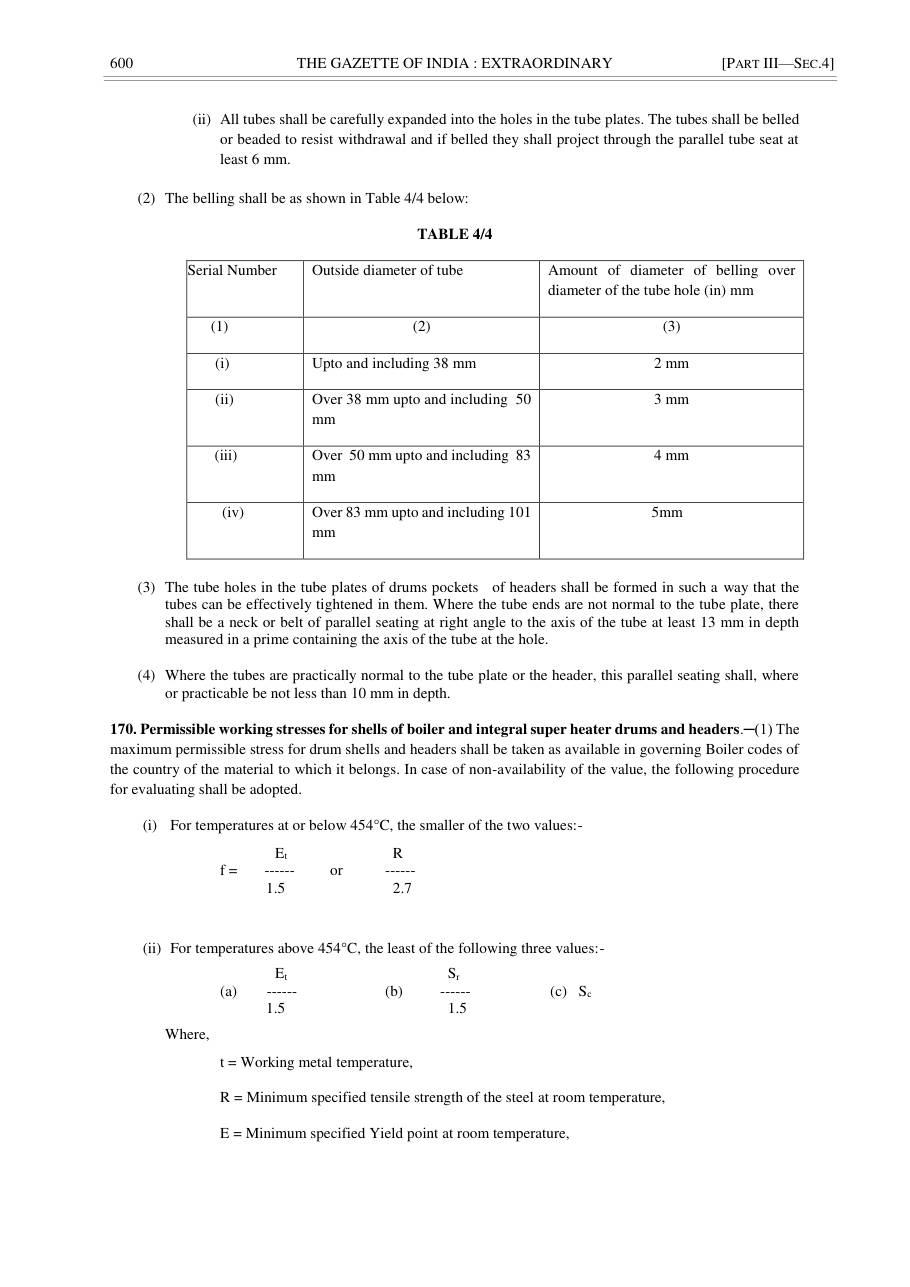
170. Permissible working stresses for shells of boiler and integral super heater drums and headers.─(1) The maximum permissible stress for drum shells and headers shall be taken as available in governing Boiler codes of the country of the material to which it belongs. In case of non-availability of the value, the following procedure for evaluating shall be adopted.
(i)For temperatures at or below 454°C, the smaller of the two values:-
| Et | R | ||
| f = | ------ 1.5 | or | ------ 2.7 |
Table structure read from the Gazette PDF, page 600. Verification status as for the text above.
Show original extracted text (diagnostic, not authoritative)
          Et       R
f = ------ or     ------

1.5 2.7(ii)For temperatures above 454°C, the least of the following three values:-
| Et | Sr | ||||
| (a) | ------ 1.5 | (b) | ------ 1.5 | (c) | Sc |
Table structure read from the Gazette PDF, page 600. Verification status as for the text above.
Show original extracted text (diagnostic, not authoritative)
          Et                  Sr                 (c) Sc
(a) ------        (b) ------

         1.5                  1.5
Where, t = Working metal temperature,
R = Minimum specified tensile strength of the steel at room temperature,
E = Minimum specified Yield point at room temperature,
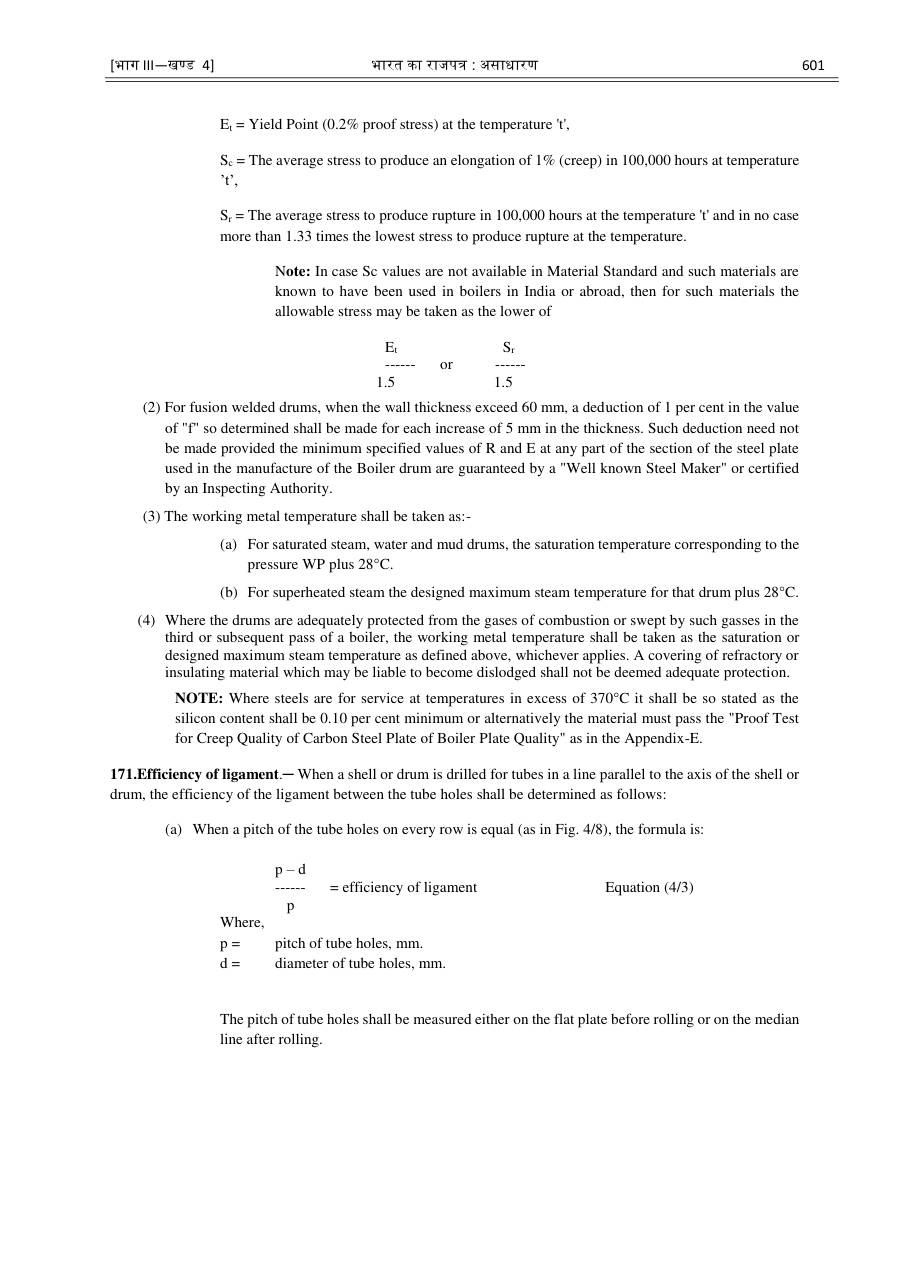
Et = Yield Point (0.2% proof stress) at the temperature 't',
Sc = The average stress to produce an elongation of 1% (creep) in 100,000 hours at temperature ’t’,
Sr = The average stress to produce rupture in 100,000 hours at the temperature 't' and in no case more than 1.33 times the lowest stress to produce rupture at the temperature.
Note: In case Sc values are not available in Material Standard and such materials are
known to have been used in boilers in India or abroad, then for such materials the
allowable stress may be taken as the lower of

         Et                        Sr
         ------ or                ------
        1.5                       1.5
(2)For fusion welded drums, when the wall thickness exceed 60 mm, a deduction of 1 per cent in the value of "f" so determined shall be made for each increase of 5 mm in the thickness. Such deduction need not be made provided the minimum specified values of R and E at any part of the section of the steel plate used in the manufacture of the Boiler drum are guaranteed by a "Well known Steel Maker" or certified by an Inspecting Authority.
(3)The working metal temperature shall be taken as:-
(a)For saturated steam, water and mud drums, the saturation temperature corresponding to the pressure WP plus 28°C.
(b)For superheated steam the designed maximum steam temperature for that drum plus 28°C.
(4)Where the drums are adequately protected from the gases of combustion or swept by such gasses in the third or subsequent pass of a boiler, the working metal temperature shall be taken as the saturation or designed maximum steam temperature as defined above, whichever applies. A covering of refractory or insulating material which may be liable to become dislodged shall not be deemed adequate protection.
NOTE: Where steels are for service at temperatures in excess of 370°C it shall be so stated as the silicon content shall be 0.10 per cent minimum or alternatively the material must pass the "Proof Test for Creep Quality of Carbon Steel Plate of Boiler Plate Quality" as in the Appendix-E.
Tables and formulae are shown in their extracted layout. Alignment, superscripts and subscripts may be lost. The Gazette page image is authoritative.
Drum shell calculator, permissible stress derived per this regulation
In short
Regulation 170 sets the permissible working stress f for drum shells and headers. Use the value in the governing boiler code of the material's country; if none is available, use the procedure here.
Key points
- (1)(i) At or below 454°C: f is the smaller of Et/1.5 and R/2.7.
- (1)(ii) Above 454°C: f is the least of Et/1.5, Sr/1.5 and Sc. Et is the 0.2% proof stress at temperature; Sr and Sc are the average stresses for rupture and for 1% creep in 100,000 hours (Sr capped at 1.33 times the lowest rupture stress).
- Note: if Sc is not available and the material is known to have been used in boilers in India or abroad, f may be the lower of Et/1.5 and Sr/1.5.
- (2) For fusion welded drums thicker than 60 mm, f is reduced by 1 per cent for each 5 mm increase in thickness, unless R and E are guaranteed across the section by a "Well known Steel Maker" or certified by an Inspecting Authority.
- (3) Working metal temperature: saturation temperature at working pressure plus 28°C for saturated steam, water and mud drums; designed maximum steam temperature plus 28°C for superheated steam.
- (4) Drums adequately protected from combustion gases, or swept by them in the third or later pass, use the saturation or design steam temperature without the addition.
Watch out
- Refractory or insulation that may become dislodged is not adequate protection.
- Steels for service above 370°C must be so stated, with silicon of at least 0.10 per cent or a pass in the creep quality proof test in Appendix-E.
Written by IBRsource editors · last edited 2026-11-20. Explanations simplify and are not a design method, testing procedure or authorisation. Requirements come from the complete regulations, the Gazette and approved documentation.
Comparison pending: the IBR 1950 text in force on 30 September 2026 is not yet established for this provision, so no change is claimed (how this works).
Orientation hints (unverified)
These candidates come from automated heading matching against DPIIT's scanned historical print edition of IBR 1950. That edition uses imperial units and riveted-construction provisions, so it is not the operative 2026 predecessor text. Regulation numbers alone never prove equivalence.
| Historical 1950-edition reg. | Heading as OCR'd | Heading similarity | Source image |
|---|---|---|---|
| 564 | Shells | 100% | Chapter XII (DPIIT scan), image 2 |
Amendment history of the candidate IBR 1950 regulation: Reg. 564 (1 amendment)
IBR 1950 regulation 564 as last published in the DPIIT web edition (archived 2022)
Unofficial archived copy, not verified; see the regulation 564 page for its amendments.
| Reg. 563, Reg. 564 | |||||||||||||||||||||||||||||||||||||
Reg. 564 Shells
| |||||||||||||||||||||||||||||||||||||
Images of the official Gazette pages that contain this regulation. Click to zoom. Compare word by word before relying on the extracted text.
Indian Boiler Regulations, 2026, reg. 170, Regulation 170, Gazette of India, Extraordinary, Part III—Section 4, No. 596, 1 October 2026, printed p.600–601. https://egazette.gov.in/WriteReadData/2026/276813.pdf (text consulted via IBRsource, 2026-11-23).
The citation refers to the government publication. Cite the Gazette, not this website.