
Indian Boiler Regulations, 2026 · Chapter 4 · Fusion Welded Drums for Water Tube Boilers and Superheaters
Regulation 164. Non-Destructive test
Not yet checked against the official Gazette; verify before relying on it.
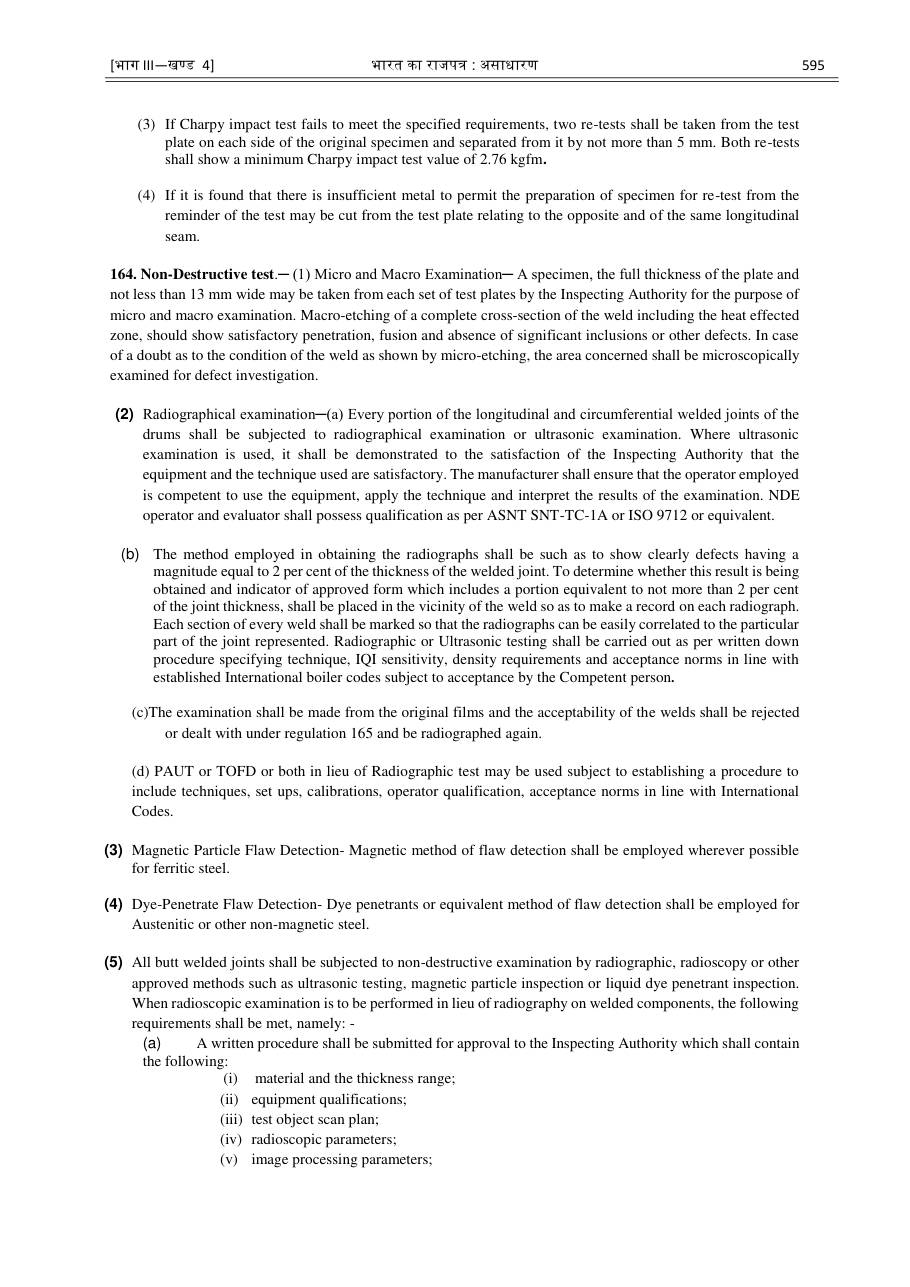
164. Non-Destructive test.─ (1) Micro and Macro Examination─ A specimen, the full thickness of the plate and not less than 13 mm wide may be taken from each set of test plates by the Inspecting Authority for the purpose of micro and macro examination. Macro-etching of a complete cross-section of the weld including the heat effected zone, should show satisfactory penetration, fusion and absence of significant inclusions or other defects. In case of a doubt as to the condition of the weld as shown by micro-etching, the area concerned shall be microscopically examined for defect investigation.
(2)Radiographical examination─(a) Every portion of the longitudinal and circumferential welded joints of the drums shall be subjected to radiographical examination or ultrasonic examination. Where ultrasonic examination is used, it shall be demonstrated to the satisfaction of the Inspecting Authority that the equipment and the technique used are satisfactory. The manufacturer shall ensure that the operator employed is competent to use the equipment, apply the technique and interpret the results of the examination. NDE operator and evaluator shall possess qualification as per ASNT SNT-TC-1A or ISO 9712 or equivalent.
(b)The method employed in obtaining the radiographs shall be such as to show clearly defects having a magnitude equal to 2 per cent of the thickness of the welded joint. To determine whether this result is being obtained and indicator of approved form which includes a portion equivalent to not more than 2 per cent of the joint thickness, shall be placed in the vicinity of the weld so as to make a record on each radiograph. Each section of every weld shall be marked so that the radiographs can be easily correlated to the particular part of the joint represented. Radiographic or Ultrasonic testing shall be carried out as per written down procedure specifying technique, IQI sensitivity, density requirements and acceptance norms in line with established International boiler codes subject to acceptance by the Competent person.
(c)The examination shall be made from the original films and the acceptability of the welds shall be rejected or dealt with under regulation 165 and be radiographed again.
(d)PAUT or TOFD or both in lieu of Radiographic test may be used subject to establishing a procedure to include techniques, set ups, calibrations, operator qualification, acceptance norms in line with International Codes.
(3)Magnetic Particle Flaw Detection- Magnetic method of flaw detection shall be employed wherever possible for ferritic steel.
(4)Dye-Penetrate Flaw Detection- Dye penetrants or equivalent method of flaw detection shall be employed for Austenitic or other non-magnetic steel.
(5)All butt welded joints shall be subjected to non-destructive examination by radiographic, radioscopy or other approved methods such as ultrasonic testing, magnetic particle inspection or liquid dye penetrant inspection. When radioscopic examination is to be performed in lieu of radiography on welded components, the following requirements shall be met, namely: -
(a)A written procedure shall be submitted for approval to the Inspecting Authority which shall contain the following:
(i)material and the thickness range;
(ii)equipment qualifications;
(iii)test object scan plan;
(iv)radioscopic parameters;
(v)image processing parameters;
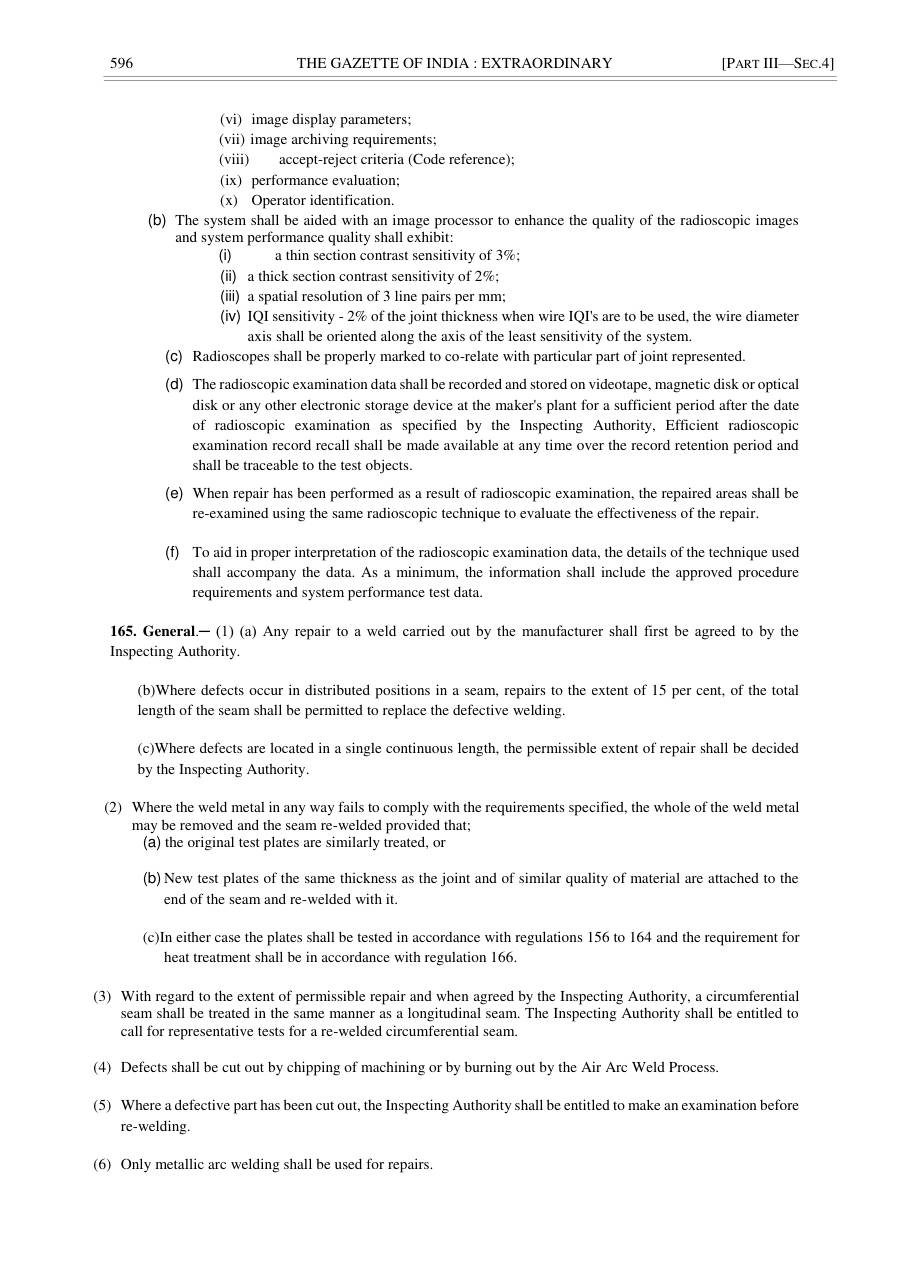
(vi)image display parameters;
(vii)image archiving requirements;
(viii)accept-reject criteria (Code reference);
(ix)performance evaluation;
(x)Operator identification.
(b)The system shall be aided with an image processor to enhance the quality of the radioscopic images and system performance quality shall exhibit:
(i)a thin section contrast sensitivity of 3%;
(ii)a thick section contrast sensitivity of 2%;
(iii)a spatial resolution of 3 line pairs per mm;
(iv)IQI sensitivity - 2% of the joint thickness when wire IQI's are to be used, the wire diameter axis shall be oriented along the axis of the least sensitivity of the system.
(c)Radioscopes shall be properly marked to co-relate with particular part of joint represented.
(d)The radioscopic examination data shall be recorded and stored on videotape, magnetic disk or optical disk or any other electronic storage device at the maker's plant for a sufficient period after the date of radioscopic examination as specified by the Inspecting Authority, Efficient radioscopic examination record recall shall be made available at any time over the record retention period and shall be traceable to the test objects.
(e)When repair has been performed as a result of radioscopic examination, the repaired areas shall be re-examined using the same radioscopic technique to evaluate the effectiveness of the repair.
(f)To aid in proper interpretation of the radioscopic examination data, the details of the technique used shall accompany the data. As a minimum, the information shall include the approved procedure requirements and system performance test data.
In short
Regulation 164 covers the examinations of fusion welded drum seams: micro and macro examination, full radiographic or ultrasonic examination, magnetic particle and dye penetrant tests, and radioscopy.
Key points
- (1) The Inspecting Authority may take a full-thickness specimen at least 13 mm wide from each set of test plates. Macro-etching must show satisfactory penetration and fusion and no significant inclusions or defects.
- (2)(a) Every portion of longitudinal and circumferential drum welds must be radiographed or ultrasonically examined. For ultrasonics, equipment and technique must satisfy the Inspecting Authority. NDE operators and evaluators need ASNT SNT-TC-1A, ISO 9712 or equivalent qualification.
- (2)(b) Radiographs must show defects of 2 per cent of joint thickness, verified by an indicator on each radiograph. Welds are marked to correlate with radiographs. Testing follows a written procedure in line with international boiler codes, accepted by the Competent Person.
- (2)(c) Examination is from original films; unacceptable welds are dealt with under regulation 165 and radiographed again.
- (2)(d) PAUT or TOFD (or both) may replace radiography with an established procedure.
- (3)–(4) Magnetic particle testing for ferritic steel wherever possible; dye penetrant for austenitic or other non-magnetic steel. These surface methods do not replace the volumetric examination of drum seams.
- (5) Radioscopy in place of radiography needs an approved written procedure, an image processor, set performance (3% and 2% contrast sensitivity, 3 line pairs per mm resolution), marked images, stored records, re-examination of repairs and technique details with the data.
Written by IBRsource editors · last edited 2026-11-20. Explanations simplify and are not a design method, testing procedure or authorisation. Requirements come from the complete regulations, the Gazette and approved documentation.
Comparison pending: the IBR 1950 text in force on 30 September 2026 is not yet established for this provision, so no change is claimed (how this works).
Orientation hints (unverified)
These candidates come from automated heading matching against DPIIT's scanned historical print edition of IBR 1950. That edition uses imperial units and riveted-construction provisions, so it is not the operative 2026 predecessor text. Regulation numbers alone never prove equivalence.
No candidate heading found in the historical print edition.
Images of the official Gazette pages that contain this regulation. Click to zoom. Compare word by word before relying on the extracted text.
Indian Boiler Regulations, 2026, reg. 164, Regulation 164, Gazette of India, Extraordinary, Part III—Section 4, No. 596, 1 October 2026, printed p.595–596. https://egazette.gov.in/WriteReadData/2026/276813.pdf (text consulted via IBRsource, 2026-11-23).
The citation refers to the government publication. Cite the Gazette, not this website.