
Indian Boiler Regulations, 2026 · Chapter 4 · Fusion Welded Drums for Water Tube Boilers and Superheaters
Regulation 165. General
Not yet checked against the official Gazette; verify before relying on it.
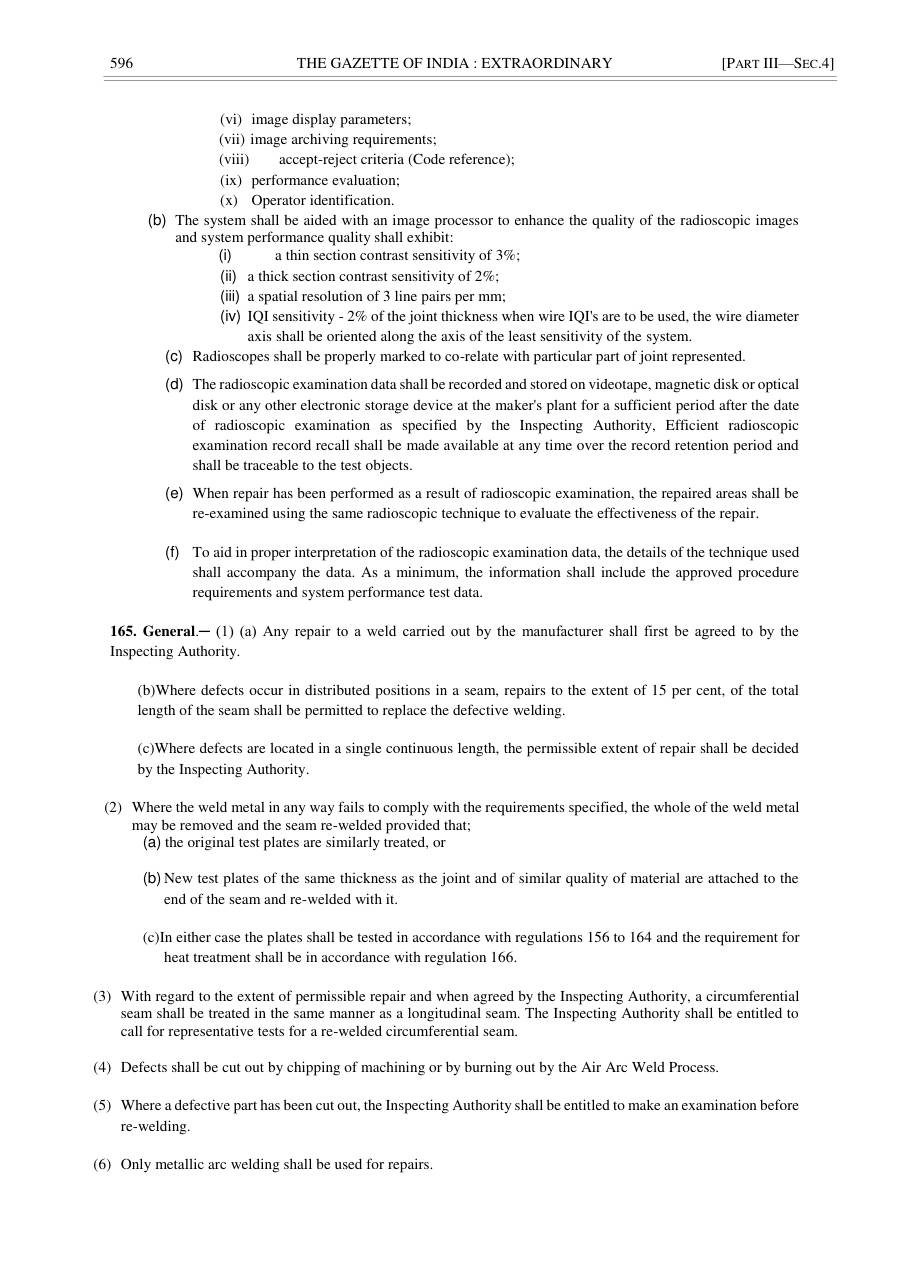
165. General.─ (1) (a) Any repair to a weld carried out by the manufacturer shall first be agreed to by the Inspecting Authority.
(b)Where defects occur in distributed positions in a seam, repairs to the extent of 15 per cent, of the total length of the seam shall be permitted to replace the defective welding.
(c)Where defects are located in a single continuous length, the permissible extent of repair shall be decided by the Inspecting Authority.
(2)Where the weld metal in any way fails to comply with the requirements specified, the whole of the weld metal may be removed and the seam re-welded provided that;
(a)the original test plates are similarly treated, or
(b)New test plates of the same thickness as the joint and of similar quality of material are attached to the end of the seam and re-welded with it.
(c)In either case the plates shall be tested in accordance with regulations 156 to 164 and the requirement for heat treatment shall be in accordance with regulation 166.
(3)With regard to the extent of permissible repair and when agreed by the Inspecting Authority, a circumferential seam shall be treated in the same manner as a longitudinal seam. The Inspecting Authority shall be entitled to call for representative tests for a re-welded circumferential seam.
(4)Defects shall be cut out by chipping of machining or by burning out by the Air Arc Weld Process.
(5)Where a defective part has been cut out, the Inspecting Authority shall be entitled to make an examination before re-welding.
(6)Only metallic arc welding shall be used for repairs.
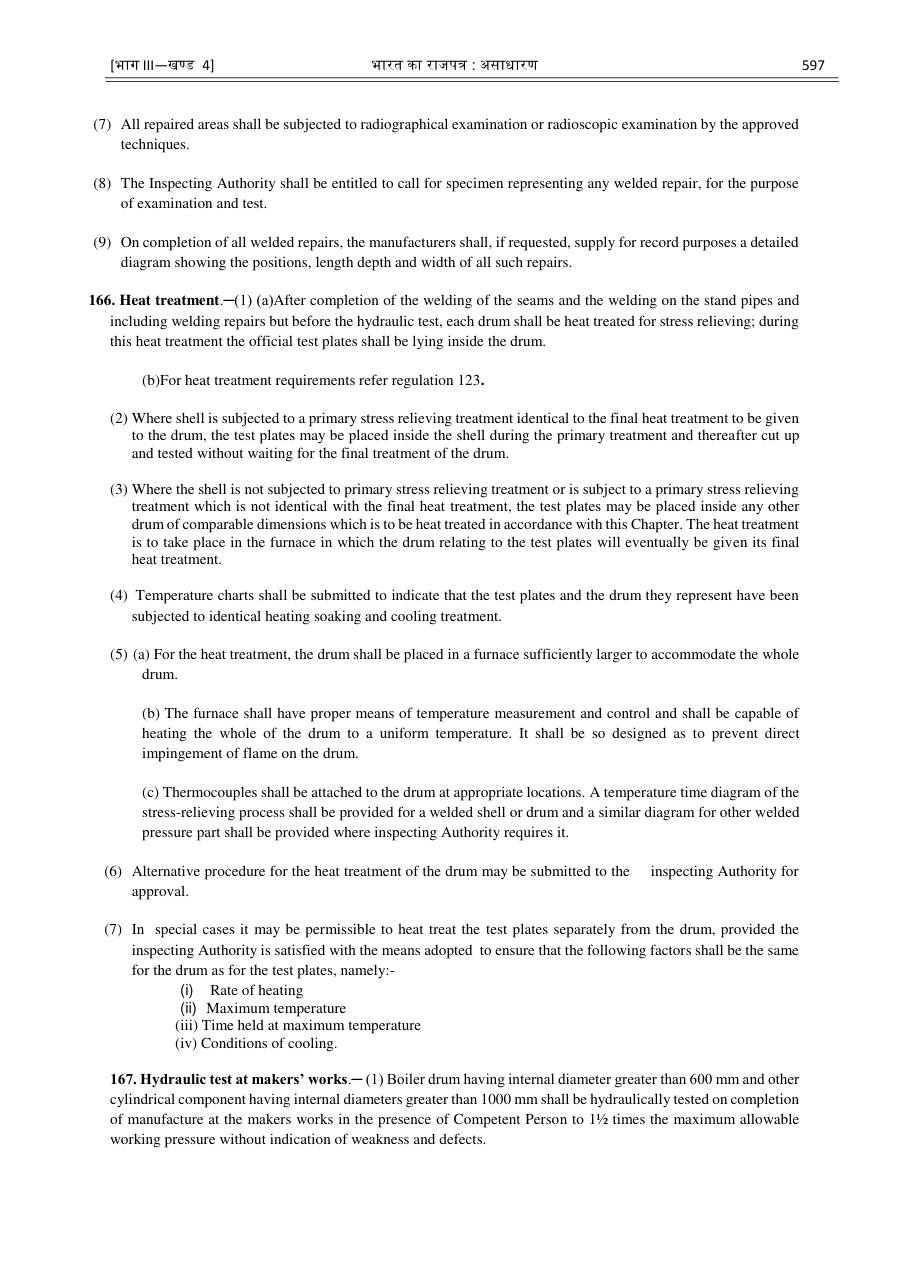
(7)All repaired areas shall be subjected to radiographical examination or radioscopic examination by the approved techniques.
(8)The Inspecting Authority shall be entitled to call for specimen representing any welded repair, for the purpose of examination and test.
(9)On completion of all welded repairs, the manufacturers shall, if requested, supply for record purposes a detailed diagram showing the positions, length depth and width of all such repairs.
In short
Regulation 165 sets the rules for repairing defective welds in fusion welded drums.
Key points
- (1)(a) Any weld repair must first be agreed by the Inspecting Authority.
- (1)(b)–(c) Distributed defects: repairs up to 15 per cent of total seam length. Defects in one continuous length: the Inspecting Authority decides the extent.
- (2) If weld metal fails the requirements, the whole weld may be removed and re-welded, provided the original test plates are treated the same way or new test plates are welded on with it. These are tested under regulations 156 to 164, with heat treatment under regulation 166.
- (3) Circumferential seams are treated like longitudinal seams for repair extent, and the Inspecting Authority may call for representative tests.
- (4)–(6) Defects are removed by chipping, machining or air arc burning out. The Inspecting Authority may examine before re-welding. Only metallic arc welding may be used for repairs.
- (7)–(8) All repairs are radiographed or radioscopically examined, and the Inspecting Authority may call for specimens.
- (9) On request, the manufacturer supplies a diagram of the position, length, depth and width of all repairs.
Written by IBRsource editors · last edited 2026-11-20. Explanations simplify and are not a design method, testing procedure or authorisation. Requirements come from the complete regulations, the Gazette and approved documentation.
Comparison pending: the IBR 1950 text in force on 30 September 2026 is not yet established for this provision, so no change is claimed (how this works).
Orientation hints (unverified)
These candidates come from automated heading matching against DPIIT's scanned historical print edition of IBR 1950. That edition uses imperial units and riveted-construction provisions, so it is not the operative 2026 predecessor text. Regulation numbers alone never prove equivalence.
| Historical 1950-edition reg. | Heading as OCR'd | Heading similarity | Source image |
|---|---|---|---|
| 52 | General | 100% | Chapter II (DPIIT scan), image 9 |
| 94 | General requirements | 100% | Chapter II (DPIIT scan), image 19 |
| 276 | General | 100% | Chapter V (DPIIT scan), image 11 |
Amendment history of the candidate IBR 1950 regulations: Reg. 52 (2 amendments)
IBR 1950 regulation 52 as last published in the DPIIT web edition (archived 2022)
Unofficial archived copy, not verified; see the regulation 52 page for its amendments.
| Reg. 52 MATERIALS OF CONSTRUCTION SEAMLESS FERRITIC PIPES FOR HIGH TEMPERATURE SERVICE |
| (i) These regulations cover both hot finished and cold drawn seamless pipes of ferritic alloy steel grades. These shall conform in all respects with the requirements herein specified. (ii) The seamless pipes conforming to other national/international standards which are known to be commonly used as being suitable for high temperature service can also be used with the designations of the national/international standards, provided such materials are not specifically prohibited by the regulations. (iii) While making pipes to other national/international standards the allowable stresses of the respective standard shall be strictly followed while designing the tubes. (iv) The design metal temperatures shall not exceed the following limits Grade Temp. Degree C (Degree F) P1, P2 537 (1000) P5, P9, P11, P12, P22, P91, X20CrMoV121 648 (1200) |
IBR 1950 regulation 94 as last published in the DPIIT web edition (archived 2019)
Unofficial archived copy, not verified; see the regulation 94 page for its amendments.
| Reg. 94 MATERIALS OF CONSTRUCTION COVERED ELECTRODES FOR METAL ARC WELDING OF MILD STEEL General requirements |
| (1) Application.- The following Regulations apply to electrodes of sizes 3/32 inch (12 S.W.G.) and larger in diameter for metal arc welding of carbon steels having ultimate tensile strength not exceeding 33 tons per square inch and Sulphur and Phosphorus contents not greater than 0.06 per cent each. Electrodes less than 3/32 inch in diameter shall not be used in boilers. The electrodes shall comply with the requirements of physical tests prescribed for each class. Their characteristics and behaviour under ordinary working conditions shall be such that satisfactory weld deposits can be made by a welder of average skill and experience and that the following characteristics are also obtained:-
(2) Classification.- The electrodes shall be classified into:
(3) Manufacture.- Electrodes may be made by any method that shall yield a product conforming to the requirements of these Regulations. (4) Size of Electrodes.- The nominal size of the electrodes shall refer to the diameter of the core wire and the length shall not exceed 18 inches. Provision shall be made for end or centre gripping. The tolerances on the specified diameter of the core wire of the electrodes shall be plus or minus 0.002 inch. (5) Covering.- The flux covering shall be sufficiently robust to withstand the normal conditions of transport, storage, handling and use, without damage and shall be uniform in thickness all over so that it fuses evenly. The variation in the thickness shall not exceed 3 per cent. (6) (a) Packing and storage.- Electrodes shall be suitably packed to guard against damage during transportation. When stored, the electrodes shall be kept in their original bundles or packings in a dry store room and under such conditions, the electrodes shall for a period of at least six months be capable of giving results similar to those which they would have given on the date of their despatch from the manufacturer. (b) Marking.- Each package shall be marked with the following information:-
(7) Tests.- The electrodes shall be subjected to Initial tests, Periodic check tests and Production control to ensure that the requirements of these Regulations are fulfilled. Electrodes intended for use with more than one type of current or polarity shall be tested using each type of current and polarity. Where any test specimen fails to satisfy the requirements of any particular test, two further test specimens shall be prepared using the electrodes from the same batch and submitted to the same test. The batch of electrodes shall be accepted as having passed the test provided that the tests of both the additional specimens are satisfactory. (8) Test Certificates.- The manufacturers shall, when called upon, produce the results of the most recent Periodic check tests carried out within the preceding 12 months, on electrodes representative of the electrodes supplied. |
IBR 1950 regulation 276 as last published in the DPIIT web edition (archived 2022)
Unofficial archived copy, not verified; see the regulation 276 page for its amendments.
|
| ||||||||||||||||||||||||||||||||
Reg. 277
| ||||||||||||||||||||||||||||||||
Images of the official Gazette pages that contain this regulation. Click to zoom. Compare word by word before relying on the extracted text.
Indian Boiler Regulations, 2026, reg. 165, Regulation 165, Gazette of India, Extraordinary, Part III—Section 4, No. 596, 1 October 2026, printed p.596–597. https://egazette.gov.in/WriteReadData/2026/276813.pdf (text consulted via IBRsource, 2026-11-23).
The citation refers to the government publication. Cite the Gazette, not this website.