
Indian Boiler Regulations, 2026 · Chapter 4 · Fusion Welded Drums for Water Tube Boilers and Superheaters
Regulation 154. Position of the tube holes
Not yet checked against the official Gazette; verify before relying on it.
154. Position of the tube holes.─(1) Tube holes in welded seams shall be avoided as far as possible. Where the holes are unavoidable, they may be machined through welded seams after these seams are radiographed.
(2)In the case of vanadium steels, in addition to radiography, the welded seams shall be stress relieved.
(3)The efficiency of the ligament in the direction of weld shall be multiplied by a weld factor not exceeding 0.95 except where the distance from the edge of the tube hole to the edge of the weld is greater than 13 mm.
(4)The edge of the weld shall be considered to be the edge of the weld groove as machined in the plate prior to welding.
Notwithstanding anything in this regulation, efficiency of the ligament in the direction of weld shall not be multiplied by a weld factor 0.95 where 100 percent radiography of weld joint is done.
In short
Tube holes in welded seams should be avoided as far as possible. Where unavoidable, they may be machined through the seam only after it has been radiographed.
Key points
- (2) For vanadium steels, the seams must also be stress relieved.
- (3) Ligament efficiency in the direction of the weld is multiplied by a weld factor not exceeding 0.95, unless the tube hole edge is more than 13 mm from the weld edge.
- (4) The weld edge means the edge of the weld groove as machined before welding.
Watch out
- The 0.95 weld factor is not applied where 100 percent radiography of the weld joint is done.
Written by IBRsource editors · last edited 2026-11-20. Explanations simplify and are not a design method, testing procedure or authorisation. Requirements come from the complete regulations, the Gazette and approved documentation.
Comparison pending: the IBR 1950 text in force on 30 September 2026 is not yet established for this provision, so no change is claimed (how this works).
Orientation hints (unverified)
These candidates come from automated heading matching against DPIIT's scanned historical print edition of IBR 1950. That edition uses imperial units and riveted-construction provisions, so it is not the operative 2026 predecessor text. Regulation numbers alone never prove equivalence.
No candidate heading found in the historical print edition.
Images of the official Gazette pages that contain this regulation. Click to zoom. Compare word by word before relying on the extracted text.
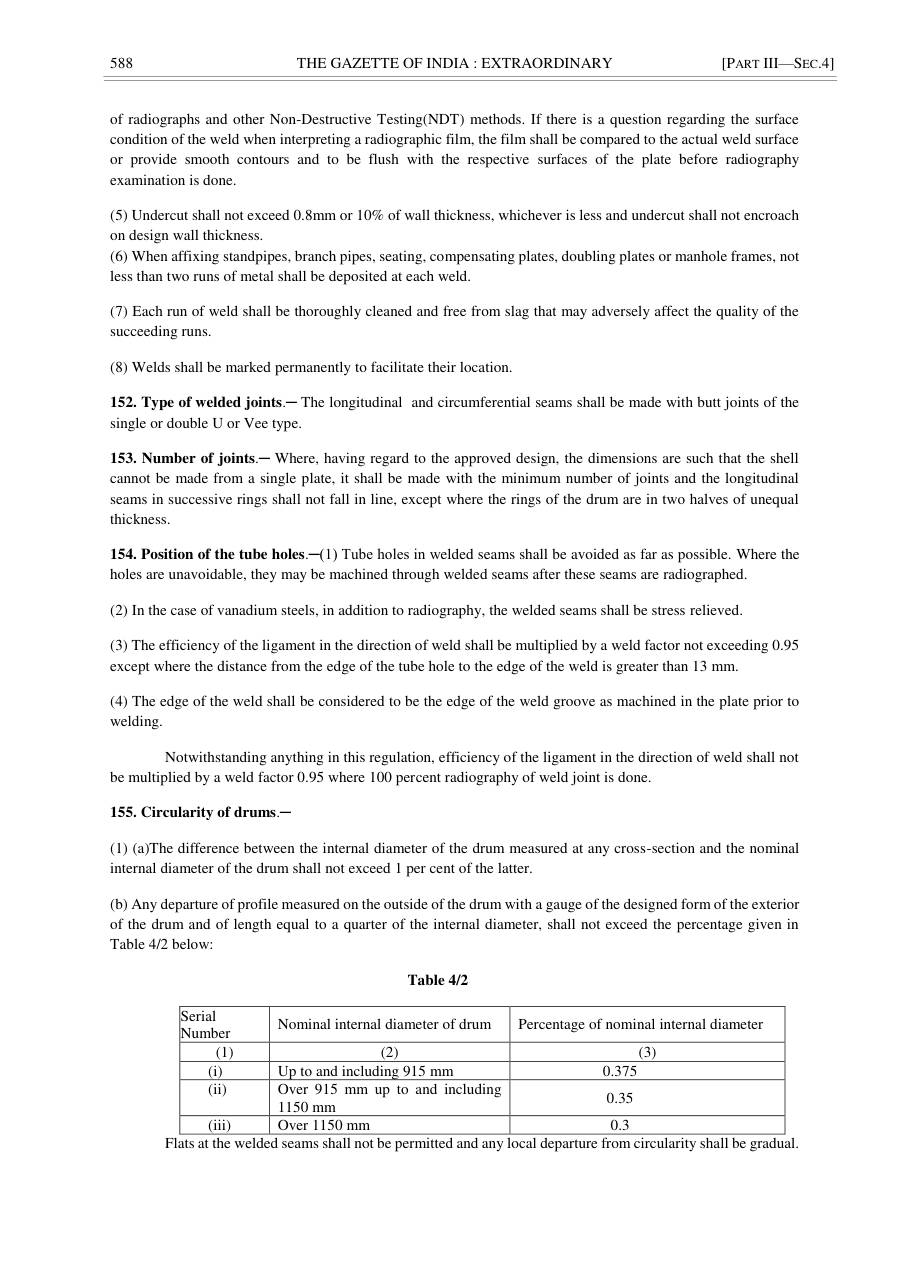
Indian Boiler Regulations, 2026, reg. 154, Regulation 154, Gazette of India, Extraordinary, Part III—Section 4, No. 596, 1 October 2026, printed p.588. https://egazette.gov.in/WriteReadData/2026/276813.pdf (text consulted via IBRsource, 2026-11-23).
The citation refers to the government publication. Cite the Gazette, not this website.