
Indian Boiler Regulations, 2026 · Chapter 1 · General Requirements, Registration, Recognition and Competent Persons
Regulation 7. Standard requirements
Not yet checked against the official Gazette; verify before relying on it.
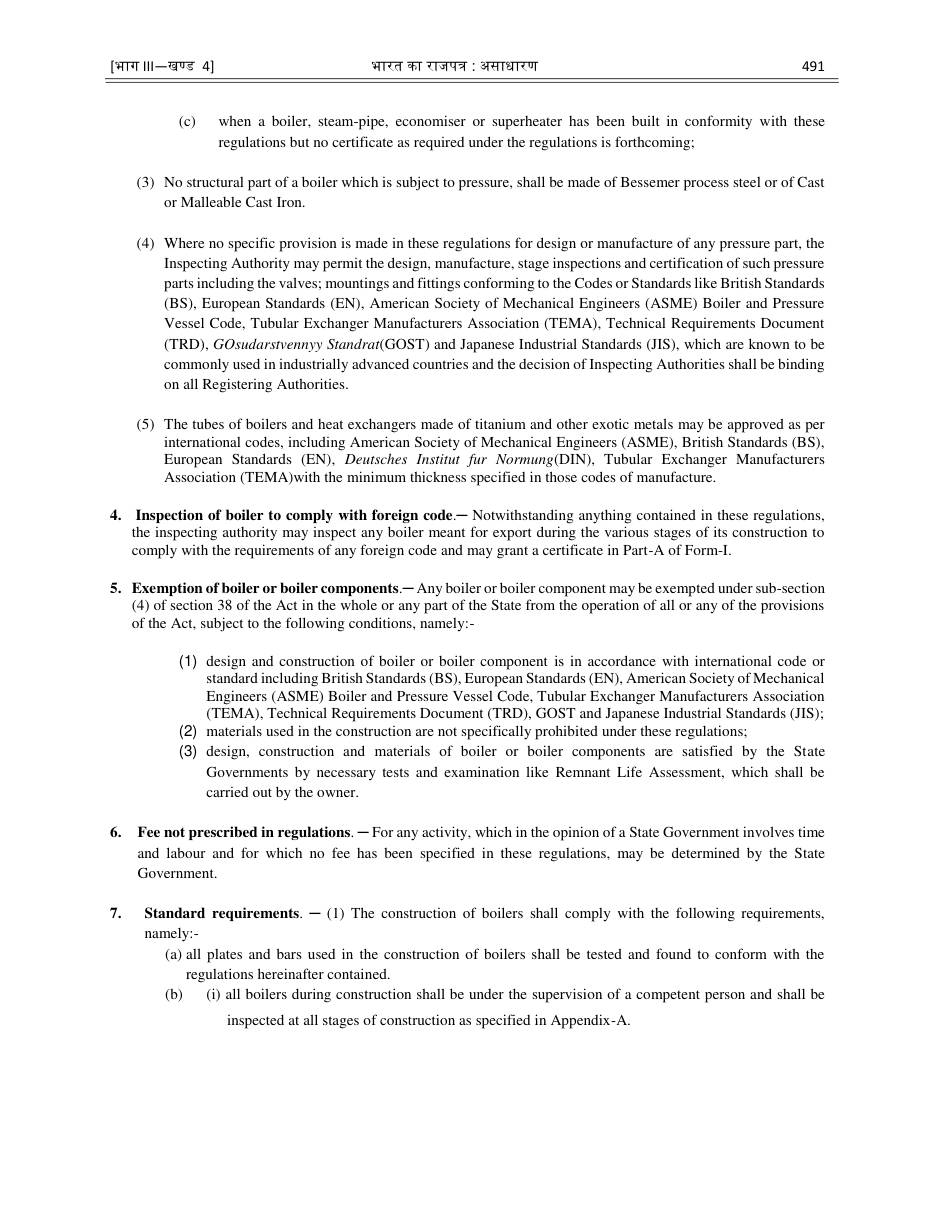
7. Standard requirements. ─ (1) The construction of boilers shall comply with the following requirements, namely:-
(a)all plates and bars used in the construction of boilers shall be tested and found to conform with the regulations hereinafter contained.
(b)(i) all boilers during construction shall be under the supervision of a competent person and shall be inspected at all stages of construction as specified in Appendix-A.
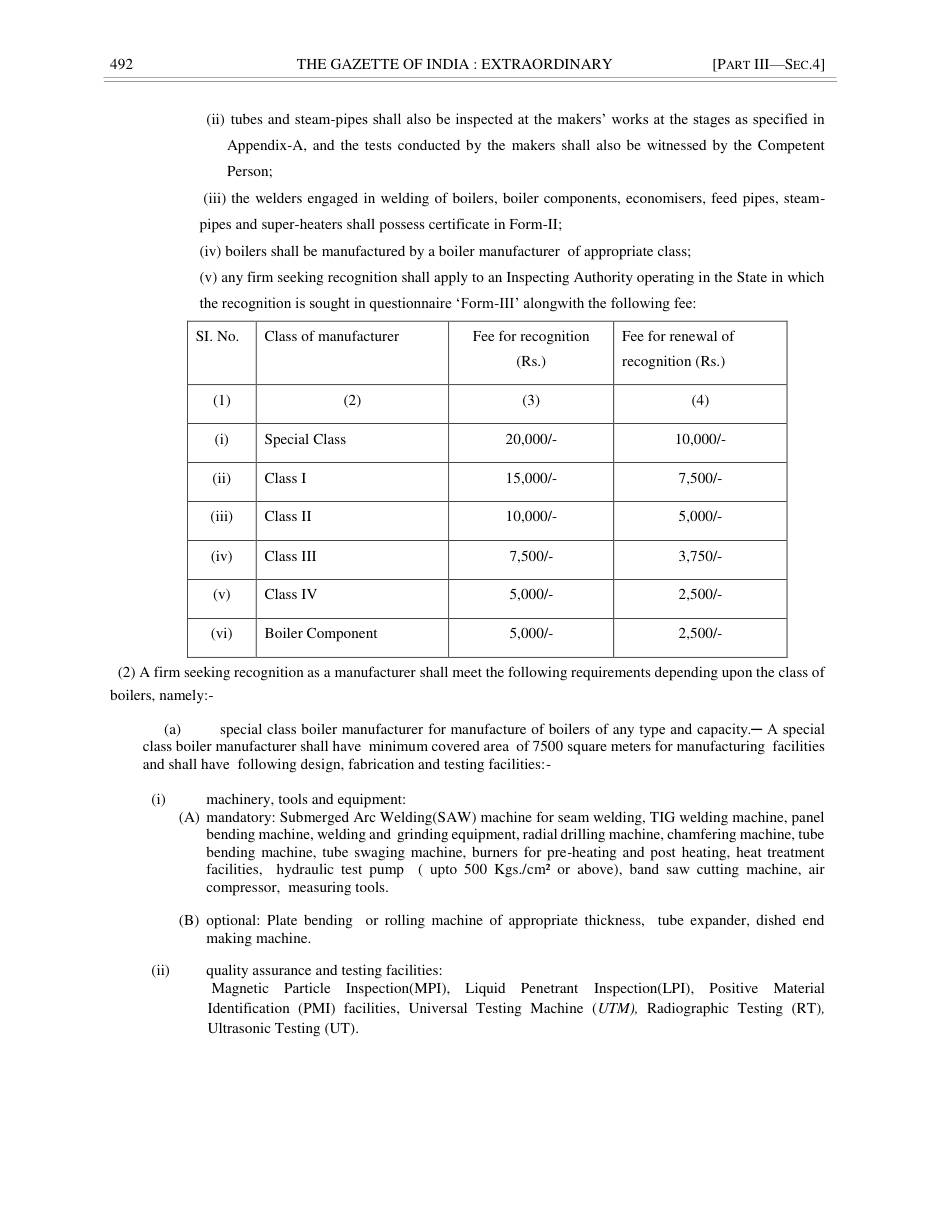
(ii)tubes and steam-pipes shall also be inspected at the makers’ works at the stages as specified in Appendix-A, and the tests conducted by the makers shall also be witnessed by the Competent Person;
(iii)the welders engaged in welding of boilers, boiler components, economisers, feed pipes, steam-pipes and super-heaters shall possess certificate in Form-II;
(iv)boilers shall be manufactured by a boiler manufacturer of appropriate class;
(v)any firm seeking recognition shall apply to an Inspecting Authority operating in the State in which the recognition is sought in questionnaire ‘Form-III’ alongwith the following fee:
| SI. No. | Class of manufacturer | Fee for recognition (Rs.) | Fee for renewal of recognition (Rs.) |
|---|---|---|---|
| (1) | (2) | (3) | (4) |
| (i) | Special Class | 20,000/- | 10,000/- |
| (ii) | Class I | 15,000/- | 7,500/- |
| (iii) | Class II | 10,000/- | 5,000/- |
| (iv) | Class III | 7,500/- | 3,750/- |
| (v) | Class IV | 5,000/- | 2,500/- |
| (vi) | Boiler Component | 5,000/- | 2,500/- |
Table structure read from the Gazette PDF, page 492. Verification status as for the text above.
Show original extracted text (diagnostic, not authoritative)
SI. No. Class of manufacturer    Fee for recognition              Fee for renewal of
                                         (Rs.)                    recognition (Rs.)

(1)             (2)              (3)                              (4)

(i) Special Class                20,000/-                         10,000/-

(ii) Class I                     15,000/-                         7,500/-

(iii) Class II                   10,000/-                         5,000/-

(iv) Class III                   7,500/-                          3,750/-

(v) Class IV                     5,000/-                          2,500/-

(vi) Boiler Component 5,000/- 2,500/-(2)A firm seeking recognition as a manufacturer shall meet the following requirements depending upon the class of boilers, namely:-
(a)special class boiler manufacturer for manufacture of boilers of any type and capacity.─ A special class boiler manufacturer shall have minimum covered area of 7500 square meters for manufacturing facilities and shall have following design, fabrication and testing facilities:-
(i)machinery, tools and equipment:
(A) mandatory: Submerged Arc Welding(SAW) machine for seam welding, TIG welding machine, panel bending machine, welding and grinding equipment, radial drilling machine, chamfering machine, tube bending machine, tube swaging machine, burners for pre-heating and post heating, heat treatment facilities, hydraulic test pump ( upto 500 Kgs./cm² or above), band saw cutting machine, air compressor, measuring tools.
(B) optional: Plate bending or rolling machine of appropriate thickness, tube expander, dished end making machine.
(ii)quality assurance and testing facilities:
Magnetic Particle Inspection(MPI), Liquid Penetrant Inspection(LPI), Positive Material Identification (PMI) facilities, Universal Testing Machine (UTM), Radiographic Testing (RT), Ultrasonic Testing (UT).
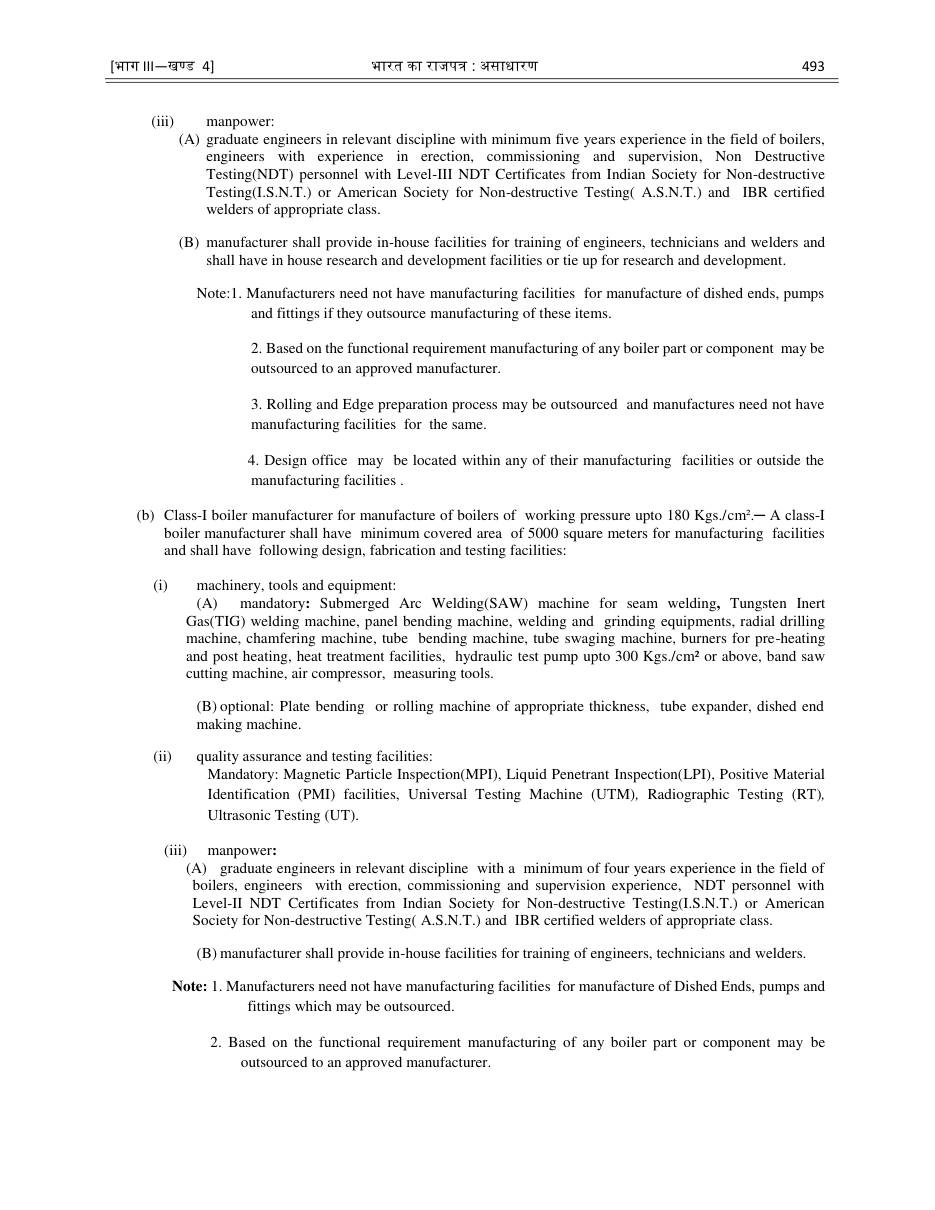
(iii)manpower:
(A) graduate engineers in relevant discipline with minimum five years experience in the field of boilers, engineers with experience in erection, commissioning and supervision, Non Destructive Testing(NDT) personnel with Level-III NDT Certificates from Indian Society for Non-destructive Testing(I.S.N.T.) or American Society for Non-destructive Testing( A.S.N.T.) and IBR certified welders of appropriate class.
(B) manufacturer shall provide in-house facilities for training of engineers, technicians and welders and shall have in house research and development facilities or tie up for research and development.
Note:1. Manufacturers need not have manufacturing facilities for manufacture of dished ends, pumps and fittings if they outsource manufacturing of these items.
2. Based on the functional requirement manufacturing of any boiler part or component may be outsourced to an approved manufacturer.
3. Rolling and Edge preparation process may be outsourced and manufactures need not have manufacturing facilities for the same.
4. Design office may be located within any of their manufacturing facilities or outside the manufacturing facilities .
(b)Class-I boiler manufacturer for manufacture of boilers of working pressure upto 180 Kgs./cm².─ A class-I boiler manufacturer shall have minimum covered area of 5000 square meters for manufacturing facilities and shall have following design, fabrication and testing facilities:
(i)machinery, tools and equipment:
(A) mandatory: Submerged Arc Welding(SAW) machine for seam welding, Tungsten Inert
Gas(TIG) welding machine, panel bending machine, welding and grinding equipments, radial drilling machine, chamfering machine, tube bending machine, tube swaging machine, burners for pre-heating and post heating, heat treatment facilities, hydraulic test pump upto 300 Kgs./cm² or above, band saw cutting machine, air compressor, measuring tools.
(B) optional: Plate bending or rolling machine of appropriate thickness, tube expander, dished end making machine.
(ii)quality assurance and testing facilities:
Mandatory: Magnetic Particle Inspection(MPI), Liquid Penetrant Inspection(LPI), Positive Material Identification (PMI) facilities, Universal Testing Machine (UTM), Radiographic Testing (RT), Ultrasonic Testing (UT).
(iii)manpower:
(A) graduate engineers in relevant discipline with a minimum of four years experience in the field of boilers, engineers with erection, commissioning and supervision experience, NDT personnel with Level-II NDT Certificates from Indian Society for Non-destructive Testing(I.S.N.T.) or American Society for Non-destructive Testing( A.S.N.T.) and IBR certified welders of appropriate class.
(B) manufacturer shall provide in-house facilities for training of engineers, technicians and welders.
Note: 1. Manufacturers need not have manufacturing facilities for manufacture of Dished Ends, pumps and fittings which may be outsourced.
2. Based on the functional requirement manufacturing of any boiler part or component may be outsourced to an approved manufacturer.
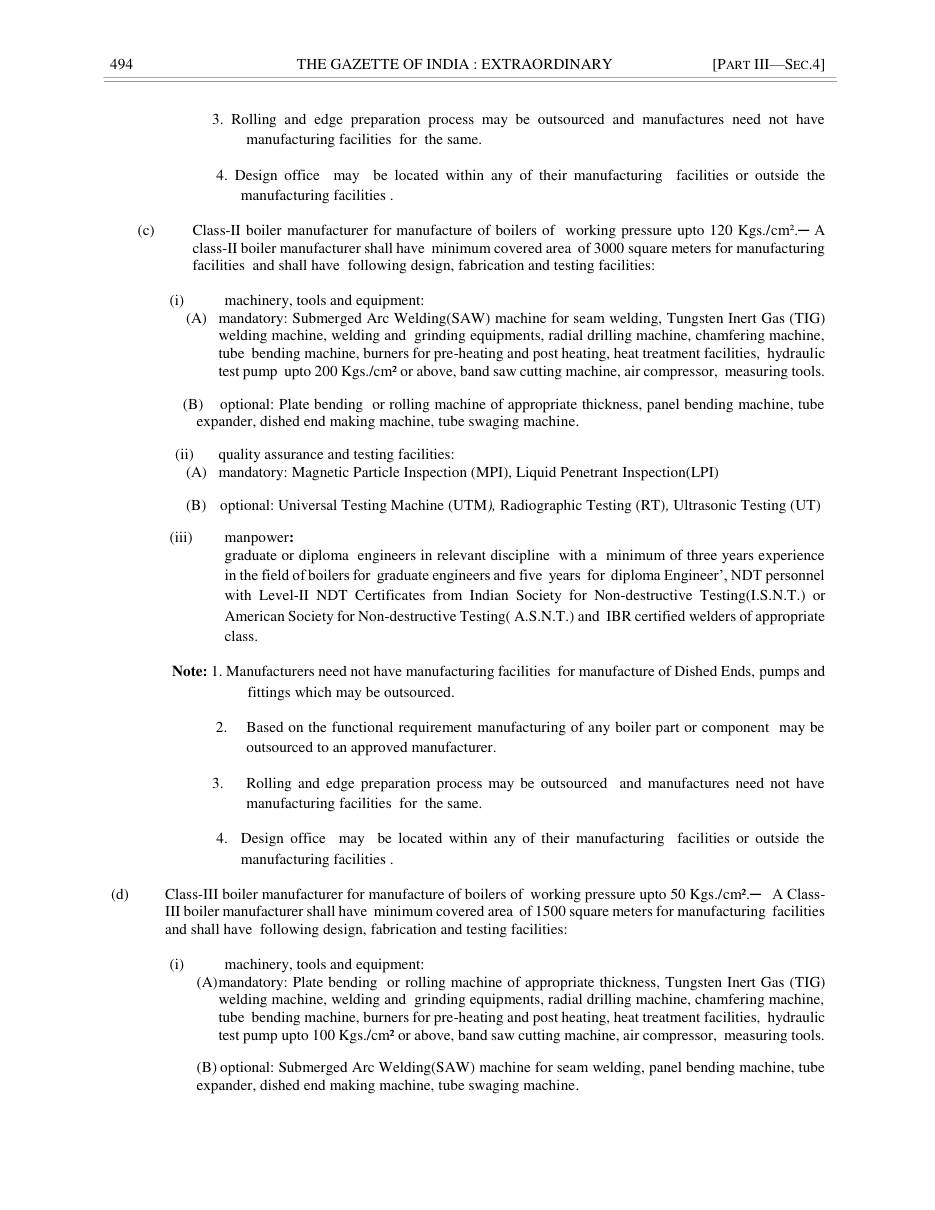
3. Rolling and edge preparation process may be outsourced and manufactures need not have manufacturing facilities for the same.
4. Design office may be located within any of their manufacturing facilities or outside the manufacturing facilities .
(c)Class-II boiler manufacturer for manufacture of boilers of working pressure upto 120 Kgs./cm².─ A class-II boiler manufacturer shall have minimum covered area of 3000 square meters for manufacturing facilities and shall have following design, fabrication and testing facilities:
(i)machinery, tools and equipment:
(A) mandatory: Submerged Arc Welding(SAW) machine for seam welding, Tungsten Inert Gas (TIG) welding machine, welding and grinding equipments, radial drilling machine, chamfering machine, tube bending machine, burners for pre-heating and post heating, heat treatment facilities, hydraulic test pump upto 200 Kgs./cm² or above, band saw cutting machine, air compressor, measuring tools.
(B) optional: Plate bending or rolling machine of appropriate thickness, panel bending machine, tube expander, dished end making machine, tube swaging machine.
(ii)quality assurance and testing facilities:
(A) mandatory: Magnetic Particle Inspection (MPI), Liquid Penetrant Inspection(LPI)
(B) optional: Universal Testing Machine (UTM), Radiographic Testing (RT), Ultrasonic Testing (UT)
(iii)manpower:
graduate or diploma engineers in relevant discipline with a minimum of three years experience in the field of boilers for graduate engineers and five years for diploma Engineer’, NDT personnel with Level-II NDT Certificates from Indian Society for Non-destructive Testing(I.S.N.T.) or American Society for Non-destructive Testing( A.S.N.T.) and IBR certified welders of appropriate class.
Note: 1. Manufacturers need not have manufacturing facilities for manufacture of Dished Ends, pumps and fittings which may be outsourced.
2. Based on the functional requirement manufacturing of any boiler part or component may be outsourced to an approved manufacturer.
3. Rolling and edge preparation process may be outsourced and manufactures need not have manufacturing facilities for the same.
4. Design office may be located within any of their manufacturing facilities or outside the manufacturing facilities .
(d)Class-III boiler manufacturer for manufacture of boilers of working pressure upto 50 Kgs./cm².─ A Class-III boiler manufacturer shall have minimum covered area of 1500 square meters for manufacturing facilities and shall have following design, fabrication and testing facilities:
(i)machinery, tools and equipment:
(A)mandatory: Plate bending or rolling machine of appropriate thickness, Tungsten Inert Gas (TIG)
welding machine, welding and grinding equipments, radial drilling machine, chamfering machine, tube bending machine, burners for pre-heating and post heating, heat treatment facilities, hydraulic test pump upto 100 Kgs./cm² or above, band saw cutting machine, air compressor, measuring tools.
(B) optional: Submerged Arc Welding(SAW) machine for seam welding, panel bending machine, tube expander, dished end making machine, tube swaging machine.
(ii)quality assurance and testing facilities:
(A)mandatory: Magnetic Particle Inspection (MPI), Liquid Penetrant Inspection(LPI)
(B) optional: Universal Testing Machine (UTM), Radiographic Testing (RT), Ultrasonic Testing (UT)
(iii)manpower:
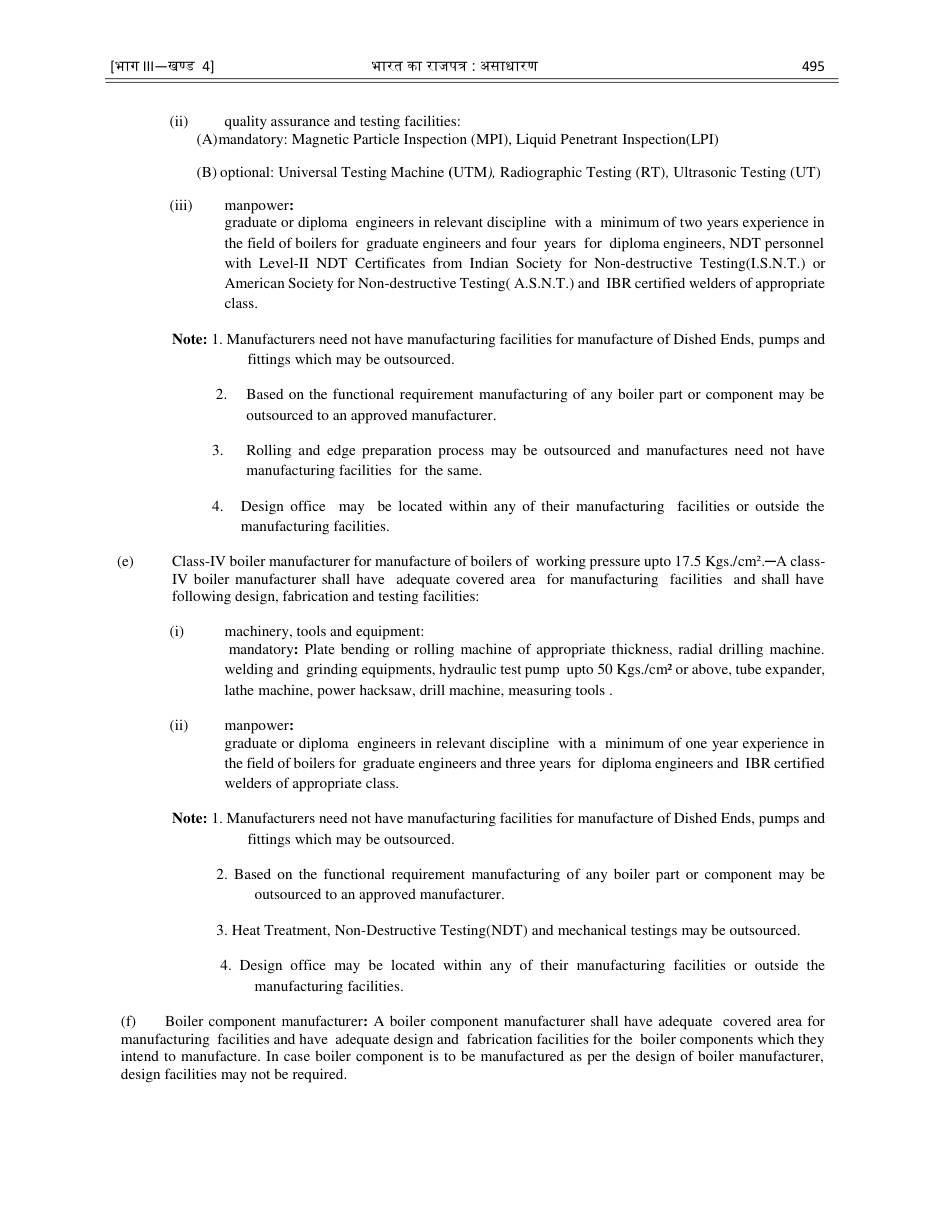
graduate or diploma engineers in relevant discipline with a minimum of two years experience in the field of boilers for graduate engineers and four years for diploma engineers, NDT personnel with Level-II NDT Certificates from Indian Society for Non-destructive Testing(I.S.N.T.) or American Society for Non-destructive Testing( A.S.N.T.) and IBR certified welders of appropriate class.
Note: 1. Manufacturers need not have manufacturing facilities for manufacture of Dished Ends, pumps and fittings which may be outsourced.
2. Based on the functional requirement manufacturing of any boiler part or component may be outsourced to an approved manufacturer.
3. Rolling and edge preparation process may be outsourced and manufactures need not have manufacturing facilities for the same.
4. Design office may be located within any of their manufacturing facilities or outside the manufacturing facilities.
(e)Class-IV boiler manufacturer for manufacture of boilers of working pressure upto 17.5 Kgs./cm².─A class-
IV boiler manufacturer shall have adequate covered area for manufacturing facilities and shall have following design, fabrication and testing facilities:
(i)machinery, tools and equipment:
mandatory: Plate bending or rolling machine of appropriate thickness, radial drilling machine.
welding and grinding equipments, hydraulic test pump upto 50 Kgs./cm² or above, tube expander, lathe machine, power hacksaw, drill machine, measuring tools .
(ii)manpower:
graduate or diploma engineers in relevant discipline with a minimum of one year experience in the field of boilers for graduate engineers and three years for diploma engineers and IBR certified welders of appropriate class.
Note: 1. Manufacturers need not have manufacturing facilities for manufacture of Dished Ends, pumps and fittings which may be outsourced.
2. Based on the functional requirement manufacturing of any boiler part or component may be outsourced to an approved manufacturer.
3. Heat Treatment, Non-Destructive Testing(NDT) and mechanical testings may be outsourced.
4. Design office may be located within any of their manufacturing facilities or outside the manufacturing facilities.
(f)Boiler component manufacturer: A boiler component manufacturer shall have adequate covered area for manufacturing facilities and have adequate design and fabrication facilities for the boiler components which they intend to manufacture. In case boiler component is to be manufactured as per the design of boiler manufacturer, design facilities may not be required.
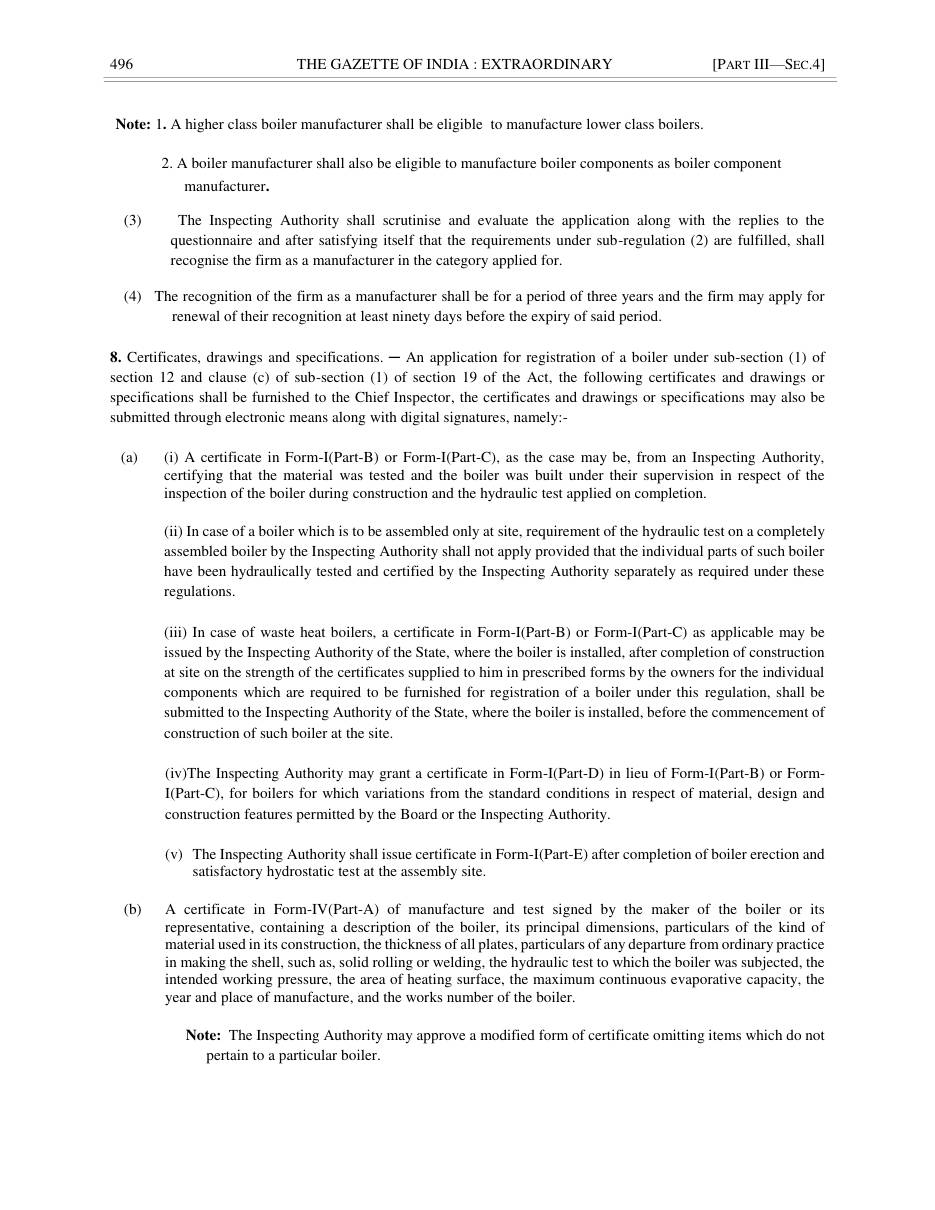
Note: 1. A higher class boiler manufacturer shall be eligible to manufacture lower class boilers.
2. A boiler manufacturer shall also be eligible to manufacture boiler components as boiler component manufacturer.
(3)The Inspecting Authority shall scrutinise and evaluate the application along with the replies to the questionnaire and after satisfying itself that the requirements under sub-regulation (2) are fulfilled, shall recognise the firm as a manufacturer in the category applied for.
(4)The recognition of the firm as a manufacturer shall be for a period of three years and the firm may apply for renewal of their recognition at least ninety days before the expiry of said period.
In short
Regulation 7 sets the standard requirements for constructing boilers and the scheme for recognising boiler manufacturers by class.
Key points
- (1)(a)–(b) Construction. All plates and bars must be tested and conform to these regulations. Boilers are built under a Competent Person's supervision and inspected at all stages listed in Appendix-A. Tubes and steam-pipes are also inspected at the makers' works, with makers' tests witnessed by the Competent Person.
- Welders on boilers, boiler components, economisers, feed pipes, steam-pipes and super-heaters must hold a Form-II certificate.
- Boilers must be made by a manufacturer of the appropriate class. A firm seeking recognition applies to an Inspecting Authority operating in that State, using questionnaire Form-III, with the fee for its class shown in the table.
- (2) Classes of manufacturer, each with a minimum covered area, mandatory and optional machinery, quality assurance and testing facilities, and manpower:
- Special class: boilers of any type and capacity; 7500 square meters; NDT personnel with Level-III certificates; in-house training and research and development (or a tie up).
- Class-I: working pressure up to 180 Kgs./cm²; 5000 square meters.
- Class-II: up to 120 Kgs./cm²; 3000 square meters.
- Class-III: up to 50 Kgs./cm²; 1500 square meters.
- Class-IV: up to 17.5 Kgs./cm²; adequate covered area. Heat treatment, NDT and mechanical testing may be outsourced.
- Boiler component manufacturer: adequate area and facilities for the components made. Design facilities are not needed if components follow the boiler manufacturer's design.
- The notes allow dished ends, pumps and fittings to be outsourced, and other parts to be outsourced to an approved manufacturer on functional grounds, subject to the class-specific provisions. For the Special class to Class-III, rolling and edge preparation may also be outsourced. The design office may be inside or outside the manufacturing facilities.
- (3) The Inspecting Authority evaluates the application and questionnaire replies and, if satisfied, recognises the firm in the class applied for.
- (4) Recognition lasts three years. Apply for renewal at least ninety days before expiry.
Watch out
- A higher class manufacturer may make lower class boilers, and any boiler manufacturer may also make boiler components.
- Mandatory equipment lists differ by class, including the minimum hydraulic test pump capacity. Check the Official text tab for the full list for your class.
Written by IBRsource editors · last edited 2026-11-20. Explanations simplify and are not a design method, testing procedure or authorisation. Requirements come from the complete regulations, the Gazette and approved documentation.
Comparison pending: the IBR 1950 text in force on 30 September 2026 is not yet established for this provision, so no change is claimed (how this works).
Orientation hints (unverified)
These candidates come from automated heading matching against DPIIT's scanned historical print edition of IBR 1950. That edition uses imperial units and riveted-construction provisions, so it is not the operative 2026 predecessor text. Regulation numbers alone never prove equivalence.
| Historical 1950-edition reg. | Heading as OCR'd | Heading similarity | Source image |
|---|---|---|---|
| 94 | General requirements | 75% | Chapter II (DPIIT scan), image 19 |
| 625 | General requirements | 75% | Chapter XV (DPIIT scan), image 1 |
| 96 | Requirements for Deep Penetration Butt | 73% | Chapter II (DPIIT scan), image 20 |
Amendment history of the candidate IBR 1950 regulations: Reg. 625 (1 amendment)
IBR 1950 regulation 94 as last published in the DPIIT web edition (archived 2019)
Unofficial archived copy, not verified; see the regulation 94 page for its amendments.
| Reg. 94 MATERIALS OF CONSTRUCTION COVERED ELECTRODES FOR METAL ARC WELDING OF MILD STEEL General requirements |
| (1) Application.- The following Regulations apply to electrodes of sizes 3/32 inch (12 S.W.G.) and larger in diameter for metal arc welding of carbon steels having ultimate tensile strength not exceeding 33 tons per square inch and Sulphur and Phosphorus contents not greater than 0.06 per cent each. Electrodes less than 3/32 inch in diameter shall not be used in boilers. The electrodes shall comply with the requirements of physical tests prescribed for each class. Their characteristics and behaviour under ordinary working conditions shall be such that satisfactory weld deposits can be made by a welder of average skill and experience and that the following characteristics are also obtained:-
(2) Classification.- The electrodes shall be classified into:
(3) Manufacture.- Electrodes may be made by any method that shall yield a product conforming to the requirements of these Regulations. (4) Size of Electrodes.- The nominal size of the electrodes shall refer to the diameter of the core wire and the length shall not exceed 18 inches. Provision shall be made for end or centre gripping. The tolerances on the specified diameter of the core wire of the electrodes shall be plus or minus 0.002 inch. (5) Covering.- The flux covering shall be sufficiently robust to withstand the normal conditions of transport, storage, handling and use, without damage and shall be uniform in thickness all over so that it fuses evenly. The variation in the thickness shall not exceed 3 per cent. (6) (a) Packing and storage.- Electrodes shall be suitably packed to guard against damage during transportation. When stored, the electrodes shall be kept in their original bundles or packings in a dry store room and under such conditions, the electrodes shall for a period of at least six months be capable of giving results similar to those which they would have given on the date of their despatch from the manufacturer. (b) Marking.- Each package shall be marked with the following information:-
(7) Tests.- The electrodes shall be subjected to Initial tests, Periodic check tests and Production control to ensure that the requirements of these Regulations are fulfilled. Electrodes intended for use with more than one type of current or polarity shall be tested using each type of current and polarity. Where any test specimen fails to satisfy the requirements of any particular test, two further test specimens shall be prepared using the electrodes from the same batch and submitted to the same test. The batch of electrodes shall be accepted as having passed the test provided that the tests of both the additional specimens are satisfactory. (8) Test Certificates.- The manufacturers shall, when called upon, produce the results of the most recent Periodic check tests carried out within the preceding 12 months, on electrodes representative of the electrodes supplied. |
IBR 1950 regulation 625 as last published in the DPIIT web edition (archived 2022)
Unofficial archived copy, not verified; see the regulation 625 page for its amendments.
| Reg. 623, Reg. 624, Reg. 625 | |||||||||||
Reg. 624 Requirements
Reg. 625 Sampling Sampling shall be done following general directions given in 2 of IS:3025-1964*. In particular, the following points shall be observed :
| |||||||||||
IBR 1950 regulation 96 as last published in the DPIIT web edition (archived 2022)
Unofficial archived copy, not verified; see the regulation 96 page for its amendments.
| Reg. 96 MATERIALS OF CONSTRUCTION COVERED ELECTRODES FOR METAL ARC WELDING OF MILD STEEL Requirements for Deep Penetration Butt-Welding Electrodes |
| Initial Test.- For electrodes recommended for deep penetration butt-welding, the following initial tests shall be carried out:- (1) Transverse Tensile Test.- Three transverse tensile test specimens, one each from test pieces shall be prepared according to Table 3 in Appendix H-2 and tested as specified in Appendix H-2. If the diameter of the largest size of electrode manufactured is less than ¼ inch only two specimens need be prepared. The ultimate tensile stress of each specimen shall be not less than 28 tons per square inch. (2) Transverse bend Test.- Six bend test specimens, two each from test pieces, prepared according to the Table 3 in Appendix H-2 shall be tested in accordance with the method specified in Appendix H-2. If the diameter of the largest size of the electrode manufactured be less than ¼ inch, only 4 specimens will be required. Of each pair of specimens, one shall be tested with the side first welded in tension and one with the other side in tension. The electrode shall be deemed to be satisfactory if on completion of the test no crack or defect at the outer surface of the specimen is greater than 1/8 inch measured across it or 1/16 inch measured along its length. Premature failure at corners shall not be considered cause for rejection. (3) Butt-Weld Penetration Test.- Examination of the inner edges of the outer discards from the butt-weld test pieces prepared as specified in Appendix H-2 shall show that complete penetration has been achieved. |
Images of the official Gazette pages that contain this regulation. Click to zoom. Compare word by word before relying on the extracted text.
Indian Boiler Regulations, 2026, reg. 7, Regulation 7, Gazette of India, Extraordinary, Part III—Section 4, No. 596, 1 October 2026, printed p.491–496. https://egazette.gov.in/WriteReadData/2026/276813.pdf (text consulted via IBRsource, 2026-11-23).
The citation refers to the government publication. Cite the Gazette, not this website.