
Indian Boiler Regulations, 2026 · Chapter 1 · General Requirements, Registration, Recognition and Competent Persons
Regulation 29. Registration of second-hand boilers not in accordance with the standard conditions
Not yet checked against the official Gazette; verify before relying on it.
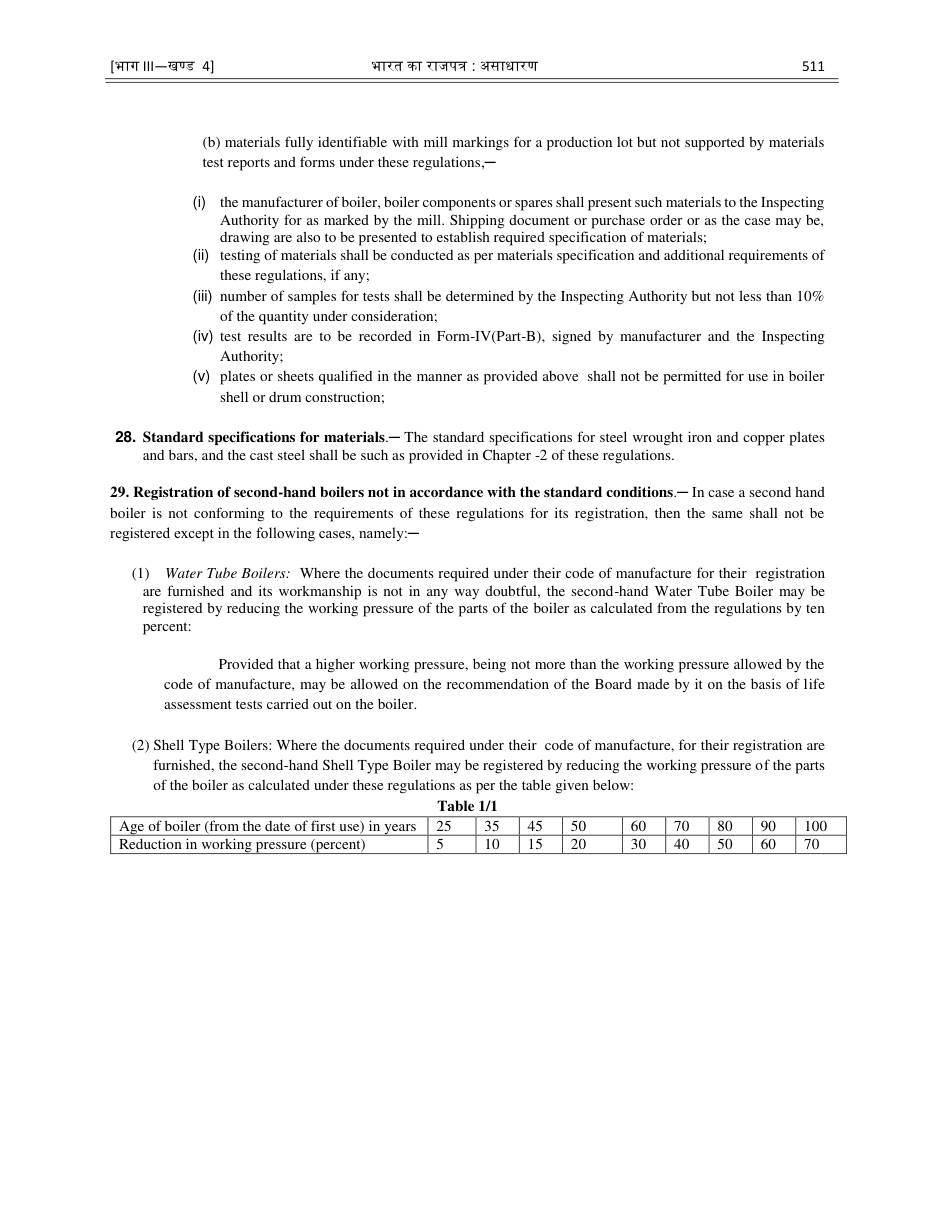
29. Registration of second-hand boilers not in accordance with the standard conditions.─ In case a second hand boiler is not conforming to the requirements of these regulations for its registration, then the same shall not be registered except in the following cases, namely:─
(1)Water Tube Boilers: Where the documents required under their code of manufacture for their registration are furnished and its workmanship is not in any way doubtful, the second-hand Water Tube Boiler may be registered by reducing the working pressure of the parts of the boiler as calculated from the regulations by ten percent:
Provided that a higher working pressure, being not more than the working pressure allowed by the code of manufacture, may be allowed on the recommendation of the Board made by it on the basis of life assessment tests carried out on the boiler.
(2)Shell Type Boilers: Where the documents required under their code of manufacture, for their registration are furnished, the second-hand Shell Type Boiler may be registered by reducing the working pressure of the parts of the boiler as calculated under these regulations as per the table given below:
Table 1/1
| Age of boiler (from the date of first use) in years | 25 | 35 | 45 | 50 | 60 | 70 | 80 | 90 | 100 |
| Reduction in working pressure (percent) | 5 | 10 | 15 | 20 | 30 | 40 | 50 | 60 | 70 |
Table structure read from the Gazette PDF, page 511. Verification status as for the text above.
Show original extracted text (diagnostic, not authoritative)
Age of boiler (from the date of first use) in years 25 35 45 50     60 70 80 90 100

Reduction in working pressure (percent)  5  10 15 20                30 40 50 60 70
Tables and formulae are shown in their extracted layout. Alignment, superscripts and subscripts may be lost. The Gazette page image is authoritative.
In short
A second-hand boiler that does not conform to these regulations may not be registered, except in the cases set out in regulation 29. Both cases need the documents required under the boiler's code of manufacture.
Key points
- (1) Water tube boilers. May be registered if the documents are furnished and the workmanship is not in any way doubtful, with the working pressure calculated from the regulations reduced by ten percent.
- (2) Shell type boilers. May be registered with the calculated working pressure reduced according to the boiler's age from the date of first use. Table 1/1 gives the percentage reduction for each age band, rising with age. See the Official text tab for the values.
Watch out
- For water tube boilers, a higher working pressure, not more than that allowed by the code of manufacture, may be allowed on the Board's recommendation based on life assessment tests on the boiler.
- See also regulation 3, which makes registration under its exceptions subject to this regulation.
Written by IBRsource editors · last edited 2026-11-20. Explanations simplify and are not a design method, testing procedure or authorisation. Requirements come from the complete regulations, the Gazette and approved documentation.
Comparison pending: the IBR 1950 text in force on 30 September 2026 is not yet established for this provision, so no change is claimed (how this works).
Orientation hints (unverified)
These candidates come from automated heading matching against DPIIT's scanned historical print edition of IBR 1950. That edition uses imperial units and riveted-construction provisions, so it is not the operative 2026 predecessor text. Regulation numbers alone never prove equivalence.
| Historical 1950-edition reg. | Heading as OCR'd | Heading similarity | Source image |
|---|---|---|---|
| 7 | Boilers not in accordance with standard conditions | 100% | Chapter I (DPIIT scan), image 3 |
| 385 | Registration fee | 86% | Chapter IX (DPIIT scan), image 4 |
Amendment history of the candidate IBR 1950 regulations: Reg. 7 (2 amendments) · Reg. 385 (5 amendments)
IBR 1950 regulation 7 as last published in the DPIIT web edition (archived 2022)
Unofficial archived copy, not verified; see the regulation 7 page for its amendments.
| Reg. 7 Registration of second hand boilers not in accordance with the standard conditions:- |
If a second hand boiler is not conforming to the requirements of these regulations for its registration, then the same shall not be registered except in the following cases, namely:-
Age of boiler (from the date of first use) in years. 25 35 45 50 60 70 80 90 100 Reduction in working pressure (percent) 5 10 15 20 30 40 50 60 70 |
IBR 1950 regulation 385 as last published in the DPIIT web edition (archived 2022)
Unofficial archived copy, not verified; see the regulation 385 page for its amendments.
| Reg. 384
Reg. 385
| ||||
Images of the official Gazette pages that contain this regulation. Click to zoom. Compare word by word before relying on the extracted text.
Indian Boiler Regulations, 2026, reg. 29, Regulation 29, Gazette of India, Extraordinary, Part III—Section 4, No. 596, 1 October 2026, printed p.511–512. https://egazette.gov.in/WriteReadData/2026/276813.pdf (text consulted via IBRsource, 2026-11-23).
The citation refers to the government publication. Cite the Gazette, not this website.