
Indian Boiler Regulations, 2026 · Chapter 1 · General Requirements, Registration, Recognition and Competent Persons
Regulation 23. Evaluation Committee
Not yet checked against the official Gazette; verify before relying on it.
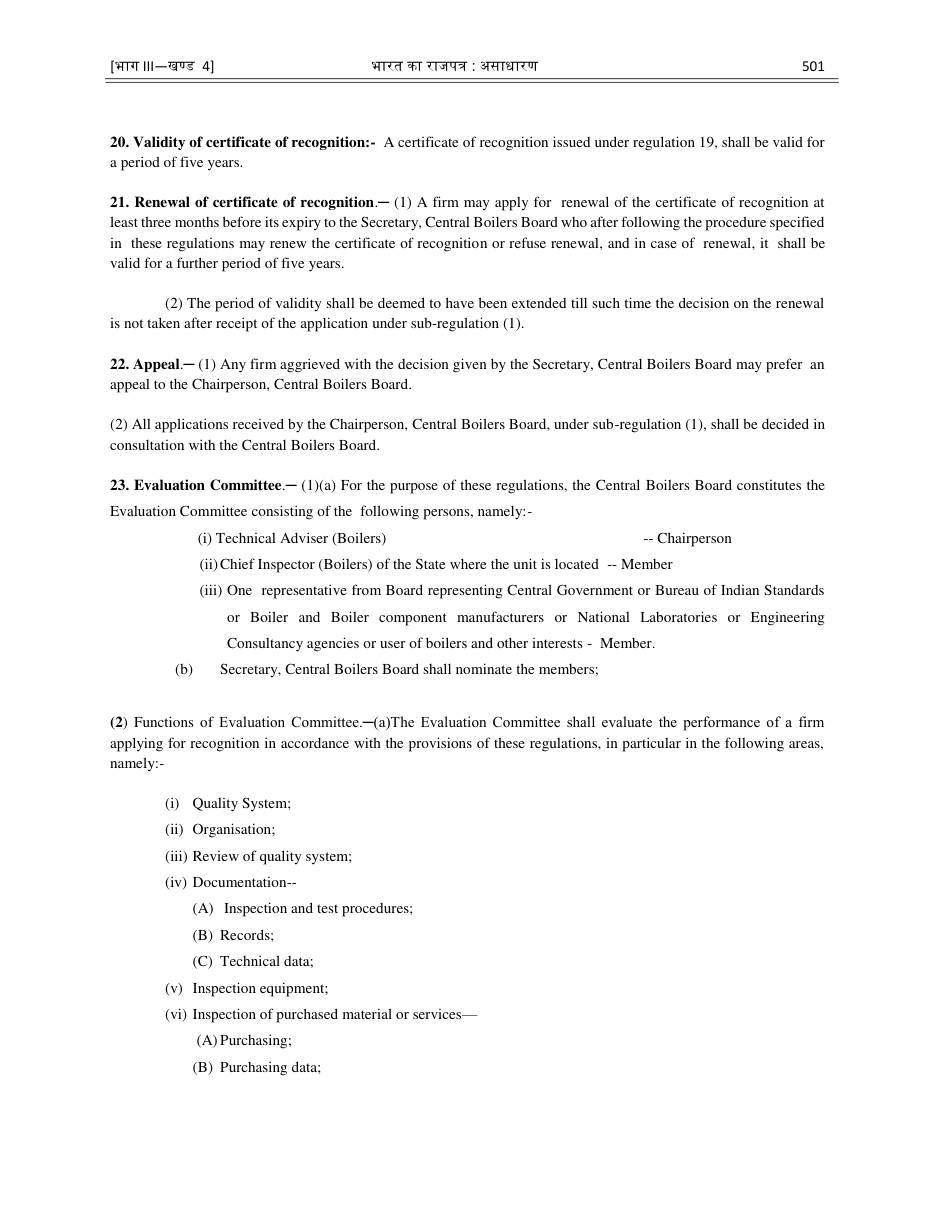
23. Evaluation Committee.─ (1)(a) For the purpose of these regulations, the Central Boilers Board constitutes the Evaluation Committee consisting of the following persons, namely:-
(i)Technical Adviser (Boilers) -- Chairperson
(ii)Chief Inspector (Boilers) of the State where the unit is located -- Member
(iii)One representative from Board representing Central Government or Bureau of Indian Standards or Boiler and Boiler component manufacturers or National Laboratories or Engineering
Consultancy agencies or user of boilers and other interests - Member.
(b)Secretary, Central Boilers Board shall nominate the members;
(2)Functions of Evaluation Committee.─(a)The Evaluation Committee shall evaluate the performance of a firm applying for recognition in accordance with the provisions of these regulations, in particular in the following areas, namely:-
(i)Quality System;
(ii)Organisation;
(iii)Review of quality system;
(iv)Documentation--
(A) Inspection and test procedures;
(B) Records;
(C) Technical data;
(v)Inspection equipment;
(vi)Inspection of purchased material or services—
(A) Purchasing;
(B) Purchasing data;
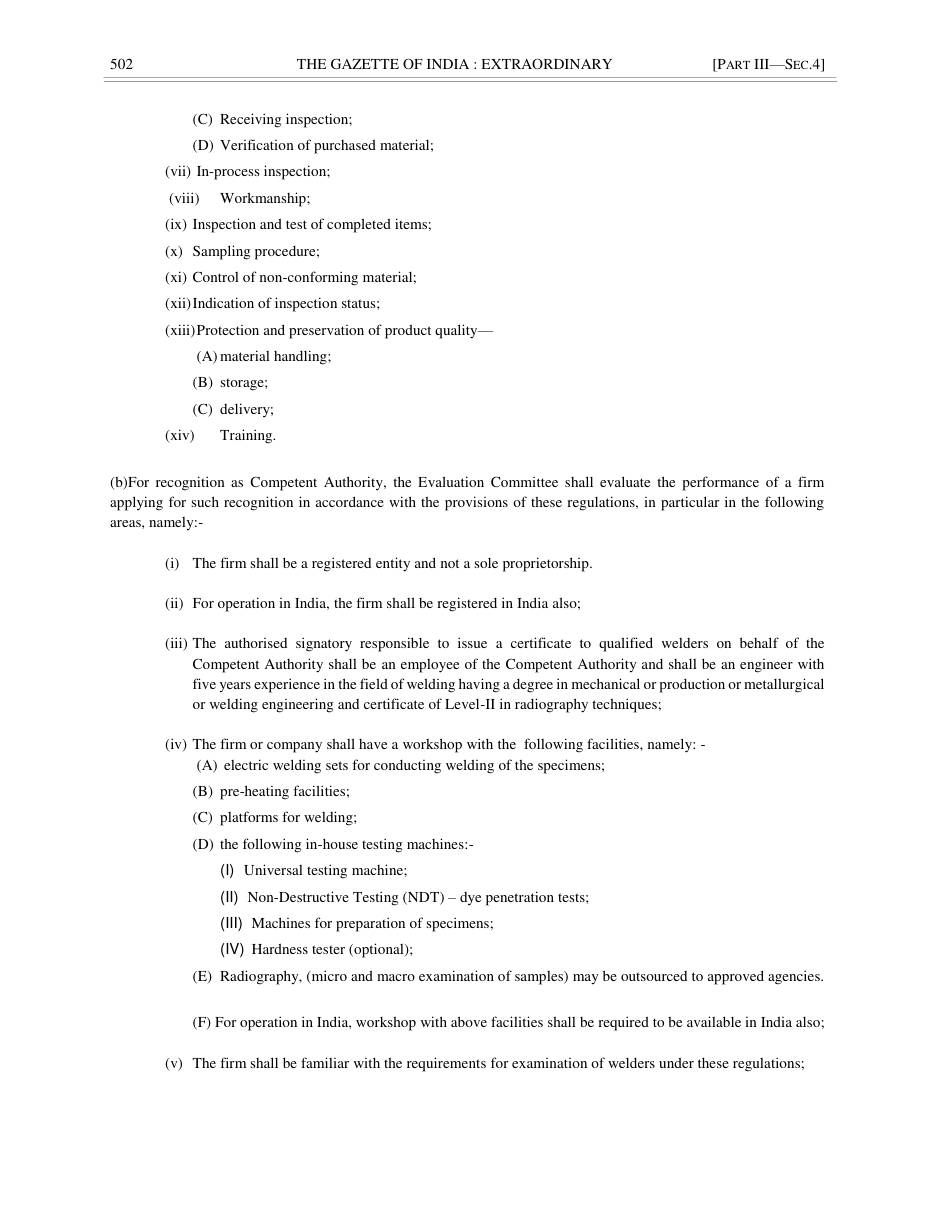
(C) Receiving inspection;
(D) Verification of purchased material;
(vii)In-process inspection;
(viii)Workmanship;
(ix)Inspection and test of completed items;
(x)Sampling procedure;
(xi)Control of non-conforming material;
(xii)Indication of inspection status;
(xiii)Protection and preservation of product quality—
(A) material handling;
(B) storage;
(C) delivery;
(xiv)Training.
(b)For recognition as Competent Authority, the Evaluation Committee shall evaluate the performance of a firm applying for such recognition in accordance with the provisions of these regulations, in particular in the following areas, namely:-
(i)The firm shall be a registered entity and not a sole proprietorship.
(ii)For operation in India, the firm shall be registered in India also;
(iii)The authorised signatory responsible to issue a certificate to qualified welders on behalf of the Competent Authority shall be an employee of the Competent Authority and shall be an engineer with five years experience in the field of welding having a degree in mechanical or production or metallurgical or welding engineering and certificate of Level-II in radiography techniques;
(iv)The firm or company shall have a workshop with the following facilities, namely: -(A) electric welding sets for conducting welding of the specimens; (B) pre-heating facilities;
(C) platforms for welding;
(D) the following in-house testing machines:-
(I) Universal testing machine;
(II) Non-Destructive Testing (NDT) – dye penetration tests;
(III) Machines for preparation of specimens;
(IV) Hardness tester (optional);
(E) Radiography, (micro and macro examination of samples) may be outsourced to approved agencies.
(F) For operation in India, workshop with above facilities shall be required to be available in India also;
(v)The firm shall be familiar with the requirements for examination of welders under these regulations;
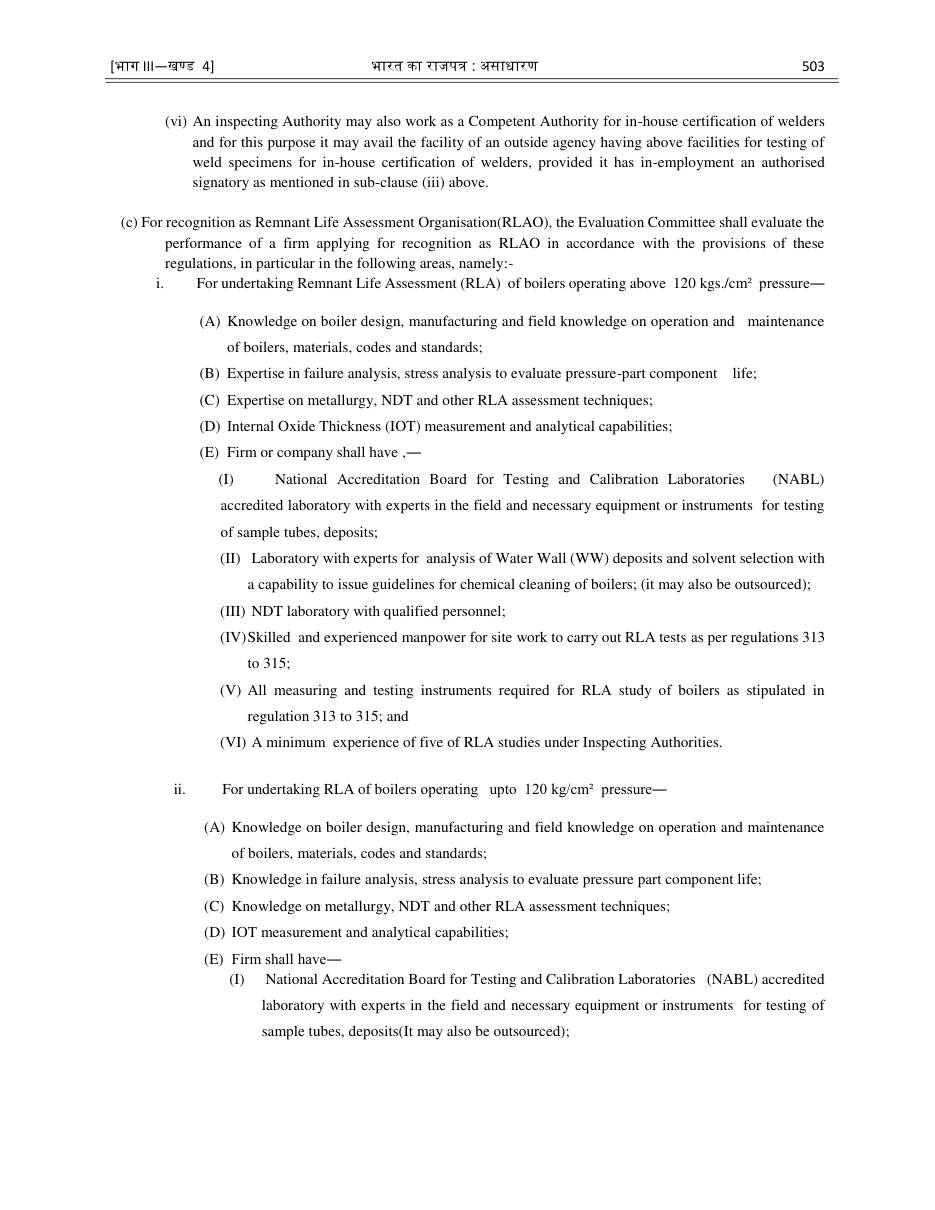
(vi)An inspecting Authority may also work as a Competent Authority for in-house certification of welders and for this purpose it may avail the facility of an outside agency having above facilities for testing of weld specimens for in-house certification of welders, provided it has in-employment an authorised signatory as mentioned in sub-clause (iii) above.
(c)For recognition as Remnant Life Assessment Organisation(RLAO), the Evaluation Committee shall evaluate the performance of a firm applying for recognition as RLAO in accordance with the provisions of these regulations, in particular in the following areas, namely:-
i. For undertaking Remnant Life Assessment (RLA) of boilers operating above 120 kgs./cm² pressure―
(A) Knowledge on boiler design, manufacturing and field knowledge on operation and maintenance of boilers, materials, codes and standards;
(B) Expertise in failure analysis, stress analysis to evaluate pressure-part component life;
(C) Expertise on metallurgy, NDT and other RLA assessment techniques;
(D) Internal Oxide Thickness (IOT) measurement and analytical capabilities;
(E) Firm or company shall have ,―
(I) National Accreditation Board for Testing and Calibration Laboratories (NABL)
accredited laboratory with experts in the field and necessary equipment or instruments for testing of sample tubes, deposits;
(II) Laboratory with experts for analysis of Water Wall (WW) deposits and solvent selection with a capability to issue guidelines for chemical cleaning of boilers; (it may also be outsourced);
(III) NDT laboratory with qualified personnel;
(IV)Skilled and experienced manpower for site work to carry out RLA tests as per regulations 313 to 315;
(V) All measuring and testing instruments required for RLA study of boilers as stipulated in regulation 313 to 315; and
(VI) A minimum experience of five of RLA studies under Inspecting Authorities.
ii. For undertaking RLA of boilers operating upto 120 kg/cm² pressure―
(A) Knowledge on boiler design, manufacturing and field knowledge on operation and maintenance of boilers, materials, codes and standards;
(B) Knowledge in failure analysis, stress analysis to evaluate pressure part component life; (C) Knowledge on metallurgy, NDT and other RLA assessment techniques; (D) IOT measurement and analytical capabilities;
(E) Firm shall have―
(I) National Accreditation Board for Testing and Calibration Laboratories (NABL) accredited laboratory with experts in the field and necessary equipment or instruments for testing of sample tubes, deposits(It may also be outsourced);
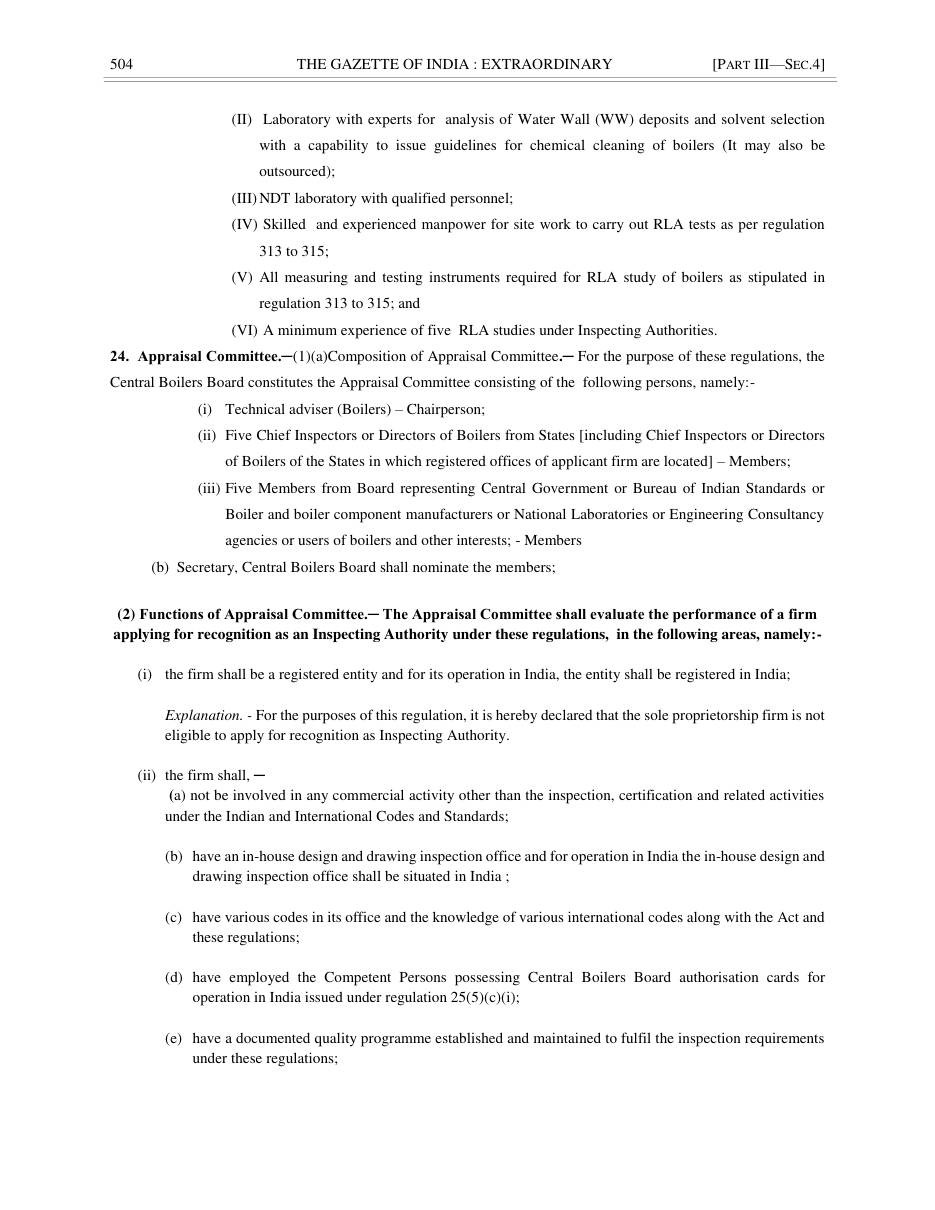
(II) Laboratory with experts for analysis of Water Wall (WW) deposits and solvent selection with a capability to issue guidelines for chemical cleaning of boilers (It may also be outsourced);
(III) NDT laboratory with qualified personnel;
(IV) Skilled and experienced manpower for site work to carry out RLA tests as per regulation
313 to 315;
(V) All measuring and testing instruments required for RLA study of boilers as stipulated in regulation 313 to 315; and
(VI) A minimum experience of five RLA studies under Inspecting Authorities.
In short
Regulation 23 constitutes the Evaluation Committee and lists what it evaluates when a firm applies for recognition, with specific criteria for Competent Authorities and Remnant Life Assessment Organisations (RLAO).
Key points
- (1) Composition. Technical Adviser (Boilers) as Chairperson; the Chief Inspector (Boilers) of the State where the unit is located; and one Board representative from the listed interests. The Secretary, Central Boilers Board nominates the members.
- (2)(a) General areas evaluated. Quality system and its review, organisation, documentation, inspection equipment, inspection of purchased material or services, in-process inspection, workmanship, final inspection and test, sampling, control of non-conforming material, inspection status, protection of product quality, and training.
- (2)(b) Competent Authority. The firm must be a registered entity, not a sole proprietorship, and registered in India for operation in India. Its authorised signatory for welder certificates must be an employee and an engineer with five years' welding experience, a degree in mechanical, production, metallurgical or welding engineering, and a Level-II radiography certificate. For operation in India the firm must also be registered in India and have its workshop facilities available in India. It needs a workshop with welding sets, pre-heating, welding platforms and in-house testing machines (universal testing machine, dye penetration NDT, specimen preparation; hardness tester optional). Radiography and micro and macro examination may be outsourced to approved agencies.
- (2)(c) RLAO. Separate lists for RLA of boilers operating above 120 kgs./cm² and up to 120 kg/cm². Both cover knowledge of design, manufacture, operation, materials and codes; failure and stress analysis; metallurgy and NDT; IOT measurement; laboratory, NDT and site capability for RLA tests under regulations 313 to 315; and experience of five RLA studies under Inspecting Authorities.
Watch out
- An Inspecting Authority may also act as a Competent Authority for in-house welder certification, using an outside agency's testing facilities, but only if it employs an authorised signatory meeting the (2)(b)(iii) criteria.
- For RLA above 120 kgs./cm², "expertise" is required and the NABL accredited laboratory is not marked as outsourceable. For RLA up to 120 kg/cm², "knowledge" is required and that laboratory may be outsourced.
Written by IBRsource editors · last edited 2026-11-20. Explanations simplify and are not a design method, testing procedure or authorisation. Requirements come from the complete regulations, the Gazette and approved documentation.
Comparison pending: the IBR 1950 text in force on 30 September 2026 is not yet established for this provision, so no change is claimed (how this works).
Orientation hints (unverified)
These candidates come from automated heading matching against DPIIT's scanned historical print edition of IBR 1950. That edition uses imperial units and riveted-construction provisions, so it is not the operative 2026 predecessor text. Regulation numbers alone never prove equivalence.
No candidate heading found in the historical print edition.
Images of the official Gazette pages that contain this regulation. Click to zoom. Compare word by word before relying on the extracted text.
Indian Boiler Regulations, 2026, reg. 23, Regulation 23, Gazette of India, Extraordinary, Part III—Section 4, No. 596, 1 October 2026, printed p.501–504. https://egazette.gov.in/WriteReadData/2026/276813.pdf (text consulted via IBRsource, 2026-11-23).
The citation refers to the government publication. Cite the Gazette, not this website.