
Indian Boiler Regulations, 2026 · Chapter 1 · General Requirements, Registration, Recognition and Competent Persons
Regulation 26. Modification of formulae
Not yet checked against the official Gazette; verify before relying on it.
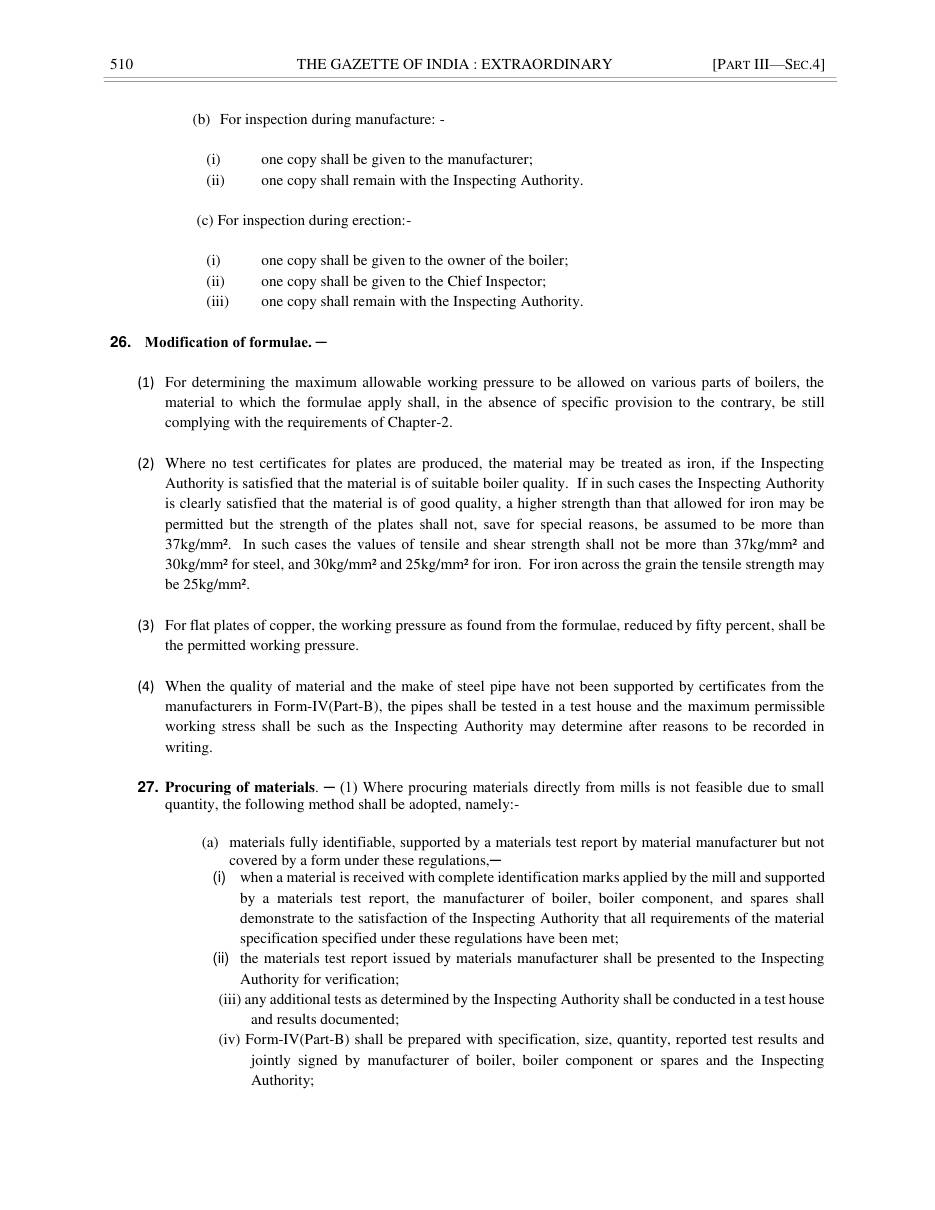
26. Modification of formulae. ─
(1)For determining the maximum allowable working pressure to be allowed on various parts of boilers, the material to which the formulae apply shall, in the absence of specific provision to the contrary, be still complying with the requirements of Chapter-2.
(2)Where no test certificates for plates are produced, the material may be treated as iron, if the Inspecting Authority is satisfied that the material is of suitable boiler quality. If in such cases the Inspecting Authority is clearly satisfied that the material is of good quality, a higher strength than that allowed for iron may be permitted but the strength of the plates shall not, save for special reasons, be assumed to be more than 37kg/mm². In such cases the values of tensile and shear strength shall not be more than 37kg/mm² and 30kg/mm² for steel, and 30kg/mm² and 25kg/mm² for iron. For iron across the grain the tensile strength may be 25kg/mm².
(3)For flat plates of copper, the working pressure as found from the formulae, reduced by fifty percent, shall be the permitted working pressure.
(4)When the quality of material and the make of steel pipe have not been supported by certificates from the manufacturers in Form-IV(Part-B), the pipes shall be tested in a test house and the maximum permissible working stress shall be such as the Inspecting Authority may determine after reasons to be recorded in writing.
In short
Regulation 26 sets rules for applying the working-pressure formulae when material certification is missing or the material is not steel.
Key points
- (1) Unless a provision says otherwise, the formulae apply to material that complies with Chapter-2.
- (2) With no plate test certificates, the material may be treated as iron if the Inspecting Authority is satisfied it is of suitable boiler quality. If clearly satisfied it is of good quality, a higher strength may be allowed, but not more than 37kg/mm² save for special reasons. Tensile and shear strength are limited to 37kg/mm² and 30kg/mm² for steel, and 30kg/mm² and 25kg/mm² for iron. For iron across the grain, tensile strength may be 25kg/mm².
- (3) For flat copper plates, the permitted working pressure is the formula value reduced by fifty percent.
- (4) Steel pipe without Form-IV (Part-B) certificates must be tested in a test house. The Inspecting Authority then sets the maximum permissible working stress, with reasons recorded in writing.
Written by IBRsource editors · last edited 2026-11-20. Explanations simplify and are not a design method, testing procedure or authorisation. Requirements come from the complete regulations, the Gazette and approved documentation.
Comparison pending: the IBR 1950 text in force on 30 September 2026 is not yet established for this provision, so no change is claimed (how this works).
Orientation hints (unverified)
These candidates come from automated heading matching against DPIIT's scanned historical print edition of IBR 1950. That edition uses imperial units and riveted-construction provisions, so it is not the operative 2026 predecessor text. Regulation numbers alone never prove equivalence.
| Historical 1950-edition reg. | Heading as OCR'd | Heading similarity | Source image |
|---|---|---|---|
| 5 | Modification of Formulae | 100% | Chapter I (DPIIT scan), image 3 |
Amendment history of the candidate IBR 1950 regulation: Reg. 5 (1 amendment)
IBR 1950 regulation 5 as last published in the DPIIT web edition (archived 2022)
Unofficial archived copy, not verified; see the regulation 5 page for its amendments.
| Reg. 5 Modification of Formulae |
| (i) | Under the Regulations for determining the working pressure to be allowed on various parts of boilers, the material to which the formulae apply shall in the absence of express provision to the contrary be steel complying with the requirements of Chapter II. |
| (ii) | Where no test certificate for plates and rivets are produced, the material may be treated as iron, if the Chief Inspector is satisfied that the material is of suitable boiler quality. If in such cases the Chief Inspector is clearly satisfied that the material is of good quality, a higher strength than that allowed for iron may be permitted but the strength of the plates shall not, save for special reasons, be assumed to be more than 26 tons per square inch. In such cases the values of tensile and shear strength shall not be more than 26 and 21 tons per square inch for steel, and 21 and 18 tons per square inch for iron. For iron across the grain the tensile strength may be 18 tons per square inch. |
| (iii) | For flat plates of copper, the working pressure as found from the formulae, reduced by 50 per cent shall be the working pressure permitted. |
Images of the official Gazette pages that contain this regulation. Click to zoom. Compare word by word before relying on the extracted text.
Indian Boiler Regulations, 2026, reg. 26, Regulation 26, Gazette of India, Extraordinary, Part III—Section 4, No. 596, 1 October 2026, printed p.510. https://egazette.gov.in/WriteReadData/2026/276813.pdf (text consulted via IBRsource, 2026-11-23).
The citation refers to the government publication. Cite the Gazette, not this website.