Indian Boiler Regulations, 2026
Appendix A — INSPECTION AND TESTING OF BOILERS, BOILER COMPONENTS AND OTHER PARTS DURING MANUFACTURE
Not yet checked against the official Gazette; verify before relying on it.
Open the official Gazette at this appendix
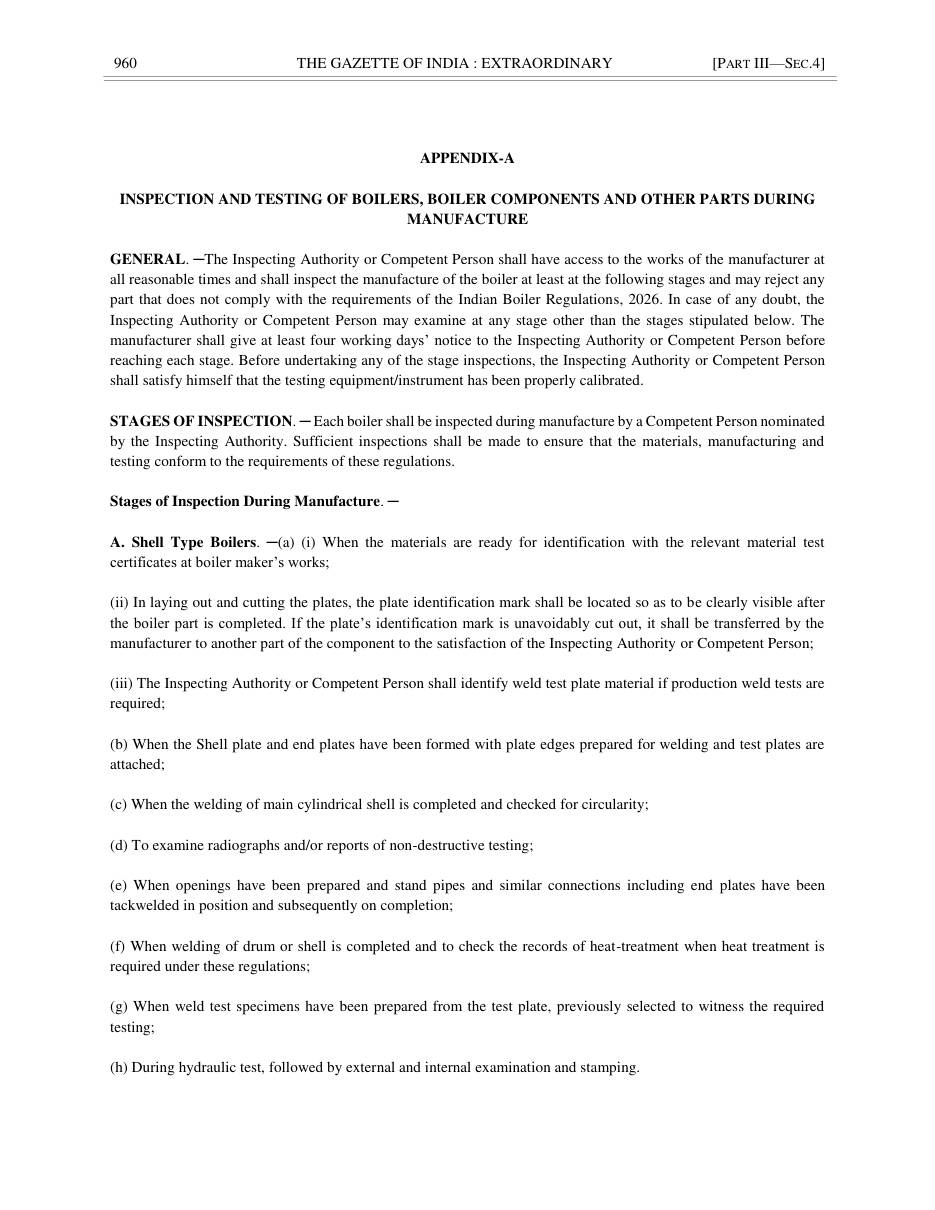
APPENDIX-A
INSPECTION AND TESTING OF BOILERS, BOILER COMPONENTS AND OTHER PARTS DURING MANUFACTURE
GENERAL. ─The Inspecting Authority or Competent Person shall have access to the works of the manufacturer at all reasonable times and shall inspect the manufacture of the boiler at least at the following stages and may reject any part that does not comply with the requirements of the Indian Boiler Regulations, 2026. In case of any doubt, the Inspecting Authority or Competent Person may examine at any stage other than the stages stipulated below. The manufacturer shall give at least four working days’ notice to the Inspecting Authority or Competent Person before reaching each stage. Before undertaking any of the stage inspections, the Inspecting Authority or Competent Person shall satisfy himself that the testing equipment/instrument has been properly calibrated.
STAGES OF INSPECTION. ─ Each boiler shall be inspected during manufacture by a Competent Person nominated by the Inspecting Authority. Sufficient inspections shall be made to ensure that the materials, manufacturing and testing conform to the requirements of these regulations.
Stages of Inspection During Manufacture. ─
A. Shell Type Boilers. ─(a) (i) When the materials are ready for identification with the relevant material test certificates at boiler maker’s works;
(ii)In laying out and cutting the plates, the plate identification mark shall be located so as to be clearly visible after the boiler part is completed. If the plate’s identification mark is unavoidably cut out, it shall be transferred by the manufacturer to another part of the component to the satisfaction of the Inspecting Authority or Competent Person;
(iii)The Inspecting Authority or Competent Person shall identify weld test plate material if production weld tests are required;
(b)When the Shell plate and end plates have been formed with plate edges prepared for welding and test plates are attached;
(c)When the welding of main cylindrical shell is completed and checked for circularity;
(d)To examine radiographs and/or reports of non-destructive testing;
(e)When openings have been prepared and stand pipes and similar connections including end plates have been tackwelded in position and subsequently on completion;
(f)When welding of drum or shell is completed and to check the records of heat-treatment when heat treatment is required under these regulations;
(g)When weld test specimens have been prepared from the test plate, previously selected to witness the required testing;
(h)During hydraulic test, followed by external and internal examination and stamping.
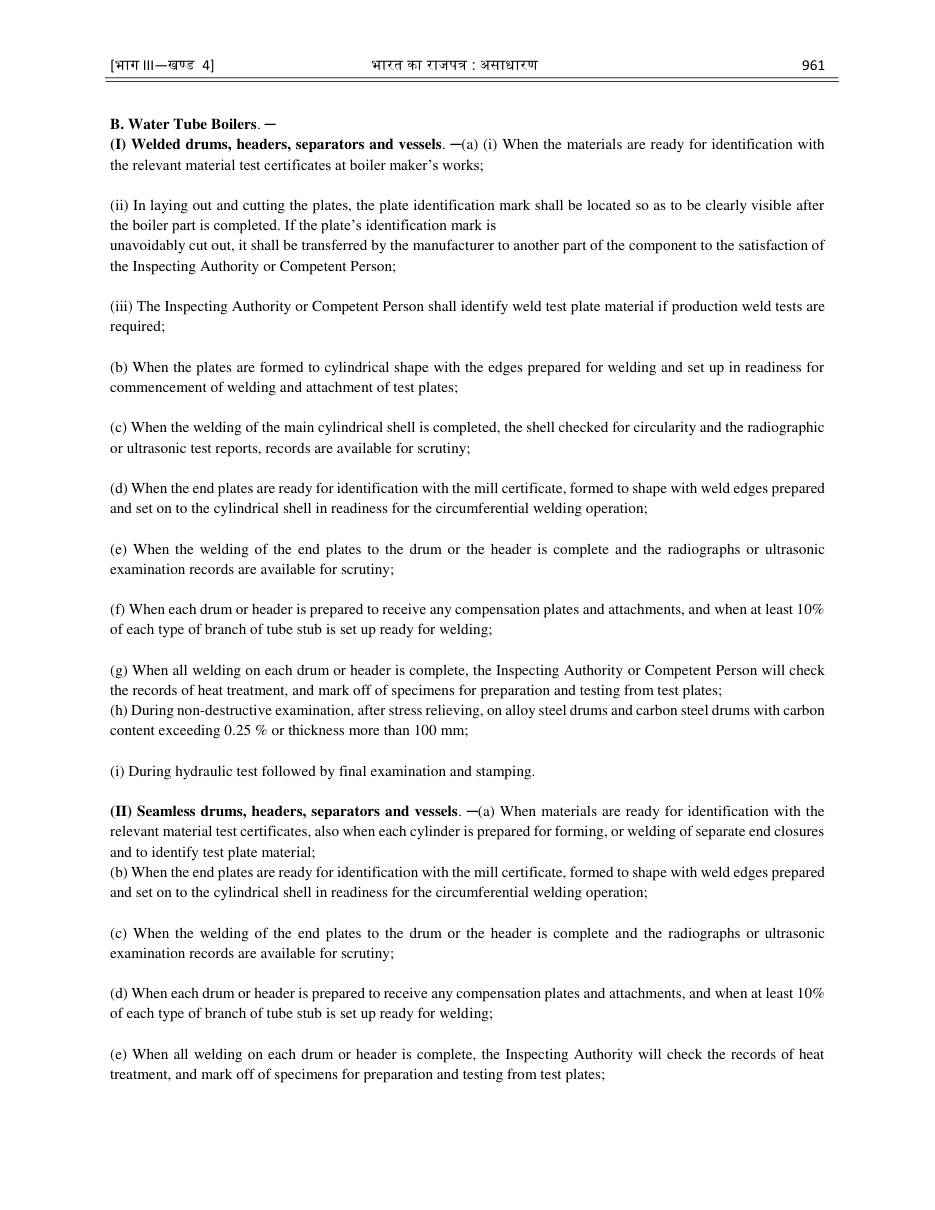
B. Water Tube Boilers. ─
(I) Welded drums, headers, separators and vessels. ─(a) (i) When the materials are ready for identification with the relevant material test certificates at boiler maker’s works;
(ii)In laying out and cutting the plates, the plate identification mark shall be located so as to be clearly visible after the boiler part is completed. If the plate’s identification mark is unavoidably cut out, it shall be transferred by the manufacturer to another part of the component to the satisfaction of the Inspecting Authority or Competent Person;
(iii)The Inspecting Authority or Competent Person shall identify weld test plate material if production weld tests are required;
(b)When the plates are formed to cylindrical shape with the edges prepared for welding and set up in readiness for commencement of welding and attachment of test plates;
(c)When the welding of the main cylindrical shell is completed, the shell checked for circularity and the radiographic or ultrasonic test reports, records are available for scrutiny;
(d)When the end plates are ready for identification with the mill certificate, formed to shape with weld edges prepared and set on to the cylindrical shell in readiness for the circumferential welding operation;
(e)When the welding of the end plates to the drum or the header is complete and the radiographs or ultrasonic examination records are available for scrutiny;
(f)When each drum or header is prepared to receive any compensation plates and attachments, and when at least 10% of each type of branch of tube stub is set up ready for welding;
(g)When all welding on each drum or header is complete, the Inspecting Authority or Competent Person will check the records of heat treatment, and mark off of specimens for preparation and testing from test plates;
(h)During non-destructive examination, after stress relieving, on alloy steel drums and carbon steel drums with carbon content exceeding 0.25 % or thickness more than 100 mm;
(i)During hydraulic test followed by final examination and stamping.
(II) Seamless drums, headers, separators and vessels. ─(a) When materials are ready for identification with the relevant material test certificates, also when each cylinder is prepared for forming, or welding of separate end closures and to identify test plate material;
(b)When the end plates are ready for identification with the mill certificate, formed to shape with weld edges prepared and set on to the cylindrical shell in readiness for the circumferential welding operation;
(c)When the welding of the end plates to the drum or the header is complete and the radiographs or ultrasonic examination records are available for scrutiny;
(d)When each drum or header is prepared to receive any compensation plates and attachments, and when at least 10% of each type of branch of tube stub is set up ready for welding;
(e)When all welding on each drum or header is complete, the Inspecting Authority will check the records of heat treatment, and mark off of specimens for preparation and testing from test plates;
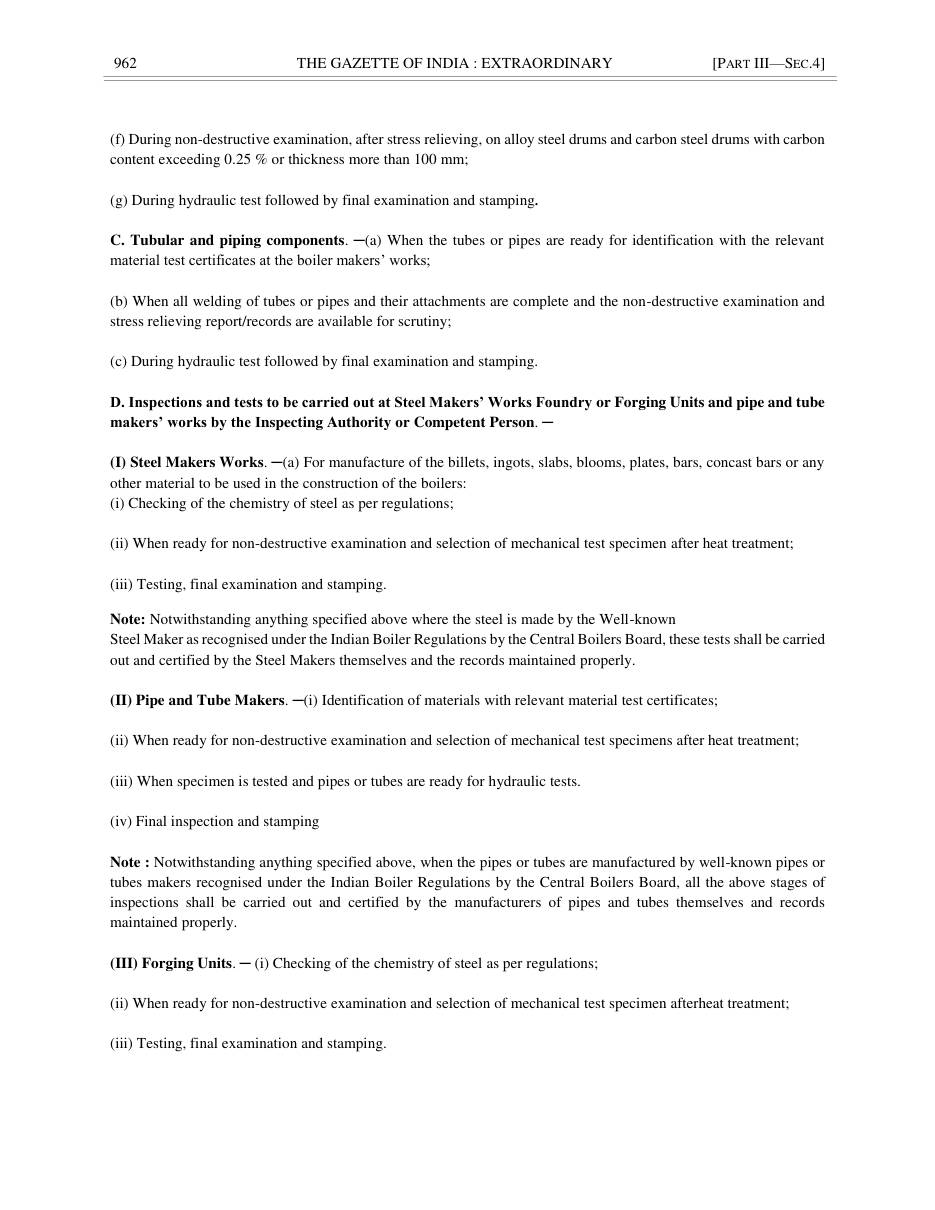
(f)During non-destructive examination, after stress relieving, on alloy steel drums and carbon steel drums with carbon content exceeding 0.25 % or thickness more than 100 mm;
(g)During hydraulic test followed by final examination and stamping.
C. Tubular and piping components. ─(a) When the tubes or pipes are ready for identification with the relevant material test certificates at the boiler makers’ works;
(b)When all welding of tubes or pipes and their attachments are complete and the non-destructive examination and stress relieving report/records are available for scrutiny;
(c)During hydraulic test followed by final examination and stamping.
D. Inspections and tests to be carried out at Steel Makers’ Works Foundry or Forging Units and pipe and tube makers’ works by the Inspecting Authority or Competent Person. ─
(I) Steel Makers Works. ─(a) For manufacture of the billets, ingots, slabs, blooms, plates, bars, concast bars or any other material to be used in the construction of the boilers:
(i)Checking of the chemistry of steel as per regulations;
(ii)When ready for non-destructive examination and selection of mechanical test specimen after heat treatment;
(iii)Testing, final examination and stamping.
Note: Notwithstanding anything specified above where the steel is made by the Well-known Steel Maker as recognised under the Indian Boiler Regulations by the Central Boilers Board, these tests shall be carried out and certified by the Steel Makers themselves and the records maintained properly.
(II) Pipe and Tube Makers. ─(i) Identification of materials with relevant material test certificates;
(ii)When ready for non-destructive examination and selection of mechanical test specimens after heat treatment;
(iii)When specimen is tested and pipes or tubes are ready for hydraulic tests.
(iv)Final inspection and stamping
Note : Notwithstanding anything specified above, when the pipes or tubes are manufactured by well-known pipes or tubes makers recognised under the Indian Boiler Regulations by the Central Boilers Board, all the above stages of inspections shall be carried out and certified by the manufacturers of pipes and tubes themselves and records maintained properly.
(III) Forging Units. ─ (i) Checking of the chemistry of steel as per regulations;
(ii)When ready for non-destructive examination and selection of mechanical test specimen afterheat treatment;
(iii)Testing, final examination and stamping.
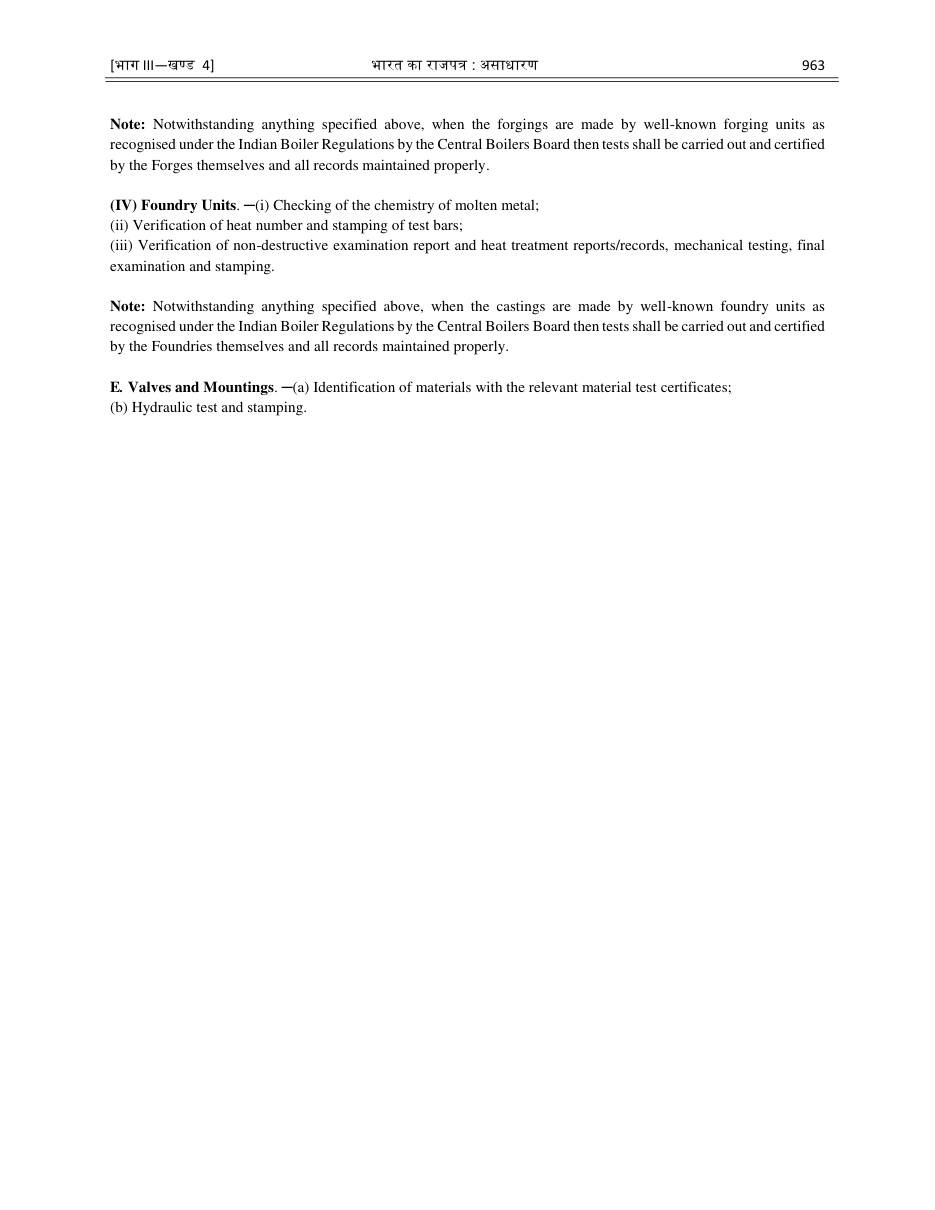
Note: Notwithstanding anything specified above, when the forgings are made by well-known forging units as recognised under the Indian Boiler Regulations by the Central Boilers Board then tests shall be carried out and certified by the Forges themselves and all records maintained properly.
(IV) Foundry Units. ─(i) Checking of the chemistry of molten metal;
(ii)Verification of heat number and stamping of test bars;
(iii)Verification of non-destructive examination report and heat treatment reports/records, mechanical testing, final examination and stamping.
Note: Notwithstanding anything specified above, when the castings are made by well-known foundry units as recognised under the Indian Boiler Regulations by the Central Boilers Board then tests shall be carried out and certified by the Foundries themselves and all records maintained properly.
E. Valves and Mountings. ─(a) Identification of materials with the relevant material test certificates;
(b)Hydraulic test and stamping.
Gazette pages