
Indian Boiler Regulations, 2026 · Chapter 7 · Pipes and Fittings
Regulation 253. Tests
Not yet checked against the official Gazette; verify before relying on it.
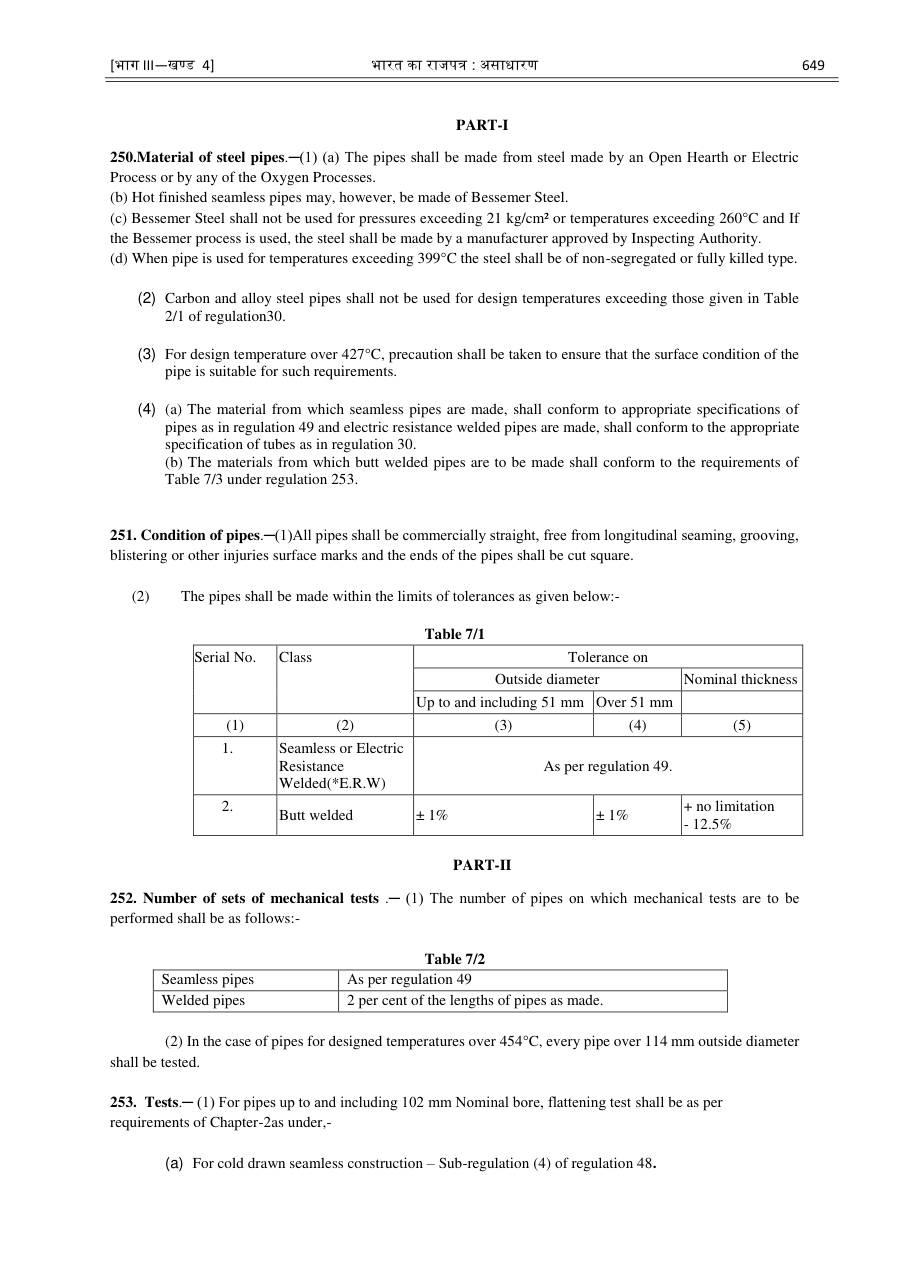
253. Tests.─ (1) For pipes up to and including 102 mm Nominal bore, flattening test shall be as per requirements of Chapter-2as under,-
(a)For cold drawn seamless construction – Sub-regulation (4) of regulation 48.
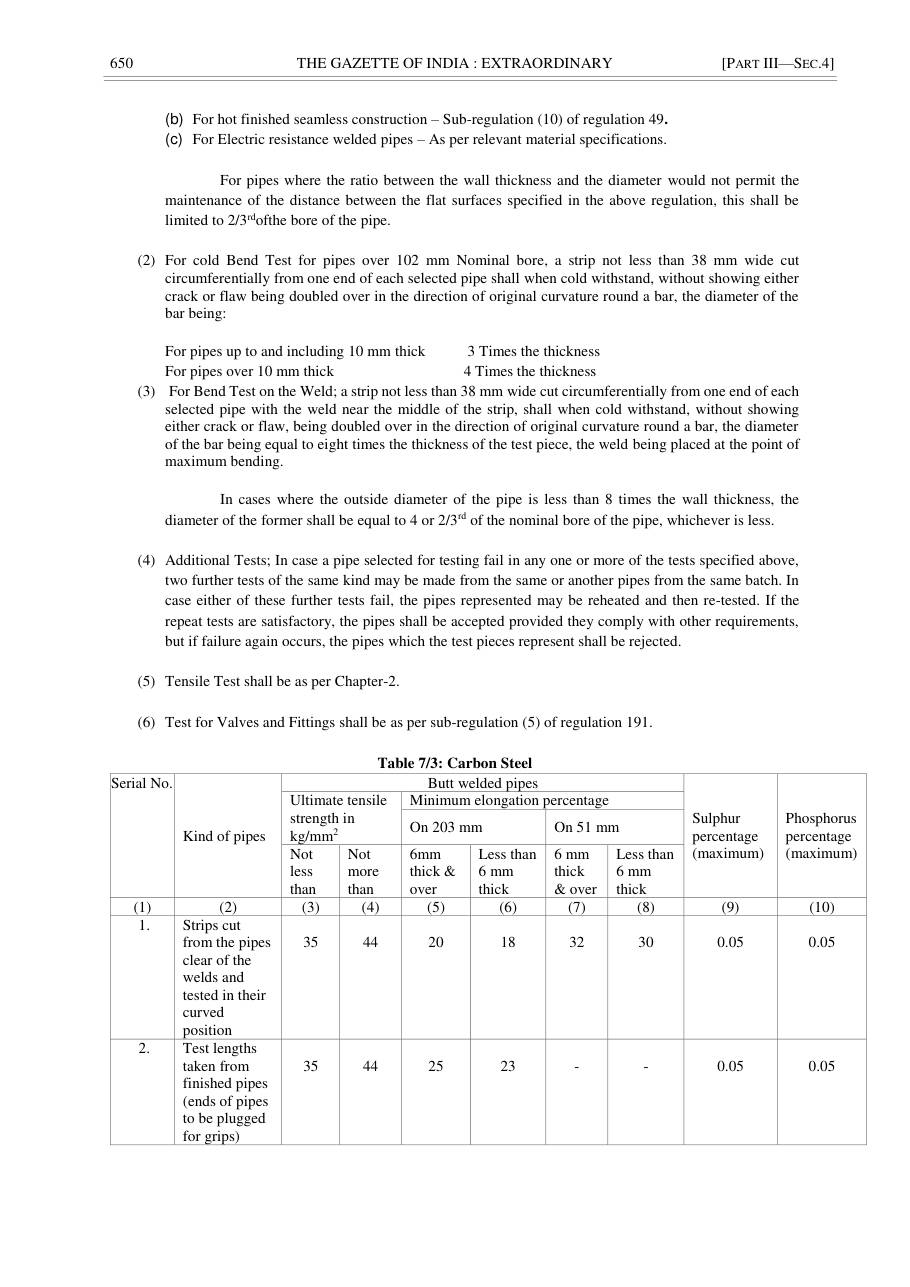
(b)For hot finished seamless construction – Sub-regulation (10) of regulation 49.
(c)For Electric resistance welded pipes – As per relevant material specifications.
For pipes where the ratio between the wall thickness and the diameter would not permit the maintenance of the distance between the flat surfaces specified in the above regulation, this shall be limited to 2/3rdofthe bore of the pipe.
(2)For cold Bend Test for pipes over 102 mm Nominal bore, a strip not less than 38 mm wide cut circumferentially from one end of each selected pipe shall when cold withstand, without showing either crack or flaw being doubled over in the direction of original curvature round a bar, the diameter of the bar being:
For pipes up to and including 10 mm thick       3 Times the thickness

For pipes over 10 mm thick                      4 Times the thickness
(3)For Bend Test on the Weld; a strip not less than 38 mm wide cut circumferentially from one end of each selected pipe with the weld near the middle of the strip, shall when cold withstand, without showing either crack or flaw, being doubled over in the direction of original curvature round a bar, the diameter of the bar being equal to eight times the thickness of the test piece, the weld being placed at the point of maximum bending.
In cases where the outside diameter of the pipe is less than 8 times the wall thickness, the diameter of the former shall be equal to 4 or 2/3rd of the nominal bore of the pipe, whichever is less.
(4)Additional Tests; In case a pipe selected for testing fail in any one or more of the tests specified above, two further tests of the same kind may be made from the same or another pipes from the same batch. In case either of these further tests fail, the pipes represented may be reheated and then re-tested. If the repeat tests are satisfactory, the pipes shall be accepted provided they comply with other requirements, but if failure again occurs, the pipes which the test pieces represent shall be rejected.
(5)Tensile Test shall be as per Chapter-2.
(6)Test for Valves and Fittings shall be as per sub-regulation (5) of regulation 191.
Table 7/3: Carbon Steel
| Serial No. | Kind of pipes | Butt welded pipes | Sulphur percentage (maximum) | Phosphorus percentage (maximum) | |||||
|---|---|---|---|---|---|---|---|---|---|
| Ultimate tensile strength in kg/mm2 | Minimum elongation percentage | ||||||||
| On 203 mm | On 51 mm | ||||||||
| Not less than | Not more than | 6mm thick & over | Less than 6 mm thick | 6 mm thick & over | Less than 6 mm thick | ||||
| (1) | (2) | (3) | (4) | (5) | (6) | (7) | (8) | (9) | (10) |
| 1. | Strips cut from the pipes clear of the welds and tested in their curved position | 35 | 44 | 20 | 18 | 32 | 30 | 0.05 | 0.05 |
| 2. | Test lengths taken from finished pipes (ends of pipes to be plugged for grips) | 35 | 44 | 25 | 23 | - | - | 0.05 | 0.05 |
Table structure read from the Gazette PDF, page 650. Verification status as for the text above.
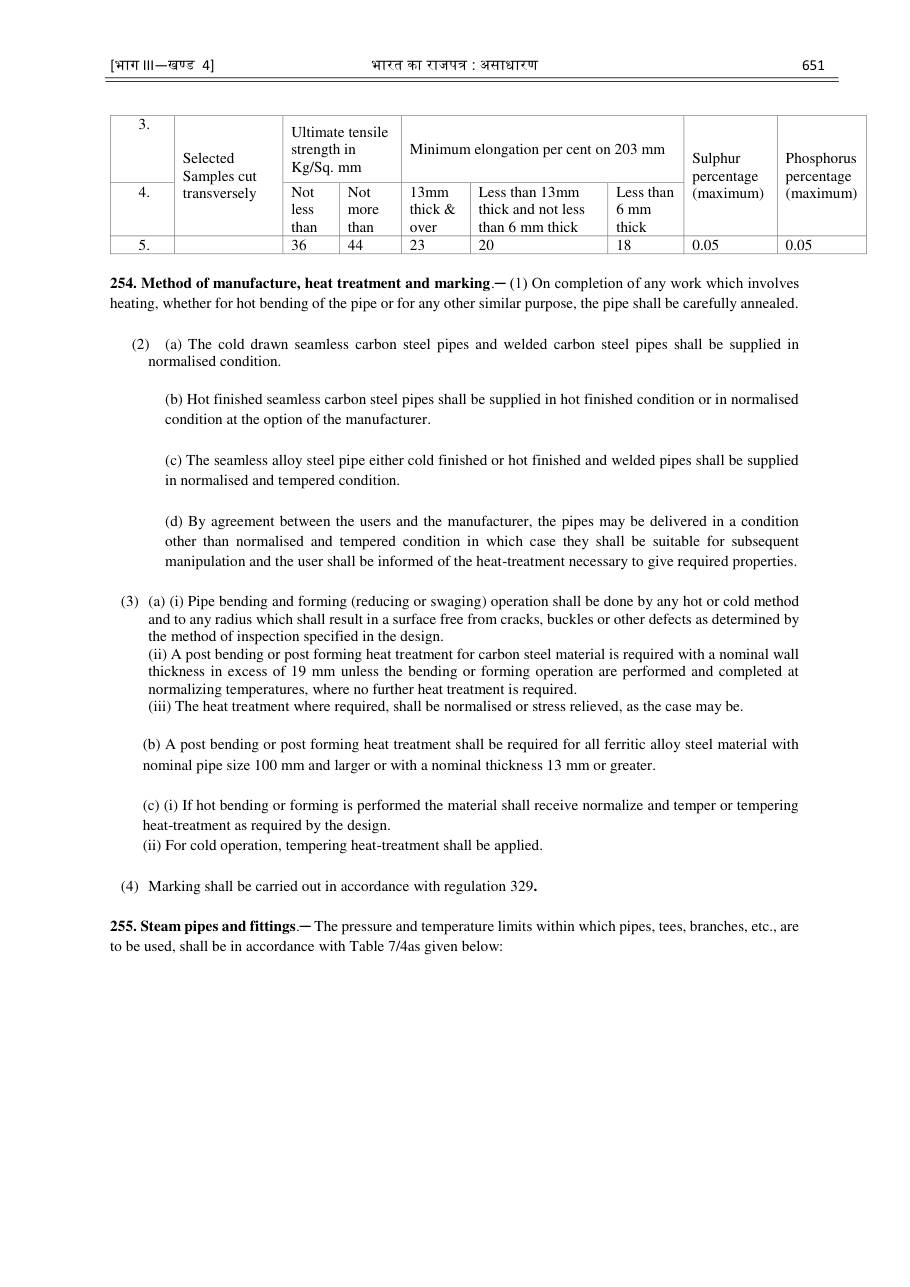
| 3. | Selected Samples cut transversely | Ultimate tensile strength in Kg/Sq. mm | Minimum elongation per cent on 203 mm | Sulphur percentage (maximum) | Phosphorus percentage (maximum) | |||
|---|---|---|---|---|---|---|---|---|
| 4. | Not less than | Not more than | 13mm thick & over | Less than 13mm thick and not less than 6 mm thick | Less than 6 mm thick | |||
| 5. | 36 | 44 | 23 | 20 | 18 | 0.05 | 0.05 | |
Table structure read from the Gazette PDF, page 651. Verification status as for the text above.
Show original extracted text (diagnostic, not authoritative)
Serial No.                                           Butt welded pipes
              Kind of pipes
                             Ultimate tensile Minimum elongation percentage

                             strength in          On 203 mm             On 51 mm               Sulphur     Phosphorus
                             kg/mm2                                                            percentage  percentage
                                                                                               (maximum)   (maximum)
                             Not Not              6mm     Less than 6 mm Less than
                                                                                                    (9)        (10)
                             less more thick & 6 mm                     thick 6 mm                             0.05

                             than than over               thick         & over thick                           0.05

     (1)  (2)                (3)          (4)        (5)     (6)        (7)       (8)

     1. Strips cut

          from the pipes     35           44         20      18         32        30           0.05

          clear of the

          welds and

          tested in their

          curved

          position

     2. Test lengths

          taken from         35           44         25      23         -         -            0.05

          finished pipes

          (ends of pipes

          to be plugged

          for grips)


3.                 Ultimate tensile

    Selected       strength in       Minimum elongation per cent on 203 mm  Sulphur     Phosphorus
    Samples cut    Kg/Sq. mm                                                percentage  percentage

4. transversely Not Not              13mm Less than 13mm             Less than (maximum) (maximum)

                   less more thick & thick and not less 6 mm

                   than than over        than 6 mm thick thick

5.                 36  44            23  20                          18     0.05        0.05
Parts of this extracted text look garbled; read the Gazette page before using any value.
Tables and formulae are shown in their extracted layout. Alignment, superscripts and subscripts may be lost. The Gazette page image is authoritative.
In short
Regulation 253 lists the mechanical tests on pipes (flattening, bend, weld bend and tensile tests) and what happens when a test fails. It also contains Table 7/3, the property limits for butt welded carbon steel pipes.
Key points
- (1) Flattening test for pipes up to and including 102 mm nominal bore: cold drawn seamless per sub-regulation (4) of regulation 48; hot finished seamless per sub-regulation (10) of regulation 49; ERW per the material specification. Where wall-to-diameter ratio prevents the set flat distance, it is limited to 2/3rd of the bore.
- (2) Cold bend test for pipes over 102 mm nominal bore: a strip at least 38 mm wide is bent over a bar of 3 times the thickness (up to and including 10 mm thick) or 4 times the thickness (over 10 mm), without crack or flaw.
- (3) Weld bend test: a similar strip with the weld near the middle, bent round a bar of eight times the test-piece thickness, weld at the point of maximum bending. If the pipe's outside diameter is less than 8 times the wall thickness, the former diameter changes; check the Gazette page for the exact wording.
- (5) Tensile test per Chapter-2. (6) Valves and fittings per sub-regulation (5) of regulation 191.
- Table 7/3 gives tensile strength, elongation and maximum sulphur and phosphorus percentages for butt welded carbon steel pipes. See the Official text for values.
Watch out
- (4) Re-tests: if a pipe fails, two further tests of the same kind may be made. If either fails, the pipes may be reheated and re-tested; if they fail again, the pipes represented are rejected.
Written by IBRsource editors · last edited 2026-11-20. Explanations simplify and are not a design method, testing procedure or authorisation. Requirements come from the complete regulations, the Gazette and approved documentation.
Comparison pending: the IBR 1950 text in force on 30 September 2026 is not yet established for this provision, so no change is claimed (how this works).
Orientation hints (unverified)
These candidates come from automated heading matching against DPIIT's scanned historical print edition of IBR 1950. That edition uses imperial units and riveted-construction provisions, so it is not the operative 2026 predecessor text. Regulation numbers alone never prove equivalence.
| Historical 1950-edition reg. | Heading as OCR'd | Heading similarity | Source image |
|---|---|---|---|
| 20 | Number of Bend Tests | 100% | Chapter II (DPIIT scan), image 2 |
| 17 | Number of Tensile Tests | 100% | Chapter II (DPIIT scan), image 2 |
| 18 | Dump Tests | 100% | Chapter II (DPIIT scan), image 2 |
Amendment history of the candidate IBR 1950 regulations: Reg. 20 (2 amendments) · Reg. 17 (3 amendments)
IBR 1950 regulation 20 as last published in the DPIIT web edition (archived 2022)
Unofficial archived copy, not verified; see the regulation 20 page for its amendments.
| Reg. 20 MATERIALS OF CONSTRUCTION STEEL PLATES, RIVETS, SECTION AND BARS IN CARBON STEEL |
| (a) Plates.- A bend test shall be taken from each plate as rolled. The bend test from shell plates, butt straps and other plates which have not to be flanged or worked in the fire or which when in use are not to be exposed to flame shall be cold bend test. (b) Angle Bars.- A cold bend test shall be made from each angle bar rolled, provided that the cold bend test need not be carried out if basic material specification does not call for it. (c) Stay Bars.- A cold bend test shall be made from every 15 stay bars as rolled from each charge. |
IBR 1950 regulation 17 as last published in the DPIIT web edition (archived 2022)
Unofficial archived copy, not verified; see the regulation 17 page for its amendments.
| Reg. 17 MATERIALS OF CONSTRUCTION STEEL PLATES, RIVETS, SECTION AND BARS IN CARBON STEEL |
| (a) Plates – For shell plates, butt straps and plates, gusset plates, end plates, furnace plates and flanging plates one tensile test piece shall be cut from each plate as rolled. (b) Angle, tee, rivet, and stay bars.- One tensile test shall be made from each 15 or part of 15 bars rolled of each section or diameter from the same charge, but not less than two tensile tests shall be made unless the total number of bars rolled from the same charge is 8 or less than 8 and the bars of the same section or diameter, in which case one tensile test shall suffice. For round bars of 1¾ inches diameter and under, the numbers 50 and 20 shall be substituted for 15 and 8 respectively for determining the number of tests required. |
IBR 1950 regulation 18 as last published in the DPIIT web edition (archived 2022)
Unofficial archived copy, not verified; see the regulation 18 page for its amendments.
| Reg. 18 MATERIALS OF CONSTRUCTION STEEL PLATES, RIVETS, SECTION AND BARS IN CARBON STEEL |
| Short lengths equal to twice their diameter cut from the rivet bars shall, when cold, withstand without fracture being compressed to half their length. A dump test shall be made for each Tensile Test. |
Images of the official Gazette pages that contain this regulation. Click to zoom. Compare word by word before relying on the extracted text.
Indian Boiler Regulations, 2026, reg. 253, Regulation 253, Gazette of India, Extraordinary, Part III—Section 4, No. 596, 1 October 2026, printed p.649–651. https://egazette.gov.in/WriteReadData/2026/276813.pdf (text consulted via IBRsource, 2026-11-23).
The citation refers to the government publication. Cite the Gazette, not this website.