
Indian Boiler Regulations, 2026 · Chapter 7 · Pipes and Fittings
Regulation 282. Shell joints
Not yet checked against the official Gazette; verify before relying on it.
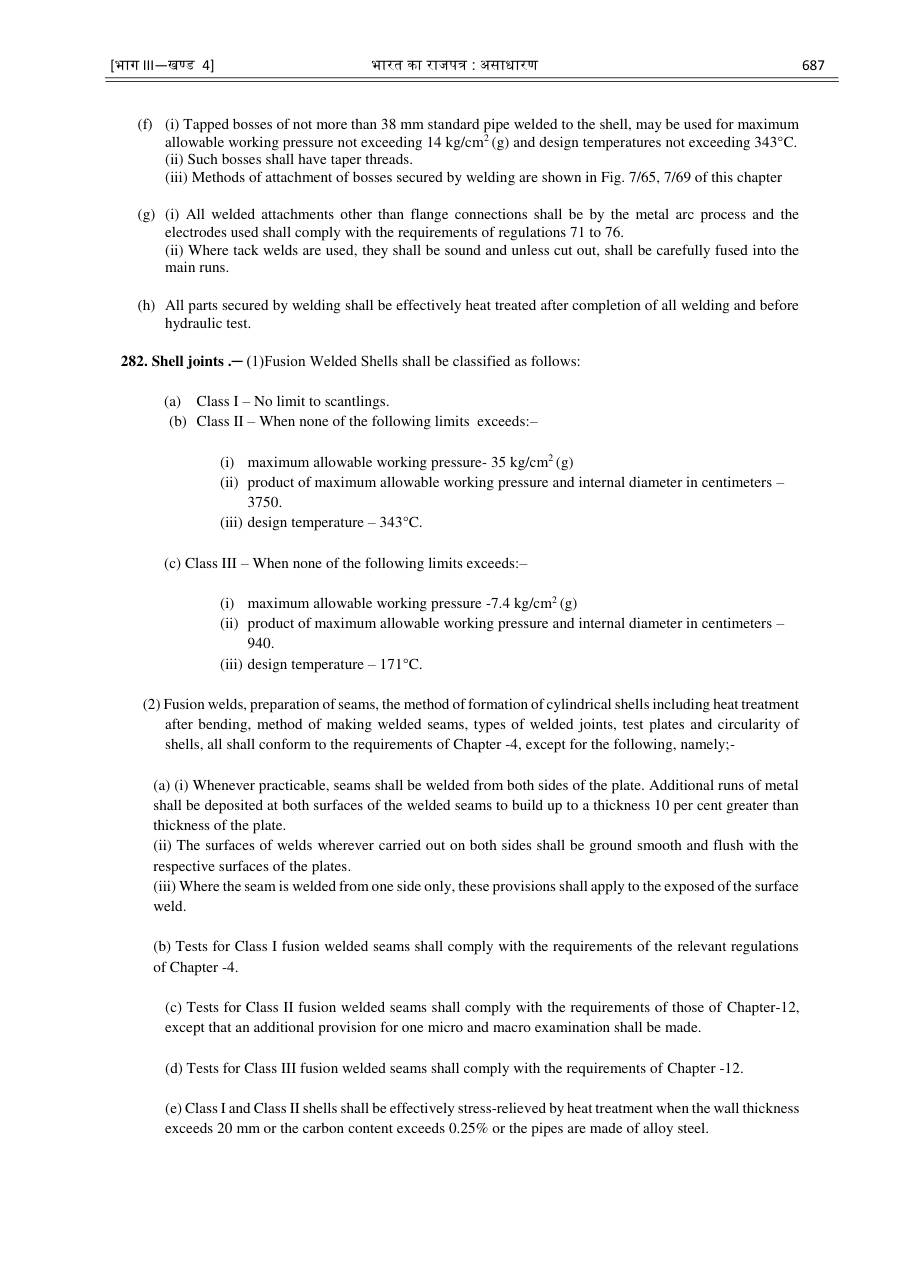
282. Shell joints .─ (1)Fusion Welded Shells shall be classified as follows:
(a)Class I – No limit to scantlings.
(b)Class II – When none of the following limits exceeds:–
(i)maximum allowable working pressure- 35 kg/cm2 (g)
(ii)product of maximum allowable working pressure and internal diameter in centimeters –
3750.
(iii)design temperature – 343°C.
(c)Class III – When none of the following limits exceeds:–
(i)maximum allowable working pressure -7.4 kg/cm2 (g)
(ii)product of maximum allowable working pressure and internal diameter in centimeters –
940.
(iii)design temperature – 171°C.
(2)Fusion welds, preparation of seams, the method of formation of cylindrical shells including heat treatment after bending, method of making welded seams, types of welded joints, test plates and circularity of shells, all shall conform to the requirements of Chapter -4, except for the following, namely;-
(a)(i) Whenever practicable, seams shall be welded from both sides of the plate. Additional runs of metal shall be deposited at both surfaces of the welded seams to build up to a thickness 10 per cent greater than thickness of the plate.
(ii)The surfaces of welds wherever carried out on both sides shall be ground smooth and flush with the respective surfaces of the plates.
(iii)Where the seam is welded from one side only, these provisions shall apply to the exposed of the surface weld.
(b)Tests for Class I fusion welded seams shall comply with the requirements of the relevant regulations of Chapter -4.
(c)Tests for Class II fusion welded seams shall comply with the requirements of those of Chapter-12, except that an additional provision for one micro and macro examination shall be made.
(d)Tests for Class III fusion welded seams shall comply with the requirements of Chapter -12.
(e)Class I and Class II shells shall be effectively stress-relieved by heat treatment when the wall thickness exceeds 20 mm or the carbon content exceeds 0.25% or the pipes are made of alloy steel.
In short
Fusion welded shells of steam receivers and similar vessels are put into Class I, II or III by service limits. This sets the weld testing and stress relief needed.
Key points
- (1) Classes:
- Class I: no limit to scantlings.
- Class II: none of these exceeded: 35 kg/cm2 (g); pressure × internal diameter (cm) of 3750; design temperature 343°C.
- Class III: none of these exceeded: 7.4 kg/cm2 (g); pressure × internal diameter (cm) of 940; design temperature 171°C.
- (2) Welding, seam preparation, shell forming, joint types, test plates and circularity follow Chapter-4, with these exceptions:
- (a) Where practicable, weld from both sides and build up the seam to a thickness 10 per cent greater than the plate, then grind welds smooth and flush. One-sided welds: this applies to the exposed surface.
- (b) Class I tests per Chapter-4.
- (c) Class II tests per Chapter-12, plus one micro and macro examination.
- (d) Class III tests per Chapter-12.
- (e) Class I and Class II shells must be stress relieved by heat treatment when wall thickness exceeds 20 mm, carbon exceeds 0.25%, or the material is alloy steel.
Written by IBRsource editors · last edited 2026-11-20. Explanations simplify and are not a design method, testing procedure or authorisation. Requirements come from the complete regulations, the Gazette and approved documentation.
Comparison pending: the IBR 1950 text in force on 30 September 2026 is not yet established for this provision, so no change is claimed (how this works).
Orientation hints (unverified)
These candidates come from automated heading matching against DPIIT's scanned historical print edition of IBR 1950. That edition uses imperial units and riveted-construction provisions, so it is not the operative 2026 predecessor text. Regulation numbers alone never prove equivalence.
No candidate heading found in the historical print edition.
Images of the official Gazette pages that contain this regulation. Click to zoom. Compare word by word before relying on the extracted text.
Indian Boiler Regulations, 2026, reg. 282, Regulation 282, Gazette of India, Extraordinary, Part III—Section 4, No. 596, 1 October 2026, printed p.687–688. https://egazette.gov.in/WriteReadData/2026/276813.pdf (text consulted via IBRsource, 2026-11-23).
The citation refers to the government publication. Cite the Gazette, not this website.