
Indian Boiler Regulations, 2026 · Chapter 7 · Pipes and Fittings
Regulation 250. Material of steel pipes
Not yet checked against the official Gazette; verify before relying on it.
250.Material of steel pipes.─(1) (a) The pipes shall be made from steel made by an Open Hearth or Electric Process or by any of the Oxygen Processes.
(b)Hot finished seamless pipes may, however, be made of Bessemer Steel.
(c)Bessemer Steel shall not be used for pressures exceeding 21 kg/cm² or temperatures exceeding 260°C and If the Bessemer process is used, the steel shall be made by a manufacturer approved by Inspecting Authority.
(d)When pipe is used for temperatures exceeding 399°C the steel shall be of non-segregated or fully killed type.
(2)Carbon and alloy steel pipes shall not be used for design temperatures exceeding those given in Table 2/1 of regulation30.
(3)For design temperature over 427°C, precaution shall be taken to ensure that the surface condition of the pipe is suitable for such requirements.
(4)(a) The material from which seamless pipes are made, shall conform to appropriate specifications of pipes as in regulation 49 and electric resistance welded pipes are made, shall conform to the appropriate specification of tubes as in regulation 30.
(b)The materials from which butt welded pipes are to be made shall conform to the requirements of
Table 7/3 under regulation 253.
Tables and formulae are shown in their extracted layout. Alignment, superscripts and subscripts may be lost. The Gazette page image is authoritative.
In short
This regulation sets the steelmaking process, temperature limits and material specifications for steel pipes.
Key points
- (1)(a) Pipes must be made from Open Hearth, Electric or any Oxygen process steel.
- (1)(b)–(c) Hot finished seamless pipes may be Bessemer steel, but not for pressures over 21 kg/cm² or temperatures over 260°C, and the Bessemer steel maker must be approved by the Inspecting Authority. This is a pipe allowance only: regulation 3(3) forbids Bessemer process steel for pressure parts of the boiler itself.
- (1)(d) Above 399°C the steel must be non-segregated or fully killed.
- (2) Carbon and alloy steel pipes must not exceed the design temperatures in Table 2/1 of regulation 30.
- (3) For design temperatures over 427°C, the pipe surface condition must be made suitable.
- (4) Seamless pipe material follows the pipe specifications in regulation 49; electric resistance welded pipe material follows the tube specifications in regulation 30; butt welded pipe material follows Table 7/3 under regulation 253.
Written by IBRsource editors · last edited 2026-11-20. Explanations simplify and are not a design method, testing procedure or authorisation. Requirements come from the complete regulations, the Gazette and approved documentation.
Comparison pending: the IBR 1950 text in force on 30 September 2026 is not yet established for this provision, so no change is claimed (how this works).
Orientation hints (unverified)
These candidates come from automated heading matching against DPIIT's scanned historical print edition of IBR 1950. That edition uses imperial units and riveted-construction provisions, so it is not the operative 2026 predecessor text. Regulation numbers alone never prove equivalence.
| Historical 1950-edition reg. | Heading as OCR'd | Heading similarity | Source image |
|---|---|---|---|
| 351 | Cast Steel Pipes | 81% | Chapter VIII (DPIIT scan), image 5 |
Amendment history of the candidate IBR 1950 regulation: Reg. 351 (1 amendment)
IBR 1950 regulation 351 as last published in the DPIIT web edition (archived 2022)
Unofficial archived copy, not verified; see the regulation 351 page for its amendments.
| Reg. 351 Cast Steel Pipes
|
Images of the official Gazette pages that contain this regulation. Click to zoom. Compare word by word before relying on the extracted text.
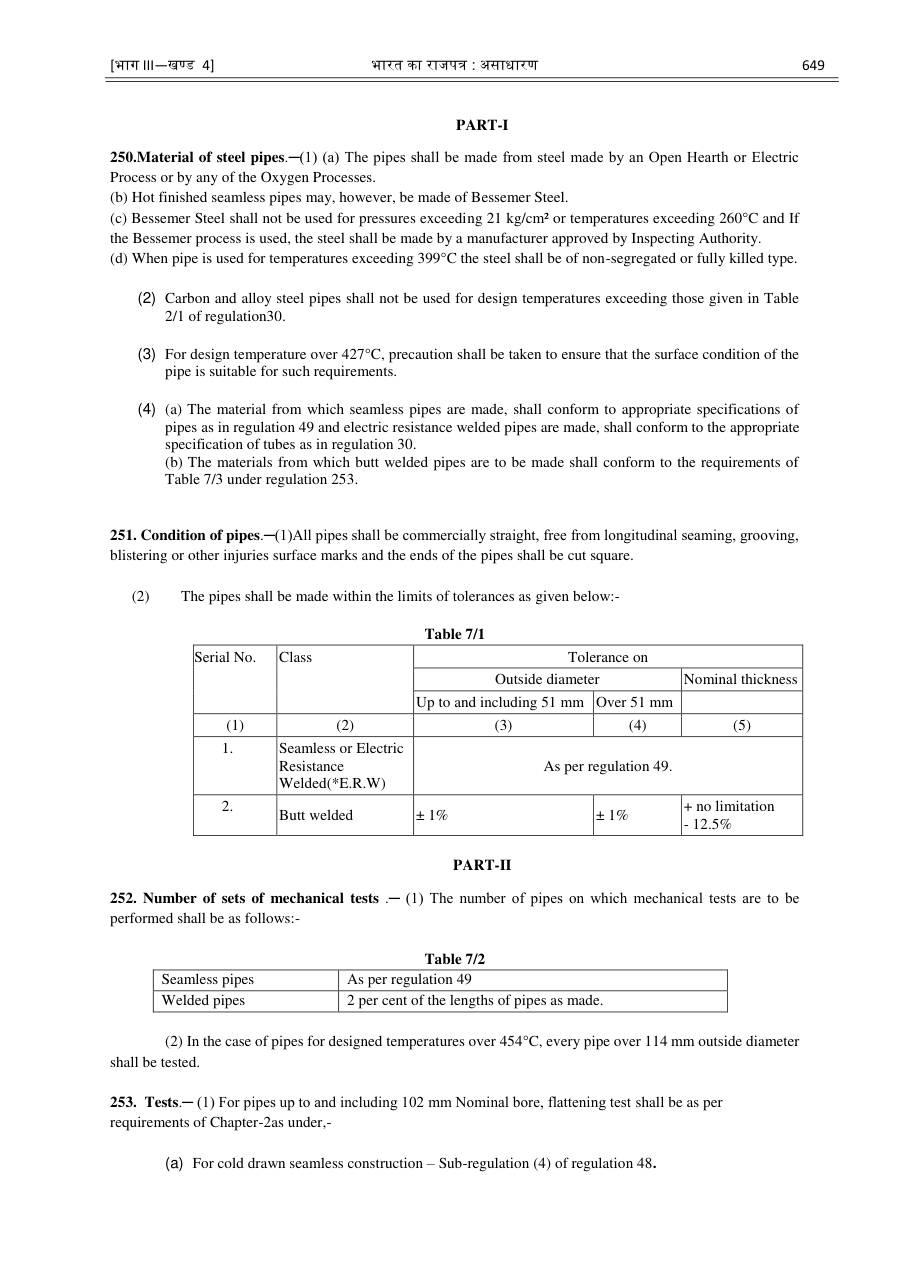
Indian Boiler Regulations, 2026, reg. 250, Regulation 250, Gazette of India, Extraordinary, Part III—Section 4, No. 596, 1 October 2026, printed p.649. https://egazette.gov.in/WriteReadData/2026/276813.pdf (text consulted via IBRsource, 2026-11-23).
The citation refers to the government publication. Cite the Gazette, not this website.