
Indian Boiler Regulations, 2026 · Chapter 7 · Pipes and Fittings
Regulation 259. Flanges of alloy steel pipes
Not yet checked against the official Gazette; verify before relying on it.
259. Flanges of alloy steel pipes.─ (1) (a) The material for alloy steel flanges where forged, cast or cut from plates (excluding branches forged integral with the pipes), shall be made from the steel produced by an Open Hearth or Electric process.
(b)Flanges shall be made without a weld and shall be free from lamination or other defects.
(c)The material of alloy steel flanges shall comply the provisions of regulation 30.
(d)The material for flanges shall be similar to that of the pipes to which they are to be attached.
(e)The flanges are to be so designed that the total stress induced in them does not exceed the maximum permissible stress as per criteria mentioned in regulation 170.
(2)Blank flanges of alloy steel shall be not less in thickness that the flanges to which they are to be attached and the material shall be similar to that of the flanges.
In short
This regulation sets material and design requirements for alloy steel pipe flanges and blank flanges.
Key points
- (1)(a) Alloy steel flanges that are forged, cast or cut from plate must be Open Hearth or Electric process steel. Branches forged integral with the pipes are excluded.
- (1)(b) Flanges must be made without a weld and be free from lamination or other defects.
- (1)(c)–(d) Material must comply with regulation 30 and be similar to that of the pipes they attach to.
- (1)(e) Total stress in the flange must not exceed the maximum permissible stress under the criteria in regulation 170.
- (2) Alloy steel blank flanges must be at least as thick as the flanges they attach to, with similar material.
Watch out
- Unlike carbon steel flanges in regulation 258, the Oxygen processes are not listed here.
Written by IBRsource editors · last edited 2026-11-20. Explanations simplify and are not a design method, testing procedure or authorisation. Requirements come from the complete regulations, the Gazette and approved documentation.
Comparison pending: the IBR 1950 text in force on 30 September 2026 is not yet established for this provision, so no change is claimed (how this works).
Orientation hints (unverified)
These candidates come from automated heading matching against DPIIT's scanned historical print edition of IBR 1950. That edition uses imperial units and riveted-construction provisions, so it is not the operative 2026 predecessor text. Regulation numbers alone never prove equivalence.
| Historical 1950-edition reg. | Heading as OCR'd | Heading similarity | Source image |
|---|---|---|---|
| 410 | Flanges | 100% | Chapter X (DPIIT scan), image 4 |
| 358 | Flanges of copper pipes | 82% | Chapter VIII (DPIIT scan), image 6 |
| 351 | Cast Steel Pipes | 81% | Chapter VIII (DPIIT scan), image 5 |
Amendment history of the candidate IBR 1950 regulations: Reg. 351 (1 amendment)
IBR 1950 regulation 410 as last published in the DPIIT web edition (archived 2022)
Unofficial archived copy, not verified; see the regulation 410 page for its amendments.
| Reg. 410, Reg. 411, Reg. 412
Reg. 411
Reg. 412
|
IBR 1950 regulation 358 as last published in the DPIIT web edition (archived 2022)
Unofficial archived copy, not verified; see the regulation 358 page for its amendments.
| Reg. 358, Reg. 359 Flanges of copper pipes
| ||||
IBR 1950 regulation 351 as last published in the DPIIT web edition (archived 2022)
Unofficial archived copy, not verified; see the regulation 351 page for its amendments.
| Reg. 351 Cast Steel Pipes
|
Images of the official Gazette pages that contain this regulation. Click to zoom. Compare word by word before relying on the extracted text.
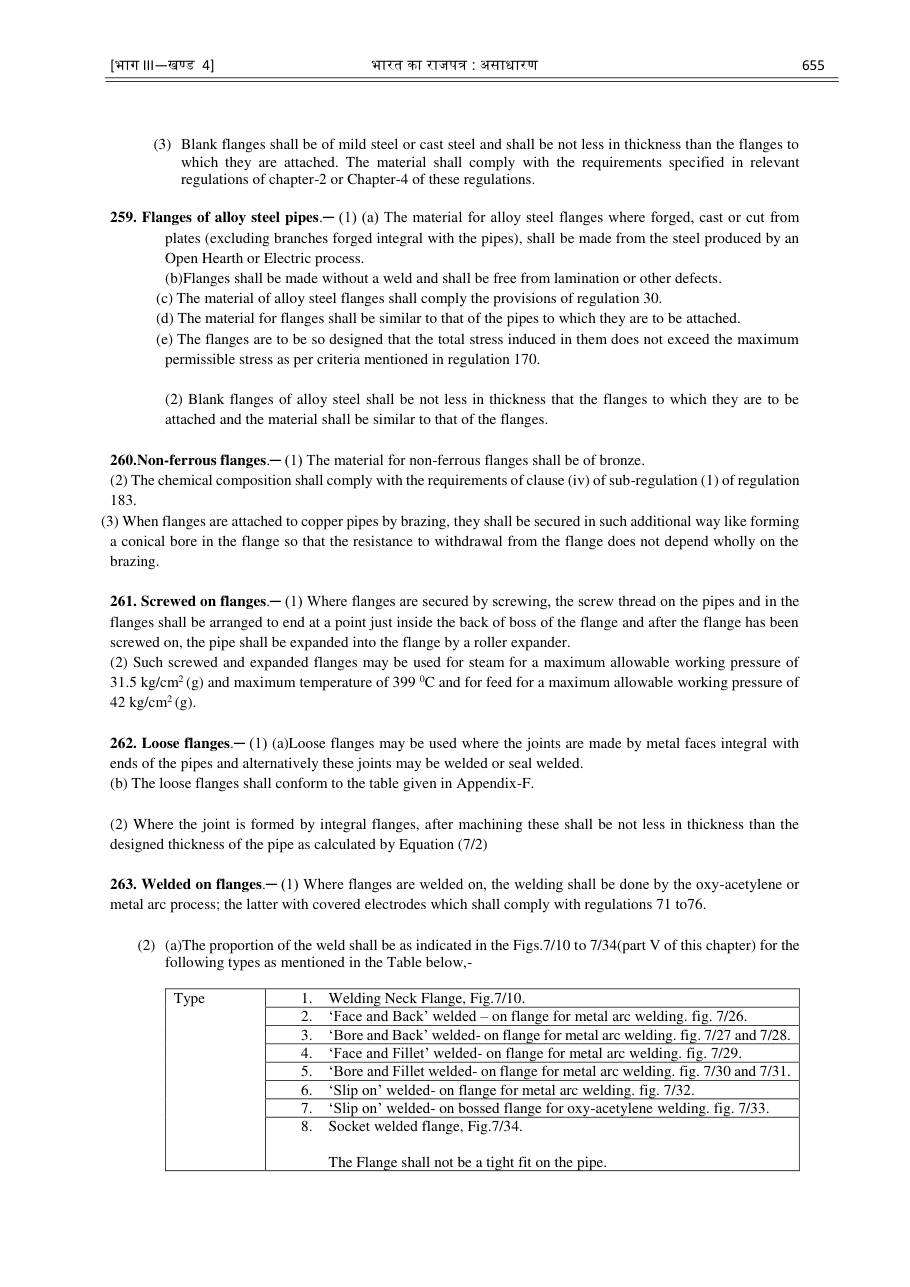
Indian Boiler Regulations, 2026, reg. 259, Regulation 259, Gazette of India, Extraordinary, Part III—Section 4, No. 596, 1 October 2026, printed p.655. https://egazette.gov.in/WriteReadData/2026/276813.pdf (text consulted via IBRsource, 2026-11-23).
The citation refers to the government publication. Cite the Gazette, not this website.