
Indian Boiler Regulations, 2026 · Chapter 7 · Pipes and Fittings
Regulation 258. Flanges of carbon steel pipes
Not yet checked against the official Gazette; verify before relying on it.
258. Flanges of carbon steel pipes.─(1)The material for carbon steel flanges, where forged, cast or cut from the plates (excluding branches forged integral with the pipes) shall be made of steel produced by an Open Hearth or Electric process or any of the Oxygen processes.
(2)Carbon steel flanges shall not be used for temperatures exceeding 454°C and such flanges shall be made without a weld and free from lamination or other defects secured by welding.
(3)Blank flanges shall be of mild steel or cast steel and shall be not less in thickness than the flanges to which they are attached. The material shall comply with the requirements specified in relevant regulations of chapter-2 or Chapter-4 of these regulations.
In short
This regulation sets material and use limits for carbon steel pipe flanges and blank flanges.
Key points
- (1) Carbon steel flanges that are forged, cast or cut from plate must be of Open Hearth, Electric or Oxygen process steel. This excludes branches forged integral with the pipes.
- (2) Carbon steel flanges must not be used above 454°C. They must be made without a weld and be free from lamination or other defects secured by welding.
- (3) Blank flanges must be mild steel or cast steel, and not thinner than the flanges they are attached to. Material must meet the relevant regulations of Chapter-2 or Chapter-4.
Written by IBRsource editors · last edited 2026-11-20. Explanations simplify and are not a design method, testing procedure or authorisation. Requirements come from the complete regulations, the Gazette and approved documentation.
Comparison pending: the IBR 1950 text in force on 30 September 2026 is not yet established for this provision, so no change is claimed (how this works).
Orientation hints (unverified)
These candidates come from automated heading matching against DPIIT's scanned historical print edition of IBR 1950. That edition uses imperial units and riveted-construction provisions, so it is not the operative 2026 predecessor text. Regulation numbers alone never prove equivalence.
| Historical 1950-edition reg. | Heading as OCR'd | Heading similarity | Source image |
|---|---|---|---|
| 410 | Flanges | 100% | Chapter X (DPIIT scan), image 4 |
| 358 | Flanges of copper pipes | 82% | Chapter VIII (DPIIT scan), image 6 |
| 351 | Cast Steel Pipes | 81% | Chapter VIII (DPIIT scan), image 5 |
Amendment history of the candidate IBR 1950 regulations: Reg. 351 (1 amendment)
IBR 1950 regulation 410 as last published in the DPIIT web edition (archived 2022)
Unofficial archived copy, not verified; see the regulation 410 page for its amendments.
| Reg. 410, Reg. 411, Reg. 412
Reg. 411
Reg. 412
|
IBR 1950 regulation 358 as last published in the DPIIT web edition (archived 2022)
Unofficial archived copy, not verified; see the regulation 358 page for its amendments.
| Reg. 358, Reg. 359 Flanges of copper pipes
| ||||
IBR 1950 regulation 351 as last published in the DPIIT web edition (archived 2022)
Unofficial archived copy, not verified; see the regulation 351 page for its amendments.
| Reg. 351 Cast Steel Pipes
|
Images of the official Gazette pages that contain this regulation. Click to zoom. Compare word by word before relying on the extracted text.
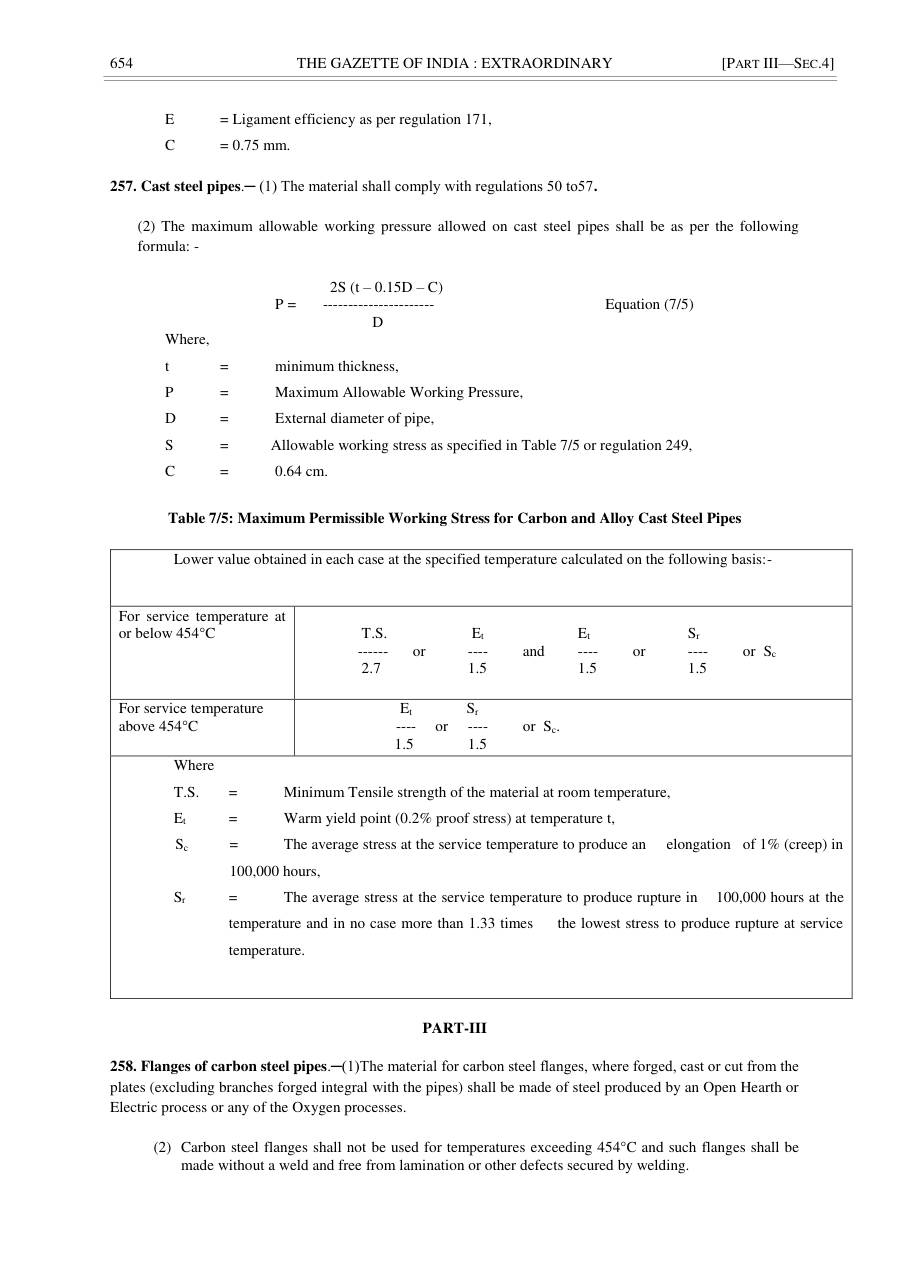
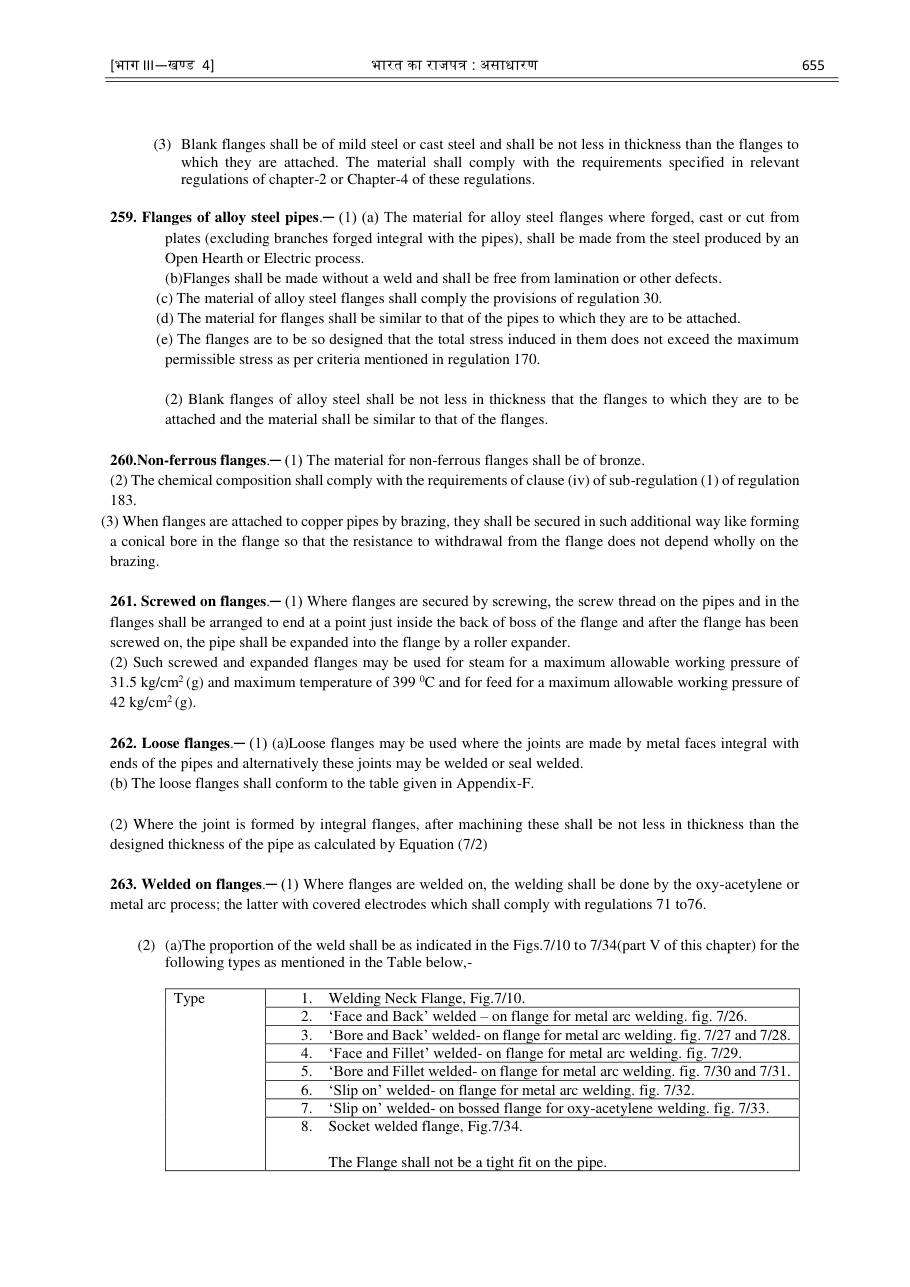
Indian Boiler Regulations, 2026, reg. 258, Regulation 258, Gazette of India, Extraordinary, Part III—Section 4, No. 596, 1 October 2026, printed p.654–655. https://egazette.gov.in/WriteReadData/2026/276813.pdf (text consulted via IBRsource, 2026-11-23).
The citation refers to the government publication. Cite the Gazette, not this website.