
Indian Boiler Regulations, 2026 · Chapter 7 · Pipes and Fittings
Regulation 266. Tests on completed welds on pipelines
Not yet checked against the official Gazette; verify before relying on it.
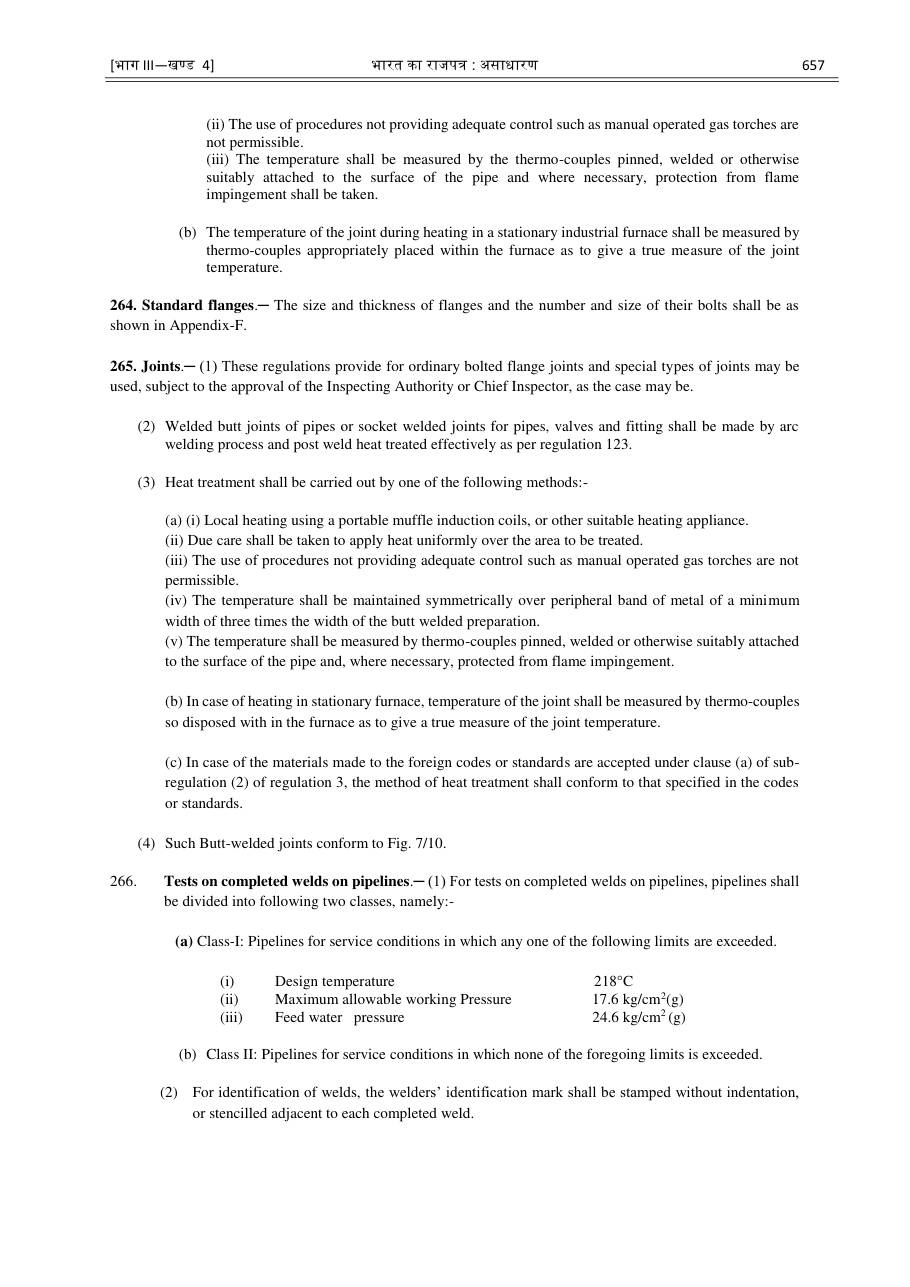
266. Tests on completed welds on pipelines.─ (1) For tests on completed welds on pipelines, pipelines shall be divided into following two classes, namely:-
(a)Class-I: Pipelines for service conditions in which any one of the following limits are exceeded.
(i) Design temperature 218°C
17.6 kg/cm2(g)
(ii) Maximum allowable working Pressure 24.6 kg/cm2 (g)
(iii)Feed water pressure
(b)Class II: Pipelines for service conditions in which none of the foregoing limits is exceeded.
(2)For identification of welds, the welders’ identification mark shall be stamped without indentation, or stencilled adjacent to each completed weld.
Parts of this extracted text look garbled; read the Gazette page before using any value.
In short
For testing completed welds, pipelines are split into Class I and Class II by service conditions. Welds must carry the welder's identification mark.
Key points
- (1)(a) Class I: pipelines where any one of the listed limits is exceeded: design temperature 218°C, maximum allowable working pressure, or feed water pressure. The pressure limits given are 17.6 kg/cm2(g) and 24.6 kg/cm2 (g); read in order they are most likely 17.6 for maximum allowable working pressure and 24.6 for feed water pressure, but the extracted layout is misaligned, so confirm on the Gazette page.
- (1)(b) Class II: pipelines where none of those limits is exceeded.
- (2) The welder's identification mark must be stamped without indentation, or stencilled, next to each completed weld.
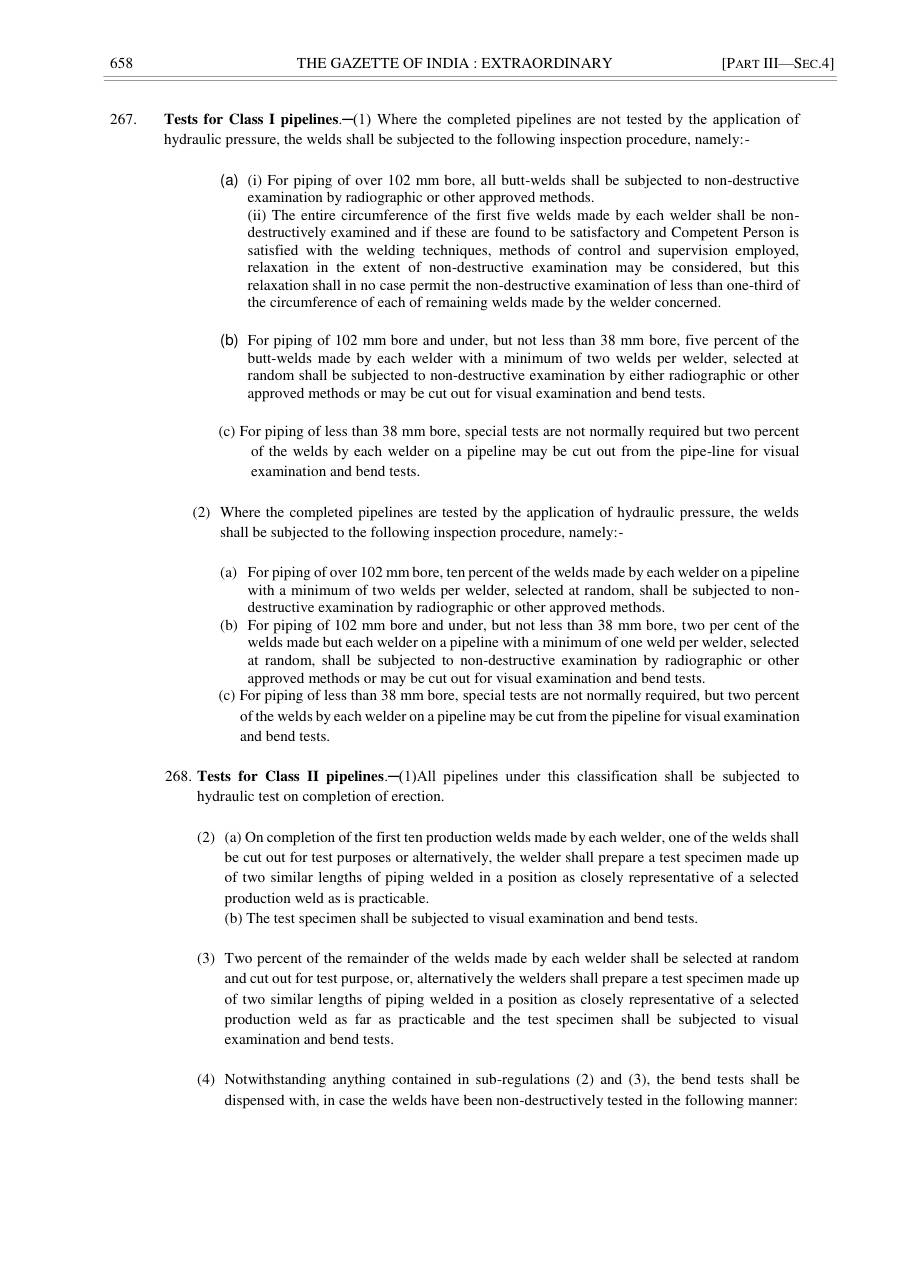
- Tests are in regulation 267 (Class I) and regulation 268 (Class II).
Watch out
- The extracted text does not clearly show which pressure limit goes with which item. Check the Gazette page.
Written by IBRsource editors · last edited 2026-11-20. Explanations simplify and are not a design method, testing procedure or authorisation. Requirements come from the complete regulations, the Gazette and approved documentation.
Comparison pending: the IBR 1950 text in force on 30 September 2026 is not yet established for this provision, so no change is claimed (how this works).
Orientation hints (unverified)
These candidates come from automated heading matching against DPIIT's scanned historical print edition of IBR 1950. That edition uses imperial units and riveted-construction provisions, so it is not the operative 2026 predecessor text. Regulation numbers alone never prove equivalence.
No candidate heading found in the historical print edition.
Images of the official Gazette pages that contain this regulation. Click to zoom. Compare word by word before relying on the extracted text.
Indian Boiler Regulations, 2026, reg. 266, Regulation 266, Gazette of India, Extraordinary, Part III—Section 4, No. 596, 1 October 2026, printed p.657–658. https://egazette.gov.in/WriteReadData/2026/276813.pdf (text consulted via IBRsource, 2026-11-23).
The citation refers to the government publication. Cite the Gazette, not this website.