
Indian Boiler Regulations, 2026 · Chapter 7 · Pipes and Fittings
Regulation 267. Tests for Class I pipelines
Not yet checked against the official Gazette; verify before relying on it.
267. Tests for Class I pipelines.─(1) Where the completed pipelines are not tested by the application of hydraulic pressure, the welds shall be subjected to the following inspection procedure, namely:-
(a)(i) For piping of over 102 mm bore, all butt-welds shall be subjected to non-destructive examination by radiographic or other approved methods.
(ii)The entire circumference of the first five welds made by each welder shall be non-destructively examined and if these are found to be satisfactory and Competent Person is satisfied with the welding techniques, methods of control and supervision employed, relaxation in the extent of non-destructive examination may be considered, but this relaxation shall in no case permit the non-destructive examination of less than one-third of the circumference of each of remaining welds made by the welder concerned.
(b)For piping of 102 mm bore and under, but not less than 38 mm bore, five percent of the butt-welds made by each welder with a minimum of two welds per welder, selected at random shall be subjected to non-destructive examination by either radiographic or other approved methods or may be cut out for visual examination and bend tests.
(c)For piping of less than 38 mm bore, special tests are not normally required but two percent of the welds by each welder on a pipeline may be cut out from the pipe-line for visual examination and bend tests.
(2)Where the completed pipelines are tested by the application of hydraulic pressure, the welds shall be subjected to the following inspection procedure, namely:-
(a)For piping of over 102 mm bore, ten percent of the welds made by each welder on a pipeline with a minimum of two welds per welder, selected at random, shall be subjected to non-destructive examination by radiographic or other approved methods.
(b)For piping of 102 mm bore and under, but not less than 38 mm bore, two per cent of the welds made but each welder on a pipeline with a minimum of one weld per welder, selected at random, shall be subjected to non-destructive examination by radiographic or other approved methods or may be cut out for visual examination and bend tests.
(c)For piping of less than 38 mm bore, special tests are not normally required, but two percent of the welds by each welder on a pipeline may be cut from the pipeline for visual examination and bend tests.
In short
This regulation sets the weld inspection required on Class I pipelines (see regulation 266). The extent depends on bore size and on whether the completed pipeline is hydraulically tested.
Key points
- (1) Not hydraulically tested:
- Over 102 mm bore: all butt welds non-destructively examined (radiographic or other approved method). The first five welds of each welder are examined around the full circumference. If these are satisfactory and the Competent Person is satisfied, examination may be relaxed, but never below one-third of the circumference of each remaining weld.
- 102 mm bore and under, but not less than 38 mm: five percent of each welder's butt welds, minimum two per welder, chosen at random, examined by NDE or cut out for visual examination and bend tests.
- Less than 38 mm bore: special tests not normally required, but two percent of each welder's welds may be cut out for visual examination and bend tests.
- (2) Hydraulically tested:
- Over 102 mm bore: ten percent of each welder's welds, minimum two per welder, at random, by NDE.
- 102 mm bore and under, but not less than 38 mm: two per cent, minimum one per welder, by NDE or cut out for visual examination and bend tests.
- Less than 38 mm bore: as in (1)(c).
Written by IBRsource editors · last edited 2026-11-20. Explanations simplify and are not a design method, testing procedure or authorisation. Requirements come from the complete regulations, the Gazette and approved documentation.
Comparison pending: the IBR 1950 text in force on 30 September 2026 is not yet established for this provision, so no change is claimed (how this works).
Orientation hints (unverified)
These candidates come from automated heading matching against DPIIT's scanned historical print edition of IBR 1950. That edition uses imperial units and riveted-construction provisions, so it is not the operative 2026 predecessor text. Regulation numbers alone never prove equivalence.
No candidate heading found in the historical print edition.
Images of the official Gazette pages that contain this regulation. Click to zoom. Compare word by word before relying on the extracted text.
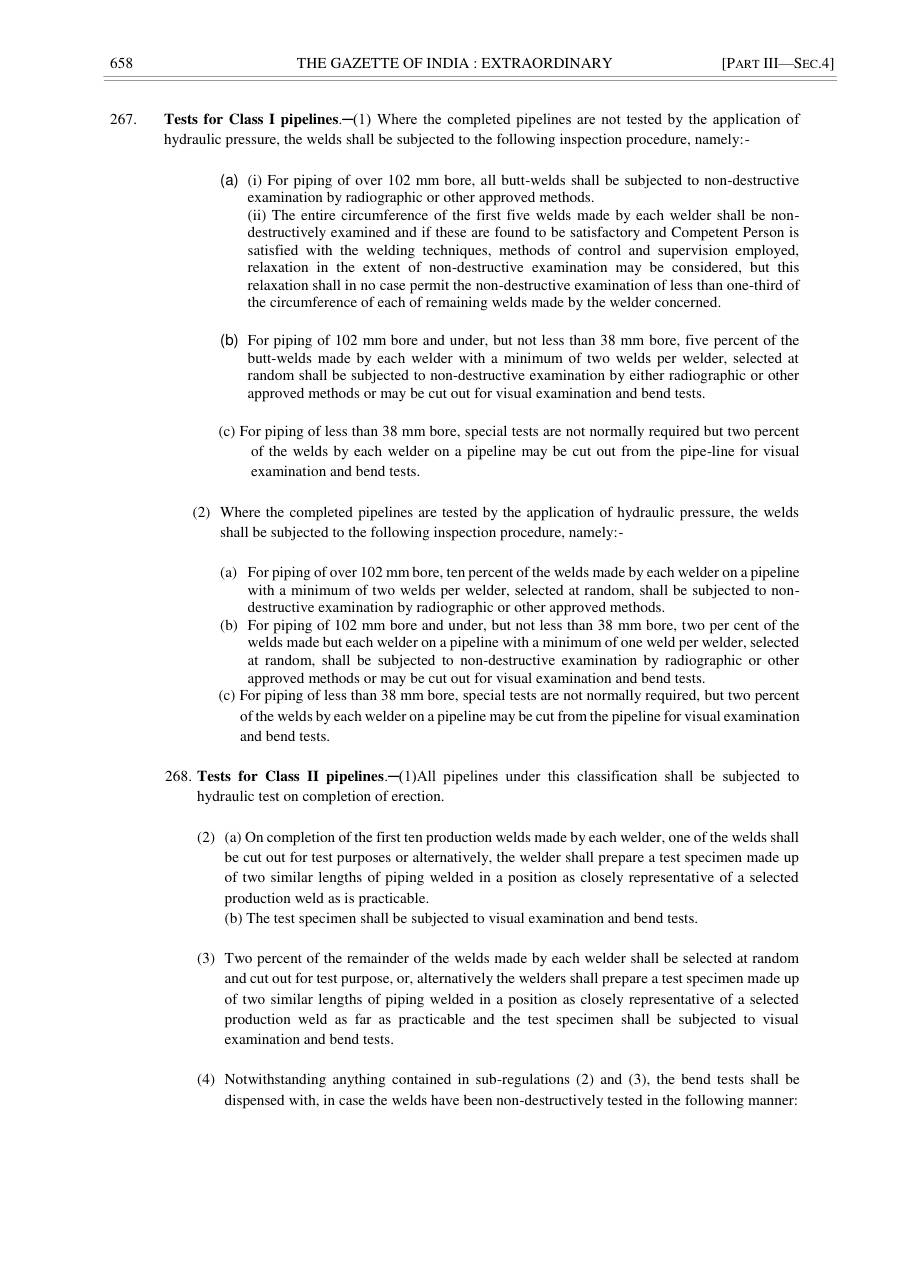
Indian Boiler Regulations, 2026, reg. 267, Regulation 267, Gazette of India, Extraordinary, Part III—Section 4, No. 596, 1 October 2026, printed p.658. https://egazette.gov.in/WriteReadData/2026/276813.pdf (text consulted via IBRsource, 2026-11-23).
The citation refers to the government publication. Cite the Gazette, not this website.