
Indian Boiler Regulations, 2026 · Chapter 7 · Pipes and Fittings
Regulation 278. Construction and workmanship
Not yet checked against the official Gazette; verify before relying on it.
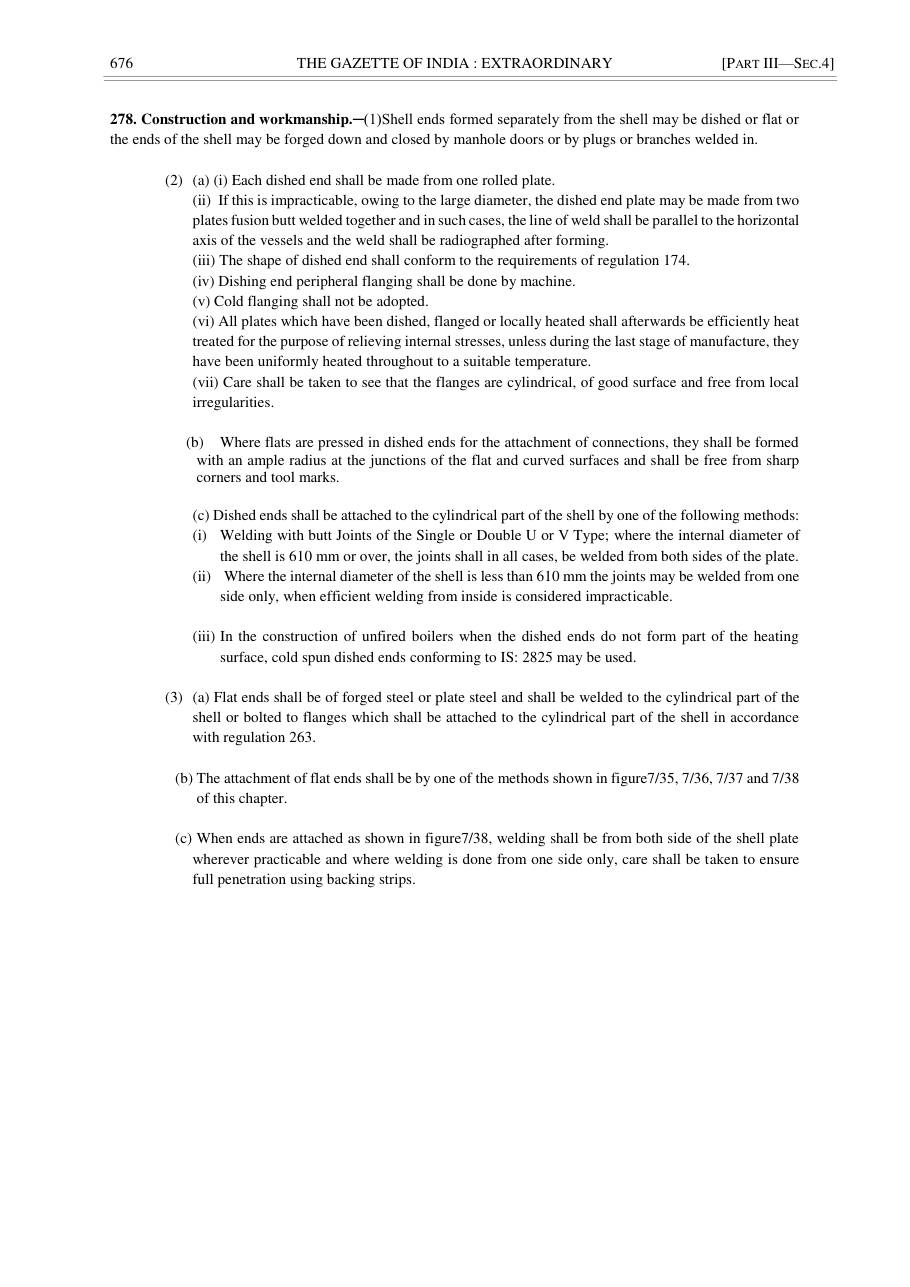
278. Construction and workmanship.─(1)Shell ends formed separately from the shell may be dished or flat or the ends of the shell may be forged down and closed by manhole doors or by plugs or branches welded in.
(2)(a) (i) Each dished end shall be made from one rolled plate.
(ii)If this is impracticable, owing to the large diameter, the dished end plate may be made from two plates fusion butt welded together and in such cases, the line of weld shall be parallel to the horizontal axis of the vessels and the weld shall be radiographed after forming.
(iii)The shape of dished end shall conform to the requirements of regulation 174.
(iv)Dishing end peripheral flanging shall be done by machine.
(v)Cold flanging shall not be adopted.
(vi)All plates which have been dished, flanged or locally heated shall afterwards be efficiently heat treated for the purpose of relieving internal stresses, unless during the last stage of manufacture, they have been uniformly heated throughout to a suitable temperature.
(vii)Care shall be taken to see that the flanges are cylindrical, of good surface and free from local irregularities.
(b)Where flats are pressed in dished ends for the attachment of connections, they shall be formed with an ample radius at the junctions of the flat and curved surfaces and shall be free from sharp corners and tool marks.
(c)Dished ends shall be attached to the cylindrical part of the shell by one of the following methods:
(i)Welding with butt Joints of the Single or Double U or V Type; where the internal diameter of the shell is 610 mm or over, the joints shall in all cases, be welded from both sides of the plate.
(ii)Where the internal diameter of the shell is less than 610 mm the joints may be welded from one side only, when efficient welding from inside is considered impracticable.
(iii)In the construction of unfired boilers when the dished ends do not form part of the heating surface, cold spun dished ends conforming to IS: 2825 may be used.
(3)(a) Flat ends shall be of forged steel or plate steel and shall be welded to the cylindrical part of the shell or bolted to flanges which shall be attached to the cylindrical part of the shell in accordance with regulation 263.
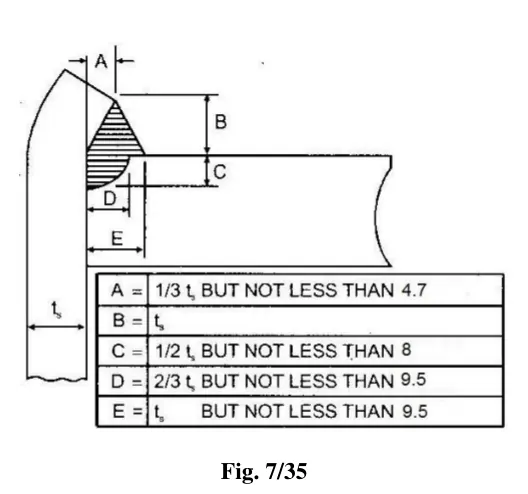
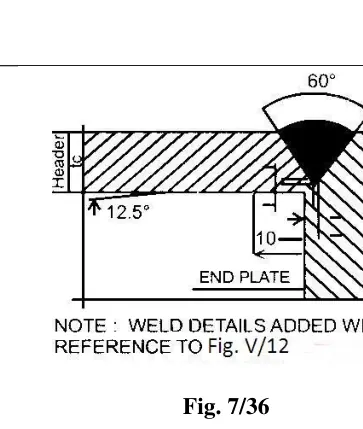
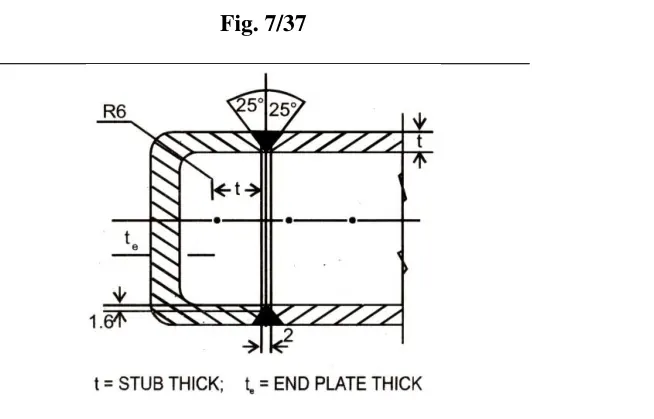
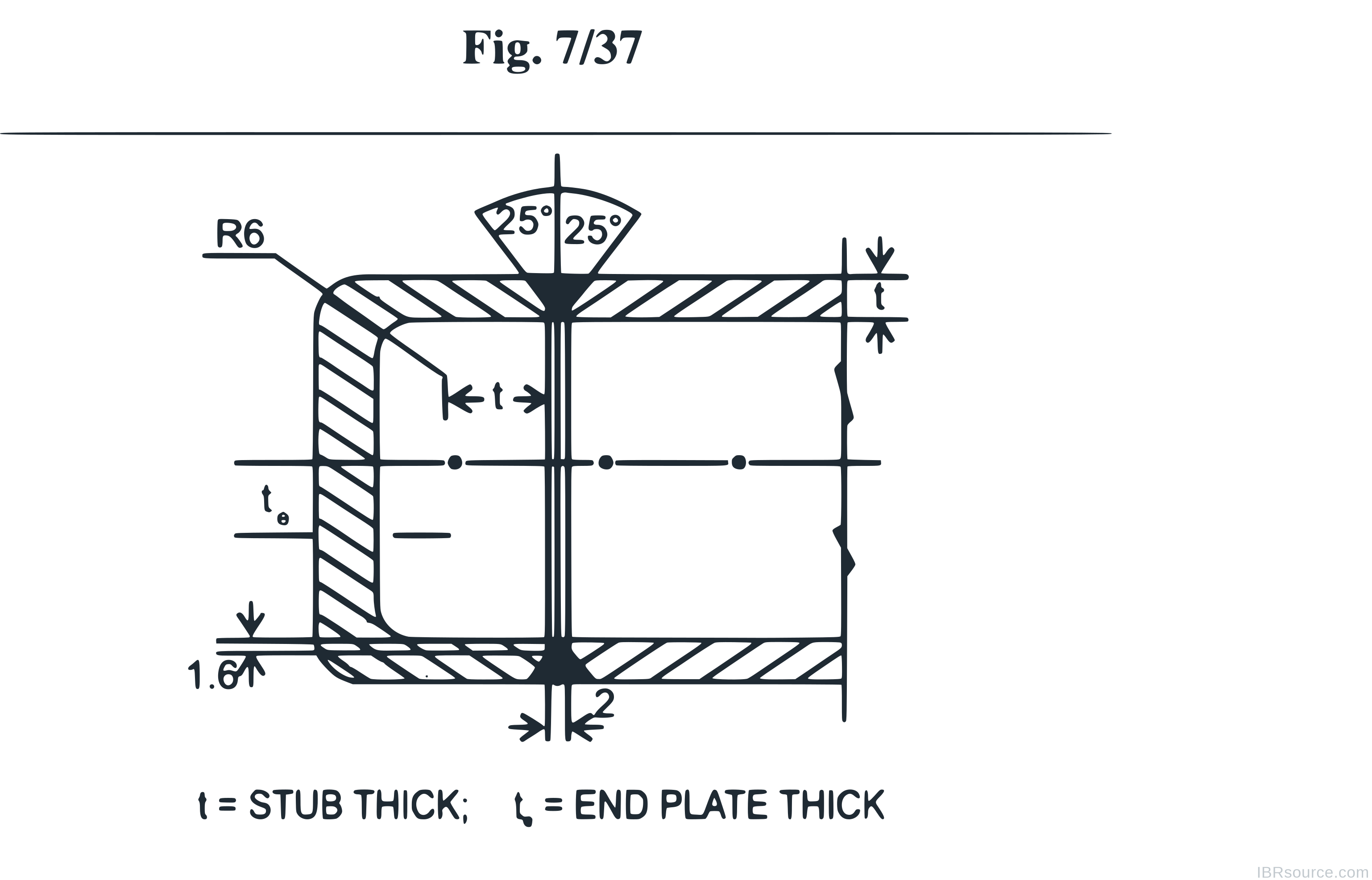
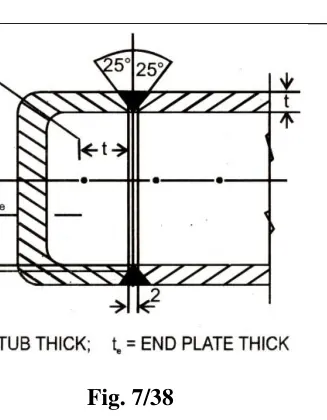
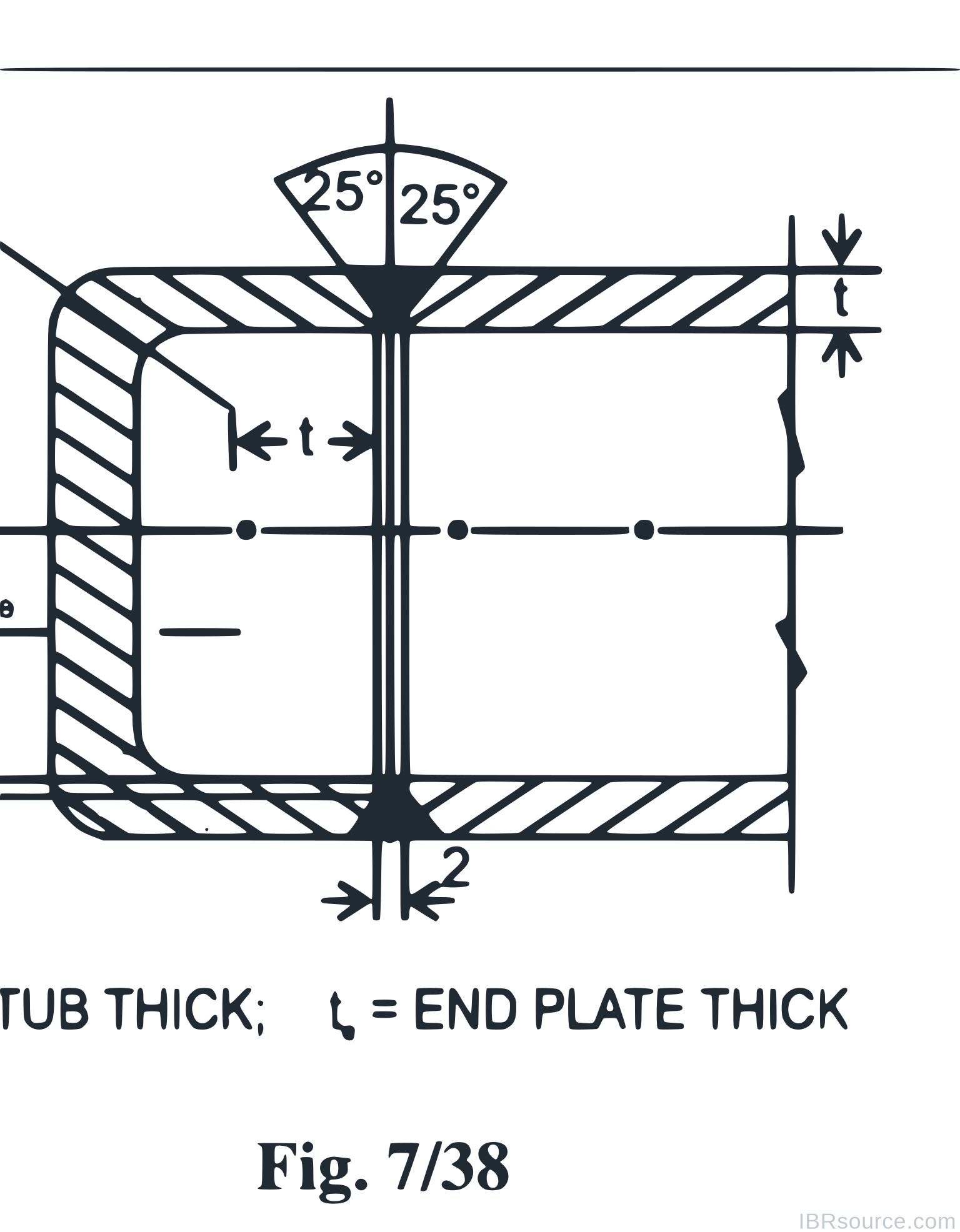
(b)The attachment of flat ends shall be by one of the methods shown in figure7/35, 7/36, 7/37 and 7/38 of this chapter.
(c)When ends are attached as shown in figure7/38, welding shall be from both side of the shell plate wherever practicable and where welding is done from one side only, care shall be taken to ensure full penetration using backing strips.
Figures cited in this regulation (4, exact crops of the Gazette)
View Gazette page 677 · figure catalogue
Auto-traced outline: SVG · DXF (not to scale, may copy print defects)
View Gazette page 677 · figure catalogue
Auto-traced outline: SVG · DXF (not to scale, may copy print defects)
View Gazette page 677 · figure catalogue
Auto-traced outline: SVG · DXF (not to scale, may copy print defects)
View Gazette page 677 · figure catalogue
Auto-traced outline: SVG · DXF (not to scale, may copy print defects)
In short
This regulation covers construction of shell ends for steam receivers and similar vessels: dished ends, their attachment, and flat ends.
Key points
- (1) Ends may be dished or flat, or the shell ends forged down and closed by manhole doors, plugs or welded-in branches.
- (2)(a) Dished ends: made from one rolled plate. If the diameter makes this impracticable, two plates may be fusion butt welded, with the weld parallel to the vessel's horizontal axis and radiographed after forming. Shape per regulation 174. Peripheral flanging by machine; flanges cylindrical, smooth and free from local irregularities.
- Dished, flanged or locally heated plates must be heat treated to relieve stress, unless uniformly heated to a suitable temperature in the last stage of manufacture.
- (2)(b) Flats pressed into dished ends need an ample radius at the junctions and no sharp corners or tool marks.
- (2)(c) Dished ends are attached by single or double U or V butt welds. Shells of internal diameter 610 mm or over must be welded from both sides. Below 610 mm, one side is allowed where welding from inside is impracticable. Unfired boilers may use cold spun dished ends to IS: 2825 where the ends are not heating surface.
- (3) Flat ends are forged or plate steel, welded to the shell or bolted to flanges attached per regulation 263, using the methods in figures 7/35 to 7/38.
Watch out
- Cold flanging must not be adopted.
- For the figure 7/38 method, weld from both sides where practicable; if only one side, use backing strips for full penetration.
Written by IBRsource editors · last edited 2026-11-20. Explanations simplify and are not a design method, testing procedure or authorisation. Requirements come from the complete regulations, the Gazette and approved documentation.
Comparison pending: the IBR 1950 text in force on 30 September 2026 is not yet established for this provision, so no change is claimed (how this works).
Orientation hints (unverified)
These candidates come from automated heading matching against DPIIT's scanned historical print edition of IBR 1950. That edition uses imperial units and riveted-construction provisions, so it is not the operative 2026 predecessor text. Regulation numbers alone never prove equivalence.
| Historical 1950-edition reg. | Heading as OCR'd | Heading similarity | Source image |
|---|---|---|---|
| 416 | Construction and Workmanship | 100% | Chapter X (DPIIT scan), image 5 |
| 624 | Construction and Workmanship | 100% | Chapter XV (DPIIT scan), image 1 |
Amendment history of the candidate IBR 1950 regulations: Reg. 624 (1 amendment)
IBR 1950 regulation 416 as last published in the DPIIT web edition (archived 2022)
Unofficial archived copy, not verified; see the regulation 416 page for its amendments.
| Reg. 413, Reg. 414, Reg. 415, Reg. 416
Reg. 414
Reg. 415
Reg. 416
|
IBR 1950 regulation 624 as last published in the DPIIT web edition (archived 2022)
Unofficial archived copy, not verified; see the regulation 624 page for its amendments.
| Reg. 623, Reg. 624, Reg. 625 | |||||||||||
Reg. 624 Requirements
Reg. 625 Sampling Sampling shall be done following general directions given in 2 of IS:3025-1964*. In particular, the following points shall be observed :
| |||||||||||
Images of the official Gazette pages that contain this regulation. Click to zoom. Compare word by word before relying on the extracted text.
Indian Boiler Regulations, 2026, reg. 278, Regulation 278, Gazette of India, Extraordinary, Part III—Section 4, No. 596, 1 October 2026, printed p.676. https://egazette.gov.in/WriteReadData/2026/276813.pdf (text consulted via IBRsource, 2026-11-23).
The citation refers to the government publication. Cite the Gazette, not this website.