
Indian Boiler Regulations, 2026 · Chapter 7 · Pipes and Fittings
Regulation 281. Branches and other connections
Not yet checked against the official Gazette; verify before relying on it.
281. Branches and other connections.─(1) (a) Connections to shell shall be made by means of branches, pressed plate saddles, forged pads or bosses or where the thickness of the shell is sufficient to allow suitable surface to be obtained, connections may be attached directly to the shell, provided that the minimum thickness at the hole in the shell is not less than the thickness required for the maximum allowable working pressure and temperature considering the shell as being unpierced and that the diameter of the hole does not exceed the maximum diameter of an uncompensated hole as defined in regulation 141 and 179.
(b)Studs for securing such connections shall have a full thread holding in the shell for a length of at least one diameter and the stud holes shall not penetrate the whole thickness of the shell.
(c)All holes for bolts and studs in branches, saddles and forged pads shall be drilled.
(d)Where such connections are secured by welding alone, a minimum of two runs of metal shall be deposited at each weld, except for seal welds.
(e)Each run of weld metal shall be thoroughly cleaned and free from slag before the next run is deposited.
(f)The final finish of the welds shall be such that change of section from shell to branch is gradual and free from sharp notches.
(g)Where the diameter of the shell is 610 mm and over, welding shall be from both sides of the plate.
(h)Where the internal diameter of the shell is less than 610 mm, external and internal welds shall be applied unless it is considered that efficient welding from both sides is impracticable.
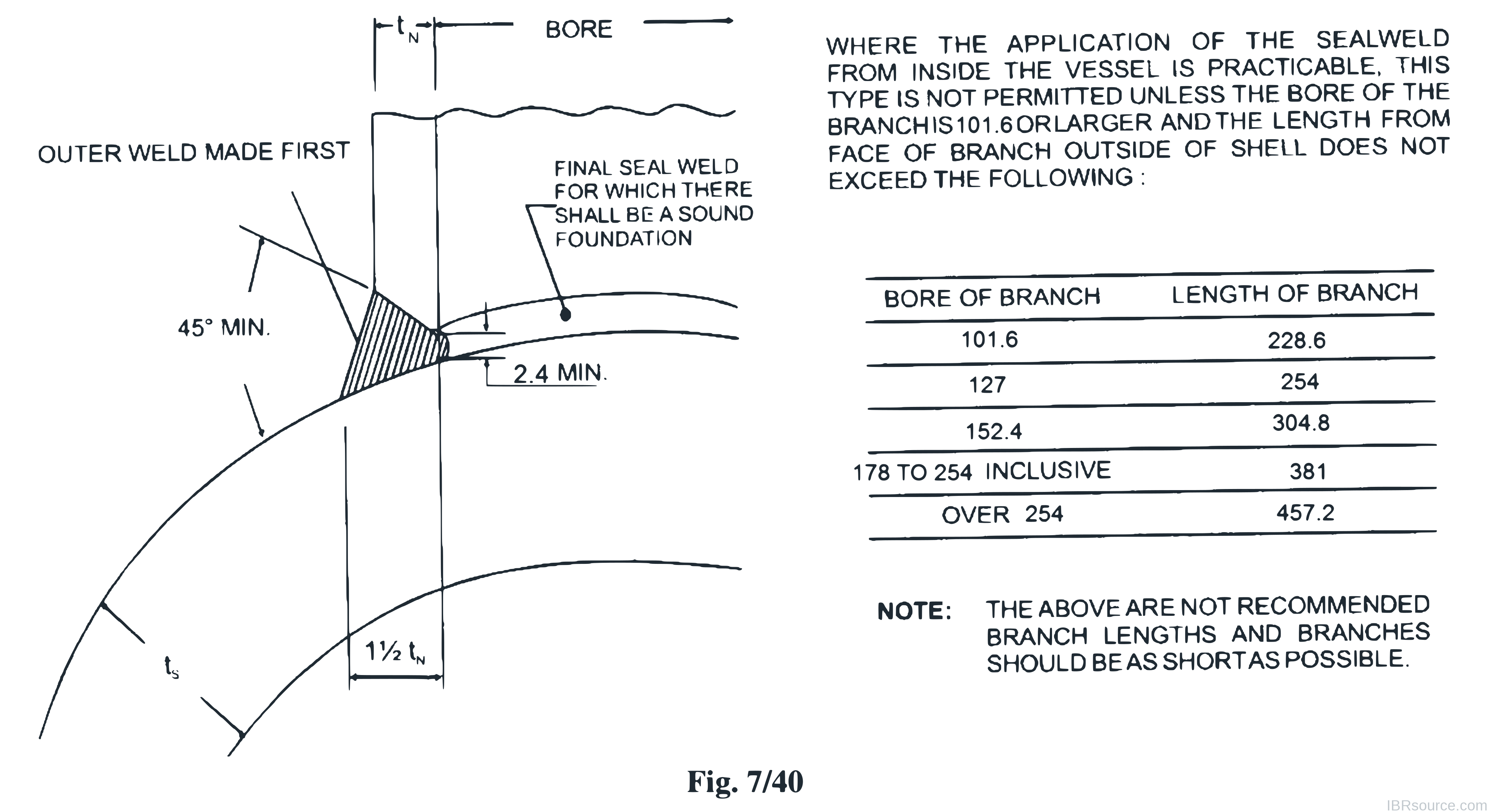
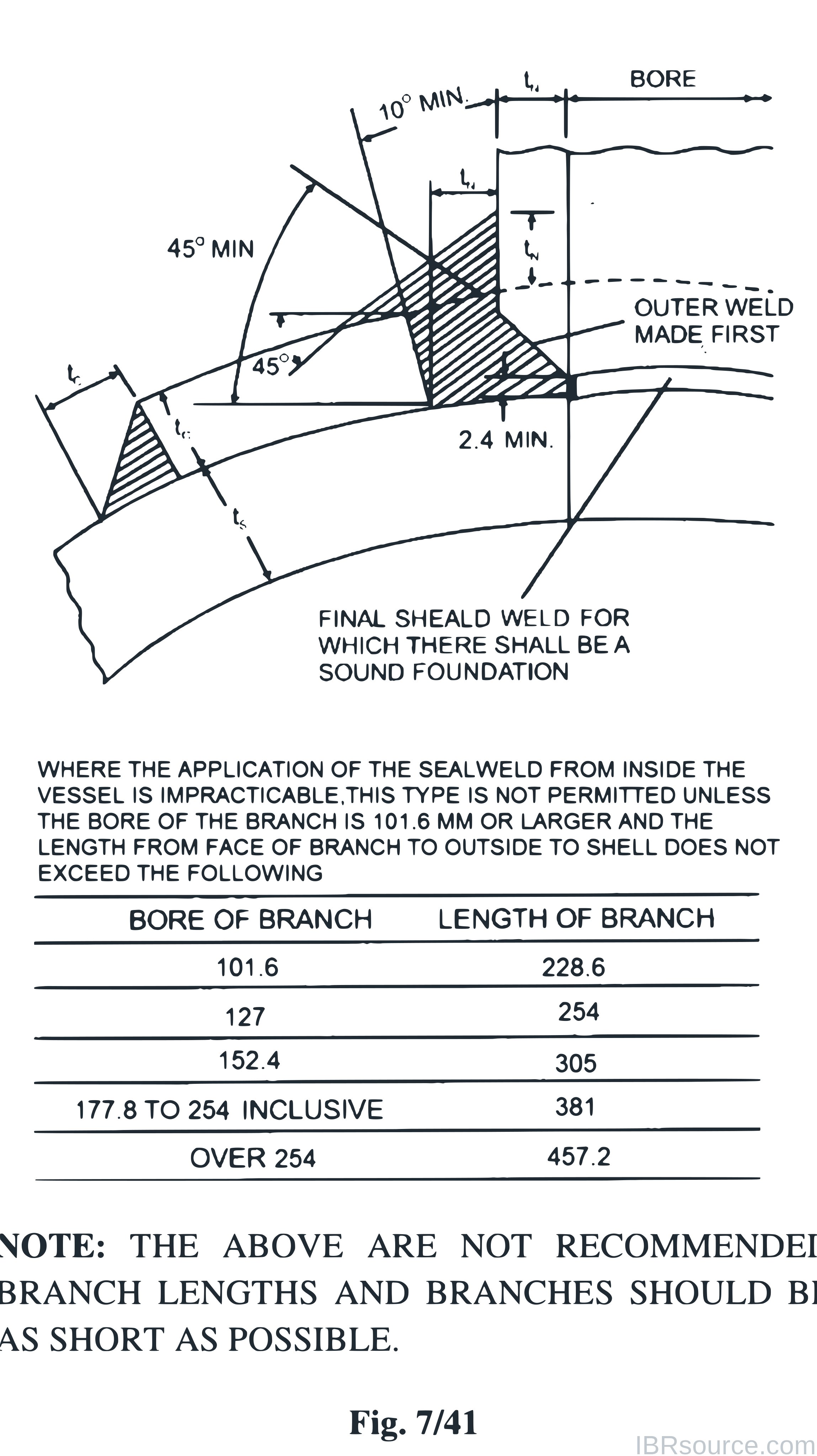
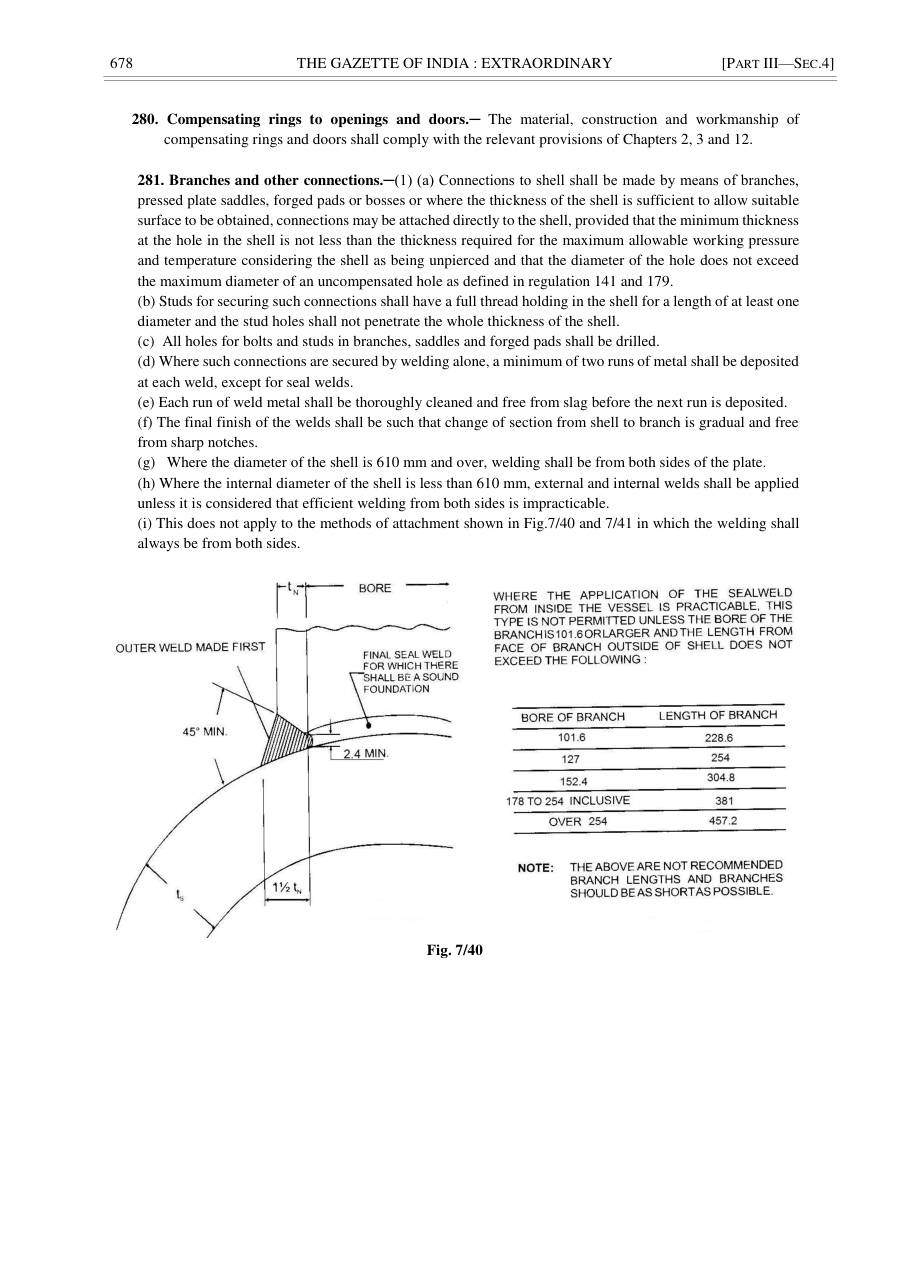
(i)This does not apply to the methods of attachment shown in Fig.7/40 and 7/41 in which the welding shall always be from both sides.
Fig. 7/40
Figures cited in this regulation (2, exact crops of the Gazette)
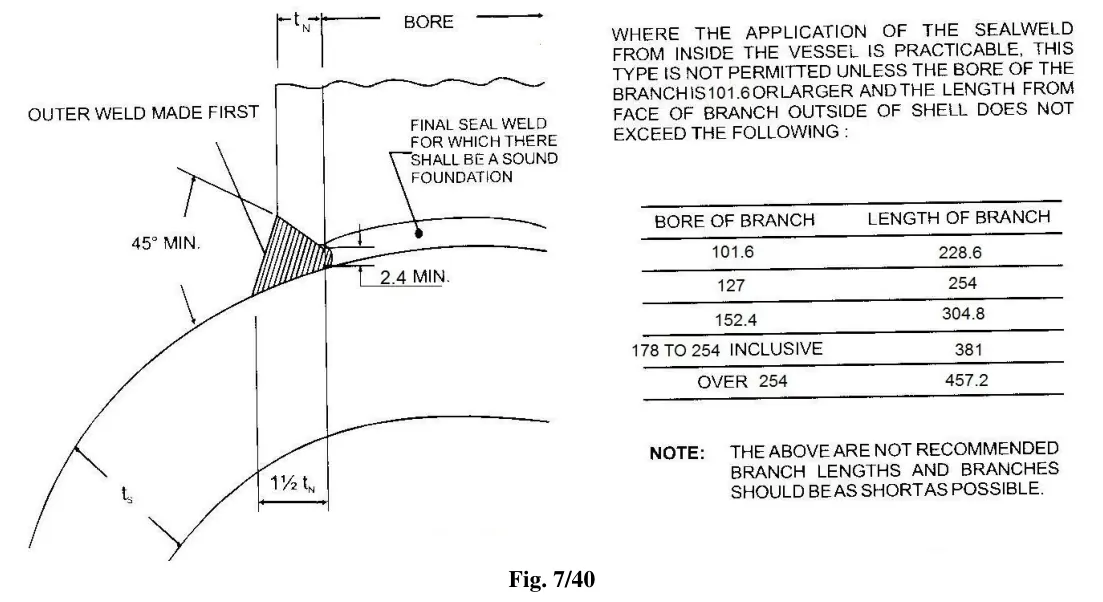
View Gazette page 678 · figure catalogue
Auto-traced outline: SVG · DXF (not to scale, may copy print defects)
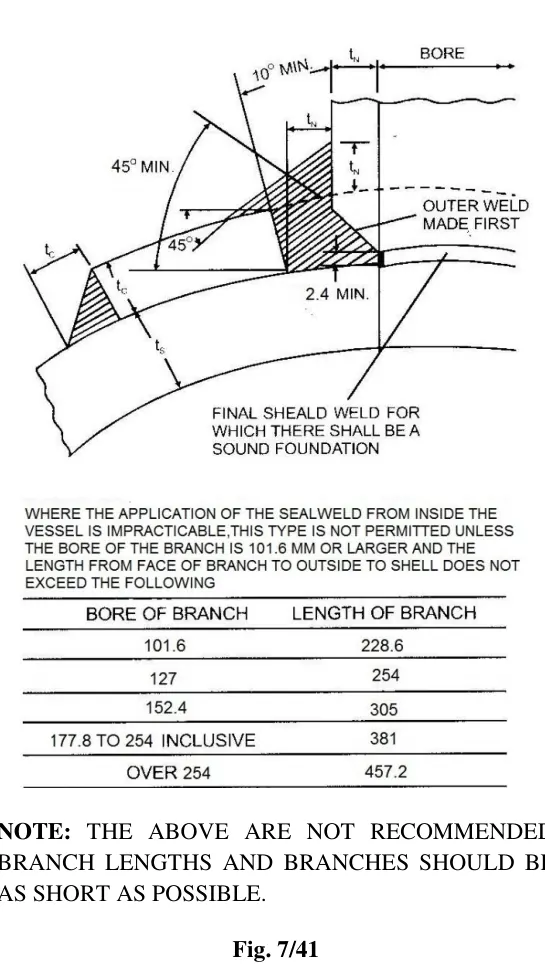
View Gazette page 679 · figure catalogue
Auto-traced outline: SVG · DXF (not to scale, may copy print defects)
In short
This regulation sets how connections are attached to shells, including direct stud attachment and welding rules.
Key points
- (1)(a) Connections may use branches, pressed plate saddles, forged pads or bosses. They may attach directly to a thick enough shell if the thickness at the hole meets the unpierced-shell requirement and the hole does not exceed the uncompensated hole limit in regulation 141 and regulation 179.
- (1)(b) Studs need full thread holding in the shell for at least one diameter, and stud holes must not go through the full shell thickness.
- (1)(c) All bolt and stud holes in branches, saddles and pads must be drilled.
- (1)(d)–(f) Connections secured by welding alone need at least two runs per weld (except seal welds). Each run must be cleaned of slag, and the finish must give a gradual change of section without sharp notches.
- (1)(g)–(h) Shells of diameter 610 mm and over: weld from both sides. Internal diameter less than 610 mm: external and internal welds unless welding both sides is impracticable.
Watch out
- (1)(i) The attachments in Fig. 7/40 and 7/41 must always be welded from both sides.
Written by IBRsource editors · last edited 2026-11-20. Explanations simplify and are not a design method, testing procedure or authorisation. Requirements come from the complete regulations, the Gazette and approved documentation.
Comparison pending: the IBR 1950 text in force on 30 September 2026 is not yet established for this provision, so no change is claimed (how this works).
Orientation hints (unverified)
These candidates come from automated heading matching against DPIIT's scanned historical print edition of IBR 1950. That edition uses imperial units and riveted-construction provisions, so it is not the operative 2026 predecessor text. Regulation numbers alone never prove equivalence.
No candidate heading found in the historical print edition.
Images of the official Gazette pages that contain this regulation. Click to zoom. Compare word by word before relying on the extracted text.
Indian Boiler Regulations, 2026, reg. 281, Regulation 281, Gazette of India, Extraordinary, Part III—Section 4, No. 596, 1 October 2026, printed p.678. https://egazette.gov.in/WriteReadData/2026/276813.pdf (text consulted via IBRsource, 2026-11-23).
The citation refers to the government publication. Cite the Gazette, not this website.